Eye on the ball

23 03 2011

Photographer Me Ra Koh on TV’s The Nate Berkus Show on Monday had a tip for people who shoot digital pictures. I think that includes just about all of us! Her specialty is photographing children.

You know how, every time we take a picture, the tendency is to stop to look and see what kind of image we got? Her advice is to resist the temptation and to just keep shooting. The reason is, when we are photographing, we are using our creative right brains. When we stop to analyze, we are switching to our left brains. Not to mention the images we might miss when we pause.

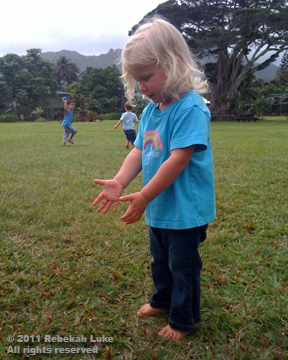
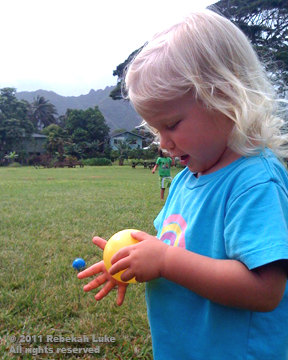
This morning I accompanied Miss Marvelous to her family-child interaction program and recorded her being so very pleased about catching the yellow ball her Papa threw. Luckily, there was no voice saying, “Lemme see!”

Copyright 2011 Rebekah Luke


Punahou Carnival 2011

31 01 2011

This Friday and Saturday, Feb. 4 and 5. All the fun is bounded by Punahou Street and Wilder Avenue in Honolulu, from 11 a.m to 11 p.m., and I’ll be there. If you’re visiting, this is a great travel tip!

The big tent and the thrill rides are up, and they’re getting ready for the Punahou Carnival again. I’m here to plug my alma mater, with notes on my contribution and my favorites. It’s a humongous fundraiser put on by the junior class to raise scholarships. First-timers wonder how they do it. I’ll tell you how.

The school ropes in all the parents of the junior class and alumni to donate their time, labor, talent, and supply goods so that everything spent at the Carnival is profit for students.

The Carnival is such a bonding experience, you remember it for life and return every year to support it. There’s fun for all ages.

Banyan in the Park, an original oil on canvas by yours truly, for purchase at the Punahou Carnival Art Gallery. 16″ x 20″.

My contribution

For the past several years I’ve placed my paintings in the Art Gallery—50% of sales goes to the school, and put my time in at the Hawaiian Plate “booth.” I also help serve up the meal (5 to 8 p.m. Saturday).

Last year my graduating class was the second oldest still working the Carnival. We report to Dole Cafeteria and don aprons and hats to plate the meal of Hawaiian food. For anyone not of school age who isn’t interested in the midway carnival rides, it’s a nice place to relax because there is air-conditioning, there is continuous live music, and there are real bathrooms.

We used to prep and cook the food, and in years before that we worked the famous malasadas booth with Mr. Bowers until we were banned for making non-regulation sizes and shapes ;-). And frankly, I don’t remember what we did prior.

My favorites

Usually I carpool with DH and his daughter, also an alumna. We each arm ourselves with an empty shopping bag and an umbrella. We go to a secret parking place if the lots on campus are full. Tip: take the bus if you can or prepare to park and walk from neighboring streets.

These are some of our favorites:

  • Silent auction—Items vary from year to year, and sometimes we’re lucky. We scope this out first.
  • Art gallery—Always like to see what other island artists are doing; it just makes me want to paint more, though. A great collection.
  • Plant booth—I’ve donated bromeliads and small avocado trees. For my garden I’ve bought herbs, red and pink ginger, native Hawaiian species, water plants, and turf grass. They will hold your purchase for you to retrieve later, if you wish.
  • Malasadas—Of course, with a hot cup of coffee at night.
  • Jams and jellies—E.g., red pepper jelly and mango chutney. I think it sells out in the first hour on Friday 😦
  • Books—At the end you can fill up a bag and get it all for something really cheap.
  • White elephant—Quick survey. You never know what you might find.
  • Food—Whatever your heart’s desire, a separate booth for each. Gyros, corn on the cob, fruit smoothies, fried noodles, pizza, teriburgers, veggie stuff, Hawaiian food, chicken, Portuguese bean soup, ice cream, saimin and meat sticks … oh la la.
  • Produce—A crew goes to the Big Island to pick. I do my next week’s fruit and veggie shopping here.
  • Games—The kiddie games are a world apart. It’s fun to watch the little ones. I think it’s time to take Miss Marvelous there. There are games for older students and teens too. My Facebook friend Yo and her husband are parent chairs of the prizes this year.
  • Will call—You can check your loot here until time to go home.

So c’mon to the Punahou Carnival, alumni or not. Spend your money. It’s for a good cause!

Copyright 2011 Rebekah Luke


Working on a diptych

28 01 2011

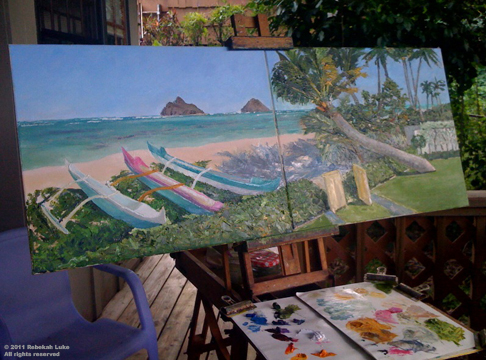
Off and on since Thanksgiving I’ve been working on finishing a diptych—an image on two panels, each of which can stand alone. I paint with oil on canvas. After I finish the painting, I’ll wait a long time—several months—for it to dry, apply a coat of varnish, and put the panels in two frames, most likely of koa.

This style is “impressionistic representationalism.” The viewer is able to recognize the scene, in this case, classic Lanikai Beach on Oahu with the Mokulua islets offshore. The paint edges are soft and approximate rather than hard and exact.

I like to paint images of where you might have been and want to remember, or of places where you’d rather be. This diptych began en plein air on location. Thanks to my hanai relatives Karl and Julie for their hospitality on site.

METHOD.  I started by loosely applying very thinned-out oil paint wash, using two or three tints, to the canvases with a 1.5″ brush, in a random pattern, leaving no white showing. I’m trying to leave  about 5 to 8% of this under painting showing to give the finished work a jeweled look.

While waiting for the wash to dry, I did an ink sketch of the scene, including the shadows, in my small notebook.  I made more than one sketch, experimenting with different compositions. Hand drawing a sketch reinforces the scene in my memory with similar results as taking written notes at a lecture.

I also set up my palette, generally arranging the colors following the color wheel order. Then I was ready to block in the scene on the canvas, using a brush and paint and referring to my ink drawing. I was careful to sight the objects to make sure my proportions were correct.  Yes, I actually stretched out my arm and measured with my thumb or a brush handle!

I mixed the “local” colors (middle tones) on my palette, as well as a dark and a light of the color. I painted analogously. That means, to darken a color I mixed in the next neighboring (on the color wheel) cool color for a shade. To lighten a color, I added a little of the next neighboring (on the color wheel)  warm color before adding white.

As a general example, take the local color red. For a dark red that one would see in the form shadow of, say, a tomato, I would mix in alizarin crimson. For a light red, I would add a little orange to the red before adding a little white. In teaching this technique, my teacher the late Gloria Foss called it the “Tomato Theory.”

Gloria taught that painting analogously was prettier than simply adding black or white, or the complement color to darken.

I love the idea of being able to call on your neighbors to help out instead of going  across the island!

When I finally got paint on canvas, I first put in the local colors that had the lightest values—usually a tint of white, and the darkest values. These were the off-white outrigger canoes and the dark coconut palm fronds. I put the lightest and darkest values in first that let me know all the values in between were relative to those two extremes.

As I painted I held up some paint on my palette knife against the object, like the sky and the ocean, to check that I had the hue and value (lightness or darkness) correct. I learned these last two tips from the late painter Peter Hayward.

I painted all over the canvas at once, by hue, considering both panels at the same time, so that the painting would become a tapestry of color. There are color repeats throughout.

In the end, much of the artwork is about the light. What direction is the light coming from in the painting? In plein air landscape painting, the sun moves constantly. What is the logic of light? That is, what does the light do when it hits a certain form? When it reflects?

Copyright 2011 Rebekah Luke

Related post: https://rebekahstudio.wordpress.com/2010/12/01/its-rock-star-snowing-on-lanikai-beach/


The right light makes all the difference

28 12 2010

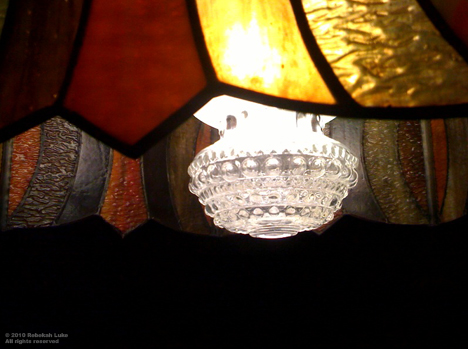
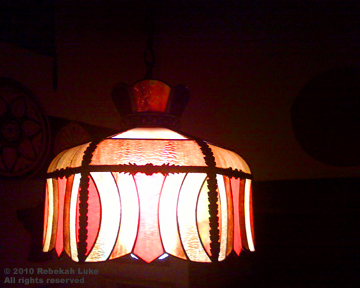
The outer shade casts attractive warm indoor light

It’s a beautiful light. And it makes all the difference. This antique leaded and metal slag stained glass chandelier makes me happy! DH found it on eBay and offered the winning bid for it. He rebuilt the fixture and we hung it yesterday afternoon. Literally years of marital discussion has resulted in a solution that we both love. But the journey wasn’t easy.

The clear glass bauble in the center captures our hearts

The original fixture was a hanging white ball placed in such a way that made it difficult to center a dining table beneath it. It illuminated the space but I didn’t care for the quality of light. Every time DH turned it on, I turned it off. I hated it. One day it didn’t light at all, and the reason wasn’t a burned-out bulb.

I tried to ignore the eyesore while DH offered alternatives. He is into eco- and energy-efficient lighting, while I am partial to the old-fashioned and energy-hoggy incandescent types. At nighttime, the whole of our living space is lighted with a seriously eclectic collection of table lamps, from heirlooms to silent auction prizes to Ross store bargains.

DH sometimes forgets that as a trained artist and photographer, I’m sensitive to the quality of light. Quality of light has to do with color, intensity, direction, and diffusion—for example. It’s part of noticing everything that makes up the scene visually. I’m not a perfectionist anymore, but I still try for good design. I’ll try darn hard to omit anything that hurts my eyes, gives me a headache or makes me feel unbalanced!

For a replacement, I envisioned a new Tiffany-style hanging fixture that could be used for both dining and reading. DH wasn’t sure. He wanted Japanese/Mission/Craft, something like that.

I have to confess: studio lighting was not my strong suit in art school. I learned about lighting, but it was a challenge for me to execute it. And obviously, after 25 years, the part of our little dwelling that suffers in design most is how to light the space.

DH, who was now unhappy with the non-working ball fixture, agreed that we could consult with a lighting/interior-design professional to help. We did, they came, and DH was wooed into a modern, high-tech solution. I have to credit him for not purchasing on impulse. It did not matter either how much I liked the solution or not. After looking at the estimates for materials and labor, we understood, sadly, that it simply was not affordable, a fact we both accepted.

I let the idea go. DH went back to “recycled” mode and started searching on eBay. How about this? No. Well then, what about this one? Nuh-uh. Oh, he was patient! Finally he showed me the pictures of a lamp that seemed to “go” with the house. It was old, but in good shape and pretty. It would be a design repeat of a few other pieces of art glass we had. And the caramel, chocolate, and orange in the shade picked up on existing colors in the room. Okay! I said.

And the rest is history.

Copyright 2010 Rebekah Luke


It’s rock-star snowing on Lanikai Beach

1 12 2010

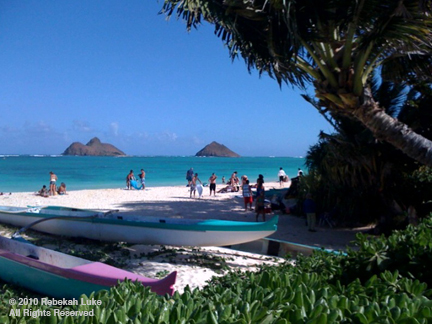
I do believe it’s snowing here at Rebekah’s Studio! Just look at the snowflakes falling! And right after I posted this photo on my Facebook page with the caption “Thanksgiving weekend & no snow!” 🙂

Lanikai Beach - Thanksgiving weekend & no snow!

I’ve been staycationing with family all weekend down the coast of Oahu at my hanai brother’s and sister-in-law’s fancy beach house. I spent a few hours there on Tuesday and will likely go again tomorrow. I’m making a painting that’s a variation of this classic Hawaiian beach scene and the Mokulua (two islands). DH suggested I do some rock-star paintings. Is this rock-star enough for you?

And, thank you WordPress.com for a rock-star visual effect!

Copyright 2010 Rebekah Luke


Rare op to view inside the Mormon temple

6 11 2010

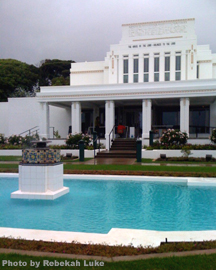
A look at the interior of Laie Hawaii Temple with two special visitors to the studio.

My glee club sisters Nani and Rae came to see my paintings yesterday! In planning the day, Nani invited me to join them for a visit to the Mormon temple in Laie afterward. It is newly renovated, and it is open for public tours through November 13 (closed Sunday). An open house!

Temple of The Church of Jesus Christ of Latter-day Saints, Laie, Oahu

Note: After the temple is re-dedicated on November 21, it will be closed to the public, so yesterday’s viewing was a rare opportunity for us. You can make a reservation to see it by phoning 1-866-537-8457.

None of us three are Mormon, but we were curious to see the temple interior and interested in hearing why the Church of Jesus Christ of Latter-day Saints builds temples and what the LDS beliefs were.

Clear signs from Kamehameha Highway in Laie directed us to the parking lot. There, ushers greeted us with white umbrellas for the rain and escorted us to a series of white tents for an orientation video, that gave a brief history of the Mormon religion, and for some remarks on what to expect on the 25-minute walking tour through the temple.

At the last minute I saw two familiar faces. My former project assistant Kura, ever cheery :-), and her husband  joined our group. Kura and David were married in the temple before the current renovation, and this was their first time to see the new look.

Before entering the front door, volunteers gave us booties to cover our shoes.

Once inside, a husband-and-wife team (we have now been greeted by seven church members) guided us through the halls and different rooms. There was an usher at every turn and doorway. Near the end of the tour I asked how many people staffed the milestone open house event. The number varies with the day and time of day or night, but all LDS members on the island of Oahu are involved, I was told.

For the uninitiated, an informative brochure explains that LDS members have churches, chapels, and other meeting facilities for their Sunday worship services and weekday activities. The temple, however, is considered to be the most sacred place on earth. It is reserved for LDS members who are worthy in the eyes of the church. Then, the more one visits the temple to study, the closer one can become to God.

On entering, I am immediately impressed with the superb wall-sized paintings, art glass windows, and bas-relief panels in the waiting area.  It is like being in an art museum. (Think Elgin marbles of the British Museum in London.) More large and fine paintings line the hallways and lovely murals line some of the rooms.

All of the interior space is very beautifully decorated, welcoming, serene, peaceful. Actually, it is divine, and designed to feel ethereal. (Think HGTV’s “Divine Design” with Candice Olson). I had a similar lightness of feeling touring Catherine Palace just outside of St. Petersburg, Russia. Tastefully grand. The temple, however, is much smaller, more intimate, and not ornate like the palace. Perhaps the way the art is treated reminds me of Catherine Palace.

What happens in the temple? LDS members believe in the Book of Revelations, eternal life, and are interested in their ancestors and their progeny, i.e., one’s family’s past, present, and future; hence, their dedication to genealogy research. In the temple one may perform baptisms for one’s ancestors who have died. A couple may seal their marriage and can have their children sealed to them forever. As one advances in the teachings given in the rooms for instruction on the commandments, one may grow spiritually closer to God.

Furnishings of hardwood, soft green upholstery and drapes, crystal chandeliers, gold leaf inlay, sculpted carpeting, white calla lilies, excellent craftsmanship — these decorated a waiting room, the men’s changing room (one must change into white clothes while in the temple), a bride’s dressing room, a baptismal font, instruction rooms, a sealing room, and the white celestial room at the top.

After the open house tour we were escorted to the refreshment tent for cookies, and Kura and David cordially chatted with us and answered our questions. Thanks, Nani, for inviting me. And thanks to the LDS church members for a pleasant and educational afternoon.

Copyright 2010 Rebekah Luke

Rev. Rebekah Luke is ordained by the Universal Life Church that has two tenets: “freedom of religion” and “do the right thing.”


A fresh look at the art of painting green

20 10 2010

Some painters claim they don’t know how to paint green. It must be why paintings of this hue are generally absent in the art galleries. In this post I’ll show how to paint green. With oil paint, the trick is to change your base color.

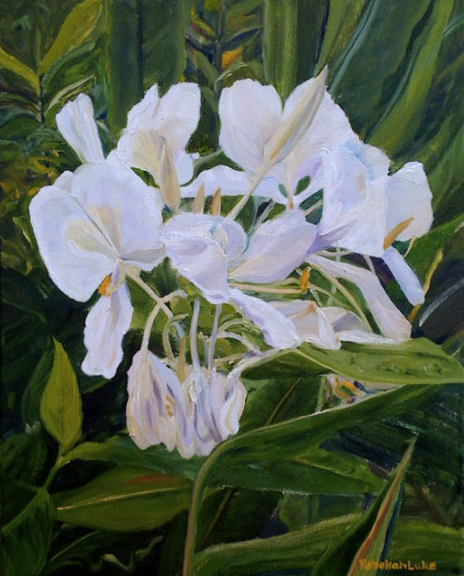
I love green. “Banyan in the Park” and “White Ginger,” two of my most recent paintings, are predominantly green. Looking at them gives me a feeling of calm, coolness, and serenity. More so, I can recall the satisfying experience of choosing the images and transferring them to canvas. I can smell the sweet scent of the ginger patch.

Banyan in the Park

White Ginger

Painting green is no secret, it’s a technique. As mentioned, it’s all about changing your base, your base being a yellow or a blue because yellow plus blue equals green. In the field, I still use a color chart I made when I took my first painting classes. Someday I’ll paint a new one!

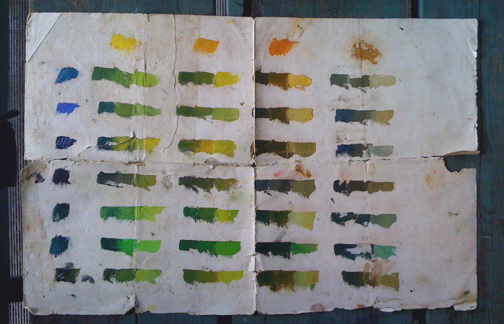
My green color chart on canvas paper, a bit ragged but still useful!

You can make a chart like this too. Use a palette knife. Put a swatch of each of your yellows in the top row. Down the left column, dab a swatch of each of your blues, including black if you use black. The greens in the body of the chart are the result of mixing a blue with a yellow. For each combination of the two colors, I have added white two times to get a “light,” “middle tone,” and “dark” of the same hue. See how many different greens there are!

When I am on location, I literally walk up to the object—e.g., a leaf—and find the swatch on my color chart that most closely matches it, eliminating any guess-work. If the object is in the distance, I hold up my palette knife—with paint on it—in the air in front the object and squint to see if the hue and value (lightness or darkness) match. When you paint a green scene, step back for a moment now and then. If it’s starting to look all the same, maybe it’s time to change your base to “find” another green.

Going a step further beyond the colors on the chart:

To lighten, “warm it in the light,” that is, add the next lighter yellow from your palette plus a little white. To darken, “cool it in the shade,” that is, add the next darker blue from your palette.

This technique of warming it in the light and cooling it in the shade is known as “analogous,” meaning to use the next color on the color wheel. In the way I paint, I prefer analogous to “complementary.” Adding the complement—the color opposite on the color wheel—to a color will also darken, but it will also appear comparatively chalky. Put another way, if I want to darken green, I add blue, not red.

If you are still with me ;-), here are a couple of exceptions.  When painting a landscape, colors become muted and lighter in value in the distance. In this case the painter would choose complements. Realize, also, that whenever you see gray, use the complement.

I learned these tips from my teachers Gloria Foss, Vicky Kula, and Peter Hayward who taught us how to turn the form and about the logic of light.

Thank you!

Copyright 2010 Rebekah Luke