Mountain panorama commands a diptych

5 01 2013

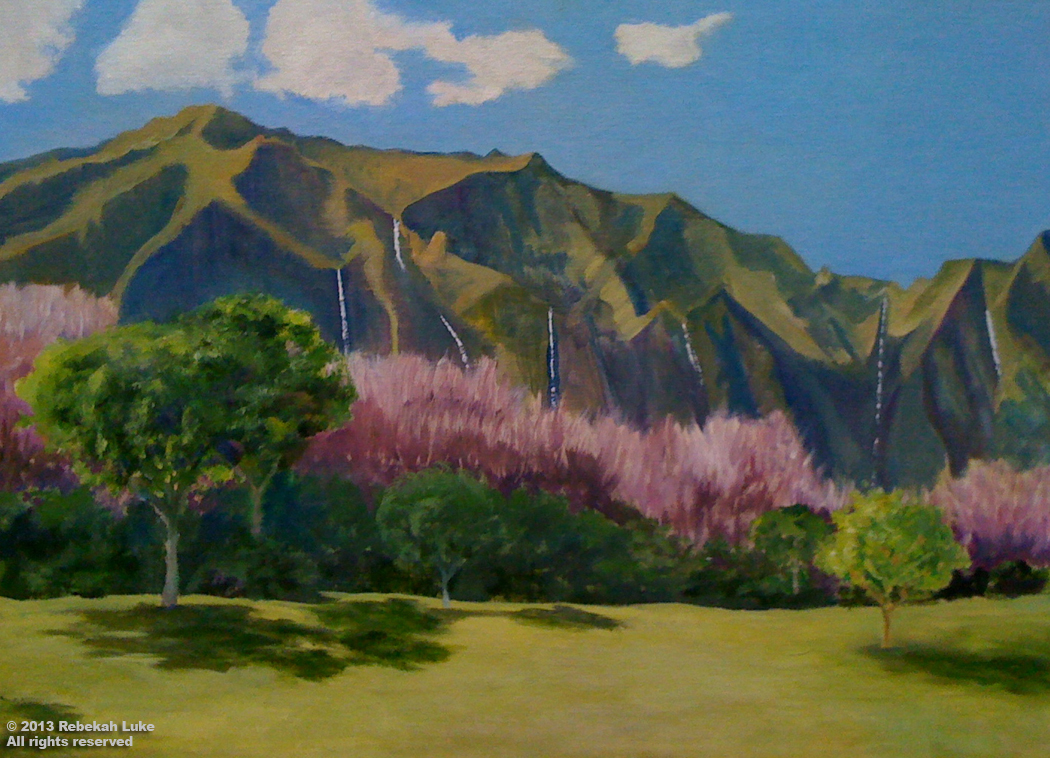
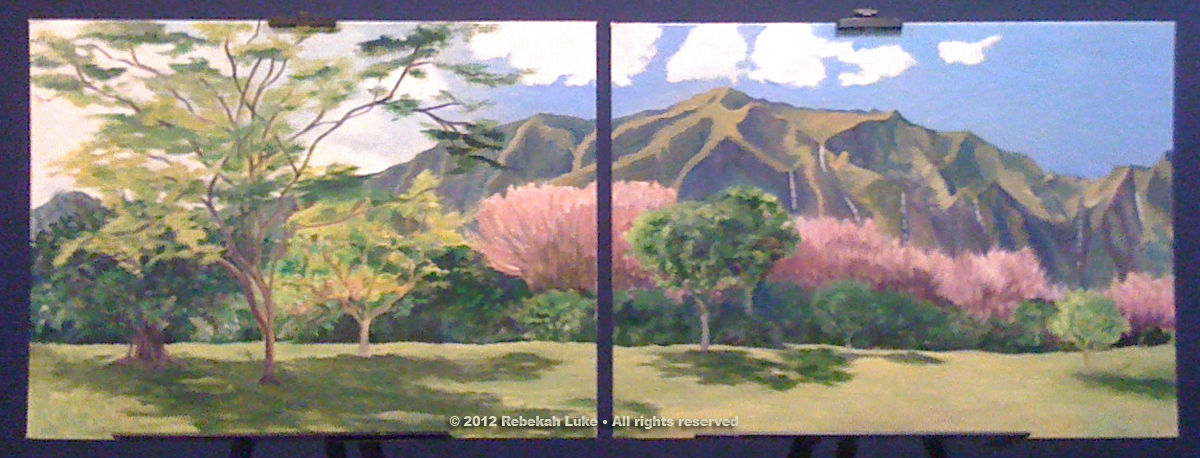
There’s something about the Ko‘olau mountains that draws painters to this landscape again and again. Besides their obvious lush and weathered volcanic beauty, they challenge us plein air painters to capture their form in the ever-changing daylight. I spent a lot of time studying the ridges and valleys in my most recent diptych of Lanihuli as viewed from Luluku. Together, the panels measure 60 inches by 22 inches, unframed. Oil on canvas board.

Lanihuli Diptypch, left panel

Lanihuli Diptych, left panel

Lanihuli Diptych, right panel

Lanihuli Diptych, right panel

Diptych by Rebekah Luke

Update 2/2/13: I am please to report that “Lanihuli Diptych” was sold to a buyer at the Punahou Carnival this past weekend. Half of all sales are donated to the student financial aid program at my alma mater. ~RL

Copyright 2013 Rebekah Luke


Big, beautiful, colorful holiday gift ideas from me to you

28 11 2012

Perhaps this is the year you want to give something big and long-lasting to your special someone. I have an idea! How about a piece of fine art?

An oil painting that you like, for example, can be more affordable than you think and retains its value over time. It can brighten a home or office interior and bring cheer to the environment.

Most local artists and even art galleries are willing to negotiate retail prices and work with customers to allow them to purchase on layaway — in installments. Don’t be afraid to talk to the artist, ask questions, and perhaps move that item from your wish list to the reality of your collection!

Considering it’s holiday time, and everyone is marketing their wares, here’s some shameless “hard sell” on my part. I invite you to view my virtual gallery of paintings once again at https://rebekahstudio.wordpress.com/paintings/ and hope you’ll consider making a purchase or tell a friend. There are also a few in my retrospective collection that I could be persuaded to part with.

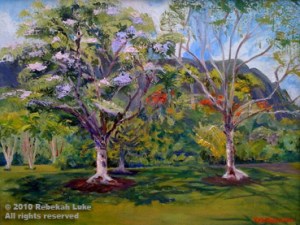
“Clouds Lifting Over Lanihuli”

Hawaiian places — places you have been or places where you’d rather be — are my favorite subject. Each painting is a one-of-a-kind original (sorry, I haven’t made any reproductions) and comes with a frame ready to hang.

Welcome Spring – 2010

Thank you so very much for your consideration! Happy holidays!

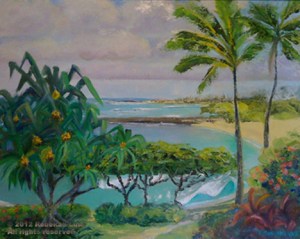
“Kuilima Cove”

Looking Down Upon the Path – 2008


I’m back from Italy

11 11 2012

Thanks for coming with me to Italy! I’m here at the studio now, getting back in the groove. If you missed my adventure, you can see it at “Popo Goes to Italy,” though it will be in reverse chronological order. I just posted the final entry at that site. I really saw and did a lot!

While in Italy, I found some time to paint in oil. I shipped some supplies ahead for convenience, unsure if I could get them at my destination. As it turned out, the frame shop at commissary at which I had privileges through our son-in-law was well stocked.

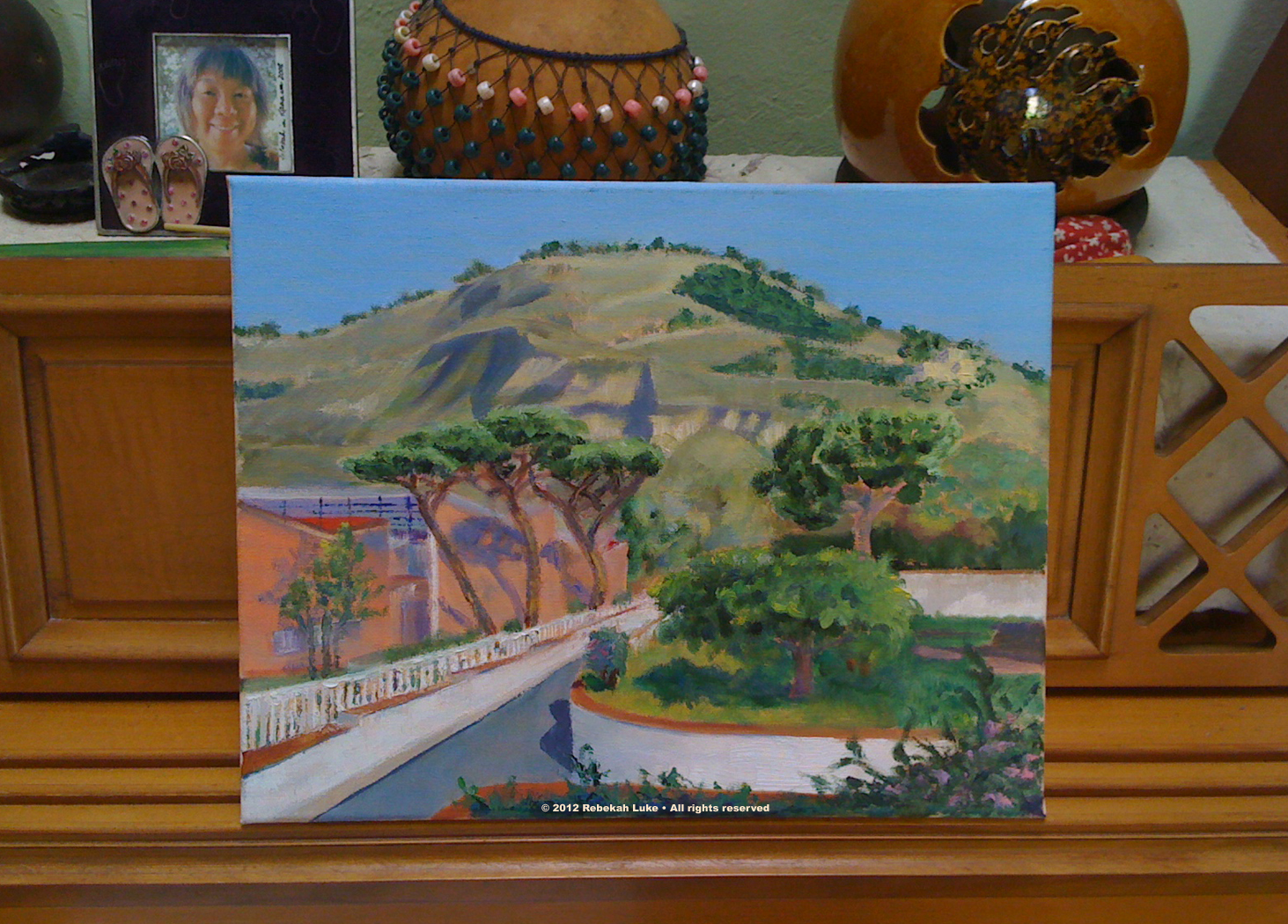
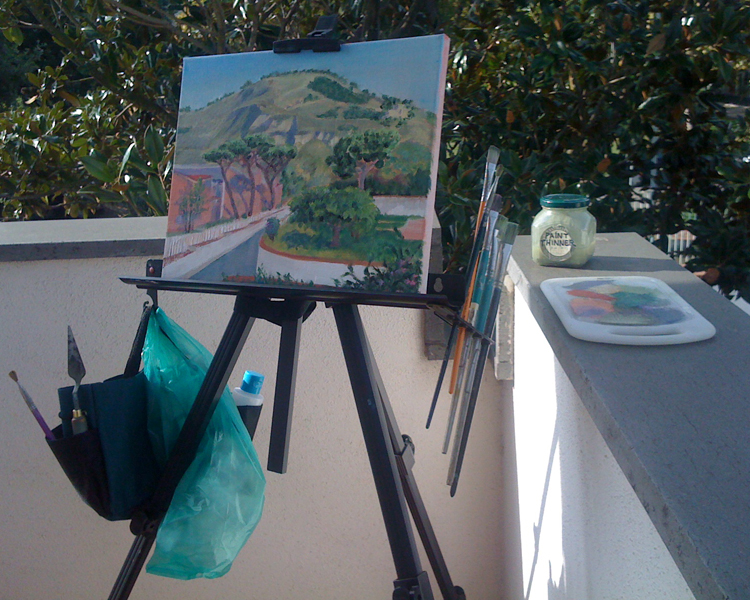
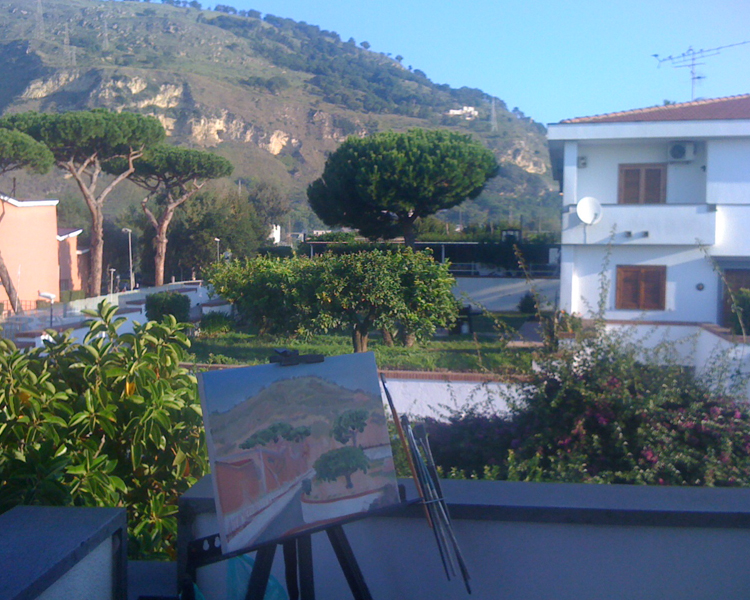
This is the view from the house, at the foot of Campiglione. Inside the crater is a large recreation area for US Armed Forces personnel and their families. DH and I went there several times with Miss Marvelous and her family.

My finished painting of Campiglione, a volcano in Campania, Italy

My set up. Painting is unfinished.

En plein air. My view from the balcony.

Copyright 2012 Rebekah Luke


Popo goes to Italy

28 09 2012

Pretty soon I’ll be posting from Italy! I’ve been getting ready for the long vacation from Rebekah’s Studio, but I’ve arranged for you to follow me on my new blog Popo Goes to Italy. I apologize so very much for being missing in action here.

DH and I are preparing to make our house guests and house- and pet-sitter welcome and to enjoy the next week and a half with friends and students.

Tomorrow we’re bicycling from Jim and Sharon’s house to see the Blue Angels fly over Kaneohe Bay. Taking the tandem.

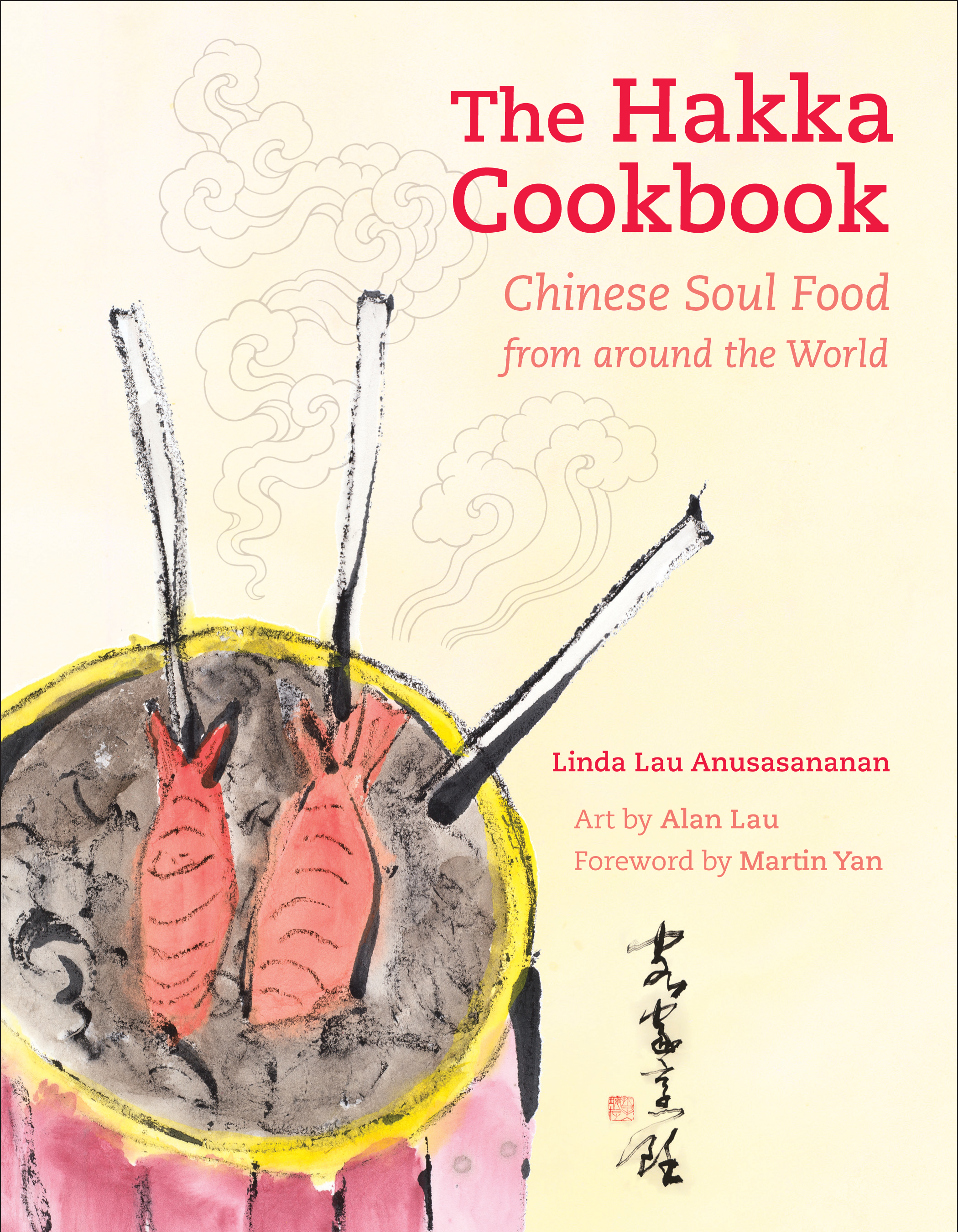
My friends Linda, Lisa, and Sofia arrive from San Francisco on Sunday. Linda is the author of The Hakka Cookbook: Chinese Soul Food from around the World (University of California Press, 2012), and she’s scheduled to do a book signing at the Tsung Tsin Association‘s Autumn Banquet in Honolulu that we’re all attending.

DH and I had the pleasure of traveling with Linda to China as she went from place to place, restaurant to restaurant, talking to chefs, researching and eating Hakka dishes, and finding out more about our Hakka heritage in our grandparents’  homeland. We each included each other in our respective publications—mine is The Chong Family in a New Millennium.

We’ll have a lot of fun with Linda’s daughter Lisa, who was on the China trip with us, and almost-three-year-old granddaughter Sofia. We need a toddler fix. Lisa lived in Italy and married an Italian.

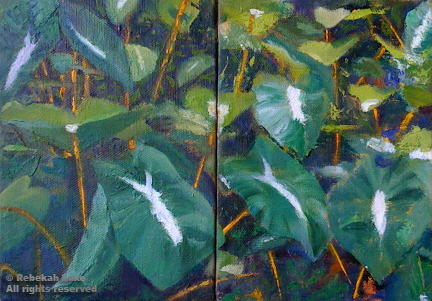
DH and I will have time to attend the First Birthday Luau for Eva and Kingston, girl-and-boy twins, who live down the highway. Special family friends too, so a very special gift is in order—my Kalo Diptych. Shh, it’s a surprise!

Kalo diptych / 10″ x 7″ / oil on canvas / each panel framed separately

My painting students have two more classes with me before a break. They’ll be painting on their own while I’m away.

Then we’ll greet Joe who’s ready at the drop of a hat to come from Florida to take care of Ula, Alice Brown, Pua, and the house. Because he just loves Hawai‘i! It’s all arranged.

Thank you so much for checking in. Be well. I’ll be in touch as Popo Goes to Italy.

Copyright 2012 Rebekah Luke


Grapes and drapes painting lesson

5 09 2012

Grapes and drapes still life setup, Painting II, Rebekah Luke, instructor.

Today my Painting II class is painting “Grapes and Drapes.” This lesson, originally from Gloria Foss, is practice in the studio for painting the Ko‘olau Mountains and trees in the landscape later on.

We pay attention to where the light is coming from in the scene and turn the form with values from light to dark.

We review the “Tomato Theory” we learned in Painting I, that is lightening and darkening the form with colors that are analogous on the color wheel instead of adding white or black, or instead of adding the complement to darken. In addition, we remember the mantra, “Warm it in the light; cool it in the shade.”

“Tomato Theory” can be a hard to get used to at first, but practicing it makes objects pop with vibrance and gives the overall painting more pizazz.

I find it satisfying to be able to pass on the techniques I learned from my own teachers Vicky Kula and Gloria Foss. What they taught me and what I am passing on to my students is the logic of light.

Copyright 2012 Rebekah Luke


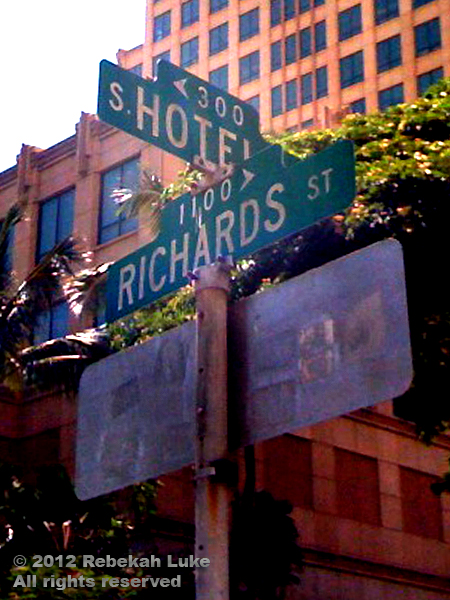
Art and architecture where Hotel and Richards intersect in Honolulu

1 09 2012

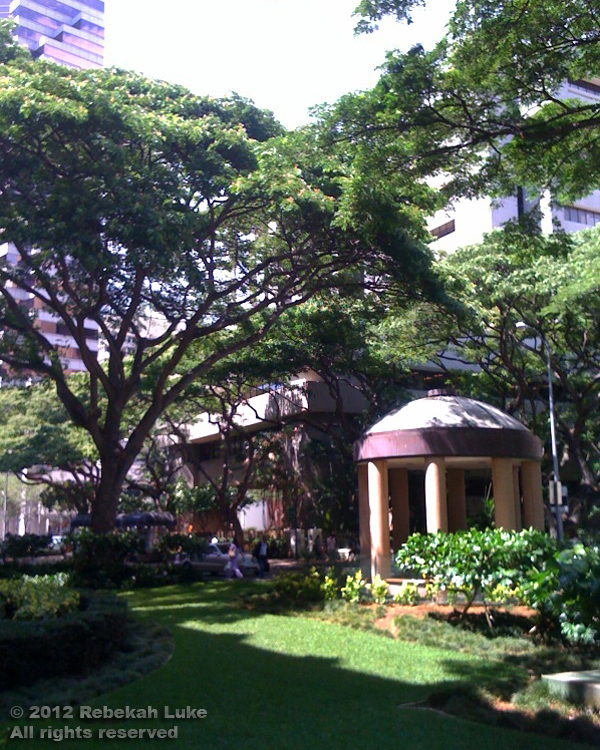
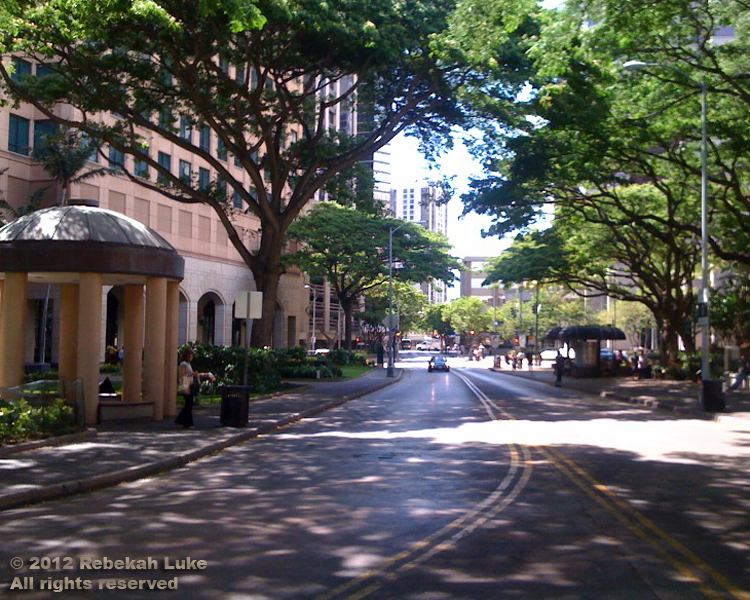
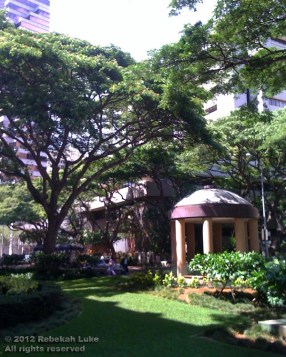
The charming gazebo at Hotel and Richards streets that caught my eye.

After lunch downtown last week with Becky at Café Julia, that got the vote for best downtown place for “breakfast and lunch only,” I strolled up the street, intending to visit the Hawai‘i State Art Museum (HiSAM). Becky suggested I take a look at what happened to the old Armed Services YMCA swimming pool.
Approaching the intersection of Hotel and Richards, the loveliness of dappled sunlight through the monkeypod trees stopped me.  Pause for photos.

I saw four familiar buildings differently than before, and I reflected on their noteworthiness, all in proximity in this small area. Later, it occurred to me that on my little walking tour, I had focused on the historical architecture and fine art of these buildings, making for a very pleasant afternoon by myself . . . while Becky went back to her office to work.

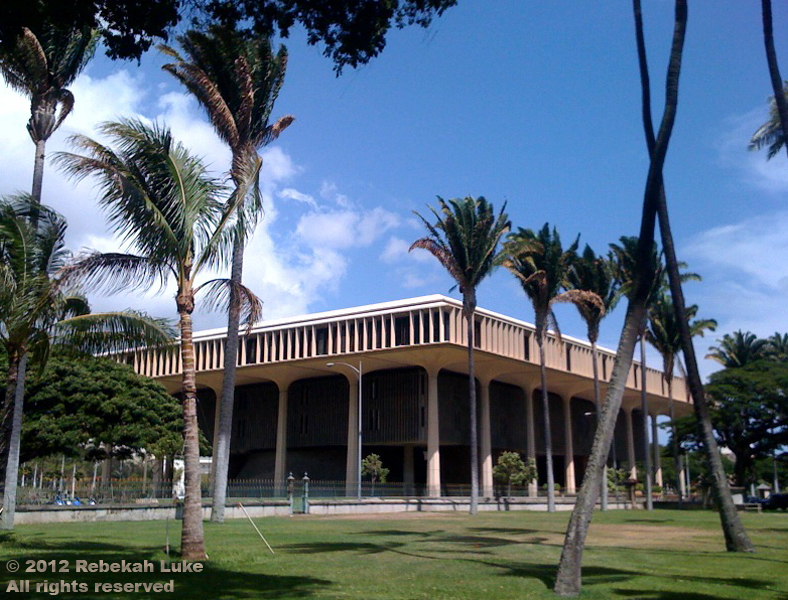
Hawai‘i State Capitol

Kitty corner to the gazebo is the Hawai‘i State Capitol designed by Belt, Lemmon & Lo and John Carl Warnecke & Associates. Its columns represent coconut palm trees, and the two cone-shaped legislative chambers represent volcanoes emerging from the reflecting pools that depict the Pacific Ocean.

In the courtyard floor is a round artwork “Aquarius,” an Italian glass tile mosaic by Tadashi Sato. There are two noteworthy statues at the Capitol: one of Father Damien of Moloka‘i on Beretania street, and one of Lili‘uokalani, Hawai‘i’s last reigning monarch, on the opposite side facing ‘Iolani Palace.  Inside the chambers there are large tapestry weavings by Ruthadell Anderson.

Looking makai (toward the sea), notice ‘Iolani Barracks (1871) that housed the Royal Guard on the royal palace grounds. Hawaiian kings and queens lived in the ‘Iolani Palace (behind the Barracks in my photo) until 1893 when Lili‘uokalani was overthrown and imprisoned in her room. Today both buildings are museums worth touring.

‘Iolani Barracks, moved to this site in 1965 to make room for the new State Capitol.

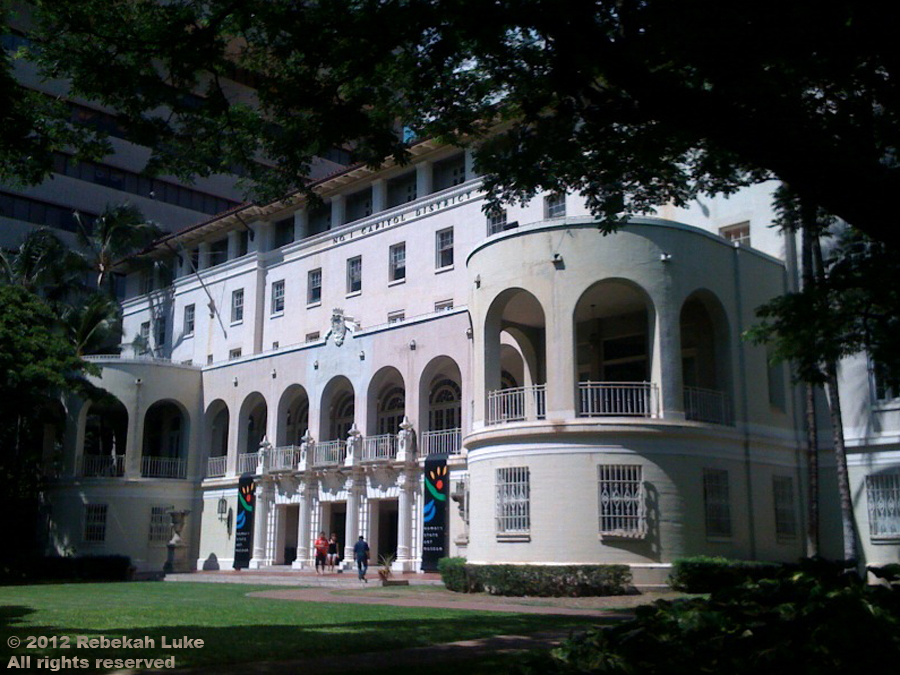
When I was in my twenties, I came to the Armed Services YMCA once a week to rehearse with the Honolulu Chorale. In 1927-28 that building was erected to replace the second building of the original Royal Hawaiian Hotel (Hotel Street was named in 1850; the original hotel was demolished in 1882 and rebuilt). I thought it was grand as a functioning Y and imagined what it must have been like in its heyday. Today the building is renovated, housing State offices and the Hawai‘i State Art Museum on the second floor, my destination.
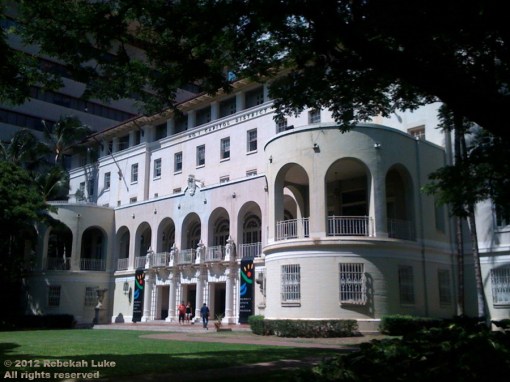
No. 1 Capitol District Building is the former Armed Services YMCA built in 1927-28. The former swimming pool and deck  in the middle of the U-shaped building is now a sculpture garden with a pretend swimming pool.

“Visions and Portraits of Hawai‘i” in the Ewa Gallery (toward Chinatown) contains representative work of Hawai‘i’s well-known artists, as defined by the State Foundation on Culture and the Arts. This display is eclectic, in that there is generally one work per artist. But Hawai‘i, since settled by non-natives, is eclectic!

Two stand-out works for me on this visit were the main piece as you enter the area — a painting of Waimea Canyon on Kaua‘i by D. H. Hitchcock (1861-1943) whose impressionistic works I admire greatly, and the painting of women, thickly painted by Madge Tennant.

The theme of the exhibit in the Diamond Head Gallery opposite is “Recent Acquisitions.” What I remember most is the nature photography of Wayne Levin. Three stunning images: an underwater shot of a diver chased by an ulua (I think), one aerial of Hawaiian monk seals at the tidal line (“Monk Seals and Surf, Derby’s Beach, Nihoa”), and one straight-on of birds and clouds (“Approaching Sooty Terns”). Classic clouds for my painting students to study!

Both galleries display impressively large wooden ‘umeke, or calabashes, turned by Robert W. Butts.

On the ground level, passing by the museum gift shop and through Downtown @ HiSAM restaurant, doors opened to the Sculpture Garden in the former swimming pool area. Artist Doug Young created a glass marvel in 2D with such visual depth that it seems as a 3D pool. I got dizzy staring down at it! Interesting. The restaurant staff began setting up for an outdoor garden party, and I moved on . . .

. . . Back to the Richards Street YWCA, half a block toward King street where Becky and I ate lunch. This attractive building was designed by architect Julia Morgan, who also designed Hearst Castle at San Simeon, California. Before I headed home, I revisited a Lau Chun painting hanging above the grand piano in the lobby. It was of the YWCA building as viewed from the palace grounds, and with the street and cars edited out.

His strokes of thick paint are of every color, you’ll see when you examine the painting closely. It’s as Miss Marvelous’s mother, when as a youngster she looked at my oil paintings, said: “I can’t figure out how, when you look at it close up, it’s just paint, but when you step back it’s a picture.” Lau Chun’s painting is an example that value (shades of light to dark) is more defining than hue (color) in a painting.

It can be useful and educational to look at other artists’ work. But more than that, I can pick out those things that are inspirational. Often, looking at other artists’ work usually frustrates me, and I’m only inspired to return to the studio to make my own creations. This time, I enjoyed the things I selected to see in a new light.
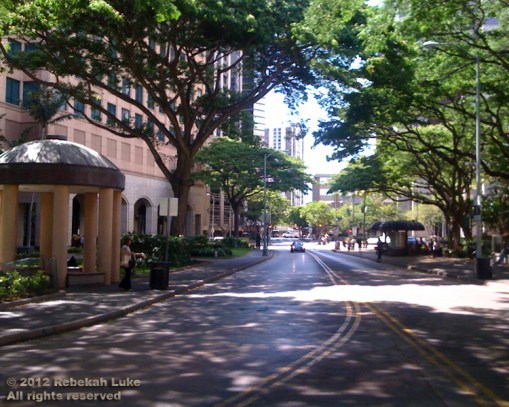
Looking north on Hotel street. Ali‘i i Place, primarily an office building, has a convenient municipal parking garage with cheap rates. The lobby and Alakea street pedestrian entry feature several fine, large paintings by John Wisnosky.

Copyright 2012 Rebekah Luke


Color and paint from still life

12 04 2012

I can teach you how to paint!

While my art students are on a little break from class—they’re vacationing in Turkey!—I’ve decided to show you what we’ve done so far in Painting I. Each week I welcome students with a studio tabletop set-up, explain the lesson, and do the lesson with them. We paint these assignments after practicing basic drawing and perspective, and learning about the values of light.

I urge students to not paint from a photograph, preferring that they draw and paint from life and the “local color” cues they should put down in the beginning. However, the now-ubiquitous digital camera phone and that the set is not available for viewing once the class is over for the day make it difficult to not refer to a photo.

The problem is, for beginners especially, if you paint from a photograph, the painting will look like a photograph. I think a painting is more interesting when it shows the artist’s individual line, imperfections included. Looseness will develop with time.

Below you can see how I treated the assignments myself. The medium is oil paint on canvas paper. Here’s evidence that limited palette paintings are generally stronger than images created with a full palette. Still to come, after students come back from break: the red-green painting and complementary color lesson and “the world in full color.”

Copyright 2012 Rebekah Luke
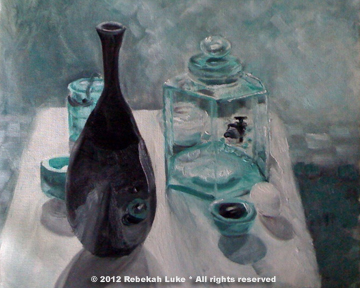
The painting. Monochromatic color lesson: adding one hue only, veridian, to black and white, still mindful of the range of values, that is, the various tints and shades of gray. Lesson includes painting glass.

The set. Analogous color painting lesson with black, white, and three yellows. Black mixed with yellow makes green.

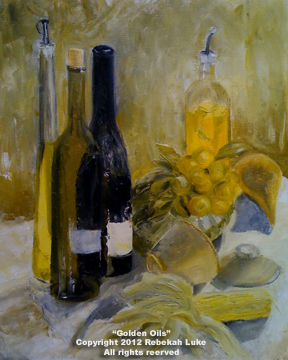
The painting. Using cadium yellow pale (cool yellow), cadmium yellow light (warm yellow), yellow ochre, black, and white.

The painting. The combinations of mixing cadmium red light (red-orange) and veridian (blue-green) represent the first of four lessons about complementary colors, that is, colors that are opposite each other on the color wheel. Combining complementary colors produces neutrals that are stronger than tube paints named for earth tones.

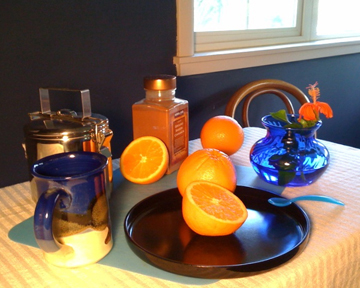
The set. Complementary colors blue and orange with shiny metal, glass, reflective surfaces, highlights (the incandescent spot) and low lights (from the window light).

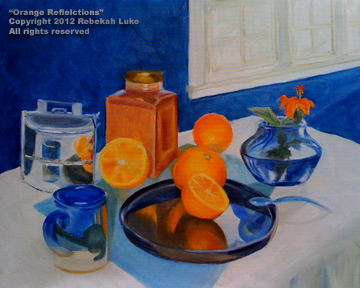
The painting. Though challenging, it is much fun to paint reflected light.

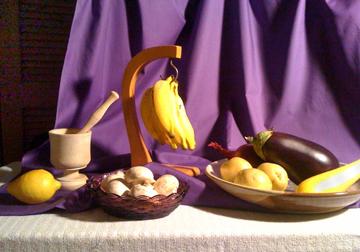
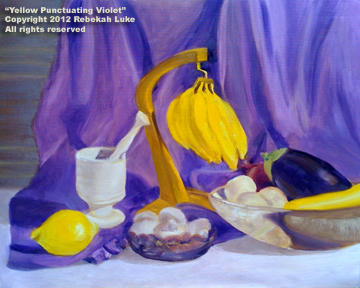
The set. The complements yellow and violet mix to make warm tans and browns. Of light rays passing through a prism, yellow is the lightest value, and violet is the darkest. This still life set introduces drapery.

The painting. Painting drapes in the studio now is good practice for painting the Ko‘olau Mountains in the landscape later!

To learn more about painting lessons by Rebekah, please see the related post: Is painting on your bucket list?