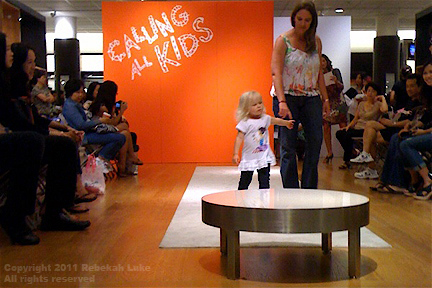
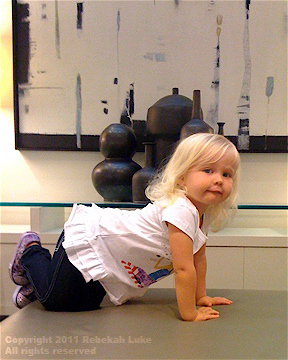
Here’s Miss Marvelous, with her mom, modeling fancy clothes at Nordstrom today. I think she was more herself after the fashion show was over. After all, she’s not yet 2.
😉
I’m lucky to be her Popo.
Here’s Miss Marvelous, with her mom, modeling fancy clothes at Nordstrom today. I think she was more herself after the fashion show was over. After all, she’s not yet 2.
😉
I’m lucky to be her Popo.

Miss Marvelous with her Papa entering the Kalakaua crypt
If they arrange ahead, Honolulu visitors to Mauna Ala, site of the Royal Mausoleum in Nuuanu, can have a guided tour by its curator William John Kaiheekai Maioho, the kahu of the iwi (bones) of the alii (royalty) and high chiefs—namely the Kamehamehas and the Kalakauas.
I and Miss Marvelous tagged along recently with DH and a group of volunteer docents from the Bishop Museum. Bill Maioho’s presentation—full of details and anecdotes, talk story style—included a chronology of the Hawaiian royals and others who are buried at Mauna Ala, information about the chapel building and how its use changed over the years, and a look inside the gates of the Kalakaua crypt.
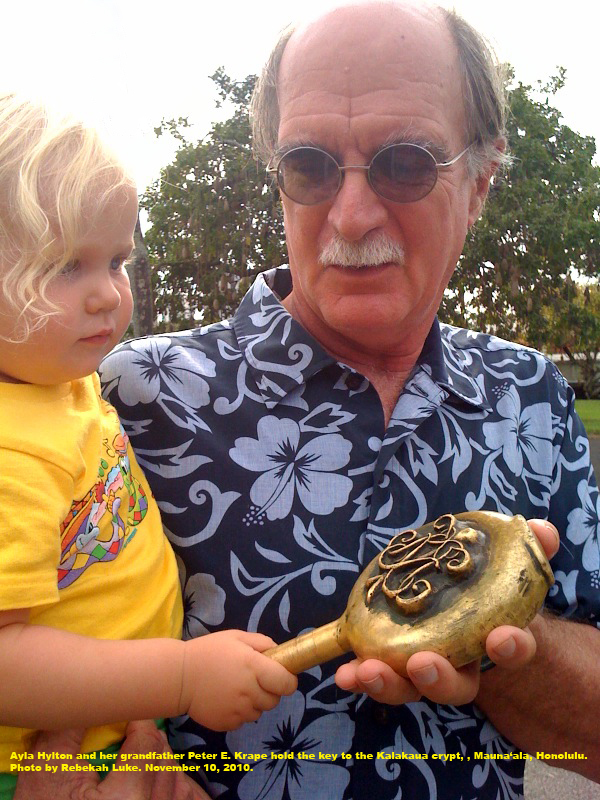
Holding the key to the Kalakaua crypt
Bill Maioho descends from the Taylor family whose kuleana (responsibility and privilege) is to care for the iwi at Mauna Ala. You can find his story as an oral history article in Pacific Worlds, an excellent website with information about Polynesia. Please click on the link.
Mahalo to Uncle Bill.

Remembering Charles Reed Bishop
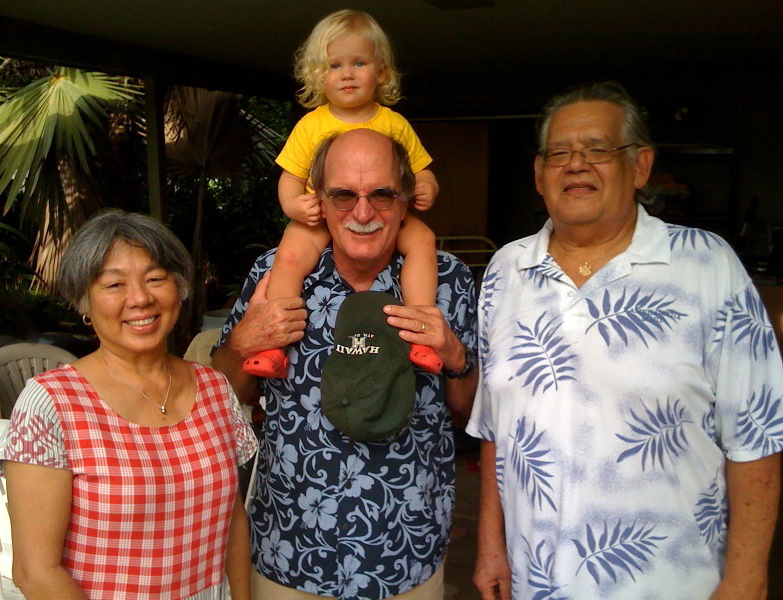
Me, Miss Marvelous, DH, and Bill Maioho
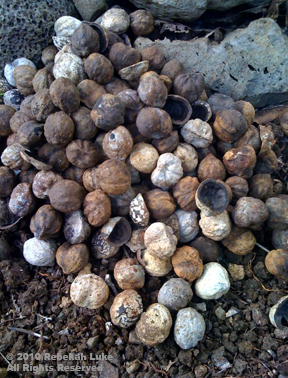
Aged kukui nuts prior to cleaning and polishing into Hawaiian jewelry
The studio and its surrounding garden of fruit trees and raised vegetable beds is not my choice for a toddler to play in, so I’ve cleared out the heliconia under the avocado tree to plant a soft thick green ground cover of clover with Miss Marvelous in mind. She likes to explore and play in the outdoors.
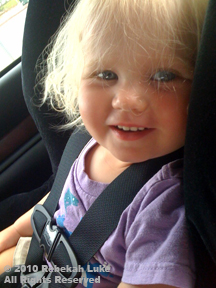
Those following the progress of Miss Marvelous may see what she looks like at 16 months this September. I snapped this image in the car on a shopping trip. She loves shopping!
The heliconia patch was there since purchasing our place. It has survived with not much care for more than 26 years. When the patch was full and thriving, gathering the fallen avocados in August was like hunting for Easter eggs in a forest.
Off and on since trimming the plants to the ground I’ve dug up roots, runners, sprouts, as well as rusty iron pieces from the old VW bug, now in its last disintegration phase.
Just by running my fingers through the coarse soil, I found lots of old, old kukui nuts, whole ones and halves of different colors—black, brown, white, multi—from the neighbor-in-the-back’s tree on the other side of the panax hedge. They were easy to find, a meditative search akin to shell seeking. In all our years here I never gathered many.
Today I thought I’d rescue the nuts for my friend Kamakea who turns them into jewelry, and I saved them for her.

The kukui fruit with its outer skin covering or husk still intact. On the tree they are a gray-green color.
Next I looked for kukui nuts that were freshly fallen for another friend, Cathy, who makes inamona, a roasted nutmeat relish mashed with paakai (salt) and used in Hawaiian cuisine.
It is a long process to prepare inamona, about as long as it takes to make kukui nut jewelry. Cathy said, as long as the outer covering is still intact, it’s good for inamona. Kukui nuts are seasonal, and they are starting to fall now.
Sure enough, in and among the fallen dried leaves in the corner of the lot were these round fruit. So I scooped those up too. When I have a few more, I’ll deliver them to Cathy.
The kukui tree (Aleurites moluccana) is amazing. It has many uses. It is a canoe plant originally brought to the Hawaiian Islands by Polynesians who arrived here by canoe. You can spot the tree in the mountains by looking for light, mint-green-colored leaves.
In Hawaiian culture the kukui is one of the kinolau (forms taken by a supernatural) of the Hawaiian pig god Kamapuaa; the shape of the leaf resembles the head and ears of a puaa (pig). Freshly plucked leaves with stems on are arranged together by knotting the stems make beautiful lei (wreaths). In laau lapaau (Hawaiian medicine), the mashed kernel, as in inamona, is a laxative and prescribed for relieving constipation.
It is often called the candlenut tree. Kukui means light. Hawaiians skewered the oily kernels and burned them for light. The oil is the preferred oil for polishing wooden utensils for food, such as umeke (bowls) and platters. You can now find the oil on the commercial market as a cooking oil and in cosmetics.
The kukui tree also provides wonderful shade. Mahalo e ke Akua! Combined with the canopy of the avocado tree and a ground carpet of hardy clover, I envision a delightful play space for Miss Marvelous. She’ll just have to duck during the month when the fruit fall.

Shall we pick this one . . .
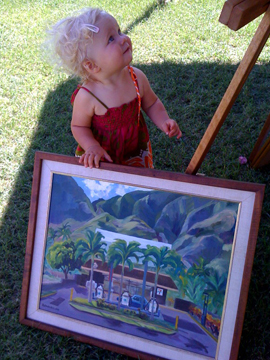
... or that one up there?
No one bought much art today at the Native Hawaiian Arts Market, but there were plenty of art appreciators. I am happy to show my work and talk about it with others. I met some very nice people, and some friends stopped by.
The artists are expecting a Sunday crowd tomorrow, the 23rd, at the Bishop Museum, on the last event day of Maoli Arts Month. (Please see two posts earlier for info.)
Miss Marvelous liked “Gas Pumps in Paradise,” an earlier work painted in 1993 of the 7-Eleven and gas station in Kaaawa the day Bula Logan led a sovereignty march along Kamehameha Highway.
The painting was part of my “Painting the Town” collection of all the public structures in Kaaawa: the post office, the fire station, the school, the bath house, the library (bookmobile), and two bridges.
I remember organizing with Pat, the then director of Swanzy Beach Park, an art show reception to open the new covered lanai for the park facility. I showed the paintings with environmental portrait photography of the people who worked in the buildings. The only advertising was a hand-painted roadside sign by the summer fun kids that read, “Everybody come.” And everybody did! Times have changed.
Rather than keep “Gas Pumps in Paradise” as a leaner becoming shop worn in the studio, I’ve marked it down to $200.00, solid koa frame included. The amount is half the original price.

Miss Marvelous enjoys the art show with her mom

Alice Brown, 7, takes care of Miss Marvelous, 1, on the baby’s birthday.
What a pair! What else can I say? “Thanks for sharing” to Miss Marvelous’s grandmother who captured this precious moment of two beloveds. This scene is linked to my earlier post, “Before and after the party.”
Granddaughter’s birthday, Mother’s Day, visits from grandparents, aunties, and friends from across the ocean.
Hawaiian tradition calls for a celebration when a child turns one because, in olden times, many children did not survive the first year of life. Thankfully, our family’s littlest one is healthy and thriving! Hauoli la hanau!
While the rest of the family opened the imu (underground oven) to take out the kalua (baked) pork, turkeys, and uala (sweet potatoes) for the luau celebrating her first birthday,

Opening the imu. It's hot!
Miss Marvelous and her Papa went for a morning walk along the beach.
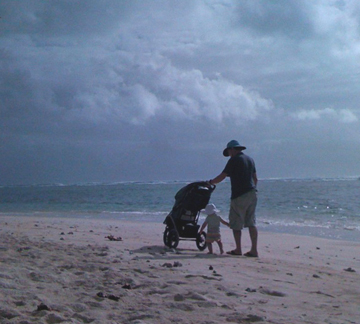
Miss Marvelous and Papa
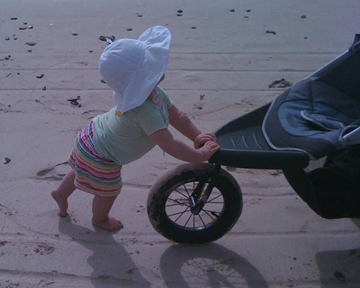
Let me! I'm one now!
Next day was Mother’s Day, and we took a relaxing drive to Mokuleia on the North Shore to see the polo matches. White team won 4-3.
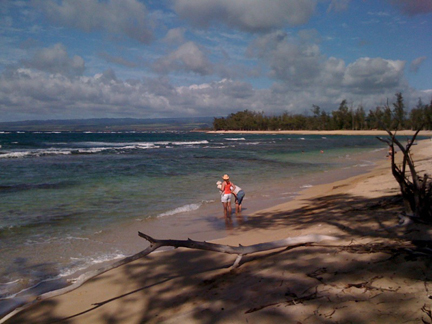
Beach at Mokuleia
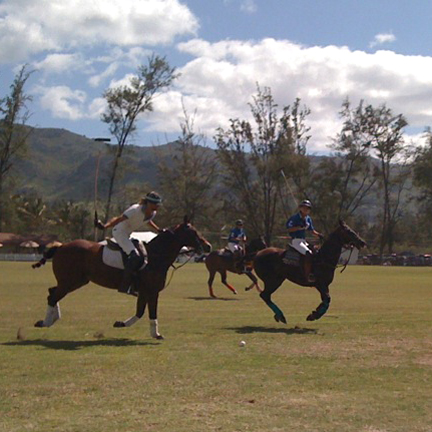
White team won 4-3
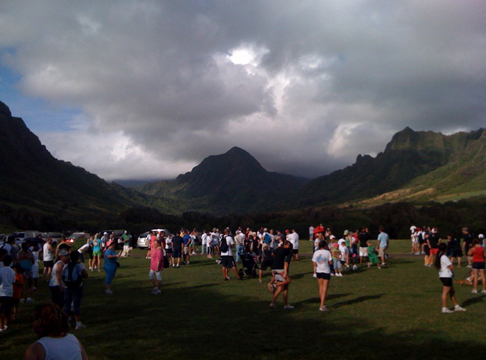
Kaaawa Valley with Puu Ohulehule beyond
This morning was perfect for the “1st Annual Kaaawa Elementary School Ocean Warrior 5K Family Fun Run/Walk” in Kaaawa Valley, a short ways down the road from the studio. The film industry uses this location for movies and TV shows. This is the beautiful place where Miss Marvelous’s parents wed.
Many thanks to the Kaaawa Elementary School PTO Committee and Kualoa Ranch for coordinating a successful community event. The entry fee bought access to the course trails, the event t-shirt, a bottle of water, and a coupon for 50% off of three different activities at Kualoa Ranch. Shave ice, spam musubi, cotton candy, music, and the great outdoors made for a great party!
We could have brought Alice Brown and Pua (guest dog), as plenty of other people brought their canines, and the event folks offered free poop bags, but, alas, we had left the pooches home. I brought my easel and took the opportunity to sketch out a new painting of the vista. Miss Marvelous was among the youngest entrants to show off her new walking skills. Congratulations, Kaaawa! Everyone had a good time!
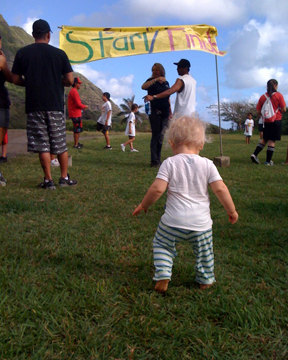
Miss Marvelous approaches the line


 Rebekah’s Studio
Recent comments