Learning about energy healing

3 09 2009

Often I’ve heard or read writings from healers who say they chose their vocation after a personal transformational experience. An unexplained miracle of healing at the time caused them to wonder and ask questions, leading them to learn how it was done so that they could help others.

My story with Reiki is not so dramatic, but I thought I would share how it evolved.

It began with a weekly meditation group in Honolulu at the residence of a psychic who ran a healing center and taught lots of interesting things. She was a lightworker. After she moved to Colorado, I was on the lookout for another teacher. That new teacher is Alice Anne Parker, an author and also a professional psychic, who suggested two years in a row that I take her Reiki class. The third year I said yes, thinking, she’s asked so many times, maybe I should. I had heard her lecture to public groups and had gone to her other workshops, including one on time travel and two on understanding dreams. I’d read her books, and she could read me!

I had no idea what Reiki was. Are there any prerequisites? I asked. Not really, just come with an open mind and a willingness to learn, she said. I signed up.

The weekend intensive course was in the Unlimited Reiki System of natural healing, and I attained the Initiation and completed the Attunements for Levels I, II, and Master. After the training, I had knowledge of using Reiki to heal myself, to heal others, and to teach it to others. The knowledge to teach the Unlimited Reiki System to others is what is meant by the title “Reiki Master.”

Now, if this is already getting a little woo-woo for you, or you want to know what Reiki is before reading further, you may click on REIKI HEALING BY OELEN in the menu bar for some background. Then click on your Back Button to return to this page.

AliceAnne explained that previously and even currently in some schools of Reiki (there are many), learning Reiki well enough to practice on others required years of training and experience, and that the cost of the training was (and still can be) very expensive. The price of a Reiki treatment used to be (and still can be) hundreds of dollars. She further taught that now, especially in the times that we live in, Reiki is available to anyone and everyone. We all need healing every day, and Reiki should be accessible.

However, with just three days of training, I wasn’t entirely comfortable hanging out my shingle, but I was still interested. At first I practiced on myself, next on darling husband and puppy dog. Those two are good receivers! Then, for about two years I gave 20-minute demos at health fairs for free. As a practitioner, I don’t know what the client feels during a Reiki session, which is why I welcome clients to report back. I, myself, don’t feel anything during a session, only the same as I feel normally, because I am channeling the energy, the Universal Life Force Energy found in all living things.

98% of the feedback was positive. Each person experiences Reiki differently, I was told, and for a person, it can be different from session to session. These are the kinds of statements people made: “You really have good hands.” “I have never had an experience like that in my entire life.” “As you moved your hands I felt as though my blood was being cleansed from head to toe.” “I have a pin in my right foot, but I felt a sensation in my left foot.” “I had so much energy afterward, I went home and cleaned my whole house.” “Your hands are so warm, they feel really good.” “After the Reiki session the pain from my surgery went away and never came back.” I made the decision to keep going.

There are many alternative healing modalities, different types of “energy work” across all cultures that have been practiced since ancient times, rediscovered and renamed in modern times. The practitioner will select the modality that feels right to him/her, and it can be a combination of methods.

As Oe-Len (that’s my Reiki name), I give straight basic Reiki the way I was taught. My learning hasn’t stopped. Most recently my study of tai chi and qigong, as well as learning about and witnessing The Reconnection, have helped me to better understand the workings of the Universal Life Force Energy. I continually learn from my clients’ feedback, too. Everyone has the ability to heal, just as most people have the ability to make music or, say, run. Some just have a stronger ability, interest or aptitude and spend more time in fine tuning the art. ~ Rebekah

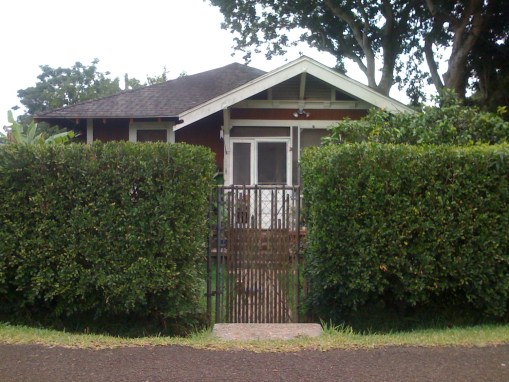
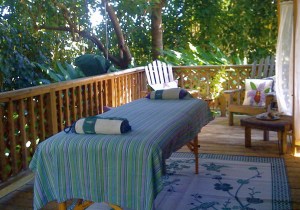
Oelen healing space

ANNOUNCING REIKI FRIDAYS.  Oelen’s new healing space in Kaaawa is open for Reiki sessions every Friday,  from  10 a.m. to 5 p.m.  For an appointment, directions, and rate information, please call 808 220-9642.

Copyright 2009 Rebekah Luke


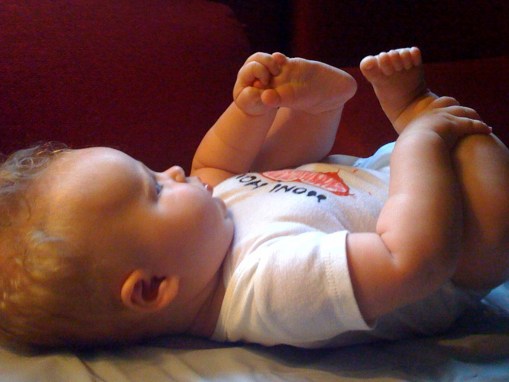
Miss Marvelous discovers her toes

1 09 2009
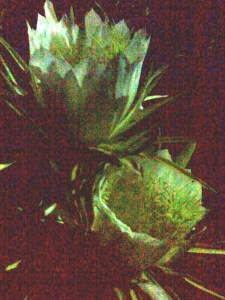
In my garden for one night only, 12 night blooming cereus flowers like these

In my garden for one night only, 12 night blooming cereus flowers like these

I made two paintings with light today. One is of our granddaughter Ayla, and the other of night blooming cereus. Both were taken with my iPhone, hand held with existing light. The only adjustment I made was to the contrast on the cereus, as I shot it just a few moments ago, and it’s dark outside! The real artist, though, and I’m sure you’ll agree, is our Creator. Mahalo e ke Akua. ~ Rebekah

She's marvelous!

She's marvelous!

Copyright 2009 Rebekah Luke

To see my paintings in oil, click on PAINTINGS in the menu bar. RL


Alii Sunday at Kawaiahao

31 08 2009

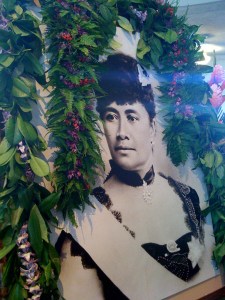
Liliu's portrait

Yesterday was Alii Sunday at Kawaiahao Church in Honolulu, honoring Queen Liliuokalani (b. 1838-d. 1917), sister of King David Kalakaua. She reigned as the last monarch of Hawaii from 1891 to 1893 when she was overthrown. Her birthday is September 2.

Each Alii Sunday, the Hawaiian Royal Societies and other ahahui (Hawaiian clubs) walk in the  processional, and the front pews are reserved for them.

Yesterday I attended as a member of the Koolauloa Hawaiian Civic Club with Kamakea, our vice president. We rode in to Honolulu with her son Kaimana, who is a member of the Royal Order of Kamehameha I.

This post shares the highlights for me. You may wish to go sometime. Visitors are welcome to Sunday worship service. Portions are in the Hawaiian language. Kawaiahao is part of the United Church of Christ.

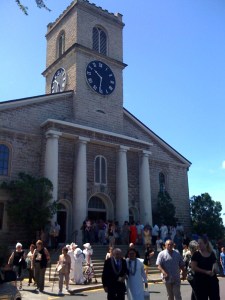
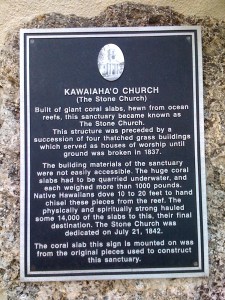
Kawaiahao Church is on the corner of King and Punchbowl streets. A plaque describes its construction

Kawaiahao Church is on the corner of King and Punchbowl streets. A plaque describes its construction.

Kawaiahao plaque

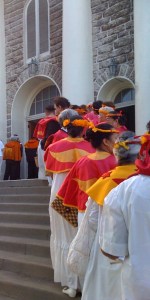
The Hawaiian Royal Societies, or Aha Hipuu, are a special sight. They include:

Royal Order of Kamehameha I who wear red and yellow capes over black suits. The different patterns and lengths of the capes indicate rank.

• Hale O Na Alii O Hawaii, whose members wear white with red and yellow capes. Hale O Na Alii O Hawaii at Kawaiahao

Ahahui Kaahumanu, whose formal attire consists of black muumuus, black hats and deep-yellow lei resembling feathers.

Ahahui Mamakakaua—Daughters and Sons of the Hawaiian Warriors wear black with red, black, and yellow capes (some capes have green).

Other groups who were represented on Alii Sunday were the Daughters of Hawaii in their pure white hats and muumuus (they operate the Queen Emma Summer Palace), the children of Queen Liliuokalani Children’s Center (QLCC is supported by Liliu’s estate, and its beneficiaries are the orphan and destitute children in Hawaii with preference to those of Hawaiian ancestry), and the Association of Hawaiian Civic Clubs that strung crown flowers into 52 strands of lei to drape on the statue of Queen Liliuokalani at the Hawaii State Capitol following the service.

Crown flower was Queen’s favorite. The lavender blossom drapes the left side of her portrait, at the top of this post, and the altar in the next photo.

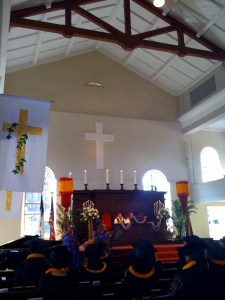
Kawaiahao interior


At left are the Ahahui Kaahumanu ladies in their formal black in the foreground. Aunty Ilima and Aunty Millie in purple muumuu sing Liliuokalani’s compositions, “Tutu” and “Paoakalani.” [See comment below.]

The church service itself was more lively and less formal than the congregational ones I attended in high school, about the last time I went. Admittedly, that was a few decades ago!

Kalowena gave a tribute to Queen Liliuokalani, and in her remarks she wondered, if Liliu’s time and our time coincided, would Google have given her an edge in maintaining Hawaii’s place in the world? Would her compositions be on iTunes, and would she be blogging and twittering?

This Sunday there was frequent applause, lots of “Amens” by the whole congregation, a testimony by a recent member for the sermon, and a hip-hop dance performance of the Black Eyed Peas’s “Where is the Love” by the youth ensemble. Apart from the pipe organist and choir in the back balcony, there was an ohana (family) choir of anyone else who wanted to sing from the front of the church.

Until she became Queen, Liliuokalani led the Kawaiahao Church choir. She composed more than 150 songs. Some were lyrics only, some were melodies without lyrics, and the rest were full arrangements. At Sunday’s service we sang “The Queen’s Prayer.” A fitting recessional was her “Aloha Oe” now famous around the world. I felt so sad.  ~ Rebekah

[See comment at the bottom.]

If you go …

Do view the 20 original portraits in oil painted by Susan S. Hoffstot entitled “Alii of Hawaii — The Hoffstot Collection” that are displayed on the walls of the right and left balconies. These were a gift from the artist and her husband William H. Hoffstot, Jr., “… to the glory of God, the honor of the Hawaiian people and the enrichment of the State of Hawaii” and dedicated on September 2, 1973.

[UPDATE: The portraits were painted by Patric Bauernschmidt, not Susan S. Hoffstot. Please read the comment by Patric’s granddaughter André below.]

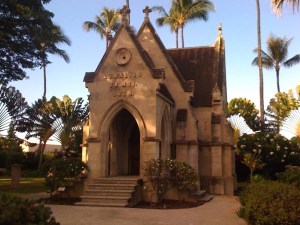
In addition to the church building are other historical structures. One is the tomb of King Lunalilo. Read the plaque explaining why Lunalilo is not buried at the Royal Mausoleum with the other monarchs.

Lunalilo's tomb

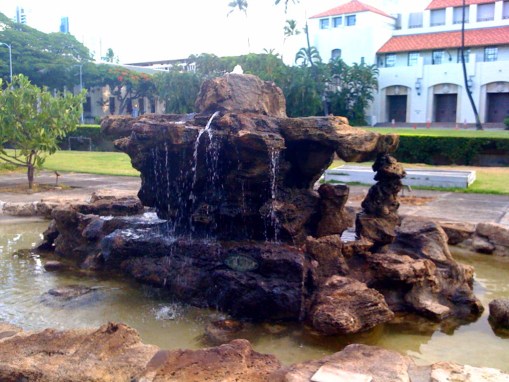
Another is a fountain on the King street side of the church. That’s the Library of Hawaii and Honolulu Hale city hall in the background.

Kawaiahao fountain

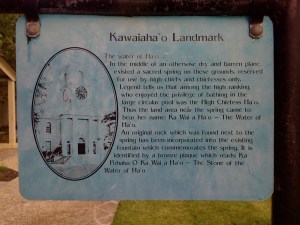
Kawaiahao fountain sign

The motto translates, "The life of the land is perpetuated in righteousness."

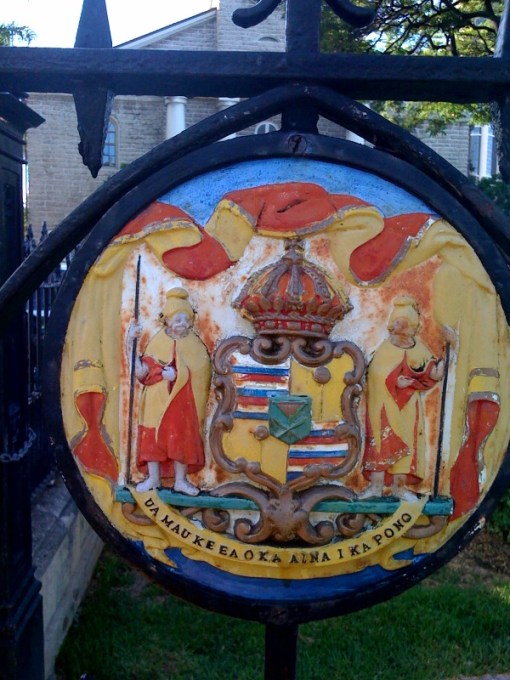
And a third is the seal on the gate to Lunalilo's tomb. "Ua mau ke ea o ka aina i ka pono." This motto became the Hawaii state motto, and it means, "The life of the land is perpetuated in righteousness."

Copyright 2009 Rebekah Luke

Rev. Rebekah Luke has a healing ministry and is ordained by the Universal Life Church. The only two tenets of the ULC are “Freedom of religion” and “Do the right thing.” For more information, click on REIKI HEALING BY OELEN on the menu bar.

Suggested reading:

Liliuokalani. Hawaii’s Story by Hawaii’s Queen. Mutual Publishing, 1991. ISBN 978-0935180855 Paperbound.

Liliuokalani, Her Majesty Queen. The Queen’s Songbook. Honolulu: Hui Hanai, 1999. Edited by Dorothy Kahananui Gillett and Barbara Barnard Smith. ISBN 0-9616738-7-7 Clothbound Edition and ISBN 0-9616738-8-5 Paperbound Edition.


For women only

29 08 2009

A birthday lunch for Georgia was on the calendar this week, girls only, and a day or two prior Nancy, the organizer, called to say she had a ride for me. We hadn’t talked about carpooling and her thoughtfulness was a surprise. Gail would meet me at the appointed time and place in her red RAV4 after she picked up Becky, and we’d go to the Japaneses restaurant together. What a great idea. Okay!

I didn’t know Gail, and I was only acquainted with Becky. Most of our spouses knew each other through sailboating. These women knew the art of socializing. Me, not so much. It was Georgia who decided who would get invitations for her special day. We were a party of seven.

Folks who know me say I’m reserved, which is a nice way of explaining that I don’t seem very friendly to others until they get to know me. I’m naturally that way and always have been. It’s the way I’m wired. So I was appreciative that Gail and Becky in the front seat drew me into the conversation as we rode around the island from Kaneohe to Waimanalo, around Makapuu Point, along Sandy Beach, pass Hanauma Bay to Niu Valley.

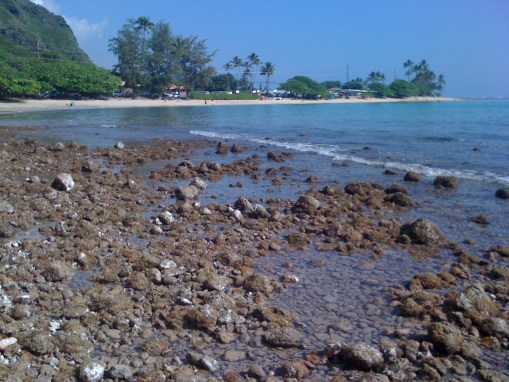
Makapuu Beach

We talked all the way, but it wasn’t gossip, just a real friendly exchange of observations and practical information. How we did stuff, what do you think about this idea, did you know that, and what do you grow in your garden.  It was a delightful ride with scenic views of our beautiful island.

By the time we had finished eating the sushi, tempura, and the Okinawan sweet potato haupia pie, Georgia the birthday gal learned that Gail was a certified pig hunter (traps), that Camille who walks fine had gotten one of those senior accessories with wheels and a seat not for her but for her miniature dachshund (the pooch rides in a custom basket made by the sailmaker), that Candy was an expert at identifying and harvesting wild mushrooms in Idaho, that in exchange for room rent Nancy accepted very snazzy high-end sun glasses, and that Becky would be able to help Rebekah find new homes for darling husband’s bromeliad collection gone astray.

I had an absolutely wonderful time and thoroughly enjoyed this group of ladies—thanks for including me, Georgia!—which brings me to my point: the importance and significance of having a group.

Well, that’s obvious, you might say, that’s part of living. People have families, work-related colleagues, professional or trade associations, civic/hobby/social clubs, school,  sports, church, and most people have at least some friends. But think about it. Do you have a group that is not tied to an obligation or a service to others? Please don’t misunderstand. Purpose and service are high on my list.

I mean, do you have a group that fits you and your passion especially, among whose company you feel comfortable enough to be silly and have fun with as kindred spirits? It’s been found that a key to living life well as we age is regular and continued socialization with others.

Darling husband throughout his entire career, and now in his volunteer work, always spent his lunch hour with the same couple of buddies. My friend Jerry, also retired and who’s always lived life well in my opinion, that’s all she does—socialize! Okay, now that I (we) understand, I’ll go first and tell how I think I socialize. These are fairly tame activities. It’s not all I do, but these are my current standing dates that I enjoy, my faves.

Once a week I paint with a group on location. It’s not a class, most are hobbyists, and there’s no formal critique. We just go religiously to paint together and have Chinese lunch afterward.

•  At least once a day, we take Puppy-chan for a walk, usually on the beach. It’s here that we meet our neighbors and exchange news. The pup checks her peemail.

Beach at Kaaawa

I look forward to the gatherings my friend Cynthia hosts periodically for a group of women who help interpret each other’s dreams a la Alice Anne Parker in Understand Your Dreams (ISBN 0-915811-95-2). We’re all graduates of Alice Anne’s dream workshop. We bring potluck for dinner, and with wine and gold-flecked sake, we enjoy a gourmet experience.

Twice a week, I go to tai chi class. Not a whole lot of time to gab, unless you come early or stay late, but the group energy when doing tai chi creates a bond.

Now it looks like everyday I’ll be going to Rebekah’s Studio. I’m such a slow learner sometimes. My gosh, coming from the old school of writing news and information in the traditional manner of publishing before there were desktop computers to the new way of using the social media on the internet—it took me awhile. It’s not too hard to catch up, I found.  WordPress.com explains that the personal news and commentary a blogger writes will attract readers of like interests, thereby creating little communities in cyberspace—little groups socializing. Voila! I get it.

What is your group? ~ Rebekah

P. S. Okay, how many guys out there read this post? No problem, the bit about socializing to thrive applies to men, too! ~ RL

Copyright 2009 Rebekah Luke


Flowing like water

28 08 2009

I visited the People’s Republic of China twice, once in 1978 with my father on a special cultural tour from Honolulu, and again in 2005 with my Sunset foodie friend on, what else?, a custom eating tour! Like all first-time visitors to China, we were impressed by the modes of transportation, the humongous population, and the bad traffic in the cities.

In 1978 the people traveled by one-speed bicycle, I recall. Valerie of our group arranged to meet relatives of friends outside the Friendship Store where only tourists were allowed to shop, and where the goods were of export quality. They gave her some money, she went inside, and in a few minutes she emerged wheeling a brand new bicycle. The family was overjoyed and so grateful. It was like getting a new car, I guess, or, perhaps greater, getting one’s first car. At that time, even if I knew how to ride a bike, I don’t think I would have, for fear of getting smooshed or yelled at in Chinese in the peloton. Except unlike a peloton, the Chinese didn’t seem quite as orderly, so how would I merge into the traffic in the first place? Let’s just say all those bicycles were awe inspiring.

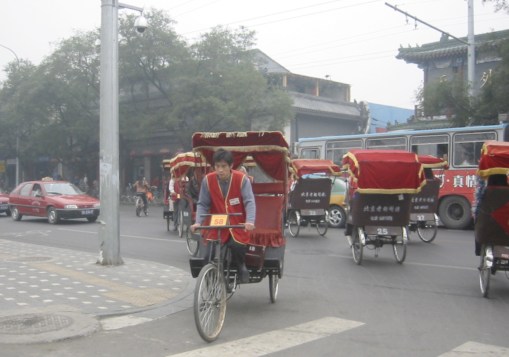
In 2005, things had changed, of course. Capitalism and automobiles had arrived. Not as many bicycles—although still enough for darling husband’s jaw to drop. Like describing the ocean surf, I informed, “You should have been here when”— and where were all the people? Answer: In their cars! We were chauffeured by bus with a good view of the traffic below, and all we could think of was, yikes! so many first-time drivers! Some of our travel mates/side-seat drivers actually closed their eyes. In China, it seemed, there was no regard for lines or arrows on the street. No one really stopped or reduced speed. My heart skipped a beat when the tourist bicycle rickshaw we were in crossed in front of a bus.

China traffic

All types of transportation are mixed up together: cars, trucks, bicycles, taxis, carts, motorbikes, three-wheel minis, rickshaws, pedestrians, you-name-it. The amazing thing is, we never witnessed a crack-up. Traffic there is like water. It just flows. How do they do it?

A better question is, why? I think it has to do with the practice of qigong. Masters of the art taught just a few others in ancient China, passing it down from generation to generation, but back then qigong was somewhat of a mystery.  Since the mid 1950s qigong and tai chi forms have been practiced widely by the Chinese. The Communist government endorsed it for health and healing. In 1978 I watched young and old alike in parks of the places we visited as they engaged in the slow moves of this exercise. Their hands, arms, legs, feet, and entire bodies moved gracefully and at a steady tempo, one movement flowing into the next as they replenished stale energy with fresh energy.

I started practicing tai chi and qigong (“chi” or “qi” are the same words meaning life force energy) with the WCC Tai Chi Class only a few years ago. It’s the same energy as the “ki” in Reiki that I do for others and myself. My understanding expanded when I read about qigong in a book my cousin gifted me. There is a way to heal, harmonize, and balance one’s mind, body, spirit, and emotions. There is a way to remove blockages and have your energy flow like water for your highest good. The technique is available to anyone. Anyone can learn to do it, provided they have an open mind and are willing to receive. As a Reiki Master and practitioner, I can show you how. ~ Rebekah

Copyright 2009 Rebekah Luke

For more on Reiki, click on Reiki Healing by Oelen on the menu bar. From now through November, we are open for Reiki Fridays.

Suggested reading: Orr, Katherine. Beautiful Heart, Beautiful Spirit Shing-Ling-Mei Wudang Qigong. Kaneohe: DragonGate Publishing, 2005. ISBN 978-0-9765178-0-1


I wasn’t always a painter

26 08 2009

First I threw up. Every week on the way home from class. I had to stop the car. Was it the paint thinner, not eating properly, or my nerves? Who knows?

I was enrolled in the Gloria Foss Color Course and was taking one vacation day per week from my university relations job because the class ran from 9 to 3 at Vicky Kula’s. Since coming home homesick from the rigorous Art Center College of Design photography program the second time I went to college (the first time was for journalism and music at UH), I vowed to keep my eye trained with continuing studio courses.

For starters, I picked Gloria’s. Gloria and I were both members of the National League of American Pen Women, Honolulu Branch. When I first met her, I was about 25 and working as a reporter. Her hair was already silver, and she was studying for her Master in Fine Arts degree so she could teach. She said she studied with a lot of art teachers and that if they had taught certain basic things in the beginning, it would have been a lot easier. So she designed her own course. I remembered  that.

These were lessons in oil painting. Enrolling was a commitment. A luxury. Something I’d wished for. In elementary school and high school, back in the day, a choice had to be made between art and music. I always picked music. My mother was a piano teacher and my father was a truck driver. Art lessons weren’t cheap, and neither were art supplies.

Vicky Kula taught the basics in the studio, like values (the shades of gray from light to dark), how to turn the form based on the logic of light (light, middle tone, dark, reflective light) starting with the ball, cube, cylinder and cone while slowly introducing color. After awhile all of it will come together, she promised. Then Gloria took students into the landscape. Her mantra was: “Warm it in the light. Cool it in the shade.” I learned about “Tomato Theory” and “Umbrella Theory” and how to apply the “Grapes and Drapes” lesson in the studio to painting the forest and the Koolau Mountains.

One day Gloria announced she was cutting us loose. Peggy Chun in her crazy fearless way organized an exhibit and opening reception for us classmates at The Croissanterie on Merchant Street. And that was the first time I put it all out there.

Then came showing on the Honolulu Zoo Fence, and invitations from galleries to exhibit. Encouraged by customers liking my work enough to buy it, I kept at it. It’s the process of making art that’s important. You do have to keep at it, and every once in a while something wonderful happens. The trick is to remember the feeling to be able to do it again.

One morning I went over to Kaaawa Valley to paint Puu Ohulehule, a mountain so sacred that Hawaiians in ancient times did not say her name out loud. I did everything I was taught: “Paint what you see; paint what you know; paint what you feel.” After the last stroke, I was sure it was the last, I put my brush down and looked at my watch. It was only 8:15 a.m.

And I wasn’t throwing up any more.

Optical illusion painting

Copyright 2009 Rebekah Luke

I’m fond of painting scenes of Kaaawa. To see more, click on PAINTINGS in the menu bar.

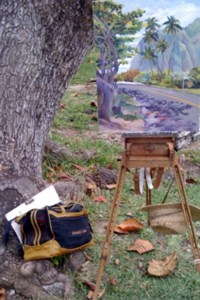
This photo juxtaposes the canvas “Kamehameha Highway and Kaaawa Place” on my easel with the actual landscape.

~ Rebekah

Thanks to my teachers Gloria and Vicky, to Peggy, and to my “Easel.”


Milestones to celebrate

25 08 2009

I turned 60 this year and must say I like it up here! Today darling husband and I complete 25 years of marital success. We welcomed our first grandchild, a girl, in May. What fascination! My puppy dog whose job is to give everyone joy turned 6 and technically she’s not a puppy anymore, so it’s probably okay that she’s upstaged by the baby. The raised garden beds were put in at last and yielded wholesome food. The eggplant, Manoa lettuce, and bok choy did great. A section of our home was dedicated and transformed into a wonderful healing space. We had a proper Hawaiian blessing for the entire property, and I resumed my Reiki practice. Equally satisfying has been my return to painting. When I remember to be mindful of the present, keep my intentions correct, and relax, I am shown that life is abundant and all is well.

Thanks to Alice Brown, Pete & Ayla