A few small traditions

23 12 2010

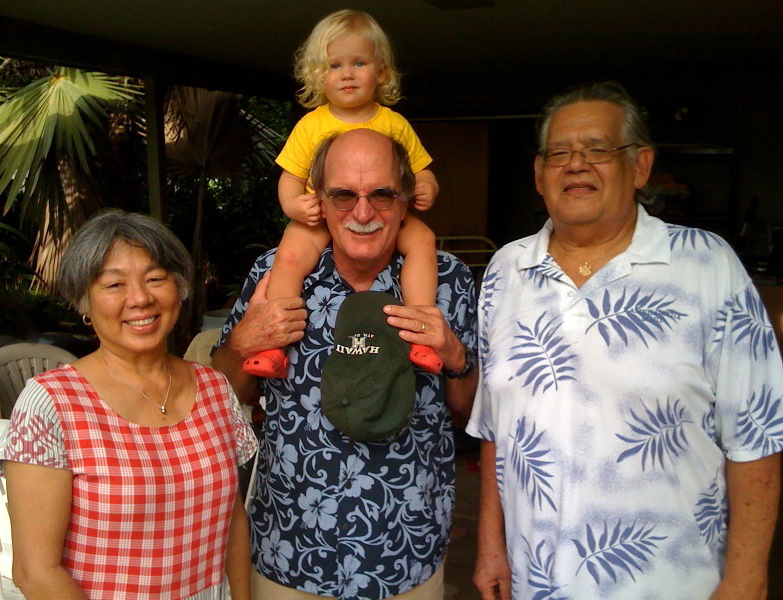
Miss Marvelous was at the studio yesterday. She discovered the “new” toy box with her grandfather’s name in big letters on the top. The one with toys her mom used to play with.

She had fun drinking “tea” out of the small plastic yellow cups and saucers she found, requesting many refills. She was able to fix my erratic laptop with a wave of her hand (which button did she press?!…for next time ;-)).

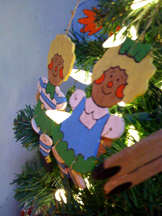
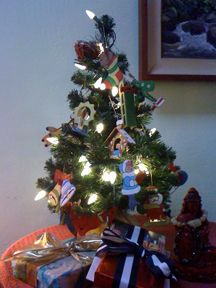
And she helped decorate our Christmas tree! The wooden ornaments were hand painted in 1977 by her great grandparents Walt and Dorothy of Pennsylvania. Merry Christmas!

Copyright 2010 Rebekah Luke


Season’s greetings from Rebekah

21 12 2010

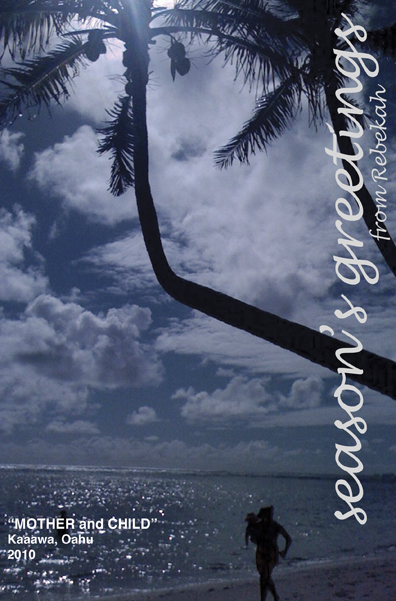
The moment I made this photo of Miss Marvelous and her mom, I knew I had our Hawaiian greeting card for this year.

Everyone at Rebekah’s Studio—DH (Darling Husband), Alice Brown, Ula and I—wish you a Happy Winter Solstice!

I hope you don’t mind a re-post from 9-11-2009 that tells how we celebrate:

“With the winter holiday season upon us, most families are starting to get into the spirit. The signs include that real or imagined cold snap on Halloween night, slick merchandising catalogs overflowing from our mailboxes, store mark downs everywhere, and the lure of local craft fairs and festive events.

“Conversations now include, “What are you doing for (fill in the holiday)?” and newspaper features carry tips on how to remain stress free. We want to remember family and friends and hope no one is left alone. As families extend generationally, geographically, and by marriage, there can be many decisions to make.

“DH and I have a couple of philosophic ideas and old-fashioned traditions that give us a sense of peace. They link to our respective roots—Hawaiian Islands for me and Pennsylvania (Delaware County) for him.

“One is to acknowledge and be mindful of the Hawaiian Makahiki season, roughly from mid-November through January (exact dates depend on the moon). The planting season is over, work is pau (finished), and warring ceases. It is the time of the god Lono.

“The best of the harvest is dedicated to Lono in the form of ho‘okupu (offerings). The people give thanks, relax, socialize, play outdoor games, and generally enjoy themselves. No stress. It’s officially okay to play!

“The other is adopted from Winterthur, Delaware, not far from DH’s birthplace. As tourists we visited Winterthur, a museum and the former country estate of Henry Francis du Pont. During his life H. F. du Pont collected whole room interiors of various periods, not to mention whole street fronts, and installed them in his mansion.

“The museum decorates the rooms of this big house for Yuletide, and visitors can tour them around the same months of Makahiki in Hawaii. The holiday decor matches the period style of each different room. It’s educational and very festive.

“When we visited, our favorite room showed how du Pont’s own family celebrated in the first half of the 20th century. The story was told that Yuletide, the time around the Winter solstice, was a time to visit and entertain friends, to rest and to celebrate a successful harvest. Children were seen but not heard.

“Decorations consisted of a small table-top evergreen—adorned simply with cookies, candles and strands of popcorn and cranberries—that was set atop a pie crust table. Gifts were exchanged among immediate family members only and placed in a basket for each person. If the children behaved well, they could have the cookies!

“We liked the idea so well that we brought home a furniture piece similar to a pie crust table for ourselves, in a nod to the East Coast style and DH’s regional heritage. Each year we hang on a small tree the wooden ornaments crafted by DH’s parents for their first granddaughter on her first Christmas.”

Copyright 2010 Rebekah Luke


Special Chinese food: joong

14 12 2010

Nani showed me how to make joong at her house today. Last month I was with her when she bought a whole bunch of eggs in flats. She said they were to make hahm dahn, or salted eggs, for joong. I began salivating.

“You know how to make joong?!” I asked. Coincidentally, my cousin Tim had just issued a joong cook-off challenge to his cousins via Facebook, but most had no idea what he was talking about!

Nani said she has made joong every year for 60 years starting from the time her mother taught her. At choir practice last week I asked how the hahm dahn were coming along, hinting that I wanted to see the production.

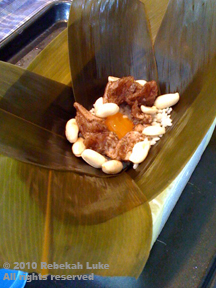
Joong is a Chinese festival food—a pouch of soft, sticky, sweet rice hiding savory morsels pork, peanuts, and a salted egg yolk. At least the way Nani makes them.

I recall my mother treating joong as special food. Nani said Chinese people eat joong for Boat Day in the spring although she makes it more often, and that joong represented an anchor—something heavy that stuck to the bottom of your stomach. Could be, I thought, but joong is also delicious.

Today Nani and her three sisters Corinne, Barbara, and Rae and her cousin Eva were already gathered around the modern kitchen island when I arrived. Each had her own set up. Each had started soaking chicken eggs in brine 30 days ago. What they made today they took home to boil for 6 hours. After cooling in the cooking water overnight they will be ready to eat or freeze for later enjoyment.

As with most Chinese recipes, much goes into preparation before cooking. Last night Nani softened the bamboo leaves that she bought in Chinatown by heating them in boiling water. She soaked the peanuts and the glutinous rice. She marinated cubes of belly pork with Hawaiian salt and Chinese five spices. Just prior to assembling the joong, she cracked the salted eggs into a bowl.

There are similar rice pouch type foods – of Chinese and other ethnic origins – of other shapes, using other kinds of outer leaves, using other fillings, but according to my joong mentor, those are not joong.

I can hardly wait to taste our efforts. Thank you, Nani, for sharing your family joong-making day with me!

This metal form makes it easy to assemble the joong. You build an upside-down pyramid starting with 3 bamboo leaves inserted a certain way.

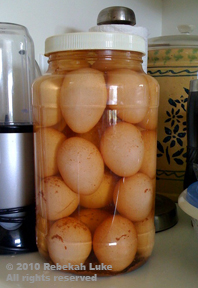
The process starts with soaking eggs in brine at least 30 days in advance. These are chicken eggs. You may also use duck eggs that would be more of a delicacy. These eggs are tan because Nani added tea to the solution. (Aha! Chef’s secret?!)

Once the bamboo leaves are in place, top sides touching the food, add a serving spoon of rice, the hahm dahn yolk (discard the whites), two pieces of marinated pork, and a few peanuts. Top with two serving spoons of the rice to cover the filling you see here. Then fold both long sides of the leaves over as if gift wrapping a box, followed by the short sides. Secure with string.

More finished bundles will go into this pot. Add water to cover and set to boil and simmer for 6 hours.

P.S. Nani said the following book most closely describes their family’s way to make joong. In it, the recipe is entitled “Savory Jeng.”

Every Grain of Rice by Ellen Blonder and Annabel Low. Clarkson N. Potter Inc./Random House, 1998. ISBN 0-609-60102-4

Copyright 2010 Rebekah Luke


The power of envisioning—for better or worse

12 12 2010

Ti, lauae, and red ginger

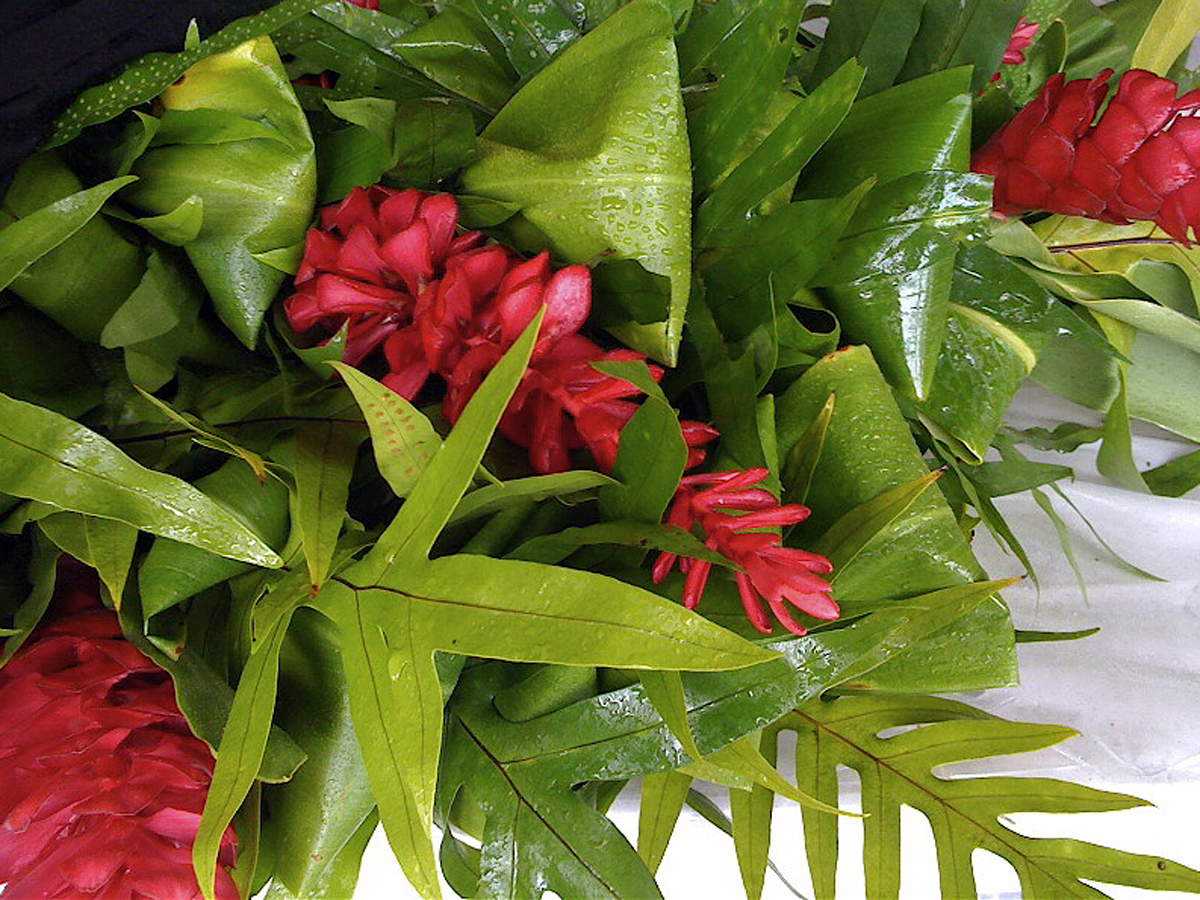
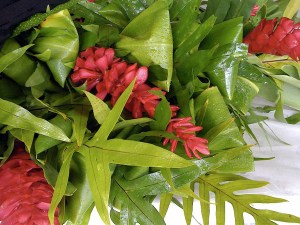
The rain pounded our island on Thursday, giving the tropical foliage in everyone’s gardens a nice boost of freshness for the “Lei Garland for the Holidays” craft workshop I gave at Kaneohe Yacht Club on Saturday.

Twenty-five people came, each with a bucket of rain-washed ti leaves and lauae ferns, their own tools, and an expectation to create a pretty decoration to take home. I put together the purchased supplies, some extra plant material, red ginger flowers for everyone, and take-home instructions.

Last July, several club members expressed their interest in learning how to make lei as they observed a crew make 12-foot lengths of the garland to welcome the arriving boats in the bi-annual Pacific Cup race.

So I envisioned showing members and their guests how to adapt the Hawaiian wili style of  lei-making to holiday wreaths, table decorations, and botanical gifts.

The longhouse smelled so fragrant, and after some background, a demo, and a few questions, people became quiet and engrossed in their work. It was satisfying to pass on the how-tos. The finished pieces were lovely and sparked “oohs” and “ahs” from the group.

Everyone had fun. No one was disappointed. And they left thanking me for the instruction and guidance and asking for more.

I’m tickled the workshop was such a success. It happened just as I envisioned it in the first place. No, better than I envisioned it. The yacht club sponsored and supported this activity, especially because it brought its members together. Thanks to Ken, Jean, Vel and staff; to Georgia and Kim who drafted me for the boat lei committee in the beginning so I learned how to do it; and to DH who has always been my easel.

I believe, though, that the outcome was a result of my envisioning it in the first place. What we visualize and direct our attention and energy toward manifests!

ON THE SAME THEME … A big, controversial project in our rural Koolauloa community is occurring because its proponents are envisioning it. In fact, the project title is “Envision Laie.”

Laie is one of several-plus smallish coastal villages and towns in the moku (district) of Koolauloa. The Polynesian Cultural Center—a theme park type of visitor attraction, the Church of Jesus Christ of Latter Day Saints, and Brigham Young University-Hawaii make up the economy and the socio/cultural environment of Laie.

Last week a public meeting was held by the City and County of Honolulu for the community to comment on the “Koolau Loa Sustainable Communities Plan Five-Year Review” draft document. The current version includes an amendment that would permit major development in Laie that would spill into neighboring Malaekahana, an area that has been natural green space.

Brand new roads inland, new homes, new student and faculty housing for a larger college enrollment, rezoning ag land for commercial use—a whole new town to accommodate population growth and make it possible for families to continue to live in Laie rather than move away.

While the residents of Laie may envision resurrecting an island ahupuaa (land division from the mountains to the sea) that is self-sufficient as in times of old, the fact is, modern commerce occurs across ahupuaa along the seashore, along the busy two-lane Kamehameha Highway, the only road that connects one community to the next.

In the Hawaiian Islands, communities preserve sense of place and indigenous culture by incorporating Hawaiian traditional knowledge and time-honored Hawaiian values. Is this type of land development the wisest use of the remaining natural resources that now define the area?

The hundreds of people who attended the public meeting dressed alike in blue shirts, contrasted to the few dozen community members who were not in blue, indicated the degree of organizational sophistication behind Envision Laie.

People who oppose the development worry that City officials will be persuaded by numbers alone, that the blue shirts represent all of Koolauloa, when they likely do not. Will they consider the fact that Envision Laie’s vision is not everyone’s vision?

The public may address comments on the plan to the planning consultants of the (Honolulu) City Department of Planning and Permitting until January 15, 2011.

My wish is that we envision peace for our Islands and our planet. And that we listen to the aina, the land.

Copyright 2010 Rebekah Luke


It’s rock-star snowing on Lanikai Beach

1 12 2010

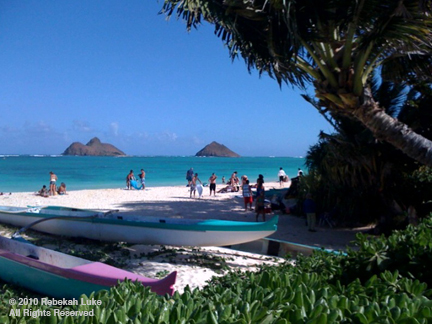
I do believe it’s snowing here at Rebekah’s Studio! Just look at the snowflakes falling! And right after I posted this photo on my Facebook page with the caption “Thanksgiving weekend & no snow!” 🙂

Lanikai Beach - Thanksgiving weekend & no snow!

I’ve been staycationing with family all weekend down the coast of Oahu at my hanai brother’s and sister-in-law’s fancy beach house. I spent a few hours there on Tuesday and will likely go again tomorrow. I’m making a painting that’s a variation of this classic Hawaiian beach scene and the Mokulua (two islands). DH suggested I do some rock-star paintings. Is this rock-star enough for you?

And, thank you WordPress.com for a rock-star visual effect!

Copyright 2010 Rebekah Luke


Thanksgiving 2010

25 11 2010

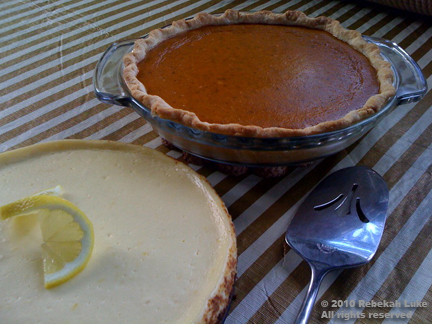
Warm and sweet Thanksgiving Day wishes to all. Tonight's feast ends with lemon cheesecake and traditional pumpkin pie. Yup, I baked 'em!


Mauna ‘Ala, burial place of the ali‘i

18 11 2010

Miss Marvelous with her Papa entering the Kalakaua crypt

If they arrange ahead, Honolulu visitors to Mauna Ala, site of the Royal Mausoleum in Nuuanu, can have a guided tour by its curator William John Kaiheekai Maioho, the kahu of the iwi (bones) of the alii (royalty) and high chiefs—namely the Kamehamehas and the Kalakauas.

I and Miss Marvelous tagged along recently with DH and a group of volunteer docents from the Bishop Museum. Bill Maioho’s presentation—full of details and anecdotes, talk story style—included a chronology of the Hawaiian royals and others who are buried at Mauna Ala, information about the chapel building and how its use changed over the years, and a look inside the gates of the Kalakaua crypt.

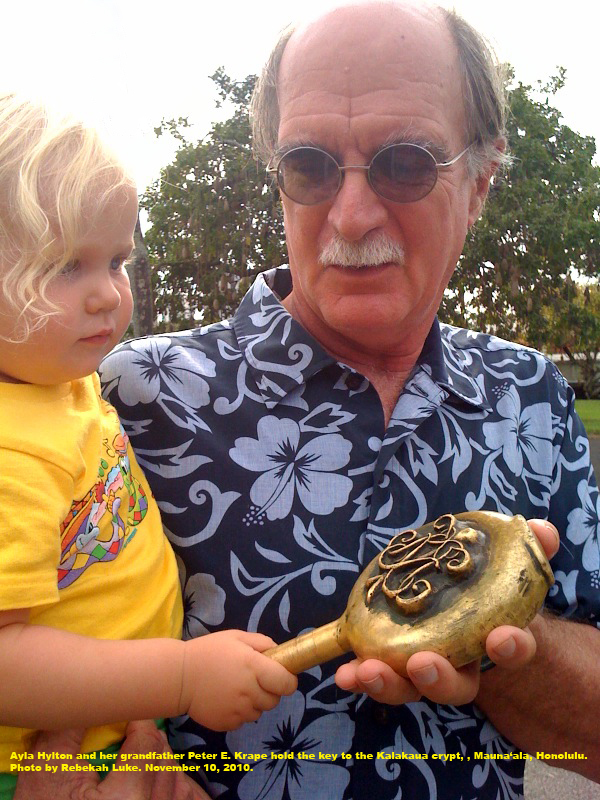
Holding the key to the Kalakaua crypt

Bill Maioho descends from the Taylor family whose kuleana (responsibility and privilege) is to care for the iwi at Mauna Ala. You can find his story as an oral history article in Pacific Worlds, an excellent website with information about Polynesia. Please click on the link.

Mahalo to Uncle Bill.

Remembering Charles Reed Bishop

Me, Miss Marvelous, DH, and Bill Maioho

Copyright 2010 Rebekah Luke