All pau & ready for market

8 06 2011

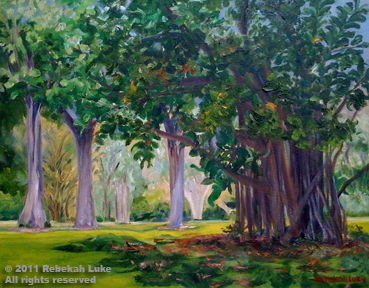
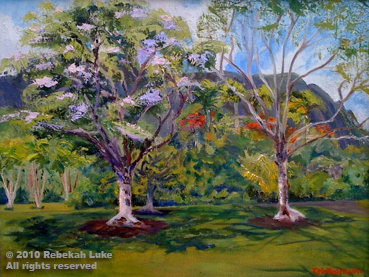
Pau means finished. I finished two more of my landscape paintings. More trees. Patrons tell me they like the way I paint them. “Banyan Shade” needs a final varnishing as soon as it’s bone dry. “Welcome Spring” is framed, wired, and ready to leave the studio.

Banyan Shade, 16" x 20" Oil on Canvas

Welcome Spring, 14" x 18" Oil on Canvas

Please click on the PAINTINGS menu tab for other available art work. Thanks for visiting!

Copyright 2011 Rebekah Luke


Contributions by artists

8 06 2011

Much of what I learned about the business of art I learned from my time with the Arts of Paradise, a fine art gallery at the International Market Place in Waikiki, that kindly represented me for several years.

Artists Susan Rogers-Aregger, Susan Brooks, and Connie Hennings-Chilton were the co-owners who sought two- and three-dimensional work by local artists and priced them realistically for the buying public. I thank them so very much.

When I co-founded Hale Kuai Cooperative with Ka Lahui Hawaii and we opened a storefront, I applied many of the management skills they taught me to running our store that sold Native-Hawaiian-made products.

During the early Arts of Paradise days, we had frequent requests to donate our work. The gallery encouraged artists to share the explanation reprinted below with whoever asked for a donation.

While cleaning the studio today, I found it on Arts of Paradise letterhead, but I recall that it was originally shared by the artist Ramsay. The information makes sense to me, and it is useful even today.

CONTRIBUTIONS BY ARTISTS

The artist is often asked to donate art to worthy causes as a “tax-deductible contribution,” as a “form of advertising,” as a “goodwill gesture,” and as “the means to increased community exposure.”

However, many artists and most solicitors are unaware that the IRS views contributions made by artists differently than those made by any other contributor. Artists are not able to deduct the appraised or fair market value of their work. Artists must enter the cost of materials as a business expense rather than a charitable contribution.

At a benefit art sale or auction, payment for contributed merchandise is made in the name of the charity. The purchaser makes a tax-deductible contribution and receives a work of art; the organization gains needed operating funds; the artist has one less asset, an added business expense, no charitable deduction, no income from the sale, a devalued reputation because the work sold at less than market value and has “increased exposure” to a  group of  potential patrons now conditioned to acquire art through donation rather than direct purchase.

This situation is particularly difficult for artists living in an insular community like Hawaii, where patrons are few and the cost of living is high.

Organizations who wish continued support from artists should adopt the following guidelines:

Artists submitting work to charitable organizations should provide the suggested retail price and receive fifty percent of that price upon sale; unsold work should be returned to the artist.

The names of contributing artists should be listed in promotional material and printed programs.

Artists should receive thank-you letters with their checks specifying the amount of their contribution, the actual amount of the art brought at auction, and the name of the purchaser.

This arrangement will enable artists to provide work of importance to organizations and the community, while uplifting the image of art in Hawaii.

Copyright 2011 Rebekah Luke


Pomp and circumstance

5 06 2011

Happy day

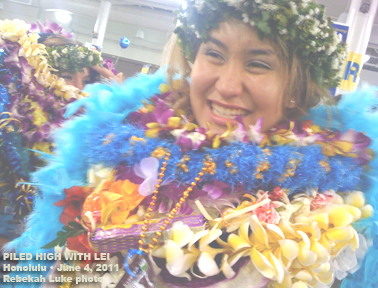
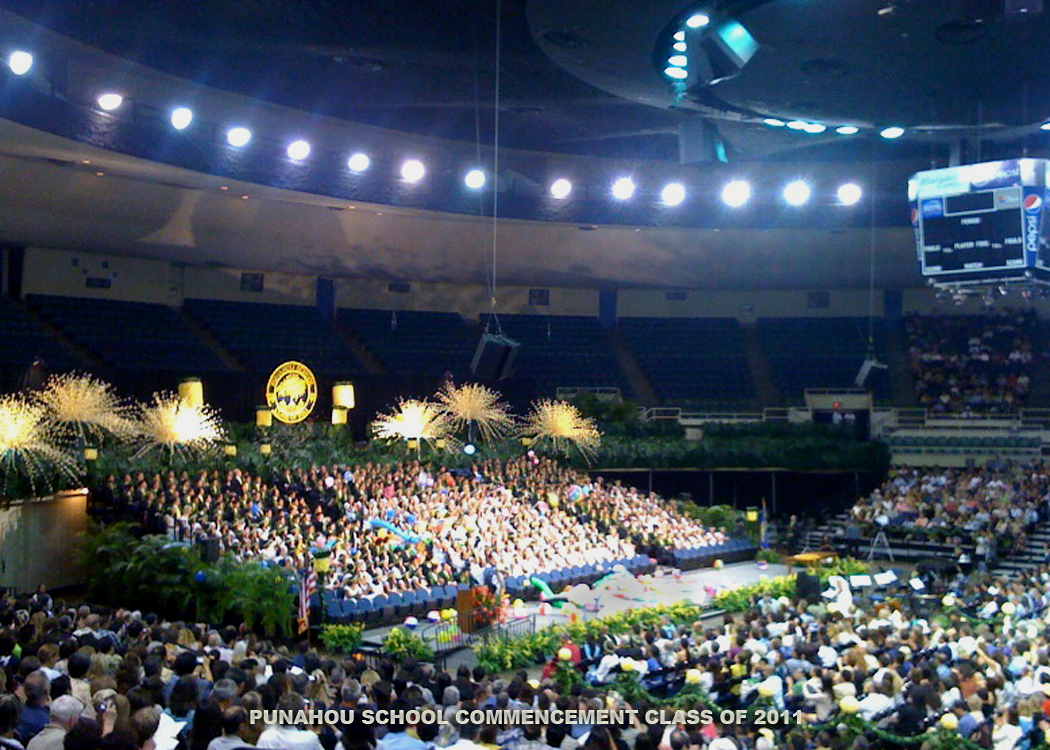
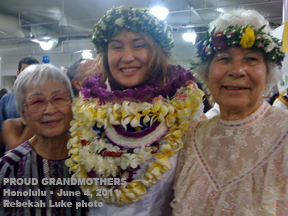
These are my photos from last night’s commencement exercises for the Punahou School Class of 2011. DH and I felt honored to watch our niece graduate among more than 400 other seniors.

This is Anna with her parents and brother, and with grandmothers from both sides of the family. It was her big night.

After the ceremony there was a human gridlock in the hall where we were to meet our graduate.

But we found her, clasping a “with honors” diploma proving that she really did it after 13 years!

P.S. Anna, look what I found on YouTube!

http://www.youtube.com/watch?v=RdTw8Alasjw

Copyright 2011 Rebekah Luke


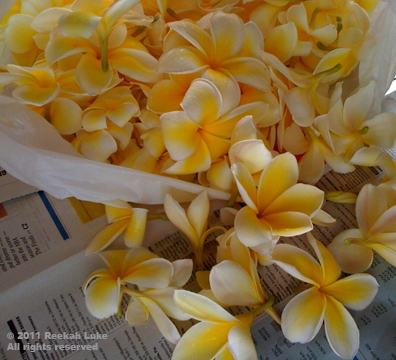
Yellow plumeria: so traditionally Punahou

4 06 2011

Ready for stringing

Last night’s heavy thunder storm left enough yellow plumeria on the tree outside the studio for tonight’s Punahou School commencement. I just finished picking the flowers in between the rain showers. Next I’ll be stringing the longest lei possible for my family’s deserving graduate Anna. Congratulations to the Class of 2011! And congratulations to all their parents, too!

Copyright 2011 Rebekah Luke


Oh my goodness, look at Lanikai beach

31 05 2011

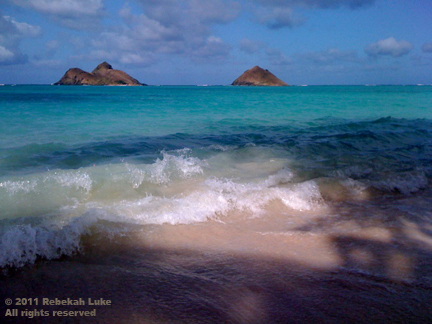
Classic Lanikai view

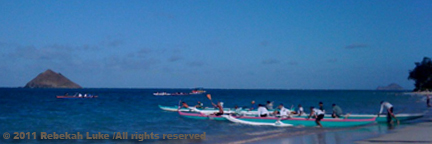
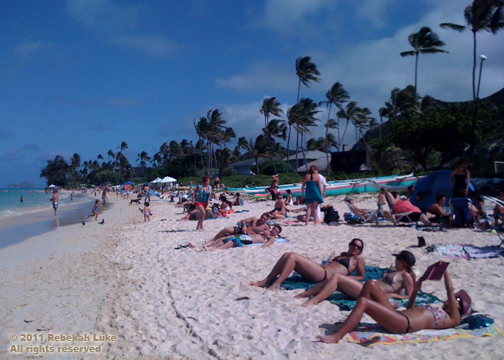
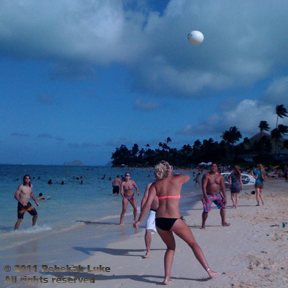
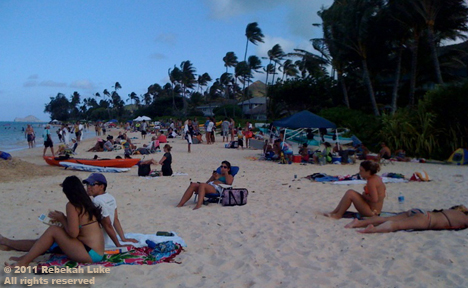
Aloha! This weekend our family spent some time at a beach house in Lanikai, Oahu. The idea of going there to relax this 3-day Memorial Day holiday was not an original one, as you can see. Never in my life have I seen this beach as crowded. On a normal day it is pretty secluded, tucked away around the corner from Kailua town, with outrigger canoes going out for practice in the early morning and late afternoon, a handful of sunbathers, and maybe a wedding shoot. But not yesterday. Take a look at all the activity!

Afternoon paddlers

Memorial Day 2011 at Lanikai

Escaping for some solitude on the sea

Beach sentinels

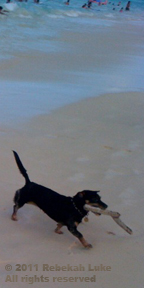
Please throw it again

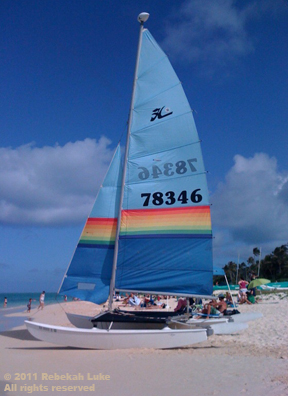
Colorful Hobie

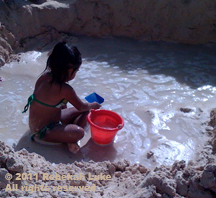
One of several "bathtubs"

One of several rafts

Para-something

Volleyball

Looks like Waikiki beach

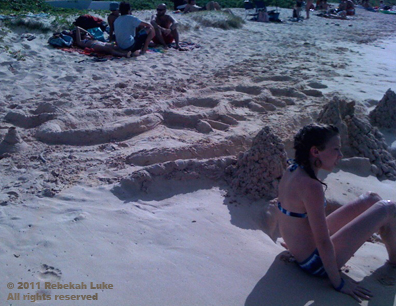
Sand caterpillar

Copyright 2011 Rebekah Luke


MAMo tee designs by Erin Malie

23 05 2011

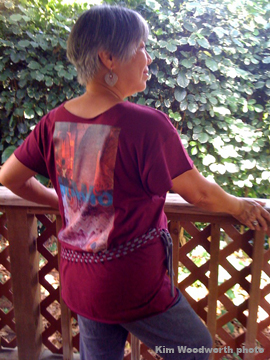
I love my new top, cut and embellished by Erin Malie! She and her mom Charlotte had a busy booth at yesterday’s Native Hawaiian arts market at the Bishop Museum. Erin Malie redesigns crew neck T-shirts with a pair of scissors, weaving, and tying. I promised in my last post about the Maoli Arts Month event to show photos of my purchase.

Sleeve and bottom hems and original crew neck binding removed while printed design is left intact

V neck and diagonal placement of the basket weave feature make this more flattering than the original crew neck T

Each garment is custom made for her customer. I admired her designs at last year’s market but didn’t get one: peek-a-boo backs and sides, off-the-shoulder looks, lattice fronts, spaghetti straps, tank tops, sexy, youthful, or demure.

“Thank you” to DH for urging me to order one this time. First I bought the shirt, that turned out to be the last one available in the color and size I wanted. Lucky me!

There was a photo sample book, but the designer’s approach with me was to ask what kind of clothes I liked to wear. I also explained what kind of clothes I didn’t want to wear. Mine was the first V neck and slanted torso she made.

I asked DH and Kim to make some photos so I could show you, and I picked these two. Thank you for the fun photo shoot. Erin Malie, thank you, I love my top and I wish you every success!

Copyright 2011 Rebekah Luke


Native artists at the Bishop Museum

22 05 2011

The enjoyment for today consisted of going to the Bishop Museum to show my oil paintings alongside other Native Hawaiian artists at the art mart that is part of the MAMo (Maoli Arts Month) Festival in Hawaii. It happens every May.

The Museum booked DH, who is a volunteer docent, to guide a group from a philosopher’s conference on a 1-1/2 hour tour of Hawaiian Hall, making it doubly worthwhile for the two of us.

Ten minutes before show time, we arrived to find our spot next to my artist friend Momi Greene who came from Hawaii island with her decorated ipu (native gourd containers).
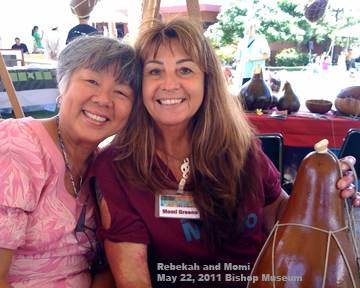
Me and my friend Momi Greene. Momi grows a native Hawaiian gourd and decorates them with carving and natural dyes she makes herself in the style that was done traditionally on the island of Niihau.

Years of art fence and craft fair experience paid off as we arrived ten minutes before show time, i.e. late. I saw some dark clouds as we drove over the mountain, and yes, we set up in the rain.

The paintings were fine; oil doesn’t like water. I just shake and blot them dry. DH staked the easels into the ground, and I attached extra ties, a good thing because gusty trade winds blew down from the valley throughout the day.

My brother-in-law Jon, in town from Oregon, came by to meet Momi in person because until today they had only been Facebook friends.
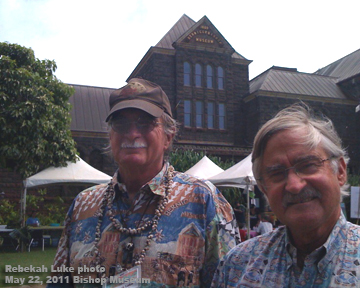
DH and Jon with the Bishop Museum's main building in the background

I loved the continuous live Hawaiian entertainment all day long.
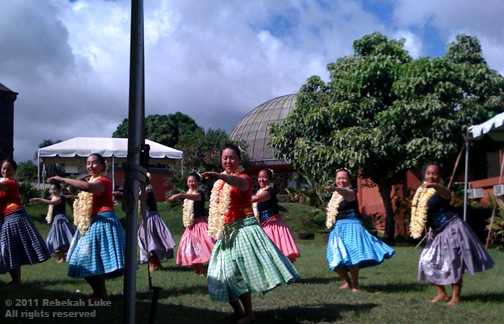
Hula dancers wear long yellow plumeria lei

DH and I made some purchases:

I bought—with cash from trading my no-longer-wanted gold and silver items—some things from other artists, including a nifty re-designed T-shirt. I always try to buy from other artists where I am selling. The designer, using scissors, cuts away parts of the original garment, slits holes in the knit, weaves in contrasting colors or ties the fabric in creative ways to make a one-of-a-kind top that is truly styling and all the rage at the Native Hawaiian art mart. I plan to post a photo of me modeling it soon!

Yesterday in a gust of wind one of Momi’s ipu broke. It looked like it could be glued, but she said she’ll stitch it back together, making the stitching part of the design and giving the ipu new life and a story. When I relayed that to DH, he immediately told Momi of our plans to take a trip to her island and that he wanted to buy the ipu after she stitched it. That piece would be really special and would she kapu (reserve) it for him, we’d pick it up next month.

She said, “Okay, do you want to see it first?” DH can be impulsive at times, but he’s a good buyer and appreciates fine Native Hawaiian-made artwork.

What I realized and appreciated the most at the end of the day was how much the art by Native Hawaiians has improved, including the marketing of it. If you are in Honolulu next May, please plan on attending some of the activities of Maoli Arts Month.

Copyright 2011 Rebekah Luke