Is painting on your bucket list?

4 01 2012

Painting is on my friends’ bucket lists. They’ve inspired me to teach some fundamentals and techniques and offer a course. As promised, I will open my Kaaawa studio for Oil Painting Lessons starting February 2012. Registration is open now and enrollment is limited.

The “Painting I” course consists of 12 weekly lessons on Wednesday from February 1 to April 25. Class sessions will be from 10 a.m. to 3 p.m. and include a lunch break. Tuition is $100 a month. Cost of materials is additional.

I just noticed it’s leap year, so you’ll either get a bonus or won’t have to feel bad if you miss one class.

Students will learn impressionistic painting in oil. Lessons will generally follow those taught by the late colorist Gloria Foss, my oil painting teacher, and as found in Foss’s guidebook How to Paint. I’ll add my own experience as a fine art painter and photographer to show you what to do.

I’ll teach you art fundamentals and the logic of light to give you a solid foundation to pursue painting as an avocation or a vocation.

What you’ll learn

Here’s just some of what you’ll learn in my Painting I:

• Basic drawing — perspective, shape, value, light and shadow
• The world in black and white
• Basic color theory—monochromatic, analogous, complementary color and full palette
• Using color charts and the color wheel
• Modeling of forms

Each lesson will consist of a brief lecture on art theory, a demonstration, hands-on still life drawing and painting in the studio, homework, and critique.

Each week we will build on the previous technique learned, and eventually we will apply what we have learned in the studio to the landscape.

Gloria Foss and me

I first met Gloria Foss at the Honolulu Branch of the National League of American Pen Women where she was an Arts member and I was a new Letters member. She was a UH Mānoa student getting her Master of Fine Arts degree. She wanted to teach. She said if all of her art teachers had explained some things from the very start, it would have been a lot easier. She was about 60. Teaching was on Gloria’s bucket list!

After I finished the black-and-white photography curricula at Art Center College of Design in Pasadena (I didn’t complete color photography), I sought a studio class to keep my eyes trained. By then Gloria had designed her own “Gloria Foss Color Course” and opened the Foss School of Fine Arts in Honolulu.

Then I had the honor and delight of making the photographs of the studio lessons in her book How to Paint. It’s now my desire to share what I learned, then and since, with others.

Tuition, materials and supplies

Your investment will be the cost of tuition—$100 a month for each of three months for a total of $300—plus the cost of materials and supplies. When you register, you will receive a complete list of art materials to buy.

For the first two or three lessons, you will not need everything on the list. All items on the list will cost an estimate of $125-$150.

Easels will be provided for class use.

An optional text is How to Paint by Gloria Foss (New York: Watson-Guptill Publications, 1991) that will be used for reference. It is out of print, but you can try to locate a used copy. Information on how to obtain a CD of the book will be given in class.

How to register

To reserve your place in class, send your correct name, mailing address with ZIP, phone number, and email address with a minimum $40 deposit to Rebekah Luke, P.O. Box 574, Kaaawa, HI 96730. Or, include the information in an email message to rebekahluke@hawaii.rr.com and send your deposit via PayPal with the DONATE button in the right sidebar. After your deposit is accepted I will send you a supplies list and information on where to go in Kaaawa for the first class. Happy painting!

PAINTING I February 1-April 25, 2012
Copyright 2012 Rebekah Luke


Happy new year! What’s on your plate for 2012?

1 01 2012

♥ LOVE, Love, love! ♥ We made it! A happy and loving new year to all. Muah! It’s gonna be a good one!

What’s new on your plate for 2012? Here’s what’s on mine: 1 lotus petal, 2 reunions, 2 books, 50 lei, and plenty of Skype.

This month I’m getting ready to teach my first formal course in Painting, to be launched in February at my studio in Kaaawa. Our kids and grand kids will be moving to Italy for their work around that time, and with a crib and other childrens’ things gone from our place, I’ll be rearranging the furniture to make room for a few students and floor easels. I can envision another petal of my lotus opening. Exciting!

As we have all noticed, I’m sure, this is a time of great change in our lives and on our planet. I look at these changes as part of the circle of life and events to be celebrated.

Of course, having one’s family move half way around the world is a big change, and we are helping each other adjust emotionally as well. My darling husband (DH), who was Miss Marvelous’s primary caregiver in her first year when her parents worked outside the home, and I will miss the two toddlers especially. It’s so much fun watching them develop.

Thank goodness for Skype. Thank goodness for a great reason to travel to Europe—I’m projecting in 2013—and thank goodness they will be back here in three years.

In June I’m partying and reminiscing with my Punahou Class of ’67 classmates for our 45th high school reunion. Yes, indeed, it’s been that long. Nearly everything is set for the six-day event, and I hope many will attend. We’ll have such a great time reconnecting.

In July I’m committed to welcoming the yachts of the Pacific Cup race to Hawaii, and my crew of lei makers will be on call once again.

Come August it’s a biggie. I’ll have published a new book and e-book about my relatives in time for a gathering. My cousins of my mom’s side and I are going to North Kohala on Hawaii island for a family reunion. Kohala is where my grandparents and their 15 children lived until June 1925 when they moved to Honolulu.

In 2011 I made two scouting trips there to find the old house (it had been moved, and I found it!) and to gather information for the trip. Our family is so fortunate that we can literally walk the land of our ancestors and experience the place of their birth.

And that’s it. Pretty full, huh? I’m sure yours is too. It’s meant to be. I wish you love during the transition. There still may be some bumps in the road, so take it easy. Thank you so very much for visiting, and check back often during the year. Reiki blessings to all. ~ Love, Rebekah

Copyright 2012 Rebekah Luke


Tying a couple-3 important loose ends

28 12 2011

The average person spends the end of the year trying to tie up loose ends, I think, and for me they have to do with seeds some of my friends planted in my brain this week, between Christmas and New Year’s. What I mean is, each expressed an interest in something I have first-hand knowledge about, and I feel I should get back to them. But why not share it with visitors to the Rebekah’s Studio too?

One is a recipe, the next is a travel tip, and last is someone’s bucket-list item.

For my hanai brother Brian, here’s “Oven Kalua Turkey” from A Hundred Years of Island Cooking by Hawaiian Electric Co. Valerie, a sister member of Hale Kūʻai Cooperative some years ago, gave it to me. During the holidays she always has this on hand for guests, she said. I made it for Christmas Day (omitting the banana leaf because I didn’t have one) and Mom served it alongside a ham. I bought a frozen turkey and started thawing it in the refrigerator four days before cooking it. After Julia Child, I used butter.

OVEN KALUA TURKEY

12-lb. turkey
12 ti leaves or foil
1 banana leaf
1/2 cup butter or margarine, softened
3 tablespoons Hawaiian salt
2 teaspoons liquid smoke

Rinse and drain turkey. Line a large baking pan with foil. Wash ti leaves and banana leaf; remove fibrous part of the veins. Line baking pan with ti leaves radiating from center; place half of the banana leaf in bottom of pan. Place turkey on leaves. Rub remaining ingredients on inside and outside of turkey. Place remaining half of banana leaf over turkey; fold leaves around turkey. Crimp foil around turkey and cover pan lightly with additional foil. Roast in electric oven at 375 degrees Fahrenheit for 6 hours. Shred turkey, adding enough of the pan liquid to moisten meat. Makes 8 to 10 servings.

For my Kaaawa neighbor Ted, who is more senior than I and who is curious about ship travel because as a member of his family has airline privileges he and his wife Dorothy have always flown, I highly recommend river cruising, and here’s the web link: http://vikingrivercruises.com. Go ahead, click on it. With the money you have saved on airfare, you can afford being pampered.

I booked a Viking River Cruise for DH and me on a whim when I quit my last job, and the trip became our 25th anniversary present to ourselves. I thought I’d better do it while I still had money in the bank. It was our first real cruise — the kind where you unpack just once — and we loved it. We rode on the Danube River on a 150-passenger longship across Austria in the December snow, stopping at the river towns and traditional Christmas markets between Germany and Hungary. Unlike us, you don’t have to go in winter.

For my alumni glee club sister Linda, who is newly retired from 9-to-5 and has painting on her bucket list, here’s a big announcement: I’ve decided to give formal lessons in how to paint, starting February, to you and a small group at my studio, following my teacher the late colorist Gloria Foss. Yes! 😉 Before I change my mind, I’m posting it here! Registration will open soon.

Linda kept whispering painting questions to me between songs in rehearsal every week, so I figured she’s serious. “I can teach you that,” I said. Teaching a course in painting will be a first for me. I’m not sure what took me so long to take this step in my journey, but I’m excited! Mahalo, Linda, for inspiring me to share what I’ve learned.

Copyright 2011 Rebekah Luke


Reflections of Christmas Day

26 12 2011

Picture-perfect family home on Christmas Day

Once when I was a teen, my best friend Margy had the bright idea that I should bring all my Christmas presents to her house to open with her family on Christmas morning.

Sometimes I’d go after Christmas Eve service, when we sang in the choir, and spend the night so I could witness the little kids’ joyful squeals as they awoke to see what was under the tree for them.

We’re senior adults now, and Margy’s been living in Oregon, but for most of the Christmas mornings that followed I have visited the venerable Sinclair Family home.

Presents under the tree

Each year varies as to who of my hanai family is arriving throughout Christmas Day, and Mom Ivalee who reared six children can rattle off the list.

Yesterday DH and I were the first to arrive and the last to leave.

That meant I could help make breakfast with Kathy and Ruth. And wash dishes — my job. Ruth cracked open the eggs for two big pans of scrambled eggs with bacon, onion, and cheddar cheese that Kathy tended while I toasted and buttered English muffins. We kept brewing more coffee as the others arrived.

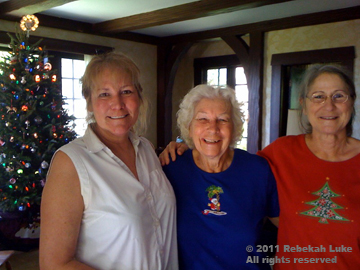
Kathy comes from her Idaho ranch every year and helps Mom decorate. Now widowed, she’s voiced her plans to move back home to Manoa with her horses, cats and dog. Ruth, also an equestrian, is single again too, and she has listed her Kailua house for sale and already moved back to Mom’s with her dog Shadow. These life changes have a way of working out, and it’s wonderful these three wahine (women) are together at home.

My hanai sisters and mom: Kathy, Ivalee, and Ruth

The Hurleys from Australia and Las Vegas arrived. They all came to Hawaii for the baptism last week of their baby granddaughter Jasmine, born to Jodee and Paul. These lovely folks are in-laws and daughter of Julie, my hanai brother Karl’s wife.

Jasmine is baptized, Dec. 18, at St. John Vianney church

The senior Hurleys, who live near Melbourne, gave DH and I the idea of buying an around-the-word air ticket when the time comes to visit Miss Marvelous and her family in Italy, which is half way around the globe from Hawaii. (Have I mentioned they’re moving for three years? 😉 and  😦 Big change!)

The Hurleys said that plan could be cheaper than buying an out-and-back round trip, and then we could visit them in Australia. I will look into it!

Karl’s family includes Brandon and his lady Charlotte, who also drove up, and Brandon’s little girl Trinity. Then my first college roommate Becky arrived on her way to the UH ball game.

Presents for everyone! Trinity and her cousin Patrick, 3,  liked popping the bubble wrap the best.

The morning group left, and in the lull I washed dishes. There were a lot of them. We walked the dog until we got tired, and Ruth made three yummy from-scratch pies for dinner. We staged the rest of the dinner meal around a baked ham and kalua turkey. I think Mom spoke long distance with her two eldest, David and Margy, in Alaska and Oregon. Our thoughts were with Margy and family whose husband Jon is recovering well from a stroke.

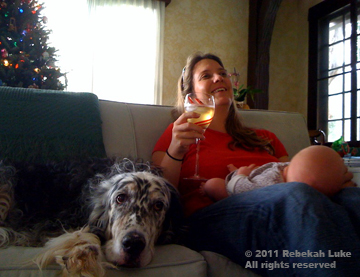
Then Miss Marvelous, her parents Ari and Travis, and baby Perrin arrived. Afternoon wine for the adults!

Shadow, Ari, and baby Perrin

Luckily my hanai brother Brian’s family could make it for dinner, as his physician’s on-call duties were light. Our niece Anna is home from college. As she spent a high school year in Italy, our kids were anxious to hear from her what living abroad might be like.

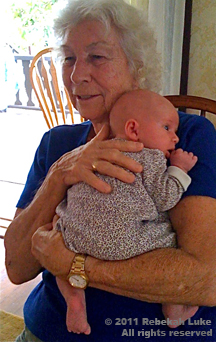
I made only a few photos in between opening gifts, visiting with everyone, and . . . washing dishes! No images of the peak excitement periods, but be assured, it was another Christmas Day of family love at the Sinclairs’. Here’s GG, our touchstone, with the youngest of our extended clan.

GG (Great grandmother) and Perrin (age 1 month)

Copyright 2011 Rebekah Luke


Waiting for Christmas eve . . .

24 12 2011

. . . DH, Alice Brown and I are continuing the tradition of having dinner and exchanging gifts on Christmas Eve at Miss Marvelous’s house down the road — with her Mom and Dad, her Tutu who she baked cookies with today, and our sometimes-guest-dog Pua. We’ll be savoring the moments and cherishing the memories because Christmas Eve most likely will not be exactly like this next year.

It’s month-old Perrin’s first Christmas. She finally has a birth certificate, that means she can file for her passport and visa so she and her family can move to Naples, Italy, where Dad will work for three years, and then they’ll come home. I think Pua will be joining us on a daily basis at the studio rather than make the trip to Europe.

Before we head out for the evening, all of us at the studio, including Ula the ageless cat, wish you a blessed Christmas full of love and peace and the wonderment of children.  Mele Kalikimaka! ~ Rebekah


Hawaiian language newspapers at www.awaiaulu.org

19 12 2011

Season’s greetings to you! Joyfully, I can report that I survived transcribing my first Hawaiian newspaper page from the 1800s. I’ve put it in my pau (finished) folder and started another one.

On Nov. 28 I answered a call for volunteers to type, in simple text manuscript form, pages from old Hawaiian language newspapers so that the content can be searchable with a computer. The project, called the “ʻIke Kūʻōkoʻa Initiative,” is seeking 200,000 volunteer hours. More than 100 Hawaiian language newspapers were published between 1834 and 1948.

Here I share my experience and tips for you if you want to try. If you have heard about this project and are anxious to help, please visit www.awaiaulu.org  and hear the welcoming invitation from Kaui Sai-Dudoit and Puakea Nogelmeier. If you sign on and decide later it’s not for you, you can always cancel.

Although it’s true that one doesn’t need to speak Hawaiian to type it, it is an advantage. In addition, good eyesight, squinting, accurate typing copyreading skills, and time = Success.

I do not speak Hawaiian. I am not fluent in the language.  I haven’t learned all the little words and parts of speech that one of my early teachers said were so important. Although I might not know what the words mean, I know what written Hawaiian looks like. I can pronounce and hear it in my head. With my Pukui-Elbert Hawaiian dictionary in hand I can figure out the gist of a paragraph.

(My Hawaiian dictionary and Place Names of Hawaii, both from University of Hawaii Press, are my standard editing tools.)

Hawaiian words are not foreign to me, as they are all around me. Hawaiian music lyrics, Hawaiian language class in the 8th grade at Kamehameha Schools, several attempts at formal language classes as an adult, my citizenship in Ka Lāhui Hawaiʻi, and membership in the Ko‘olauloa Hawaiian Civic Club are how I’ve become familiar with Hawaiian.

My most recent exposure was with Nā Kamalei-Koʻolauloa Early Education Project. I was hired to design and later direct the creation of 20 bilingual children’s books in Hawaiian and English. I worked with translators Kama Hopkins and Lono ‘Ikuwā — both excellent teachers besides . . . Mahalo! — and painstakingly copy-read every single character, ʻokina and kahakō (what typesetters refer to as a “single open quote” and a “macron.”) Long linguistic discussions with authors and Native Hawaiians of the community were enlightening.

I cut my teeth as a newswoman on hot type (before the advent of the desktop computer) in the late Sixties and early Seventies at Ka Leo o Hawaii and the Honolulu Advertiser, then read galley proofs from Hawaii Hochi during many years with the Office of University Relations at UH Mānoa. That gave me an understanding and appreciation for setting lead type by hand, upside down and backwards! I recall that a professional typesetter (not me!) commanded $50 an hour in those days for speed and accuracy.

These are additional reasons why I am excited to contribute some of my time for the current Hawaiian newspaper project.

In the end, I took 12 or so hours over three weeks that included two extensions to finish my first page. Originally the planners hoped a typist would take only 1 week to complete a page. (Another volunteer’s strategy was to transcribe one of 6 columns per day, then proofread on the seventh day.)

On one side of my computer screen is the scanned graphic of a page reserved for me. I enlarge this. On the other side is a blank text document to type into — exactly what I see. No need to correct errors or type accent marks because, except for the apostrophe, they were not used. If I cannot decipher a character, or if it is obscured for a reason, typing “@” alerts whoever reads the transcription next.

When I examine the typeface enough to tell the difference between a “u” and an “n”, or a “1” and an “l”, or a “3” and a “5”, it’s smooth sailing. But only for one hour at a time. After that I can’t “see” it any more.

Sometimes, if I’m not sure of the spelling of a word because I can’t make it out completely, I will check my dictionary; if it’s there and makes sense, I’ll put it in. Sometimes that word I can’t make out appears later in the columns, and I verify in that way.

Then I go back to check my work, and sure enough I find some typos. After the first couple of weeks, it looks like the project understood the need to grant extensions. So, if your experience is like mine, don’t fret!

To be more encouraging, let me say it is a very interesting activity to see what people were reading in those days. My first page contained a poem “The Beautiful Snow” (English title) followed by Hawaiian verse, a lyrical and sensual description of snow in seven verses (2/3 column); a Sunday school lesson; price lists for bibles.

My second page reports who bought and sold or rented how many acres of what land on what island for what amount. You can learn Hawaiian vocabulary and see what words had fallen into disuse and are being resurrected with this project.

I’m grateful for the opportunity to assist and learn, and I hope I’m doing a good enough job for the project. I want my comments to be encouraging and to give interested transcribers a “heads up” about what to expect. I hope anyone who has an interest will volunteer for this worthwhile effort.

Copyright 2011 Rebekah Luke


Hawaiian garland for the holidays

10 12 2011

In Hawaii we are fortunate to grow gardens with flowers and foliage to decorate our homes and adorn ourselves the year ’round. I’ve started to show others how to craft holiday garlands, such as Christmas wreaths, table centerpieces, hostess gifts, and swags.

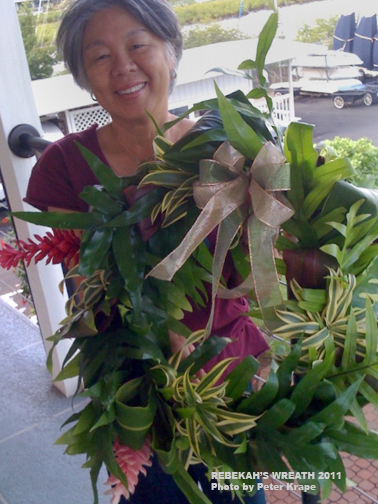
Today some of us gathered at the yacht club in Kaneohe to put the decorations together. It’s a fairly easy method adapted from the Hawaiian wili style of lei making. We substituted wire for natural fiber used to whip the plant material together, and we omitted a separate backing that is unnecessary because the stiff stems of ti leaves are sufficient foundation.

This fresh wreath is made of green ti, red ti, laua‘e, and song-of-India leaves. Red and pink ginger blossoms offer pops of complementary colors. A big bow completes my creation.

Just in time for the holidays: handcrafted decorations from our gardens

Copyright 2011 Rebekah Luke