Hawaiian language newspapers at www.awaiaulu.org

19 12 2011

Season’s greetings to you! Joyfully, I can report that I survived transcribing my first Hawaiian newspaper page from the 1800s. I’ve put it in my pau (finished) folder and started another one.

On Nov. 28 I answered a call for volunteers to type, in simple text manuscript form, pages from old Hawaiian language newspapers so that the content can be searchable with a computer. The project, called the “ʻIke Kūʻōkoʻa Initiative,” is seeking 200,000 volunteer hours. More than 100 Hawaiian language newspapers were published between 1834 and 1948.

Here I share my experience and tips for you if you want to try. If you have heard about this project and are anxious to help, please visit www.awaiaulu.org  and hear the welcoming invitation from Kaui Sai-Dudoit and Puakea Nogelmeier. If you sign on and decide later it’s not for you, you can always cancel.

Although it’s true that one doesn’t need to speak Hawaiian to type it, it is an advantage. In addition, good eyesight, squinting, accurate typing copyreading skills, and time = Success.

I do not speak Hawaiian. I am not fluent in the language.  I haven’t learned all the little words and parts of speech that one of my early teachers said were so important. Although I might not know what the words mean, I know what written Hawaiian looks like. I can pronounce and hear it in my head. With my Pukui-Elbert Hawaiian dictionary in hand I can figure out the gist of a paragraph.

(My Hawaiian dictionary and Place Names of Hawaii, both from University of Hawaii Press, are my standard editing tools.)

Hawaiian words are not foreign to me, as they are all around me. Hawaiian music lyrics, Hawaiian language class in the 8th grade at Kamehameha Schools, several attempts at formal language classes as an adult, my citizenship in Ka Lāhui Hawaiʻi, and membership in the Ko‘olauloa Hawaiian Civic Club are how I’ve become familiar with Hawaiian.

My most recent exposure was with Nā Kamalei-Koʻolauloa Early Education Project. I was hired to design and later direct the creation of 20 bilingual children’s books in Hawaiian and English. I worked with translators Kama Hopkins and Lono ‘Ikuwā — both excellent teachers besides . . . Mahalo! — and painstakingly copy-read every single character, ʻokina and kahakō (what typesetters refer to as a “single open quote” and a “macron.”) Long linguistic discussions with authors and Native Hawaiians of the community were enlightening.

I cut my teeth as a newswoman on hot type (before the advent of the desktop computer) in the late Sixties and early Seventies at Ka Leo o Hawaii and the Honolulu Advertiser, then read galley proofs from Hawaii Hochi during many years with the Office of University Relations at UH Mānoa. That gave me an understanding and appreciation for setting lead type by hand, upside down and backwards! I recall that a professional typesetter (not me!) commanded $50 an hour in those days for speed and accuracy.

These are additional reasons why I am excited to contribute some of my time for the current Hawaiian newspaper project.

In the end, I took 12 or so hours over three weeks that included two extensions to finish my first page. Originally the planners hoped a typist would take only 1 week to complete a page. (Another volunteer’s strategy was to transcribe one of 6 columns per day, then proofread on the seventh day.)

On one side of my computer screen is the scanned graphic of a page reserved for me. I enlarge this. On the other side is a blank text document to type into — exactly what I see. No need to correct errors or type accent marks because, except for the apostrophe, they were not used. If I cannot decipher a character, or if it is obscured for a reason, typing “@” alerts whoever reads the transcription next.

When I examine the typeface enough to tell the difference between a “u” and an “n”, or a “1” and an “l”, or a “3” and a “5”, it’s smooth sailing. But only for one hour at a time. After that I can’t “see” it any more.

Sometimes, if I’m not sure of the spelling of a word because I can’t make it out completely, I will check my dictionary; if it’s there and makes sense, I’ll put it in. Sometimes that word I can’t make out appears later in the columns, and I verify in that way.

Then I go back to check my work, and sure enough I find some typos. After the first couple of weeks, it looks like the project understood the need to grant extensions. So, if your experience is like mine, don’t fret!

To be more encouraging, let me say it is a very interesting activity to see what people were reading in those days. My first page contained a poem “The Beautiful Snow” (English title) followed by Hawaiian verse, a lyrical and sensual description of snow in seven verses (2/3 column); a Sunday school lesson; price lists for bibles.

My second page reports who bought and sold or rented how many acres of what land on what island for what amount. You can learn Hawaiian vocabulary and see what words had fallen into disuse and are being resurrected with this project.

I’m grateful for the opportunity to assist and learn, and I hope I’m doing a good enough job for the project. I want my comments to be encouraging and to give interested transcribers a “heads up” about what to expect. I hope anyone who has an interest will volunteer for this worthwhile effort.
Copyright 2011 Rebekah Luke


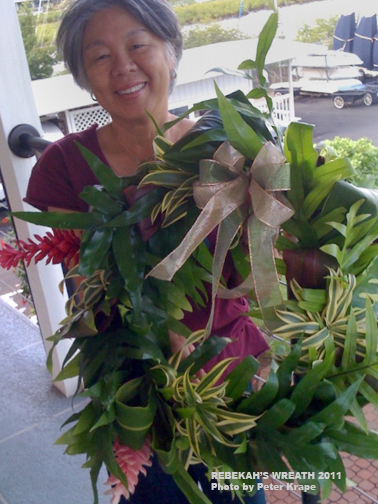
Hawaiian garland for the holidays

10 12 2011

In Hawaii we are fortunate to grow gardens with flowers and foliage to decorate our homes and adorn ourselves the year ’round. I’ve started to show others how to craft holiday garlands, such as Christmas wreaths, table centerpieces, hostess gifts, and swags.

Today some of us gathered at the yacht club in Kaneohe to put the decorations together. It’s a fairly easy method adapted from the Hawaiian wili style of lei making. We substituted wire for natural fiber used to whip the plant material together, and we omitted a separate backing that is unnecessary because the stiff stems of ti leaves are sufficient foundation.

This fresh wreath is made of green ti, red ti, laua‘e, and song-of-India leaves. Red and pink ginger blossoms offer pops of complementary colors. A big bow completes my creation.

Just in time for the holidays: handcrafted decorations from our gardens

Copyright 2011 Rebekah Luke


New life for old ornaments

5 12 2011

Greetings! from our family to yours. Christmas decorations are up at the studio, and the look gets more Zen-like each year. A collection of beloved ornaments begged to be included instead of being left in the storage box, so I came up with what I think is a clever idea.

I culled the soft and fairly unbreakable ones, stuffed them into a big stocking, and hung the stocking next to the toy box. The next time Miss Marvelous comes over, there’ll be some new surprises to discover and play with.

Soft ornaments fit into stocking for pre-Christmas fun. Each had a place on Christmas trees past. This year the toddler in the family may play with them.

Our social calendar is filling up. For example, this week DH and I will be taking Miss Marvelous on an evening trolley ride with her school; it’s joong-making time with my friend Nani; and I’m gigging with the choir. I mustn’t forget tai chi and water exercise as usual.

On Saturday I’m giving a workshop at Kaneohe Yacht Club for members and their guests on how to make lei garlands for the holidays. It can be a stressful time, especially with the kids’ new baby and exciting job change — more about that later!

I’m reminded to relax and stay in the present and make time for Miss Marvelous to play with her stocking. ~ Rebekah

P.S. Do you like the snow? It’s courtesy of wordpress.com 😉

Copyright 2011 Rebekah Luke


Welcome, little one

30 11 2011

As of 5 p.m. November 29,  we have another granddaughter, and Miss Marvelous has a baby sister. She’s called “Perrin.” A new loving chapter begins.

Perrin, less than a day out of her mother's womb, with her maternal grandfather


Kahuku 30, Punahou 24

26 11 2011

Images from last night’s HHSAA Division I State Football Championship game at Aloha Stadium. I’m a Buff ‘n’ Blue alumna. I live in Red Raider country. Where to sit? What color to wear? Arrggg! 😕 What a great game! Hail to the champs!

Early in the big game. Unfortunately, No. 90 Punahou was injured in the first quarter.

Playing with color. My neighbors of Ko'olauloa are cheering in the red section. After Kahuku won, they honked their car horns, yelled and screamed past the studio, all the way to the North Shore. Kaaawa brought out the aerial fireworks.

Copyright 2011 Rebekah Luke


Thank you for all my relations

24 11 2011

Thanksgiving Day 2011.

I am an only child, and actually an orphan, as my friend reminded me when my parents died (ha!), yet I have a family. More than one!

I made this photo of my immediate family, sans pets, this past October.

I consider my immediate family, now, as me, my darling husband (DH), his daughter who is now married and has her own family including Miss Marvelous; and we can’t forget Alice Brown and Ula. Socially our family name is Krape, though daughter didn’t hesitate to change hers to Hylton. As I write this, all of us are expecting the birth of Miss Marvelous’s new sister, any day, any minute!

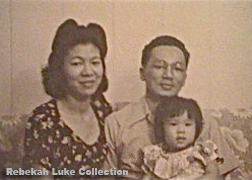
My first immediate family. Me, my momma, my daddy. Here we are, I as a toddler.

Fo-Tsin, Arthur, and Rebekah Luke

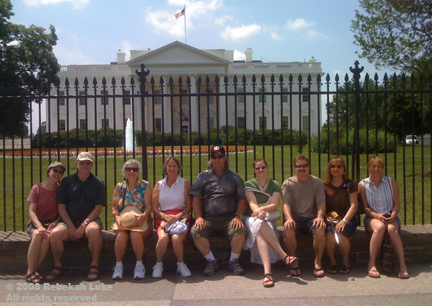
Some of the Sinclairs: Cherie & David, Ivalee, Ruth & Terry, Sarah, Karl & Julie, & Kathy in front of the White House when Mom got the Jefferson Award for public service in 2008

My hanai family the Sinclairs. Around the time I finished high school and when my parents divorced, when I was not quite mature enough nor emotionally equipped to be on my own, a wonderful kamaaina family with father, mother, and six children accepted me into their home to live. The eldest daughter Margaret was my best friend at Punahou.

Sunday family dinners at The Sinclairs’ are legendary. I was given the honor of delivering Doc Sinclair’s eulogy. Mom Ivalee is in her mid-80s, still works (!), and today she is having Thanksgiving dinner at her house as always, with David, Ruth, Karl, Brian, me and our families or partial families present. I’m baking and bringing the rolls. By the way, Doc Sinclair did deliver Barack Obama.

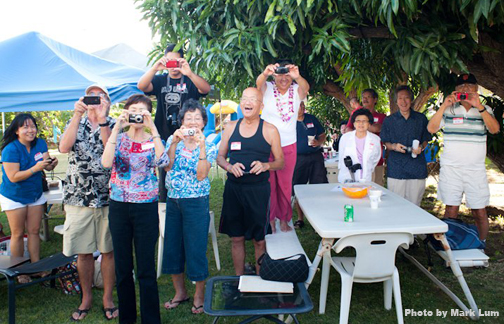
My Chong cousins. These are my relatives on my mother Fo-Tsin’s side. She was the youngest of 15 children who all were born and grew up in North Kohala. Most of my cousins are still on Oahu. Some are overseas in North America, one is in Asia, and another is in Australia. We’re having a family reunion next year, with a revisit to our ancestral homeland getting top billing. It’s really fun to plan this event, and I hope many of my cousins will turn out for it. The mailing labels number 85 families, but I should have more! I love helping to plan our reunions, though this might be the last one for which I’m the point person.

Isn't this a funny image? Mark Lum, my first cousin once removed, made this photo of the Third Generation Chongs photographing the Fourth Generation at a family gathering this summer. I'm in the red pants, vertically challenged as usual.

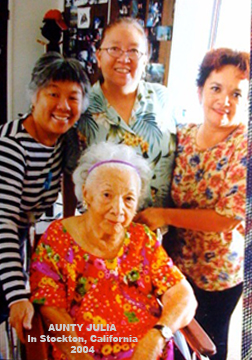
My Luke cousins. Ah, my dad Arthur’s side, the Hawaiian-Chinese side. This is a good-sized family as well; Dad was one of 13. By their nature the Lukes did not/do not stay in touch like the Chongs. They moved all over, often divorced and remarried. Some were loners. After my father died in 2003, I made it a point to visit my Aunty Julia in Stockton, California, who was Dad’s eldest sister and last-living sibling living with her daughter Loris Ann.

The occasion brought my girl cousins together. It was great to see Laureen, Lorene, and Loris Ann in California, and Bee in Colorado, share stories and meet their spouses and children. One time before that, to add to the research of my genealogy, I phoned them to re-introduce myself as Uncle Arthur’s daughter and quizzed them about how many more relatives I had. For Christmas I sent them the family tree as a gift. I am so glad I met them again as an adult, in person.

Rebekah (from left), Laureen, and Loris Ann with Aunty Julia in Stockton, 2004

My good, good friends. Although we’re not related by blood, these friends have seen me at my best and at my worst. We might not see or talk to each other regularly—years can go by, but when we do meet again, it is as if we were never apart, and we just pick up where we left off. We’re at ease together. If I am ever in need, I know I can call on them and they won’t let me down. They’re “family.”

I feel blessed to have these relationships and so many more. I am thankful, for you, too, dear reader! We are One. Happy Thanksgiving, everybody! I love you.

P.S. Oh, I haven’t forgotten my in-laws: DH’s brother-sister-aunts-cousins. That’s another clan.

Copyright 2011 Rebekah Luke


New chapter for the old Chong house

12 11 2011

In the last chapter, Rebekah, DH, cousin Nathan, and cousin Ann left North Kohala without seeing Grandfather Chong’s house. It was no longer on the former Bond Estate land in Ainakea! A neighbor said the house was hauled away on a truck. Where, oh, where was it now?

Back on Oahu in June 2011 I searched the internet for the folks who lived in the house once, when it was the Kohala Family Homeschooling Learning Center run by Kether — names I didn’t recall until I saw them on the web. Kether confirmed the house and the one next to it were hauled away on a truck. In fact, she would give me the name and number of the man who took them. Thomas A. Quinlan.

Mr. Quinlan rescues historical buildings, finds other land for them, and restores them. It’s his passion.

Map of Kohala district, Hawaii

North Kohala highlighted on a map of Hawaii island.

He said one of the houses was in Waimea (about 40 minutes drive away) with a veterinarian, and the other was behind Kita Store, the little green one right on the highway on the way out of Hawi going toward Kona ( about 5 minutes away). A new family was ready to move in.

While on the telephone I’d written in my notes where “our” house was and where the “bachelors'” house was. My grandmother cooked for the bachelors next door during her time at Ainakea.

After we hung up, I looked at my notes, but I didn’t trust them. My slight dyslexia sometimes causes me to reverse elements of pairs if the information comes in too fast. Which house was where? Shucks. It’s a long time before our August 2012 reunion that we’re planning for Kohala (hence the house search); I’ll verify the site later, I thought.

Meanwhile, after seeing the photos on my blog, Mr. Quinlan posted a comment:

“Your family house is still alive and well in Kohala. I moved it to a friend’s place so that it could be cared for and restored. That is exactly what is happening. It is looking beautiful.”

Enter cousin Jim, our family genealogist, here on vacation from the University of Melbourne (Australia) to update our family history. “Let’s go to Kohala,” he suggested. “I’m not sure my teaching schedule will allow me to come to Hawaii next August.”

Immediately DH said, “Rebekah, I think you should go. You still have something to do there.”

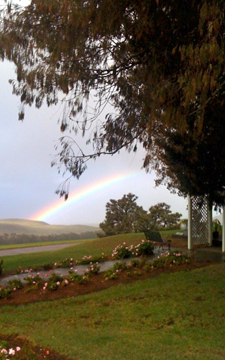
Kohala rainbow seen from the guest cottage

Jim’s aunt, who is my first cousin Elly, arranged for us to stay overnight in a private guest cottage at Kahua Ranch up in the mountains. It would be all right, as she would be there too. I emailed Tom Quinlan to ask about the houses again. As Jim and I left for Kohala, no reply.

Last Tuesday afternoon we drove down to Hawi looking for Kita Store. There were several painted green on that main street, and none named Kita. The realty office that helped me on the last trip was open, so in we marched to ask.

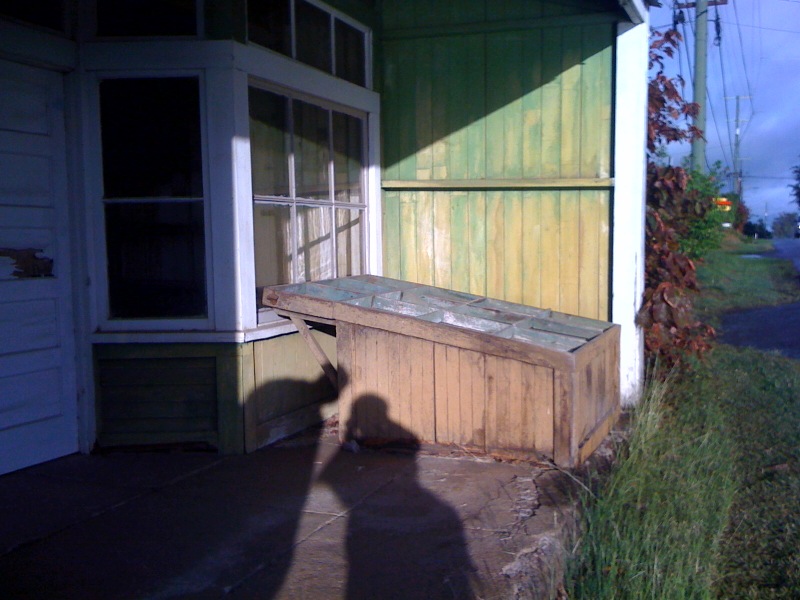
Afternoon sun casts our shadows across the Kita Store storefront, with abandoned produce bins. Through the window we saw shelves and fixtures as in a dry goods store.

We learned that Kita Store was closed, in cobwebs, and a little farther down the highway pass the theater. The kind woman in the office provided us with a detailed description, and pinpointed the property for us on a map.

The house we found in Hawi didn’t look right to me. Nope. I don’t think so. I think this was the bachelor’s house, I said to Jim. No one was home. It began to rain, and we quickly took the opportunity to take some snapshots of the exterior. In the morning we would call the vet in Waimea.

We then went to Ainakea so Jim could see that, indeed, no house was there anymore.

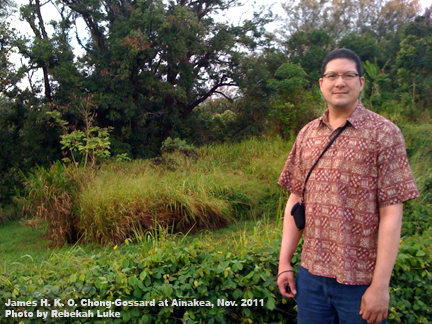
Cousin Jim at Ainakea, former site of his Great Grandfather Chong's house

On the drive up the mountain back to the Ranch, I remembered my friend Phil was now working at a ranch in Kohala, but I wasn’t sure which ranch or if there was more than one ranch. At supper around the kitchen table in the main house I asked the owner Monty Richards if Phil worked there. Yep, he’s here, he works in the shop.

Phillip Oveland is a professional motocross racer, the nephew of my good friend Andrea who lives across the stream from my studio. We’ve played poker together, but I don’t see him much since he moved to Hawaii island. I could pay him a visit in the morning.

Late that evening I saw the email reply from Tom Quinlan. He was in Ireland restoring an old castle and would be back in Kohala next week. The house behind Kita Store needed to be moved again, he wrote, and he was looking for a suitable spot. Did I know of a place? His inference (by me) was that it was our ancestral family home. I still wasn’t convinced and again reviewed comparison photos. One clue was the roof. It was white while the roof of the one we were really searching for was red.

After breakfast I phoned the vet’s office, and he was out of town until . . . next week! His staff knew of the house I asked about, and yes, I should wait until the doctor came back. I left my name and number. Guess I could ask for him to send a picture. Later.

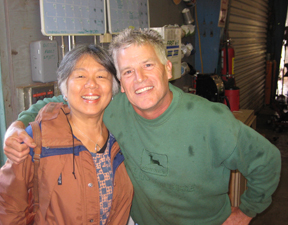
Me and Phil

There was not much to do now except see Phil. He bounced down the stairs. “Rebekah!” So welcoming. He introduced Jim and me to Jean, his trainer. When we told our story, Jean said, “I know exactly where that house is.”

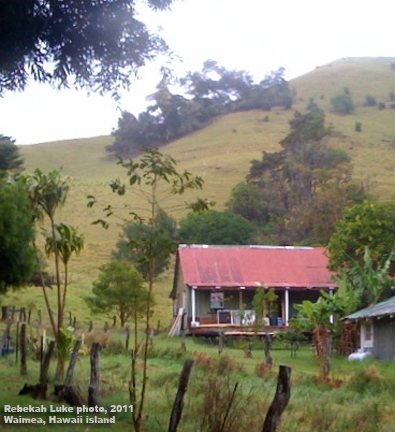
Jean told us where to go. We did. And, without a doubt, we found Grandfather Chong’s house sitting comfortably against a beautiful backdrop of the misty hills of Waimea, still under restoration and looking beautiful and well cared for.

Our family's old house from Ainakea has new life in Waimea. We're thrilled!

Current view of the side of the house that used to face Akoni Pule Highway

Copyright 2011 Rebekah Luke