Yes, I am a Reiki master

14 05 2012

I awoke with the Usui System of Reiki Healing Precepts in my head:

Just for today, do not worry.
Just for today, do not anger.
Honor your parents, teachers and elders.
Earn your living honestly.
Show gratitude to every living thing.

It dawned on me that the first two lines were keys to achieving “no more back pain” in the way suggested by John E. Sarno, M.D., in his book Healing Back Pain: The Mind-Body Connection. In my last post, that appears under this one, I told the story of a health issue and how I would be seeing how well I could “live with it” before seeing a spine surgeon.

This Mother’s Day weekend I received two noteworthy healing gifts: a Reiki workshop by my friend and colleague Lori, and Dr. Sarno’s book from DH that arrive in the mail (before, I had read only excerpts of the book).

On Saturday, Lori, one of my Reiki teachers, and I gave the Level 2 and Master level training at the studio, and at the end of the day Lori had attuned and certified two more independent Reiki masters, 11th generation from Dr. Mikao Usui through Mrs. Hawayo Takata.

In preparing for the session Lori said I should participate in the “Journey into Mastery” segment of the training, along with the new students. In other words, to put it bluntly, she thought I could use a refresher. Having experienced the 90-minute meditation when I was initially attuned to Reiki, I knew it was powerful for clearing out old, repressed emotions.

Repressed emotions are what Dr. Sarno maintains is the cause of TMS, or Tension Myositis Syndrome, a constellation of physical pain that is frequently misdiagnosed as caused by an injury to the structure of the body. Exactly what kinds of repressed emotions?

Sarno identifies anxiety (worry) and anger as number one and number two on the list.

The way to heal my TMS is remarkably simple, now that I have accepted the diagnosis. Sarno writes that treatment involves education, “the acquisition of knowledge, of insight into the nature of the disorder.” In his program he gives two lectures. In my case I am reading, reading, reading. The second part is to acquire “the ability to act on the knowledge and thereby change the brain’s behavior.”

So, here’s what I learned I have to do. When I feel physical pain, I ask myself, “Why this pain now? What is going through my mind? What am I thinking?” I regard the pain as my body’s way of telling me that there is an unpleasant, uncomfortable or unkind emotion I’m having at that moment. And I say to the pain, “Go away, stop distracting me from this emotion. I know what’s bothering me. I understand. I don’t need the pain anymore.” Yes, it can be that simple.

As long as I recognize there are psychological reasons for pain and become aware of the emotion, I am on my way to recovery. Though I don’t believe it’s necessary to go back and relive the emotional pain, I think touching that “nerve” and the few good cries I’ve had are helpful. Finding the courage to “go there” . . . yeah.

I am thankful to have had four weeks to learn about TMS while waiting to see the spine surgeon. I’m resuming my normal activities, and the sciatic pain is less and less. I meet the spine doctor for the first time in just a few hours. I’m looking forward to a good visit.
Copyright 2012 Rebekah Luke


Heal thyself (myself)

6 05 2012

Sometimes the healer needs healing. That would be me.

If you read this to the end you’ll know how I’ve decided to heal myself, but briefly, some background.

About two months ago I experienced excruciating sciatic pain in my right calf while driving. Fearing a blockage of some sort, I detoured to my internist. On a previous visit for a sudden bad pain in my buttock when I stepped out of the swimming pool, the internist sent me to a physical therapist. Eventually the pain went away with some massage and certain yoga exercises. This time, he referred me to sports medicine.

Sports medicine ordered a two-part nerve test that indicated a pinched nerve. This data was evidence for an MRI that showed “severe” arthritis of my lower back (probably inherited, said the doc) and lumbar stenosis at three levels. I was referred to a spine surgeon by the sports medicine doc who explained my options were surgery, spinal injections, or “live with it.”

I would have to wait a month for my first appointment with the surgeon when I presumed he would discuss surgery. Imagine my anxiety.

In the meantime I “put it out” to a small group of Facebook friends, some of whom are my first cousins, and I learned that spine problems are common in my mother’s family and that several have had surgery with mixed outcomes. My friends were kind and offered moral support.

I began researching spine surgery, symptoms, diagnoses, doctors, hospitals. I found online support sites where people, having no one else to sympathize with them, share their stories. I began seriously/finally to look at ergonomic furniture for me and my laptop computer, knowing that if I did have surgery I would still have to take better care of my body afterward. I thought of at least three people who opted for outpatient-type microsurgery and who came through with flying colors.

What to do, what to do? I decided to see how well I could live with it for the four weeks between appointments.

I went to see my naturopath for a Chinese acupuncture treatment. He also gave me liquidambar tablets for the arthritis. On the second visit I asked him all the questions I had, to which he replied, “That’s a good question!” I said I noticed that when I became “ill,” I somehow recovered, but when I became ill the next time, it would be worse followed by a greater recovery (I would feel better than ever), and so on. This most recent episode is a doozy. My naturopath said if this pattern gave me awareness, then it was a good thing. He said I could pay attention to the situations that coincided with pain.

Now this is the best part: He told me of John E. Sarno, M.D., who presents evidence that the kind of pain I’ve been experiencing is caused by unconscious emotions. He told me, “I believe you have the information and the ability to heal. There’s just one missing piece: the emotional piece. Think about it.”

So I did and I am. I went to amazon.com and looked up one of Sarno’s books. Here’s the link to a preview: http://www.amazon.com/Healing-Back-Pain-Mind-Body-Connection/dp/0446392308#reader_0446392308

I thank my naturopath so much, for listening to me — each appointment with him lasts 90 minutes vs. the 15 minutes of traditional health care — and for pointing me to Sarno’s work.

Sarno’s diagnosis of TMS (Tension Myositis Syndrome) resonates with me. He discusses my exact symptoms, and I fit the profile of the type of person prone to have TMS. I am giving his method for “no more back pain” a try. So far, so good.

As you may know, I am a Reiki master. I am able to help others. I know intellectually that the body heals itself and that many physical ailments have emotional roots. Though I tell clients about healing the whole self—body, mind, spirit and emotions, I hardly ever address my own need for emotional healing. If it occurred to me, I  quickly put it out of my mind. Now I am willing to own up to my denial and willing to let go of the pain.

When my Reiki master teacher heard that other members of my mother’s family had back problems, she wondered if what we all experienced was “ancestral pain.” We don’t have to know exactly what our ancestors did to cause pain or what it was that caused them to have guilt or other negative emotions, we just have to acknowledge it, express forgiveness, and release it.

I may have inherited that problem, but I have my own “stuff” to fix, too.

Sarno says (I think) deep unconscious emotional pain is the cause of a particular physical pain that is very real. TMS is induced by emotional phenomena, but it is a physical disorder. The pain is my body’s defense mechanism for unexpressed emotions. If I can get in touch with those strong (like rage), buried, and uncomfortable emotions, face them, acknowledge them and explore why, then I can release it (to the Universe) and say, “I don’t need the pain anymore.” Further, that pain is the sign for me to stop and think, “Why am I having this pain at this moment?” and answer, “Okay. I understand. No more pain.”

Like I said, I’m working on it. Talking about it. Writing about it. As for the scary images from my MRI, I’m still keeping the appointment with the spine surgeon. In taking charge of my healing I want to cover all my bases.

Thank you so much for listening. It has been therapeutic for me to write this post. Perhaps what I’ve learned will help someone else.

Copyright 2012 Rebekah Luke


Less is more

26 04 2012

I think my cousin Christina, aka Toy, will like the blog I found today.

On rare occasions I will recommend another’s blog, rare only because I think original thinking and writing that allows the reader to know the writer better should be the point of a blog like Rebekah’s Studio.

I just found a blog I like and subscribed to it: http://minimalistlifestyle.wordpress.com

Cousin Christina recently noted her love of compact living.

Mark Lowe, the author, talks about what it means to him to live simply. I’m amused because what he says is so true!

A minimalist lifestyle is more than getting rid of clutter, although that is certainly a starting point.

There are good comments and tips from his growing following of readers, too. By subscribing I’ll have a regular reminder to examine my values and get a motivational boost toward Zen.

I read some of the content out loud, and in less time than it took me to write this post, DH cleaned out a drawer and took a bagful of stuff to the trash. 😉

Thank you, Mark! Less really is more. I’m inspired!

Copyright 2012 Rebekah Luke


Kōlea: thinking about it

20 04 2012

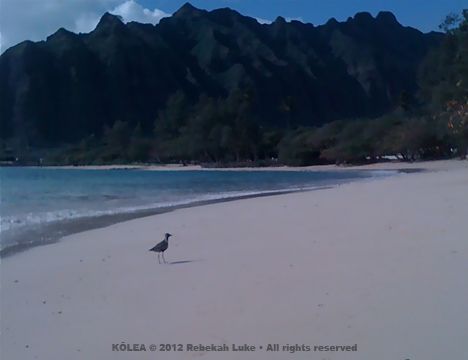
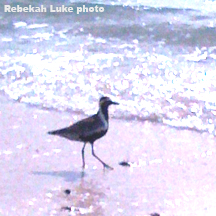
A lone kōlea — golden plover (Pluvialis) — seemed to be testing the water and thinking about a trans Pacific flight from Kaʻaʻawa beach to Alaska this morning. I pretended to be a nature photographer snapping many frames and hoping to get some good shots. Alas, nature photographer I am not, but I thought you would like to see what I made with DH’s iPhone as we walked the dogs. I applied the noise filter in Adobe Photoshop for the effect in the large photo.

Is this a good day for flying?

Shall I go now?

Umm, nope! Maybe later.

Actually, it’s a gorgeous day. The migratory bird no doubt was distracted by my presence and waited until I left. I hope it decided to take flight because conditions are beautiful! Aloha, a hui hou, e kōlea!

Copyright 2012 Rebekah Luke


Koki‘o ke‘oke‘o in bloom

15 04 2012

Image

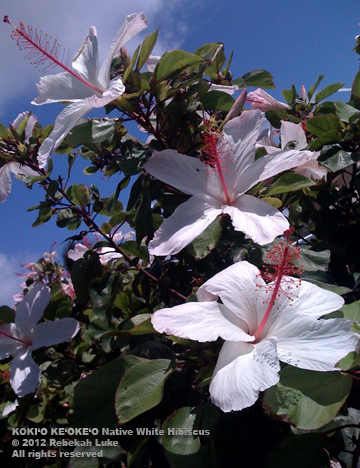
This lovely display of koki‘o ke‘oke‘o (Hibiscus arnottianus), a native Hawaiian hibiscus with white flowers, grows outside The Officers’ Club at the Marine Corps Base Hawaii, located at Mōkapu, Oʻahu. My friend Andrea treated me to a ladies’ luncheon there on Saturday with her Daughters of the Nile group. Finding this hedge in bloom made up for the eyesore of the drained and abandoned swimming pool. Our server said reconstruction work on the swimming pool was halted when iwi (bones) were uncovered at the site.

Copyright 2012 Rebekah Luke


Color and paint from still life

12 04 2012

I can teach you how to paint!

While my art students are on a little break from class—they’re vacationing in Turkey!—I’ve decided to show you what we’ve done so far in Painting I. Each week I welcome students with a studio tabletop set-up, explain the lesson, and do the lesson with them. We paint these assignments after practicing basic drawing and perspective, and learning about the values of light.

I urge students to not paint from a photograph, preferring that they draw and paint from life and the “local color” cues they should put down in the beginning. However, the now-ubiquitous digital camera phone and that the set is not available for viewing once the class is over for the day make it difficult to not refer to a photo.

The problem is, for beginners especially, if you paint from a photograph, the painting will look like a photograph. I think a painting is more interesting when it shows the artist’s individual line, imperfections included. Looseness will develop with time.

Below you can see how I treated the assignments myself. The medium is oil paint on canvas paper. Here’s evidence that limited palette paintings are generally stronger than images created with a full palette. Still to come, after students come back from break: the red-green painting and complementary color lesson and “the world in full color.”

Copyright 2012 Rebekah Luke

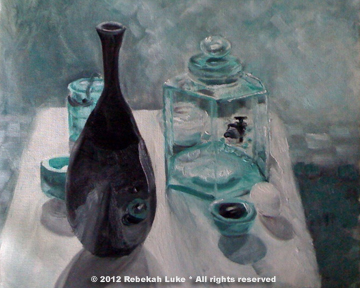
The painting. Monochromatic color lesson: adding one hue only, veridian, to black and white, still mindful of the range of values, that is, the various tints and shades of gray. Lesson includes painting glass.

The set. Analogous color painting lesson with black, white, and three yellows. Black mixed with yellow makes green.

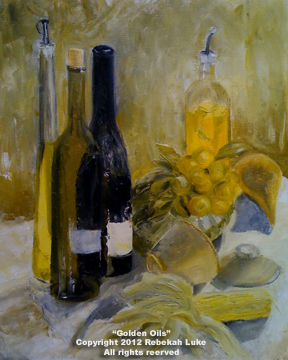
The painting. Using cadium yellow pale (cool yellow), cadmium yellow light (warm yellow), yellow ochre, black, and white.

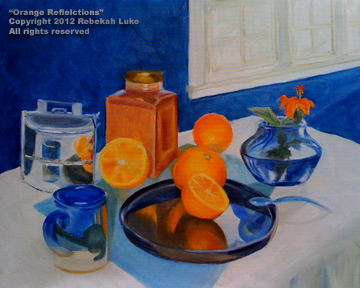
The painting. The combinations of mixing cadmium red light (red-orange) and veridian (blue-green) represent the first of four lessons about complementary colors, that is, colors that are opposite each other on the color wheel. Combining complementary colors produces neutrals that are stronger than tube paints named for earth tones.

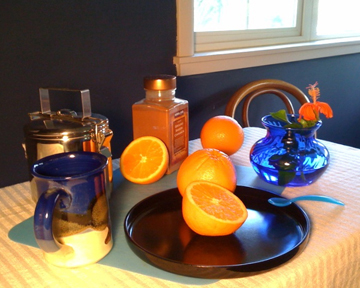
The set. Complementary colors blue and orange with shiny metal, glass, reflective surfaces, highlights (the incandescent spot) and low lights (from the window light).

The painting. Though challenging, it is much fun to paint reflected light.

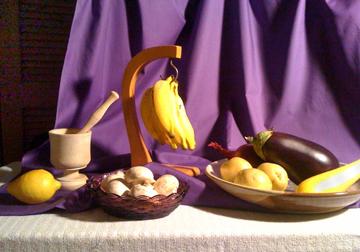
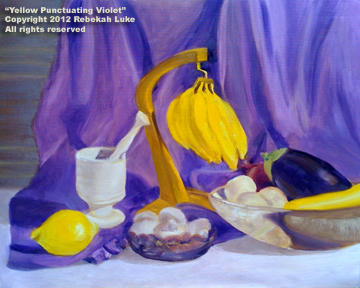
The set. The complements yellow and violet mix to make warm tans and browns. Of light rays passing through a prism, yellow is the lightest value, and violet is the darkest. This still life set introduces drapery.

The painting. Painting drapes in the studio now is good practice for painting the Ko‘olau Mountains in the landscape later!

To learn more about painting lessons by Rebekah, please see the related post: Is painting on your bucket list?


A peace of Easter – Colomba di Pasqua

8 04 2012
Image

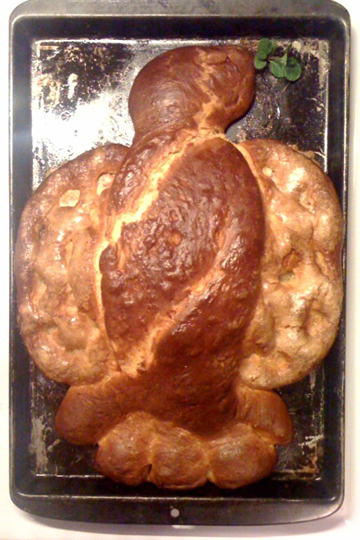
I made this bread from a recipe in the Sunset Italian Cook Book published in 1972 when I worked in the test kitchens. It was edited by Jerry Anne DiVecchio. A larger 12 x 15-inch baking sheet would have allowed the birds wings to spread more. The wings are studded with almonds over chunks of almond paste and sprinkled with sugar.

My version of Colomba di Pasqua – the Dove of Easter, a bread of Italy. Delightfully delicious with lemon and almond flavors. Enjoy your holiday! Especially our family in Naples. Happy Easter!

Copyright 2012 and 2014 Rebekah Luke