A fresh look at the art of painting green

20 10 2010

Some painters claim they don’t know how to paint green. It must be why paintings of this hue are generally absent in the art galleries. In this post I’ll show how to paint green. With oil paint, the trick is to change your base color.

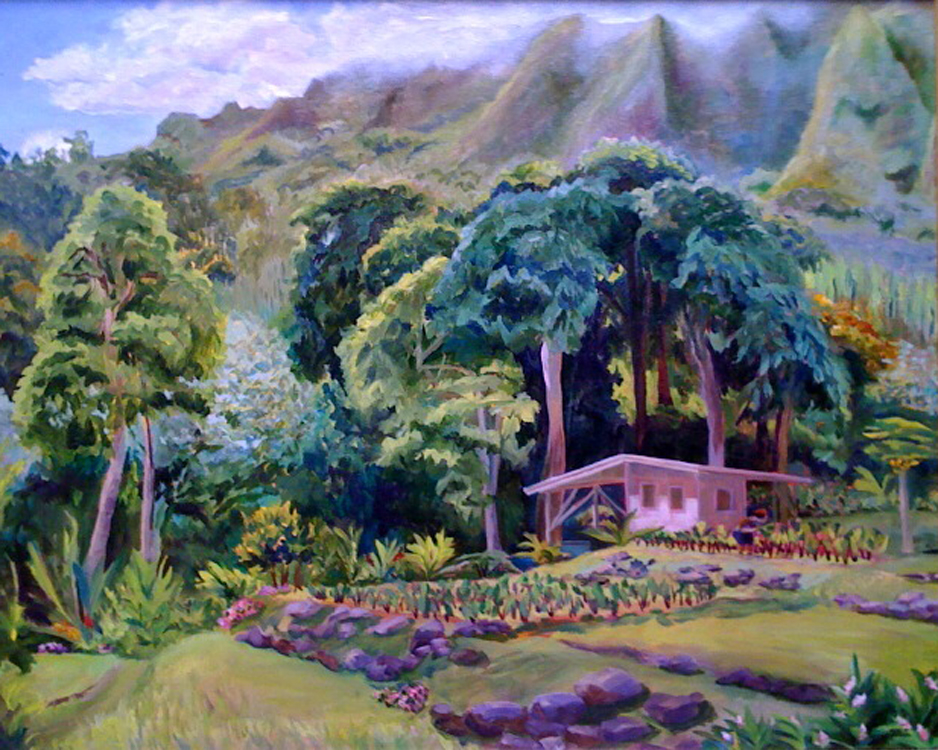
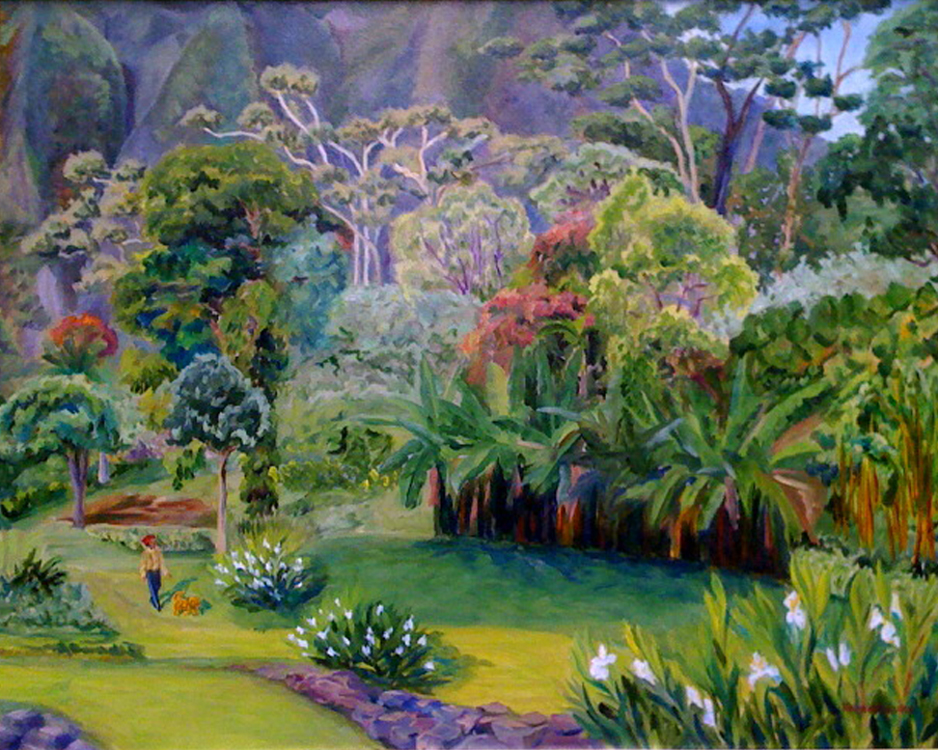
I love green. “Banyan in the Park” and “White Ginger,” two of my most recent paintings, are predominantly green. Looking at them gives me a feeling of calm, coolness, and serenity. More so, I can recall the satisfying experience of choosing the images and transferring them to canvas. I can smell the sweet scent of the ginger patch.

Banyan in the Park
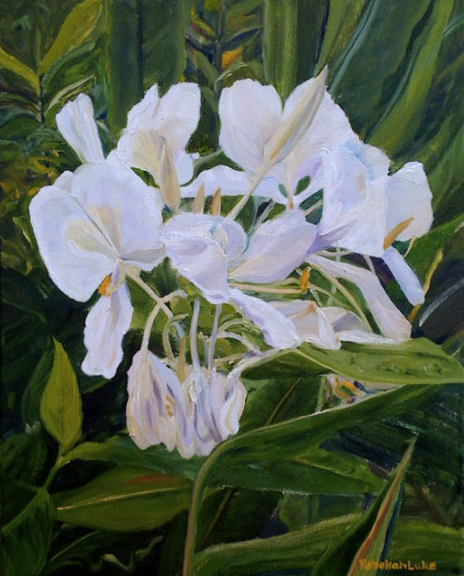
White Ginger

Painting green is no secret, it’s a technique. As mentioned, it’s all about changing your base, your base being a yellow or a blue because yellow plus blue equals green. In the field, I still use a color chart I made when I took my first painting classes. Someday I’ll paint a new one!
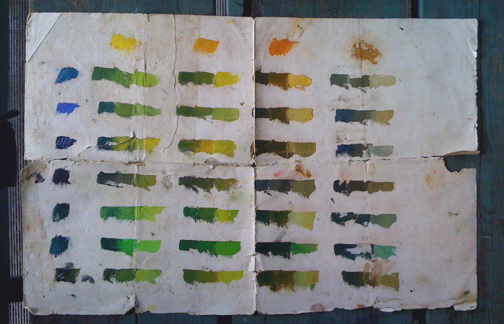
My green color chart on canvas paper, a bit ragged but still useful!

You can make a chart like this too. Use a palette knife. Put a swatch of each of your yellows in the top row. Down the left column, dab a swatch of each of your blues, including black if you use black. The greens in the body of the chart are the result of mixing a blue with a yellow. For each combination of the two colors, I have added white two times to get a “light,” “middle tone,” and “dark” of the same hue. See how many different greens there are!

When I am on location, I literally walk up to the object—e.g., a leaf—and find the swatch on my color chart that most closely matches it, eliminating any guess-work. If the object is in the distance, I hold up my palette knife—with paint on it—in the air in front the object and squint to see if the hue and value (lightness or darkness) match. When you paint a green scene, step back for a moment now and then. If it’s starting to look all the same, maybe it’s time to change your base to “find” another green.

Going a step further beyond the colors on the chart:

To lighten, “warm it in the light,” that is, add the next lighter yellow from your palette plus a little white. To darken, “cool it in the shade,” that is, add the next darker blue from your palette.

This technique of warming it in the light and cooling it in the shade is known as “analogous,” meaning to use the next color on the color wheel. In the way I paint, I prefer analogous to “complementary.” Adding the complement—the color opposite on the color wheel—to a color will also darken, but it will also appear comparatively chalky. Put another way, if I want to darken green, I add blue, not red.

If you are still with me ;-), here are a couple of exceptions.  When painting a landscape, colors become muted and lighter in value in the distance. In this case the painter would choose complements. Realize, also, that whenever you see gray, use the complement.

I learned these tips from my teachers Gloria Foss, Vicky Kula, and Peter Hayward who taught us how to turn the form and about the logic of light.

Thank you!
Copyright 2010 Rebekah Luke


Seven island artists paint and show works at Ho‘omaluhia

3 08 2010

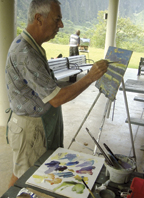
Our “If it’s Thursday, it must be Ho‘omaluhia!” public exhibit of paintings opens today at Ho‘omaluhia Botanical Garden visitor center and extends to August 30, 2010. The show displays the works of local artists Alex Weinstein, K.Y. Lum, Naomi Weinstein, Noreen Naughton, Richard Guy, Val Saban, and yours truly Rebekah Luke. The collection looks great!

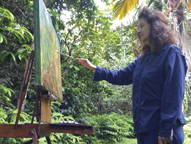
Photo of me by Noreen Naughton

Every Thursday for the past 10 years, more or less, our group has painted in the peaceful landscape that is Ho‘omaluhia, located at Luluku, at the base of the majestic Ko‘olau mountains in windward Oahu. We come from different backgrounds and for different reasons to enjoy the garden and each other’s friendship.

This the first exhibit of paintings for four of our group. All but one of the 42 works in oil and acrylic may be purchased, with prices ranging from $75 to $2,800. Most prices are reasonable and realistic for original art, so it’s a good opportunity to start or add to your collection. Interested buyers should contact the artists directly (lay away plan of installments considered), as no sales transactions are permitted on the city property.

How we met (excerpt from catalog)

In the 1990s, art professor Noreen Naughton frequented Europe with summer abroad courses. K.Y. Lum, a psychiatrist, and his wife took the “Drawing in Italy” tour, visiting Rome and Tuscany to take in Renaissance art in hill towns and obscure churches. When they went a second time to Italy, Naomi and Alex Weinstein joined Noreen’s group. Alex, an architect, is a good sketcher, and Naomi, a retired educator, was a ceramist.

They all went with Noreen again to paint in France, “Following the Path of the Impressionists” from Amsterdam to Paris.

K. Y. Lum

Naomi Weinstein

Alex Weinstein

Richard Guy

When they returned to Hawai‘i they continued to paint with Noreen in the landscape. Ho‘omaluhia Botanical Garden became a favorite venue. K.Y. and the Weinsteins are the only ones from Noreen’s original group who continue to paint together on Thursdays.

The others: Val Saban, former international trader and industrialist, lives in the same building as K.Y., and the two swim together.

Rebekah Luke (that’s me) who studied painting with the late Gloria Foss, and K.Y. are first cousins. Richard Guy, retired chief justice of Washington state and a local arbitrator and mediator, joined the group after being introduced by Naomi who is in the same book club as his wife.

Val Saban

Noreen Naughton

If you go (and we hope you will)

The park entrance is located at the end of Luluku Road in Kaneohe, Oahu. The art will be on view every day from 9 a.m. to 4 p.m. through August 30, 2010.  Exception: The park is closed on Aug. 6 and 27.

Thursday is the theme. You can meet the artists at a punch-and-cookies reception on Thursday, August 5, from noon to 2 p.m. Most of us will be there on the other Thursdays in August in the mornings only.

Allow time to enjoy the rest of Ho‘omaluhia Botanical Garden’s plants, trails, picnic areas, lake, camp sites, and overall Hawaiian tropical scenery.

Thanks for visiting!

Copyright 2010 Rebekah Luke


If it’s Thursday, it must be Ho‘omaluhia!

9 07 2010

View of the Ko‘olau Mountains from Ho‘omaluhia

My painting group and I are busy putting together an August exhibition of our artwork at Ho‘omaluhia Botanical Garden Visitor Center in Kaneohe, Oahu. It opens on August 3, with a punch-and-cookies reception on August 5 (Thursday) from noon to 2 p.m. If you are in the area, please come to see it! If time permits, see the garden too. You may click on the garden link above to read about the garden, and on the link below for details of the art show. – Rebekah

CLICK FOR THE INVITATION


Momma and Dr. Usui said, honor and thank our teachers

27 05 2010

A shopper at last weekend’s Native Hawaiian Arts Market asked me if I considered myself a self-taught painter. “No is the short answer,” I replied quietly.

I believe in taking lessons, followed by lots of practice. I took lessons.

In the Hawaiian culture I learned everyone must have a teacher. Never mind you think you don’t need one, that you can do your own whatever. At least not in the beginning.

The first thing someone will ask is, “Who’s your kumu?” If you can say, “My kumu was ___ ,”  respect for your work goes up a notch. If you can’t, the response might be, “Uh-huh,” and you hardly will be given the time of day and wonder why.

Perhaps after working at it for a while, an artist will perfect his/her line and system and turn out creations that are identifiably theirs, but most successful artists have gotten a background of the universal principles and basic techniques prior to discovering how to manipulate the medium into something original and all their own.

Having a teacher gives your work credibility. It applies to more than just painting.

For example, at the opening of Oceania Exhibit at the National Museum of Ethnology, a.k.a. Minpaku, in Osaka, Japan, for which the museum built a replica of the Hale Kuai Cooperative store in Hauula to represent the Hawaiian Islands, Kealii Gora attended officially as cultural consultant, and I attended in my role as the real co-op’s executive director.

Ka Lahui Hawaii and yours truly co-founded the cooperative to buy and sell products made by Native Hawaiians.

Hale Kuai Cooperative caught the attention of Minpaku anthropology professor Akitoshi Shimizu, who led the project team. He felt it depicted a movement in economic development among indigenous Hawaiians in 1999.

The opening ceremony was hauntingly beautiful and Kealii’s oli (chanting) rocked the entire hall. Afterward a VIP guest confronted him and wanted to know “by what authority” Mr. Gora performed the protocol, along with a Maori representative from Aotearoa.

Interestingly, but not surprisingly, Kealii did not reply that he was an officer of Ka Lahui Hawaii (a de facto Hawaiian nation). That he most certainly was. He replied, “My teacher was Kumu John Keola Lake.” There wasn’t anything the guest could say after that.

Similarly, certified Reiki masters will identify their credentials by stating the genealogy of their Reiki line. I am 10th generation from Dr. Mikao Usui through Mrs. Takata. That brings to mind Dr. Usui’s precepts:

Just for today, do not worry.
Just for today, do not anger.
Honor your parents, teachers, and elders.
Earn your living honestly.
Give thanks to every living thing.

My mother, a piano teacher, taught me to remember and acknowledge my teachers. So I honor my teachers of art and Reiki by naming them here. Most of my teachers throughout my life were influential in some way, but these people made a loving impact.

Richard Nelson, Punahou School art history
Duane Preble, University of Hawaii at Manoa art history
Masao Miyamoto, University of Hawaii photographer
Michael Tamaru, University of Hawaii graphic designer
Glenn Christiansen, Darrow Watt, Norman Plate, Sunset photographers
Art Center College of Design faculty
Gloria Foss, The Foss School of Fine Arts, landscape painting
Vickie Kula, The Gloria Foss Color Course, studio drawing and painting
Susan Rogers-Aregger, Arts of Paradise gallery management
Alice Anne Parker, Reiki master
Lori Wong, Reiki master

Thank you for teaching me.

Copyright 2010 Rebekah Luke


Artist’s unforgettable memoir

15 04 2010

Once upon a time in 1994, not too long ago, I went to a Hawaiian place, a place of healing.

Through the treetops I could see glimpses of the Ko‘olau mountains. Patches of sunlight danced on colorful impatiens, and the sound of civilization gave way to the melodic symphony of the shama thrush. How enchanting, I thought. This feels like paradise. The trail skirted dense bamboo on one side and cultivated ti plants on the other. I could hear the stream running, and farther along, soft voices below. When the view finally opened up I saw up close the back of an amphitheater-headed valley, and, below me, a stretch of green terraces planted with kalo. To the left was a small house. This was unforgettable ‘Ioleka‘a, and Anita lived here.

Anita’s Place Kaiwikee Edge of the Forest

Anita was an inspiration to me. I met her through our work with Ka Lahui Hawaii. She took care of the land, and it took care of her. I met the family members who together with Anita own the private Native Hawaiian kuleana, and after a while they welcomed me in to paint the landscape.

Over ten months, starting in February when the ‘awapuhi ke‘oke‘o (white ginger) bloomed — I still recall the sweet scent — and until a solo show exhibiting the work opened,  I hiked in and out many times and made more than a dozen oil paintings, starting with “Anita’s Place” that developed into the triptych above.

I attached pontoons to my easel to prevent the legs from sinking into the mud of this lo‘i land. I learned to smell and listen for the rain, just in time to cover my palette and don my rain gear. Sometimes Ei Nei the golden retriever would keep me company, but only until the mistress returned.

On November 5, 1994, a day after the show opened, I wrote:

I am so glad I made these paintings. Things are different at Ka ‘Ili ‘Ioleka‘a now. The goat’s gone. Got loose and took off. The papaya tree’s down. A couple more lo‘i are being prepped for planting. One of the mango trees on the trail fell. More people and the laws of nature bring constant, dynamic change.

Anita and I picked ho‘i‘o for the art show reception. One needs a good eye to spot those fern buds. Anita refused payment, even though I explained that was her income. A gift from the ‘aina, she said.

For a month the paintings are on exhibit at Leeward Community College. People like them. They really look at them. It is as though some folks have never seen a painting. It’s refreshing to see some of the green of the windward side of the island over here where it is drier. Sort of like a shot of menthol, a visitor said. When art evokes an emotional response, when it communicates, then it is successful. These images are.

These images stop people. They are scenes that people can relate to. They bring back memories and stimulate discussion. Instead of talking about budgets and college programs, they talk about their childhood experiences in the lo‘i, or on the ‘aina, on a neighbor island, when they went hiking, or … What more can one ask for in a response?

Gloria Foss, my teacher, attended the opening, and I asked her for a critique. She said there was almost no blue or violet as local color, but predominantly greens and reds, although I used blue and purple in the mixtures. In other words, it appeared that I’d used a limited palette. “Push the green as far as it will go, into blue,” she said. “Use cloud shadow to put more violet in the mountains. Use more cloud shadow everywhere to develop focal points. Focal points, yes. Work on developing those. That’s why the piece “Anita’s Place” works well. You’ve set up the little house as the focal point.”

The Leeward Community College Foyer Gallery was set up by Melvyn Sakaguchi when he was provost as a place where emerging artists could show their work and receive a little technical assistance from the college before heading out further on their own. Alan Leitner, the curator, thinks the campus galleries will become more important because they will be the places where the reviewers and critics go to see art.

Most of the ‘Ioleka‘a paintings went to buyers on opening night, and I donated some of the proceeds to Ka Lahui Hawaii. I still have the 90-inch-by-24-inch triptych and a couple of favorites in my collection.

Copyright 2010 Rebekah Luke


Ready for buyers

18 03 2010

Aloha! Today I picked up two paintings from the framer. You’ve seen them before in previous posts, but now the canvases are dry and the frames finish them off nicely. I chose a classic linen liner and koa for “The Rope Swing” and a simple antique silver-colored frame for “View of the Koolau Mountains.” If you wish to invest in any of my paintings—these are originals—I can work out a payment schedule with you. Please click on PAINTINGS tab in the menu bar. I would love for you to see them in person. Just contact me for an appointment. Thank you for visiting my gallery and studio! Rebekah


Peace begins with me

14 03 2010

Already the middle of March and approaching the equinox! Good fortune has indeed gathered at the front door since the lunar year began.

My fortunes include a potential gallery venue to show my paintings this year, freelance copy editing and proofreading income, and an extra green trash can from a neighbor for our garden trimmings, just when I wished for them!

I checked in with Oprah and enjoyed a couple of her interviews with Thich Nhat Hanh that you might like too. Here are the links:

oprah.com/spirit/Oprah-Talks-To-Thich-Nhat-Hanh

oprah.com/spirit/A-Conversation-with-Thich-Nhat-Hanh-About-Savor

What else is new in this light?

I am reading Jamling Tenzing Norgay’s book Touching My Father’s Soul, on loan from another good neighbor who has trekked in Nepal. He promises I’ll like it — the book (agreed) and the trekking (if only . . . now that’s what I call a goal!). You may click on the title to read some reviews.

Our granddaughter, who comes to the studio several times a week now when her parents are away at work, turned 10 months, and she’s so tickled to walk on her own. Look out, world! I find myself reflecting on my toddlerhood — yes, I can remember all they way back to then — and appreciate all the more the extended family, uncle, aunt, and neighbors, who took care of me.

Which brings to mind a new meditation I’m doing. It’s called “Installing Inner Game” by Devon White. You may check it out at this website: www.gogratitude.org/devon. It requires T-O-T, time on task. So far I have listened to the 70-minute audio message and read the manual one time each. Although I’ve just started this program, my guess is that it helps take you all the way back to who you were in the beginning, as well as all the way forward in terms of becoming and being at your best to fulfill your life’s purpose. How cool is that?! We all need healing every day.

So not only good fortune, but peace at the front door as well. Thank you!

Tropical Hawaiian Ti Plants

Here’s a painting of tropical Hawaiian ti plants I finished on location this week, just as a sudden downpour drenched everything and left me in a puddle.

Copyright 2010 Rebekah Luke