From the beach this morning, this is what rain coming from the direction of Kaua‘i looked like. We have flash flood advisories. The wind has changed and big raindrops are starting to fall at the studio. The clouds are hanging low and down into the valley, not moving, covering any views of the waterfalls. I bet it’s raining already in the middle of the island. I cancelled my class en plein air in favor of everyone staying indoors to work on some unfinished paintings. I love the light of stormy weather, but I and my oil paint prefer to stay dry. 😉 Here’s hoping for a fairer-weather day tomorrow!
Rain from Kaua‘i
27 03 2013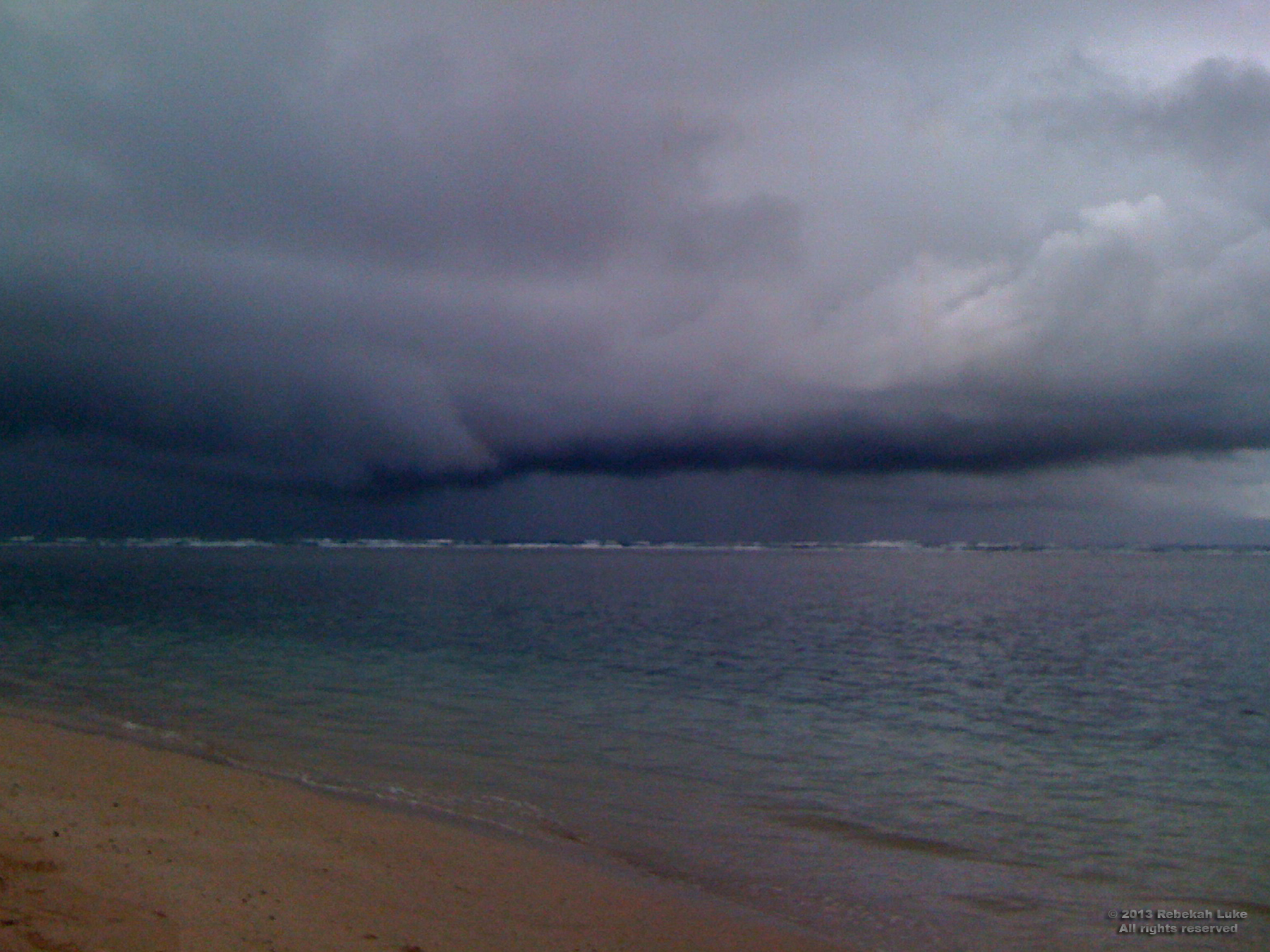
Comments : 4 Comments »
Tags: Hawaii, Kauai, rain clouds, storm clouds, weather
Categories : Fine Art, Travel
At Byodo-In
7 03 2013
Copyright 2013 Rebekah Luke
Comments : Leave a Comment »
Tags: Byodo-In, Hawaii
Categories : Poem
Kudos and thanks to my foodie friends Linda and Lori
4 03 2013Two women I am lucky to have as friends each reached a milestone in their lives and careers in the past few days, and today’s post honors them. Both happen to be foodies. Both have Hakka “blood,” as do I.
Author Linda Lau Anusasananan’s The Hakka Cookbook received the Best Chinese Cuisine Cookbook in the World for 2012 award at the Gourmand World Cookbook Awards ceremony in Paris. It’s a crowning achievement following a full career as a food editor at Sunset magazine, where we met, and many years researching around the world the “cuisine” (if you can call it that) of her ancestral Hakka roots.
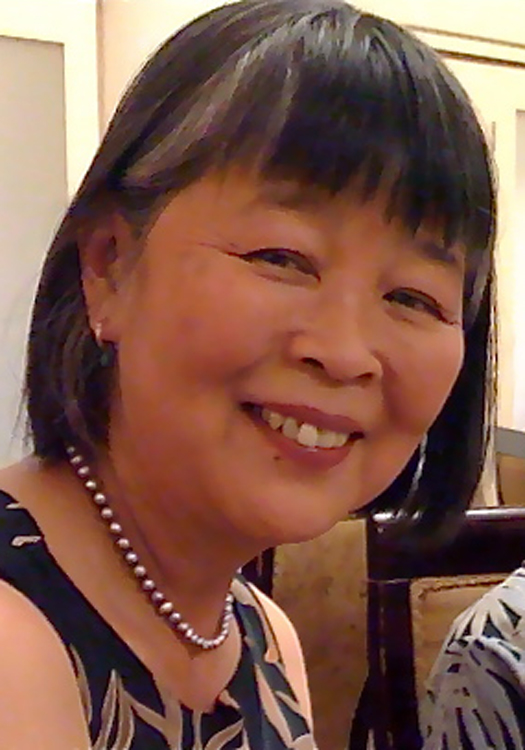
Linda Lau Anusasananan
Hakka Chinese people descend from Han people who emigrated and still emigrate from their original land for a variety of reasons. Where they ended up in the world—in China it was mostly in the south in an area known as Meixian—they were not the first, therefore were known as “guest people” who did not get the best land. They were farmers, and their food was humble and of peasants. The book’s subtitle “Soul Food from Around the World” announces the good eats the reader can learn to make from the recipes Linda tested and fine tuned for the home cook. I guarantee they will work for you.
This is what Hakka families everywhere have looked for. The recipes show how regional cuisine influences basic Hakka food. Linda’s work fills a cultural need as well as explains what “Hakka” is with added stories and historical notes. Ultimately, it is a universal story about food, families everywhere, and how the world has gotten smaller.
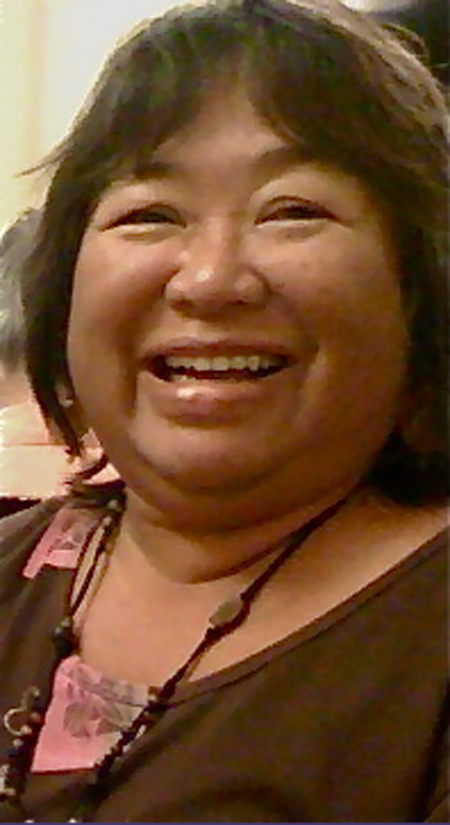
Lori A. Wong
When I left the magazine test kitchens in Menlo Park, California, those many years ago, Linda became the person I would call when I had a question about food science. Then I met Lori on my island.
This week Lori A. Wong, with her mother Marian, closed Byron’s Drive-In, the last remaining of their 17 or 18—it’s easy to lose count—restaurants on Oahu, ending 58 years of feeding islanders. Old-timers will remember Leon’s tavern, Andy’s Drive-In in Kailua, Orson’s Restaurant, Orson’s Bourbon House, Wong’s Okazu-ya, The Chowder House, Byron II, Andrew’s, Coral Reef, The Chinese Chuckwagon, Fishmonger’s Wife, Oinks, Big Ed’s, Andy’s Ebb Tide, The Little Red Hen, Henny Penny Chicken, Orson’s Chowderette, and The Seafood Emporium.
The landlord is planning to redevelop the land near Honolulu airport where you could get a good meal before boarding your plane. On Feb. 28 it was bye-bye Byron’s Drive-In. The rummage sale starts tomorrow, March 5, through Friday in the parking lot. Everything must go.
Now that you know of the Wong Family restaurant empire, and as you read the list above, most started by Lori’s father Andy Y. Y. Wong who died in 1985, and others by Lori and her mom, you are probably thinking, “They owned that restaurant, too?!”
Yup, and Lori’s first thought is that they had a really good run and that the restaurant business is pau (finished, over).
I became acquainted with Lori through our mutual Reiki teacher and friend Alice Anne Parker. Both Lori and Alice Anne certified me as a Reiki Master. Lori is a healer and was working with hospice patients. Over time I figured out Lori was a foodie. She’s taught in the Food Service department at Kapiolani Community College and now teaches cooking to middle school students at Punahou during the summer. She free lances as a food and beverage consultant.
She loves to try new restaurants with friends—as does Linda (the more dishes foodies can taste and disect, the better; lucky for me), but she rarely mentioned her family’s restaurant empire. But now that it seems to have ended, the word’s out. Bob Sigall wrote a nice column in the Honolulu Star-Advertiser.
Both Linda and Lori deserve a crown and a long rest, but I doubt they will rest on their laurels. These are my friends for a lifetime.
Copyright 2013 Rebekah Luke
Comments : 2 Comments »
Tags: cookbook, foodies, Hawaii, Linda Anusasananan, Lori A. Wong, restaurant, The Hakka Cookbook
Categories : About me, Food, Friends & Family
Mountain panorama commands a diptych
5 01 2013There’s something about the Ko‘olau mountains that draws painters to this landscape again and again. Besides their obvious lush and weathered volcanic beauty, they challenge us plein air painters to capture their form in the ever-changing daylight. I spent a lot of time studying the ridges and valleys in my most recent diptych of Lanihuli as viewed from Luluku. Together, the panels measure 60 inches by 22 inches, unframed. Oil on canvas board.

Lanihuli Diptych, left panel
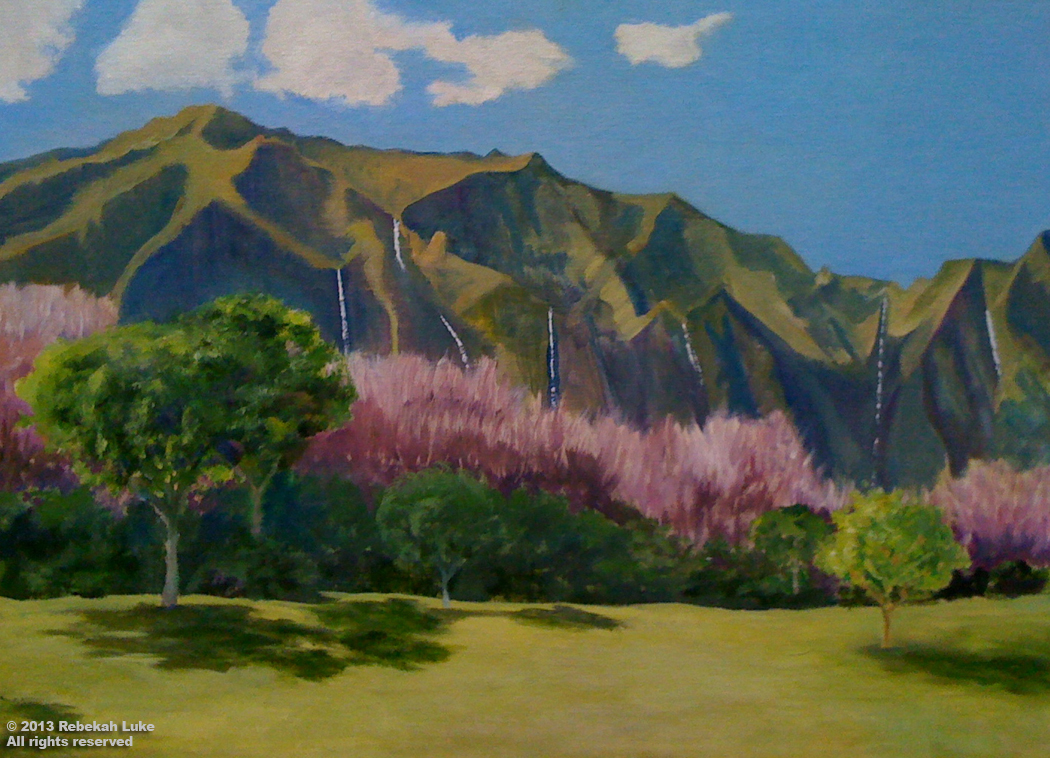
Lanihuli Diptych, right panel
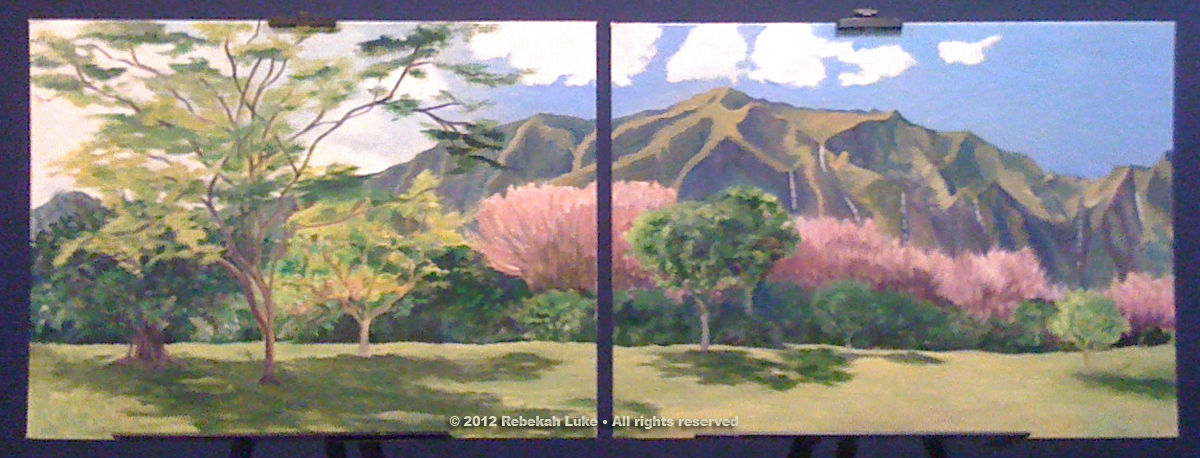
Update 2/2/13: I am please to report that “Lanihuli Diptych” was sold to a buyer at the Punahou Carnival this past weekend. Half of all sales are donated to the student financial aid program at my alma mater. ~RL
Copyright 2013 Rebekah Luke
Comments : Leave a Comment »
Tags: diptych, Hawaii, Koolau Mountains, Lanihuli, painting
Categories : Fine Art, Hawaiian
Art and architecture where Hotel and Richards intersect in Honolulu
1 09 2012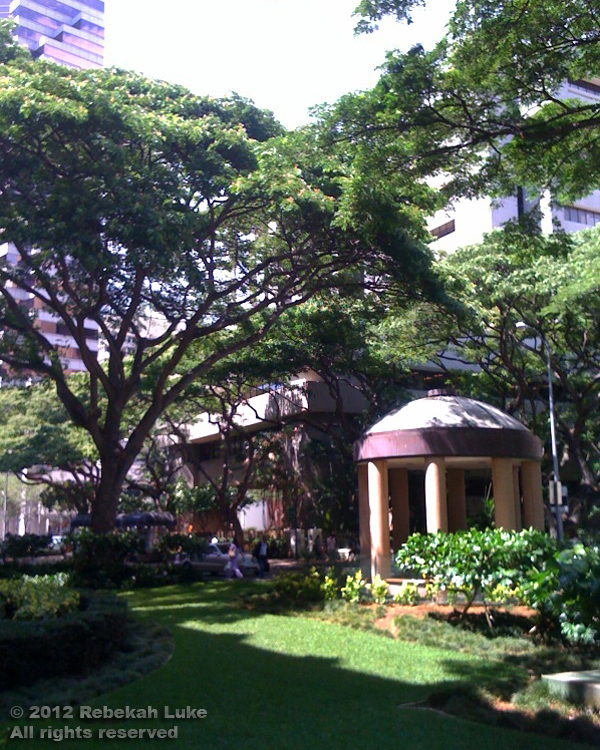
The charming gazebo at Hotel and Richards streets that caught my eye.
After lunch downtown last week with Becky at Café Julia, that got the vote for best downtown place for “breakfast and lunch only,” I strolled up the street, intending to visit the Hawai‘i State Art Museum (HiSAM). Becky suggested I take a look at what happened to the old Armed Services YMCA swimming pool.
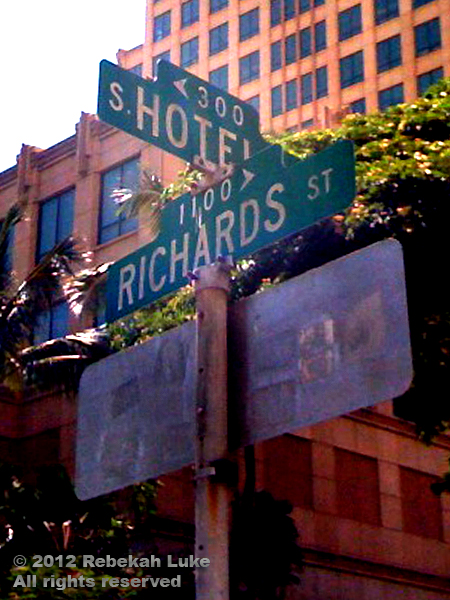
Approaching the intersection of Hotel and Richards, the loveliness of dappled sunlight through the monkeypod trees stopped me. Pause for photos.
I saw four familiar buildings differently than before, and I reflected on their noteworthiness, all in proximity in this small area. Later, it occurred to me that on my little walking tour, I had focused on the historical architecture and fine art of these buildings, making for a very pleasant afternoon by myself . . . while Becky went back to her office to work.
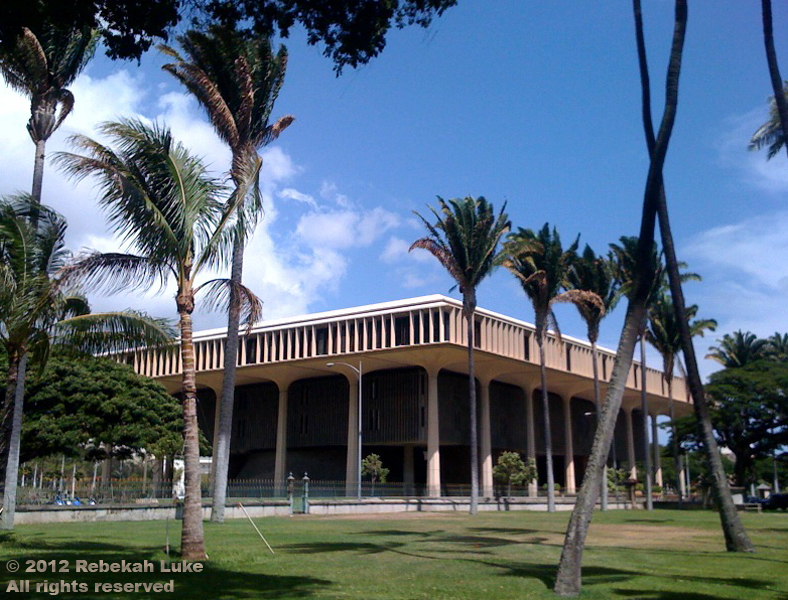
Hawai‘i State Capitol
Kitty corner to the gazebo is the Hawai‘i State Capitol designed by Belt, Lemmon & Lo and John Carl Warnecke & Associates. Its columns represent coconut palm trees, and the two cone-shaped legislative chambers represent volcanoes emerging from the reflecting pools that depict the Pacific Ocean.
In the courtyard floor is a round artwork “Aquarius,” an Italian glass tile mosaic by Tadashi Sato. There are two noteworthy statues at the Capitol: one of Father Damien of Moloka‘i on Beretania street, and one of Lili‘uokalani, Hawai‘i’s last reigning monarch, on the opposite side facing ‘Iolani Palace. Inside the chambers there are large tapestry weavings by Ruthadell Anderson.
Looking makai (toward the sea), notice ‘Iolani Barracks (1871) that housed the Royal Guard on the royal palace grounds. Hawaiian kings and queens lived in the ‘Iolani Palace (behind the Barracks in my photo) until 1893 when Lili‘uokalani was overthrown and imprisoned in her room. Today both buildings are museums worth touring.

‘Iolani Barracks, moved to this site in 1965 to make room for the new State Capitol.
When I was in my twenties, I came to the Armed Services YMCA once a week to rehearse with the Honolulu Chorale. In 1927-28 that building was erected to replace the second building of the original Royal Hawaiian Hotel (Hotel Street was named in 1850; the original hotel was demolished in 1882 and rebuilt). I thought it was grand as a functioning Y and imagined what it must have been like in its heyday. Today the building is renovated, housing State offices and the Hawai‘i State Art Museum on the second floor, my destination.
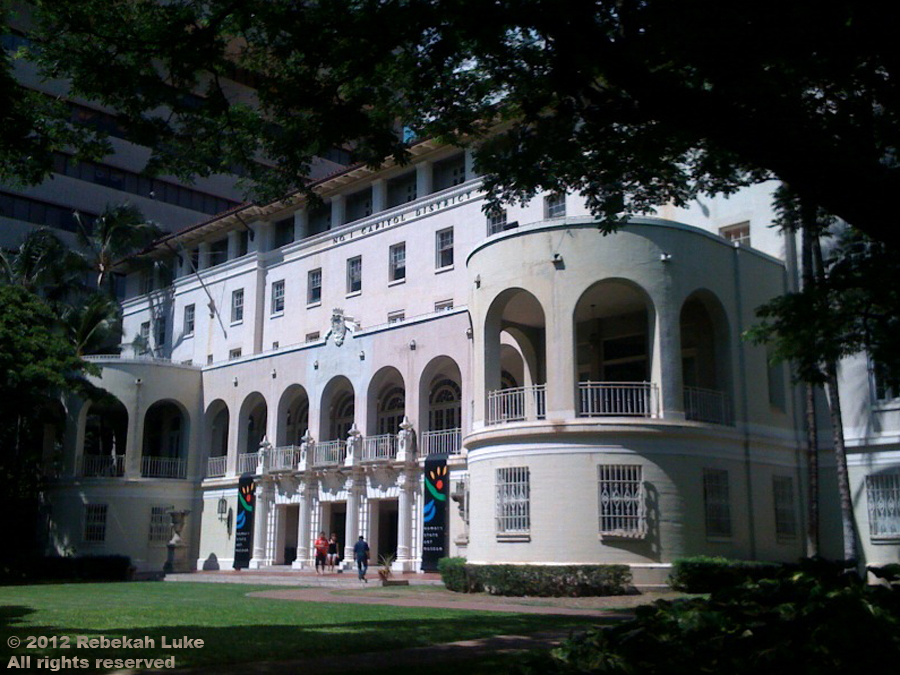
No. 1 Capitol District Building is the former Armed Services YMCA built in 1927-28. The former swimming pool and deck in the middle of the U-shaped building is now a sculpture garden with a pretend swimming pool.
“Visions and Portraits of Hawai‘i” in the Ewa Gallery (toward Chinatown) contains representative work of Hawai‘i’s well-known artists, as defined by the State Foundation on Culture and the Arts. This display is eclectic, in that there is generally one work per artist. But Hawai‘i, since settled by non-natives, is eclectic!
Two stand-out works for me on this visit were the main piece as you enter the area — a painting of Waimea Canyon on Kaua‘i by D. H. Hitchcock (1861-1943) whose impressionistic works I admire greatly, and the painting of women, thickly painted by Madge Tennant.
The theme of the exhibit in the Diamond Head Gallery opposite is “Recent Acquisitions.” What I remember most is the nature photography of Wayne Levin. Three stunning images: an underwater shot of a diver chased by an ulua (I think), one aerial of Hawaiian monk seals at the tidal line (“Monk Seals and Surf, Derby’s Beach, Nihoa”), and one straight-on of birds and clouds (“Approaching Sooty Terns”). Classic clouds for my painting students to study!
Both galleries display impressively large wooden ‘umeke, or calabashes, turned by Robert W. Butts.
On the ground level, passing by the museum gift shop and through Downtown @ HiSAM restaurant, doors opened to the Sculpture Garden in the former swimming pool area. Artist Doug Young created a glass marvel in 2D with such visual depth that it seems as a 3D pool. I got dizzy staring down at it! Interesting. The restaurant staff began setting up for an outdoor garden party, and I moved on . . .
. . . Back to the Richards Street YWCA, half a block toward King street where Becky and I ate lunch. This attractive building was designed by architect Julia Morgan, who also designed Hearst Castle at San Simeon, California. Before I headed home, I revisited a Lau Chun painting hanging above the grand piano in the lobby. It was of the YWCA building as viewed from the palace grounds, and with the street and cars edited out.
His strokes of thick paint are of every color, you’ll see when you examine the painting closely. It’s as Miss Marvelous’s mother, when as a youngster she looked at my oil paintings, said: “I can’t figure out how, when you look at it close up, it’s just paint, but when you step back it’s a picture.” Lau Chun’s painting is an example that value (shades of light to dark) is more defining than hue (color) in a painting.
It can be useful and educational to look at other artists’ work. But more than that, I can pick out those things that are inspirational. Often, looking at other artists’ work usually frustrates me, and I’m only inspired to return to the studio to make my own creations. This time, I enjoyed the things I selected to see in a new light.
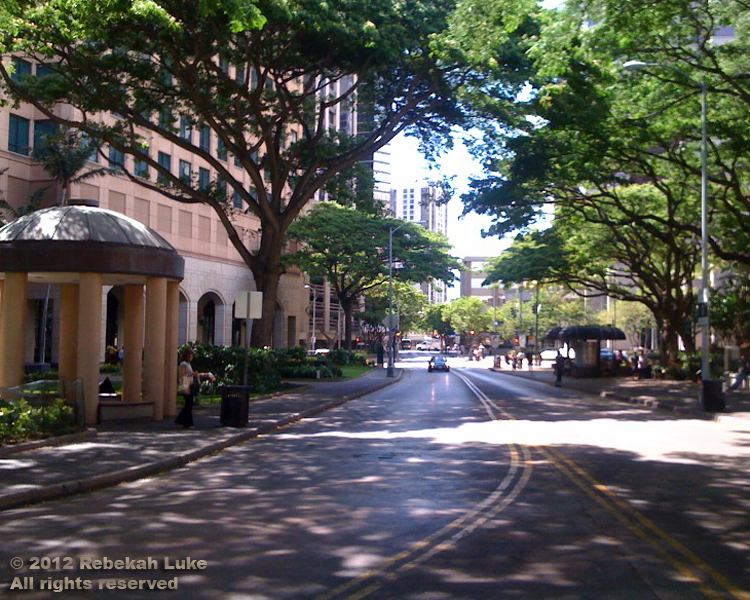
Looking north on Hotel street. Ali‘i i Place, primarily an office building, has a convenient municipal parking garage with cheap rates. The lobby and Alakea street pedestrian entry feature several fine, large paintings by John Wisnosky.
Copyright 2012 Rebekah Luke
Comments : Leave a Comment »
Tags: Alii Place, Hawaii, Hawaii artists, Hawaii State Art Museum, Hawaii State Capitol, Honolulu, Hotel Street, Iolani Barracks, No. 1 Capitol Place, Richards Street, self-guided art tour, YMCA, YWCA
Categories : Fine Art, Hawaiian, Travel
Is painting on your bucket list?
4 01 2012Painting is on my friends’ bucket lists. They’ve inspired me to teach some fundamentals and techniques and offer a course. As promised, I will open my Kaaawa studio for Oil Painting Lessons starting February 2012. Registration is open now and enrollment is limited.
The “Painting I” course consists of 12 weekly lessons on Wednesday from February 1 to April 25. Class sessions will be from 10 a.m. to 3 p.m. and include a lunch break. Tuition is $100 a month. Cost of materials is additional.
I just noticed it’s leap year, so you’ll either get a bonus or won’t have to feel bad if you miss one class.
Students will learn impressionistic painting in oil. Lessons will generally follow those taught by the late colorist Gloria Foss, my oil painting teacher, and as found in Foss’s guidebook How to Paint. I’ll add my own experience as a fine art painter and photographer to show you what to do.
I’ll teach you art fundamentals and the logic of light to give you a solid foundation to pursue painting as an avocation or a vocation.
What you’ll learn
Here’s just some of what you’ll learn in my Painting I:
• Basic drawing — perspective, shape, value, light and shadow • The world in black and white • Basic color theory—monochromatic, analogous, complementary color and full palette • Using color charts and the color wheel • Modeling of formsEach lesson will consist of a brief lecture on art theory, a demonstration, hands-on still life drawing and painting in the studio, homework, and critique.
Each week we will build on the previous technique learned, and eventually we will apply what we have learned in the studio to the landscape.
Gloria Foss and me
I first met Gloria Foss at the Honolulu Branch of the National League of American Pen Women where she was an Arts member and I was a new Letters member. She was a UH Mānoa student getting her Master of Fine Arts degree. She wanted to teach. She said if all of her art teachers had explained some things from the very start, it would have been a lot easier. She was about 60. Teaching was on Gloria’s bucket list!
After I finished the black-and-white photography curricula at Art Center College of Design in Pasadena (I didn’t complete color photography), I sought a studio class to keep my eyes trained. By then Gloria had designed her own “Gloria Foss Color Course” and opened the Foss School of Fine Arts in Honolulu.
Then I had the honor and delight of making the photographs of the studio lessons in her book How to Paint. It’s now my desire to share what I learned, then and since, with others.
Tuition, materials and supplies
Your investment will be the cost of tuition—$100 a month for each of three months for a total of $300—plus the cost of materials and supplies. When you register, you will receive a complete list of art materials to buy.
For the first two or three lessons, you will not need everything on the list. All items on the list will cost an estimate of $125-$150.
Easels will be provided for class use.
An optional text is How to Paint by Gloria Foss (New York: Watson-Guptill Publications, 1991) that will be used for reference. It is out of print, but you can try to locate a used copy. Information on how to obtain a CD of the book will be given in class.
How to register
To reserve your place in class, send your correct name, mailing address with ZIP, phone number, and email address with a minimum $40 deposit to Rebekah Luke, P.O. Box 574, Kaaawa, HI 96730. Or, include the information in an email message to rebekahluke@hawaii.rr.com and send your deposit via PayPal with the DONATE button in the right sidebar. After your deposit is accepted I will send you a supplies list and information on where to go in Kaaawa for the first class. Happy painting!
PAINTING I February 1-April 25, 2012Copyright 2012 Rebekah Luke
Comments : Leave a Comment »
Tags: Gloria Foss, Hawaii, Oahu, oil paint, painting lesson
Categories : Fine Art
New chapter for the old Chong house
12 11 2011In the last chapter, Rebekah, DH, cousin Nathan, and cousin Ann left North Kohala without seeing Grandfather Chong’s house. It was no longer on the former Bond Estate land in Ainakea! A neighbor said the house was hauled away on a truck. Where, oh, where was it now?
Back on Oahu in June 2011 I searched the internet for the folks who lived in the house once, when it was the Kohala Family Homeschooling Learning Center run by Kether — names I didn’t recall until I saw them on the web. Kether confirmed the house and the one next to it were hauled away on a truck. In fact, she would give me the name and number of the man who took them. Thomas A. Quinlan.
Mr. Quinlan rescues historical buildings, finds other land for them, and restores them. It’s his passion.

North Kohala highlighted on a map of Hawaii island.
He said one of the houses was in Waimea (about 40 minutes drive away) with a veterinarian, and the other was behind Kita Store, the little green one right on the highway on the way out of Hawi going toward Kona ( about 5 minutes away). A new family was ready to move in.
While on the telephone I’d written in my notes where “our” house was and where the “bachelors'” house was. My grandmother cooked for the bachelors next door during her time at Ainakea.
After we hung up, I looked at my notes, but I didn’t trust them. My slight dyslexia sometimes causes me to reverse elements of pairs if the information comes in too fast. Which house was where? Shucks. It’s a long time before our August 2012 reunion that we’re planning for Kohala (hence the house search); I’ll verify the site later, I thought.
Meanwhile, after seeing the photos on my blog, Mr. Quinlan posted a comment:
“Your family house is still alive and well in Kohala. I moved it to a friend’s place so that it could be cared for and restored. That is exactly what is happening. It is looking beautiful.”
Enter cousin Jim, our family genealogist, here on vacation from the University of Melbourne (Australia) to update our family history. “Let’s go to Kohala,” he suggested. “I’m not sure my teaching schedule will allow me to come to Hawaii next August.”
Immediately DH said, “Rebekah, I think you should go. You still have something to do there.”
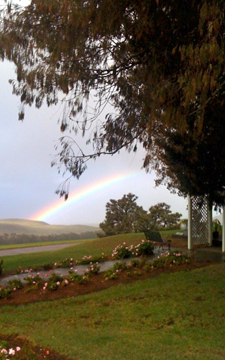
Kohala rainbow seen from the guest cottage
Jim’s aunt, who is my first cousin Elly, arranged for us to stay overnight in a private guest cottage at Kahua Ranch up in the mountains. It would be all right, as she would be there too. I emailed Tom Quinlan to ask about the houses again. As Jim and I left for Kohala, no reply.
Last Tuesday afternoon we drove down to Hawi looking for Kita Store. There were several painted green on that main street, and none named Kita. The realty office that helped me on the last trip was open, so in we marched to ask.
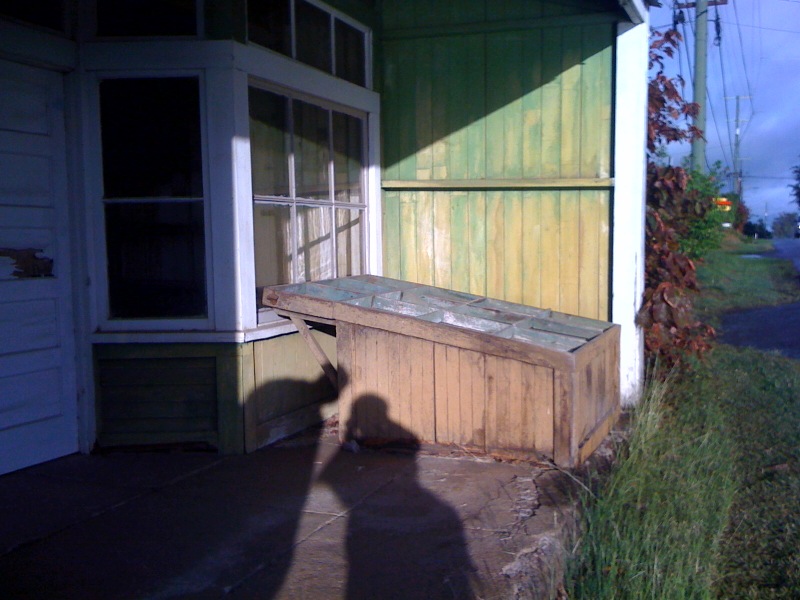
Afternoon sun casts our shadows across the Kita Store storefront, with abandoned produce bins. Through the window we saw shelves and fixtures as in a dry goods store.
We learned that Kita Store was closed, in cobwebs, and a little farther down the highway pass the theater. The kind woman in the office provided us with a detailed description, and pinpointed the property for us on a map.
The house we found in Hawi didn’t look right to me. Nope. I don’t think so. I think this was the bachelor’s house, I said to Jim. No one was home. It began to rain, and we quickly took the opportunity to take some snapshots of the exterior. In the morning we would call the vet in Waimea.
We then went to Ainakea so Jim could see that, indeed, no house was there anymore.
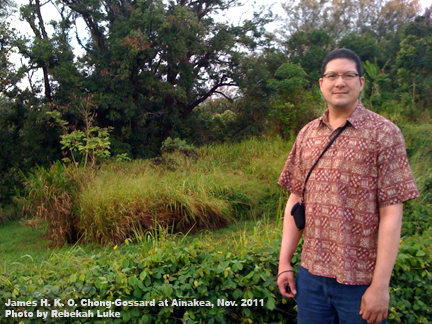
Cousin Jim at Ainakea, former site of his Great Grandfather Chong's house
On the drive up the mountain back to the Ranch, I remembered my friend Phil was now working at a ranch in Kohala, but I wasn’t sure which ranch or if there was more than one ranch. At supper around the kitchen table in the main house I asked the owner Monty Richards if Phil worked there. Yep, he’s here, he works in the shop.
Phillip Oveland is a professional motocross racer, the nephew of my good friend Andrea who lives across the stream from my studio. We’ve played poker together, but I don’t see him much since he moved to Hawaii island. I could pay him a visit in the morning.
Late that evening I saw the email reply from Tom Quinlan. He was in Ireland restoring an old castle and would be back in Kohala next week. The house behind Kita Store needed to be moved again, he wrote, and he was looking for a suitable spot. Did I know of a place? His inference (by me) was that it was our ancestral family home. I still wasn’t convinced and again reviewed comparison photos. One clue was the roof. It was white while the roof of the one we were really searching for was red.
After breakfast I phoned the vet’s office, and he was out of town until . . . next week! His staff knew of the house I asked about, and yes, I should wait until the doctor came back. I left my name and number. Guess I could ask for him to send a picture. Later.
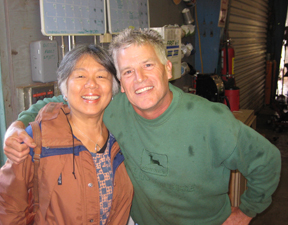
Me and Phil
There was not much to do now except see Phil. He bounced down the stairs. “Rebekah!” So welcoming. He introduced Jim and me to Jean, his trainer. When we told our story, Jean said, “I know exactly where that house is.”
Jean told us where to go. We did. And, without a doubt, we found Grandfather Chong’s house sitting comfortably against a beautiful backdrop of the misty hills of Waimea, still under restoration and looking beautiful and well cared for.
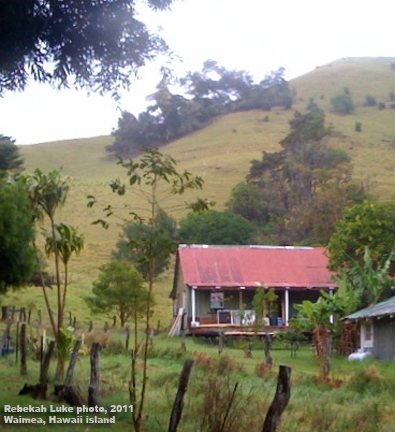
Our family's old house from Ainakea has new life in Waimea. We're thrilled!

Current view of the side of the house that used to face Akoni Pule Highway
Copyright 2011 Rebekah Luke
Comments : Leave a Comment »
Tags: Ainakea, building restoration, family house, gratitude, Hawaii, historical preservation, James K.O. Chong-Gossard, North Kohala, rainbow, Thomas A. Quinlan
Categories : About me, Friends & Family, Memoir


 Rebekah’s Studio

Recent comments