Working on a diptych

28 01 2011

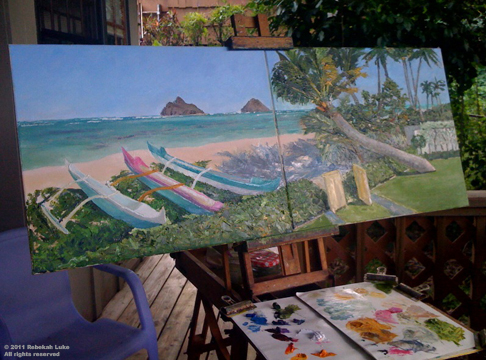
Off and on since Thanksgiving I’ve been working on finishing a diptych—an image on two panels, each of which can stand alone. I paint with oil on canvas. After I finish the painting, I’ll wait a long time—several months—for it to dry, apply a coat of varnish, and put the panels in two frames, most likely of koa.

This style is “impressionistic representationalism.” The viewer is able to recognize the scene, in this case, classic Lanikai Beach on Oahu with the Mokulua islets offshore. The paint edges are soft and approximate rather than hard and exact.

I like to paint images of where you might have been and want to remember, or of places where you’d rather be. This diptych began en plein air on location. Thanks to my hanai relatives Karl and Julie for their hospitality on site.

METHOD.  I started by loosely applying very thinned-out oil paint wash, using two or three tints, to the canvases with a 1.5″ brush, in a random pattern, leaving no white showing. I’m trying to leave  about 5 to 8% of this under painting showing to give the finished work a jeweled look.

While waiting for the wash to dry, I did an ink sketch of the scene, including the shadows, in my small notebook.  I made more than one sketch, experimenting with different compositions. Hand drawing a sketch reinforces the scene in my memory with similar results as taking written notes at a lecture.

I also set up my palette, generally arranging the colors following the color wheel order. Then I was ready to block in the scene on the canvas, using a brush and paint and referring to my ink drawing. I was careful to sight the objects to make sure my proportions were correct.  Yes, I actually stretched out my arm and measured with my thumb or a brush handle!

I mixed the “local” colors (middle tones) on my palette, as well as a dark and a light of the color. I painted analogously. That means, to darken a color I mixed in the next neighboring (on the color wheel) cool color for a shade. To lighten a color, I added a little of the next neighboring (on the color wheel)  warm color before adding white.

As a general example, take the local color red. For a dark red that one would see in the form shadow of, say, a tomato, I would mix in alizarin crimson. For a light red, I would add a little orange to the red before adding a little white. In teaching this technique, my teacher the late Gloria Foss called it the “Tomato Theory.”

Gloria taught that painting analogously was prettier than simply adding black or white, or the complement color to darken.

I love the idea of being able to call on your neighbors to help out instead of going  across the island!

When I finally got paint on canvas, I first put in the local colors that had the lightest values—usually a tint of white, and the darkest values. These were the off-white outrigger canoes and the dark coconut palm fronds. I put the lightest and darkest values in first that let me know all the values in between were relative to those two extremes.

As I painted I held up some paint on my palette knife against the object, like the sky and the ocean, to check that I had the hue and value (lightness or darkness) correct. I learned these last two tips from the late painter Peter Hayward.

I painted all over the canvas at once, by hue, considering both panels at the same time, so that the painting would become a tapestry of color. There are color repeats throughout.

In the end, much of the artwork is about the light. What direction is the light coming from in the painting? In plein air landscape painting, the sun moves constantly. What is the logic of light? That is, what does the light do when it hits a certain form? When it reflects?

Copyright 2011 Rebekah Luke

Related post: https://rebekahstudio.wordpress.com/2010/12/01/its-rock-star-snowing-on-lanikai-beach/


A fresh look at the art of painting green

20 10 2010

Some painters claim they don’t know how to paint green. It must be why paintings of this hue are generally absent in the art galleries. In this post I’ll show how to paint green. With oil paint, the trick is to change your base color.

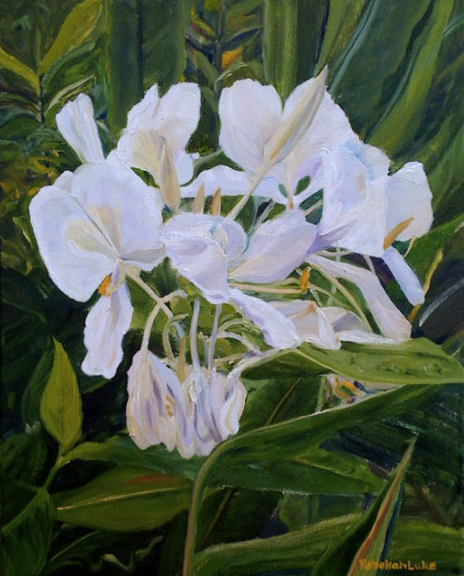
I love green. “Banyan in the Park” and “White Ginger,” two of my most recent paintings, are predominantly green. Looking at them gives me a feeling of calm, coolness, and serenity. More so, I can recall the satisfying experience of choosing the images and transferring them to canvas. I can smell the sweet scent of the ginger patch.

Banyan in the Park

White Ginger

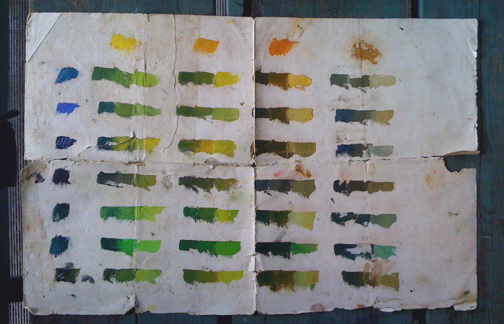
Painting green is no secret, it’s a technique. As mentioned, it’s all about changing your base, your base being a yellow or a blue because yellow plus blue equals green. In the field, I still use a color chart I made when I took my first painting classes. Someday I’ll paint a new one!

My green color chart on canvas paper, a bit ragged but still useful!

You can make a chart like this too. Use a palette knife. Put a swatch of each of your yellows in the top row. Down the left column, dab a swatch of each of your blues, including black if you use black. The greens in the body of the chart are the result of mixing a blue with a yellow. For each combination of the two colors, I have added white two times to get a “light,” “middle tone,” and “dark” of the same hue. See how many different greens there are!

When I am on location, I literally walk up to the object—e.g., a leaf—and find the swatch on my color chart that most closely matches it, eliminating any guess-work. If the object is in the distance, I hold up my palette knife—with paint on it—in the air in front the object and squint to see if the hue and value (lightness or darkness) match. When you paint a green scene, step back for a moment now and then. If it’s starting to look all the same, maybe it’s time to change your base to “find” another green.

Going a step further beyond the colors on the chart:

To lighten, “warm it in the light,” that is, add the next lighter yellow from your palette plus a little white. To darken, “cool it in the shade,” that is, add the next darker blue from your palette.

This technique of warming it in the light and cooling it in the shade is known as “analogous,” meaning to use the next color on the color wheel. In the way I paint, I prefer analogous to “complementary.” Adding the complement—the color opposite on the color wheel—to a color will also darken, but it will also appear comparatively chalky. Put another way, if I want to darken green, I add blue, not red.

If you are still with me ;-), here are a couple of exceptions.  When painting a landscape, colors become muted and lighter in value in the distance. In this case the painter would choose complements. Realize, also, that whenever you see gray, use the complement.

I learned these tips from my teachers Gloria Foss, Vicky Kula, and Peter Hayward who taught us how to turn the form and about the logic of light.

Thank you!

Copyright 2010 Rebekah Luke


Lifelong learning about my art process

10 08 2010

Kaaawa Valley Morning

Some things take a long time. Waiting for an oil painting to dry is one of them. Here is “Kaaawa Valley Morning.” I painted it in May and varnished it this week. It’s already sold to a happy family waiting patiently to hang it in their home!

Oil paint takes at least three months to dry. A painted canvas should be bone dry before adding a protective varnish coat, for best results. So when commissioning an original painting, allow at least six months for delivery. That would be the technical aspect. As for the practical aspect, each artist has his/her own process that varies from artist to artist. Perhaps plan on a little longer.

Last Thursday I was happy to see Kit Kowalke, among other lovely friends, at our art reception at Ho‘omaluhia Botanical Garden. I first met Kit, an artist and art educator, when she was teaching at Honolulu Community College and I was in university relations. She was always cheerful, always a pleasure to be around, always sharing and helpful, always fun! And she still is.

She asked what medium, I said oil, she asked how do I paint, I said one at a time. That is, I like to finish one painting before starting another. And that my paintings take a long time to dry. Oil painters often switch to acrylic because the medium dries quickly, and they can get their work out on the market faster. Personally, I’ve been partial to oil because of the way the colors mix and look.

What I didn’t say was that I don’t like the state of unfinished-ness, or that unfinished projects are stressful to me.

“Oh!” Kit told me, “no need to paint one at a time, you can paint more than one at a time. Like two or three.”

“I can?!” 😕

“Yes!” she said. “Sometimes you might want to let an oil dry before painting on it some more. While you wait, start another one. Go back and forth.”

Well, that’s a perspective I’ll consider. And, I think that will ease my stress over things like unfinished home and garden remodeling projects. I can think of them as works in progress!

She asked more questions and gave me more tips, even volunteered which classes and workshops I could attend nearby. Which is what my intention was when I first left art school—to regularly keep my eye in training by always taking part in a studio class.

It is the advice given also by my tai chi sifu Alex Dong, who advocates not waiting until you have mastered a set before learning a new one because there are aspects of each set that help in understanding other sets. Or, (my interpretation) you will always be improving on the basics. Clicking on the above link to his website takes you to his journal article about the subject.

Somewhat similarly, when I was taking beginning kumidaiko (Japanese ensemble drumming) lessons and had an interest in composing, I asked the master Kenny Endo at what level one could start composing. How long must I study taiko before I would have enough knowledge to write drum music? He replied he believed one could start composing at any level.

Some things to think about. In my case, they still may take time because that’s my process. So far.

Copyright 2010 Rebekah Luke

Quite a few images are ready to leave the studio; these paintings are dry!  See my PAINTINGS page. If you are on Oahu, visit the art show at Ho‘omaluhia Botanical Garden during August 2010. Please see my previous post about seven artists.


The story of the boat lei

21 07 2010

Every two years in July about 50 sailing yachts compete from San Francisco Bay to Kaneohe Bay for the Pacific Cup, “the fun race to Hawaii.” It’s organized and hosted by Pacific Cup Yacht Club in Northern California and Kaneohe Yacht Club in Hawaii. The boats have handicap starts and sail under the Golden Gate Bridge and across the sea to arrive around the same time, hopefully, and in time for the parties ashore on Oahu.
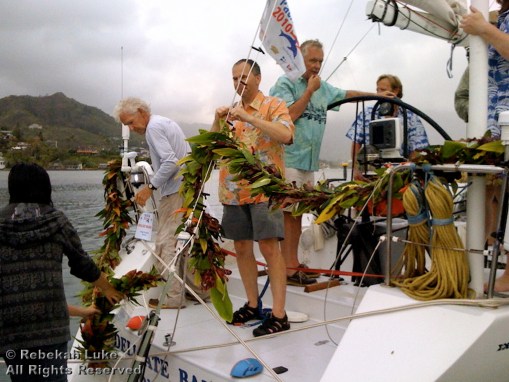
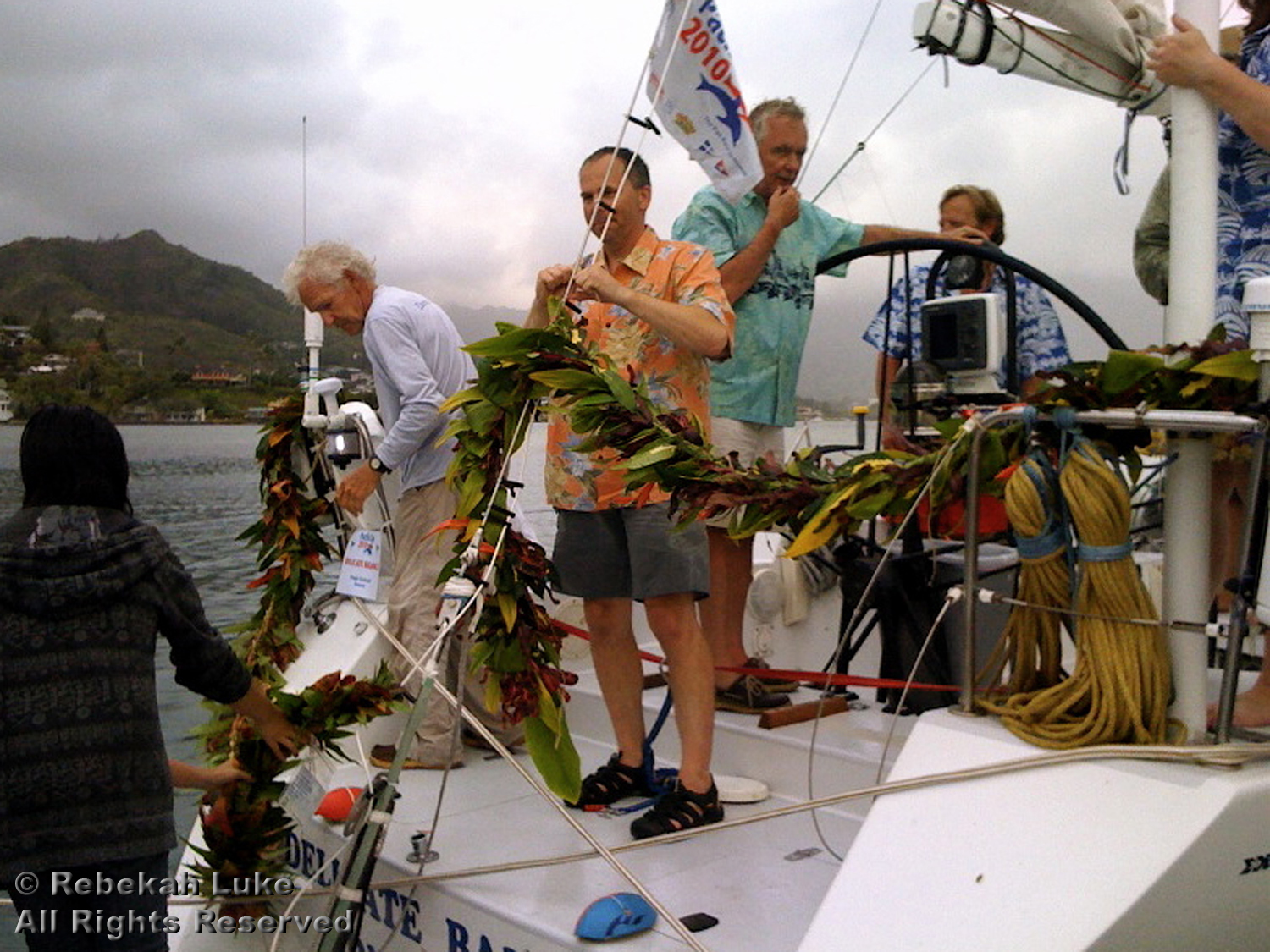
Delicate Balance arrives at Kaneohe on a cloudy afternoon. Two boat lei welcome her.

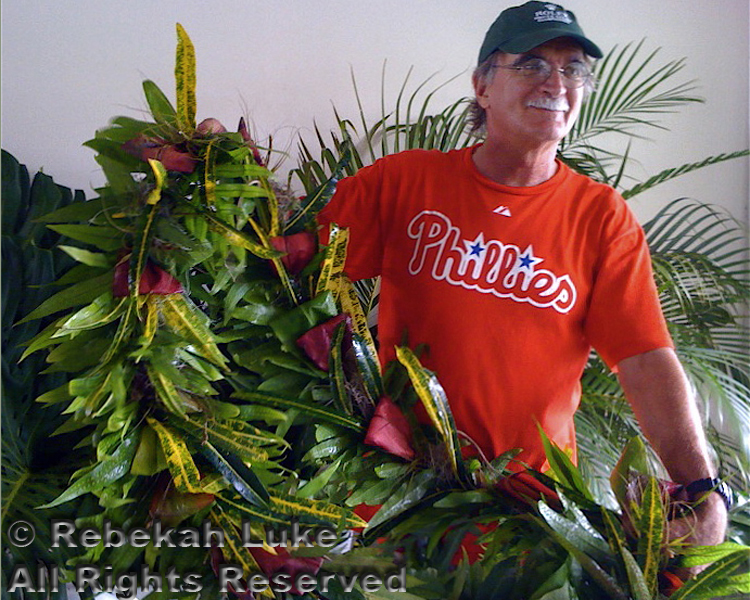
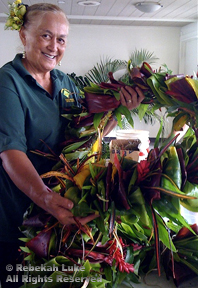
Many years ago I became the volunteer chair of the Boat Lei committee for KYC. I’m affectionately known as the Boat Lei Lady! A boat lei is a giant 12-foot garland of fresh, tropical foliage to greet and honor the vessel that carried her skipper and crew safely across the ocean.

Some call it a bow lei because it is attractive draped over the front end of the boat. Because most of the Pacific Cup yachts tie up stern to, we renamed it boat lei. It may be fastened anywhere as a decoration. The custom of presenting the lei has become a Pacific Cup tradition.

It takes many hands to make the boat lei for this event. The finished products are beautiful works of art and much admired. Event organizers inform the racers, family and friends they may pre-order the lei so it’s ready for their favorite boat when it arrives.

Last Friday, Saturday, and Sunday my crew made 45 boat lei! Many thanks to Michael and Bobbi for the promotion in California and for handling the sales from the e-store. That was a big help. Thanks to Kaneohe Yacht Club for lending the workspace. And, of course, mahalo (thanks) to all the lei artists for their remarkable team effort. Some KYC members also pitched in, and we are grateful for their contribution.
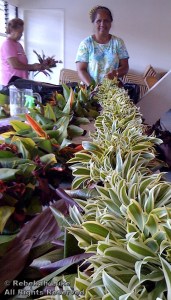
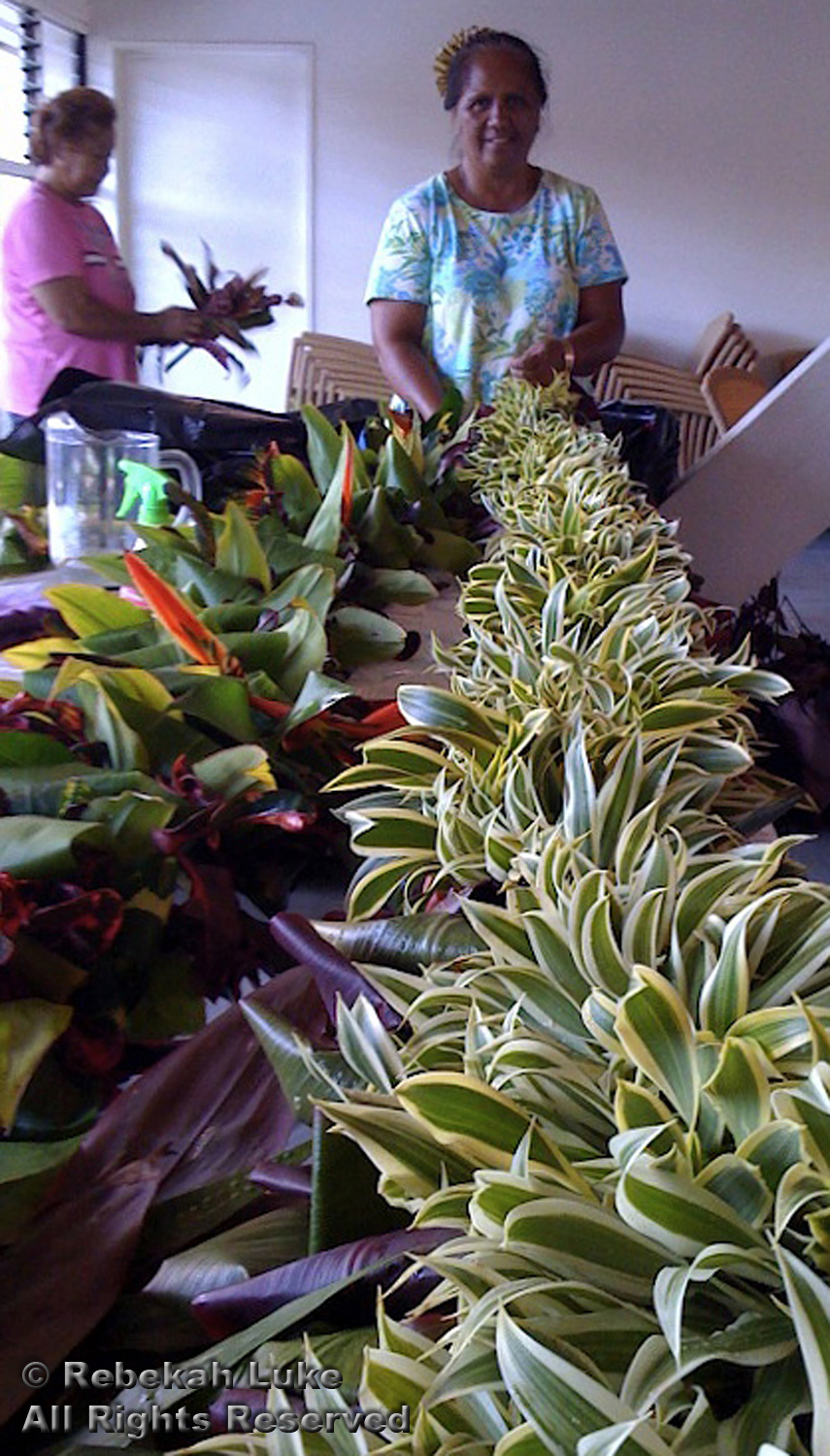
Haleaha finishes her 12-foot lei made with variegated Song of India clusters and red ti leaves

How do we make the lei? And how are we able to make so many? I’ve been asked. I will tell you! But first a little history and a funny story.

LITTLE HISTORY. In the early years I worked with  members of Hale Kuai Cooperative, a Native Hawaiian organization, to design the basic lei. We wanted cut foliage that would hold up in the sun, rain, trade winds, and salt air and look pretty for at least a couple of days in the elements.

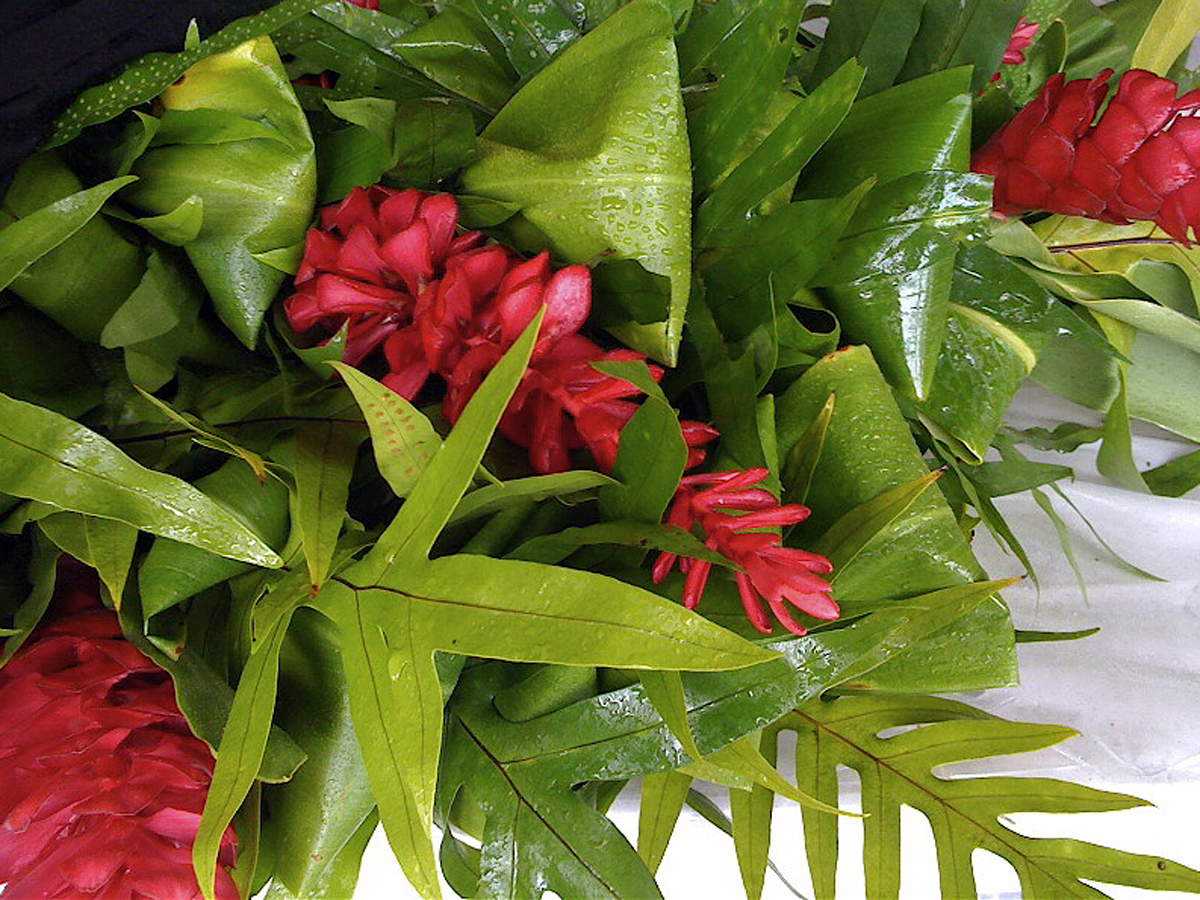
We settled on lai (say LAH-EEE, leaves from the ti plant), lauae (say LUH-AU-AY , a fragrant yet sturdy fern … Phymatosorus scolopendria, syn. Microsorium scolopendria), and multi-colored croton leaves. Our friend Kapa showed us how to use floral wire to bind the foliage; she learned the use of wire from her kumu hula. And Aunty Havana, who is a master at making hat lei, showed how to combine everything into lovely creations, once she figured out how to translate small to big. The lei became a product of the Co-op.
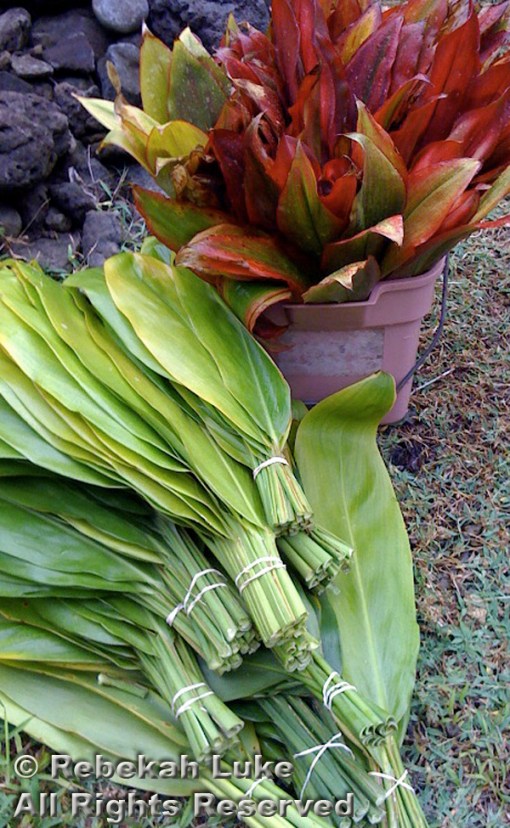
Green and red ti leaves. When picked from the stalk, they are called la‘i.

In more recent years, I have partnered with Koolauloa Hawaiian Civic Club to supply the boat lei. Volunteer members and friends gather the plant material from their gardens and from the mountains, donating the material and their time to the project. Other members and friends, who are artistic and enjoy lei making, work professionally as floral designers for a few days and assemble the lei.  The net proceeds from the sale of the lei provide scholarships for Native Hawaiian club members and/or their children.
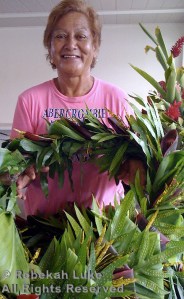
Clover's lei

FUNNY STORY. The very first year of my boat lei experience, we made the lei fine, but I had not given any thought to delivering the lei. I was so involved in providing a product that it did not occur to me that the boats would arrive at any time of day or night, 24/7. OMG! It was too late to organize any shift work.
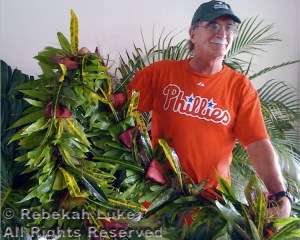
Pekelo's lei. Yellow-and-green croton and red ti provide accent color among the other greenery.

DH (Darling Husband) has a sailboat moored at the yacht club. He and I monitored the ETAs, and for an evening arrival, we would catnap on his little Mugquomp and wake up as the radio crackled to announce a boat had crossed the finish line. As we climbed out of our bunk and put on our jackets, for it was cool and a little rainy, we were fascinated and impressed by the radio conversation between Iwalani of the Escort committee and each arriving yacht. In her very calm, reassuring, professional, and gracious way, Iwalani gave the information and instructions on how to enter and come down the channel (with coral reef on both sides) to the dock at night. We had enough time on foot to greet the boat with a big lei.

DH and I were very short on sleep that year. Someone later suggested that we arrange for the Leis and Trays committee to deliver the lei. Brilliant! That committee is much larger and greets the boats with Hawaiian music, lei and mai tais for the captain and crew. Why not the lei for the boat too?

HOW TO MAKE A BOAT LEI

The style of the lei is known as wili (say WEE-LEE), meaning to wind. We wind by hand—one must have strong hands to tug—using wire instead of a natural twine or raffia traditionally used to make a hat or neck lei. Wire allows us to put the work down and makes it easier on our hands. Our lei are 12 feet long, but shorter lengths make lovely bouquets, wreaths, and table decorations. Allow enough time to gather & prep the materials and make the lei. It takes about two hours to make, excluding time to gather.

Each artist has his/her “line,” so do not worry that your lei does not look like someone else’s. It won’t. The variables are selection and placement of the plant material as well as the available supply of the greenery and flowers. Here is the basic way to construct the lei.
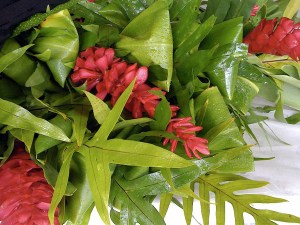
Ti, lauae, and red ginger combo

Materials to make one 12-foot lei:

1 kaau (which is 40) each of ti leaves, lauae, croton leaves. Be sure to leave about 4 inches of the stem on. The stems provide the slightly stiff backing for the lei. Do not strip the mid-rib from the ti leaf.

A few tropical flowers—such as, heliconia, red ginger, bird of paradise, bougainvillia clusters—with 6-inch stems to intersperse throughout the lei (optional)

One 24-gauge paddle wire from the floral supplier or craft store. One paddle is enough for one and a half lei, or approximately 18 feet total.

String to tie on the finished lei to the boat

Gloves (optional) to protect hands from croton stains

33-gal. plastic trash bag (optional)

Ululani's lei

Tools:

Work surface such as a table or floor, hand clippers, scissors, spray bottle of water

Step 1. Gather and prep materials by sorting by color and size, cleaning, and bundling.

Step 2. Pick a palette of 3 or 4 types of leaves if you have a wide choice. Include ti and lauae in your palette.

Step 3. Take the tip of a large ti leaf and turn it under to meet the stem, shiny side out, bending it in half but not creasing it. Fasten the tip to the stem with the wire, winding it around the leaf 5 inches from the ends. Begin winding about 5 inches from the beginning of the wire, securing both the ends of the leaf and the wire together. Grasp the two ends of the leaf and the end of the wire with one hand (if you’re right-handed, use your right hand), and wind the wire with the other hand, going around about 5 times. Be sure to pull the wire taut. This is the start. You will use one continuous length of wire and not cut it until the end (unless the wire accidentally breaks).

Step 4. With the tip of the ti leaf facing up and pointing toward you, place a lauae leaf on top with stem pointing toward you. Wind the wire around 1/2 inch down from your start 3 times, again pulling taut. Next add some croton in the same way, 1/2 inch down. Then add another ti leaf. This grouping forms your pattern.

Step 5. Repeat Step 4. Alternate placement right and left, if you wish, to cover the sides. With each addition, come down about 1/2 inch. Remember to pull the wire taut as you wind so that your lei does not come apart.

Keep the width of the lei the same by checking the sections you did earlier. If your lei is getting wider (this is common with beginning lei makers), allow less material to show or leave more space as you add. Just be sure your wire is wound every 1/2 inch, catching all the stems. From time to time, turn your lei over to examine the back. Hold your lei up with one hand and give it a good shake to make sure it is secure. From time to time, spray the lei with water to keep it fresh.

Step 6. After the lei is the desired length, end it by winding the wire around itself about 10 times. Snip wire with scissors. Tie string with a square knot to the lei at 4 or 5 points as a way to fasten the lei to the boat.

Step 7. Keep the lei cool until ready to decorate. A cold air-conditioned room is ideal. Mist with water.

Step 8 (optional). For transporting or brief storage, roll the lei into a wreath and place in a 33-gallon plastic trash bag. Leave an opening for the lei to breathe.

And that’s the story of the boat lei. Enjoy your creation!

Copyright 2010 Rebekah Luke


Momma and Dr. Usui said, honor and thank our teachers

27 05 2010

A shopper at last weekend’s Native Hawaiian Arts Market asked me if I considered myself a self-taught painter. “No is the short answer,” I replied quietly.

I believe in taking lessons, followed by lots of practice. I took lessons.

In the Hawaiian culture I learned everyone must have a teacher. Never mind you think you don’t need one, that you can do your own whatever. At least not in the beginning.

The first thing someone will ask is, “Who’s your kumu?” If you can say, “My kumu was ___ ,”  respect for your work goes up a notch. If you can’t, the response might be, “Uh-huh,” and you hardly will be given the time of day and wonder why.

Perhaps after working at it for a while, an artist will perfect his/her line and system and turn out creations that are identifiably theirs, but most successful artists have gotten a background of the universal principles and basic techniques prior to discovering how to manipulate the medium into something original and all their own.

Having a teacher gives your work credibility. It applies to more than just painting.

For example, at the opening of Oceania Exhibit at the National Museum of Ethnology, a.k.a. Minpaku, in Osaka, Japan, for which the museum built a replica of the Hale Kuai Cooperative store in Hauula to represent the Hawaiian Islands, Kealii Gora attended officially as cultural consultant, and I attended in my role as the real co-op’s executive director.

Ka Lahui Hawaii and yours truly co-founded the cooperative to buy and sell products made by Native Hawaiians.

Hale Kuai Cooperative caught the attention of Minpaku anthropology professor Akitoshi Shimizu, who led the project team. He felt it depicted a movement in economic development among indigenous Hawaiians in 1999.

The opening ceremony was hauntingly beautiful and Kealii’s oli (chanting) rocked the entire hall. Afterward a VIP guest confronted him and wanted to know “by what authority” Mr. Gora performed the protocol, along with a Maori representative from Aotearoa.

Interestingly, but not surprisingly, Kealii did not reply that he was an officer of Ka Lahui Hawaii (a de facto Hawaiian nation). That he most certainly was. He replied, “My teacher was Kumu John Keola Lake.” There wasn’t anything the guest could say after that.

Similarly, certified Reiki masters will identify their credentials by stating the genealogy of their Reiki line. I am 10th generation from Dr. Mikao Usui through Mrs. Takata. That brings to mind Dr. Usui’s precepts:

Just for today, do not worry.
Just for today, do not anger.
Honor your parents, teachers, and elders.
Earn your living honestly.
Give thanks to every living thing.

My mother, a piano teacher, taught me to remember and acknowledge my teachers. So I honor my teachers of art and Reiki by naming them here. Most of my teachers throughout my life were influential in some way, but these people made a loving impact.

Richard Nelson, Punahou School art history
Duane Preble, University of Hawaii at Manoa art history
Masao Miyamoto, University of Hawaii photographer
Michael Tamaru, University of Hawaii graphic designer
Glenn Christiansen, Darrow Watt, Norman Plate, Sunset photographers
Art Center College of Design faculty
Gloria Foss, The Foss School of Fine Arts, landscape painting
Vickie Kula, The Gloria Foss Color Course, studio drawing and painting
Susan Rogers-Aregger, Arts of Paradise gallery management
Alice Anne Parker, Reiki master
Lori Wong, Reiki master

Thank you for teaching me.

Copyright 2010 Rebekah Luke


Vog: an art lesson

29 10 2009

It’s voggy in the landscape today. I saw it when I drove from Kaaawa to Kaneohe.

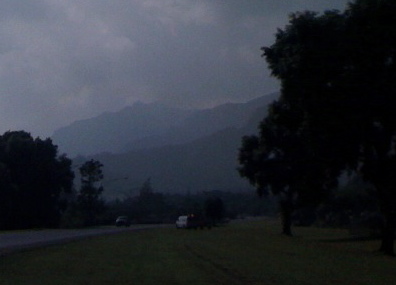
Koolaus in vog © Rebekah Luke

The Koolau Mountains in vog, about 10:15 a.m. today. Notice the ridges appear in three tints of gray.

What’s vog? Vog is the less-than-clear air that we have when the kona winds from the southeast blow the emissions from the volcano up the island chain toward the northwest. It’s like the words fog and smog. It hangs around until the regular trade winds return.

Vog is worst on Hawaii island, a.k.a the Big Island, home of the eruption. The falling ash deteriorates homes and crops, and the smokey air makes it hard to breathe. It reminds me of when I arrived at art school in Pasadena (Los Angeles) one August and was told as I gazed out the floor-to-ceiling windows, “The mountains are right there in our backyard, and they’re beautiful, but it’s so smoggy, we can’t see them.”

One good thing about the atmosphere as today’s vog, though, is that it serves to explain how to paint distance. Generally, objects in the foreground have the darkest value, and as objects recede into the middle-ground and background, they become lighter in value. As one’s eye moves back into space, the values become lighter.

On an ordinary sunny day, the kind that prompts us to say, “It’s just another beautiful day in Hawaii!” the Koolau Mountains are clear and colorful enough to see the individual trees on them. To represent such a scene with paint and for it to “read” properly, we consider the logic of light and either lighten and/or mute the colors in the background, even though we don’t see them that way with our eyes. But on a day like today, you absolutely can see it.

If you have ever seen the Blue Ridge Mountains in Appalachia, or photos of them, it’s the same thing.

Nuuanu Pali pass © Rebekah Luke

Nuuanu Pali Lookout (center of photo) viewed from Luluku, about 10:30 a.m. today

This morning my destination was Hoomaluhia Botanical Garden at Luluku at the foot of the mountains where I go to paint.  Here is a photo of the Nuuanu Pali  pass viewed from Luluku. Ordinarily the cars on the highway and the people at the lookout are visible.

Notice that both photos appear blue, or blue-gray. My own eyes did not see the scene this way because I am used to seeing the scene in full color (the whole spectrum), and my brain translated it into full color. But, as the saying goes, the camera doesn’t lie. Blue is the color of atmosphere.

Now, knowing about values (shades of gray) as they relate to distance, and knowing about the color of atmosphere, you can represent distance in a painting by muting and lightening the colors of objects as they recede.

If you forget to do this initially in an oil painting, there is a glazing technique you can use, but only after the paint is dry. Take a dollop of painting medium with your palette knife and mix it with a tint of blue pigment (e.g., white + ultramarine + cobalt). Have a clean, soft cloth handy. Brush the glaze over the part of the painting that you want to lighten. Then, working quickly (because glaze dries fast), wipe off with the cloth little by little, if you wish, to get the effect you want. Ta-dah!

The values underneath that you painted originally will stay the same, that is, the relationships among the values will remain. You are simply putting in the atmosphere with your tinted glaze.

Don’t worry if the glaze gets beyond the area you want. Just go back and paint over it. (We call that “destroy and recover.”)

Copyright 2009 Rebekah Luke

Thanks to Gloria Foss who taught me how to do this. To see my oils, click on PAINTINGS in the menu bar.


I wasn’t always a painter

26 08 2009

First I threw up. Every week on the way home from class. I had to stop the car. Was it the paint thinner, not eating properly, or my nerves? Who knows?

I was enrolled in the Gloria Foss Color Course and was taking one vacation day per week from my university relations job because the class ran from 9 to 3 at Vicky Kula’s. Since coming home homesick from the rigorous Art Center College of Design photography program the second time I went to college (the first time was for journalism and music at UH), I vowed to keep my eye trained with continuing studio courses.

For starters, I picked Gloria’s. Gloria and I were both members of the National League of American Pen Women, Honolulu Branch. When I first met her, I was about 25 and working as a reporter. Her hair was already silver, and she was studying for her Master in Fine Arts degree so she could teach. She said she studied with a lot of art teachers and that if they had taught certain basic things in the beginning, it would have been a lot easier. So she designed her own course. I remembered  that.

These were lessons in oil painting. Enrolling was a commitment. A luxury. Something I’d wished for. In elementary school and high school, back in the day, a choice had to be made between art and music. I always picked music. My mother was a piano teacher and my father was a truck driver. Art lessons weren’t cheap, and neither were art supplies.

Vicky Kula taught the basics in the studio, like values (the shades of gray from light to dark), how to turn the form based on the logic of light (light, middle tone, dark, reflective light) starting with the ball, cube, cylinder and cone while slowly introducing color. After awhile all of it will come together, she promised. Then Gloria took students into the landscape. Her mantra was: “Warm it in the light. Cool it in the shade.” I learned about “Tomato Theory” and “Umbrella Theory” and how to apply the “Grapes and Drapes” lesson in the studio to painting the forest and the Koolau Mountains.

One day Gloria announced she was cutting us loose. Peggy Chun in her crazy fearless way organized an exhibit and opening reception for us classmates at The Croissanterie on Merchant Street. And that was the first time I put it all out there.

Then came showing on the Honolulu Zoo Fence, and invitations from galleries to exhibit. Encouraged by customers liking my work enough to buy it, I kept at it. It’s the process of making art that’s important. You do have to keep at it, and every once in a while something wonderful happens. The trick is to remember the feeling to be able to do it again.

One morning I went over to Kaaawa Valley to paint Puu Ohulehule, a mountain so sacred that Hawaiians in ancient times did not say her name out loud. I did everything I was taught: “Paint what you see; paint what you know; paint what you feel.” After the last stroke, I was sure it was the last, I put my brush down and looked at my watch. It was only 8:15 a.m.

And I wasn’t throwing up any more.

Optical illusion painting

Copyright 2009 Rebekah Luke

I’m fond of painting scenes of Kaaawa. To see more, click on PAINTINGS in the menu bar.

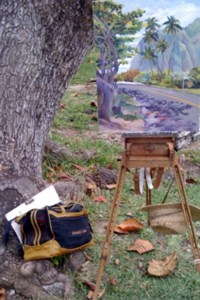
This photo juxtaposes the canvas “Kamehameha Highway and Kaaawa Place” on my easel with the actual landscape.

~ Rebekah

Thanks to my teachers Gloria and Vicky, to Peggy, and to my “Easel.”