Wrongful occupation of Hawaii

9 10 2009

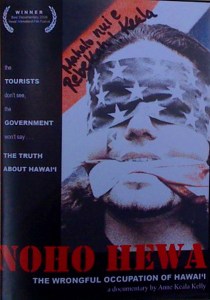
Anne Keala Kelly has made a very disturbing documentary film entitled “Noho Hewa: The Wrongful Occupation of Hawai‘i” that all Hawaiians and Hawaiians at heart should see. It is so disturbing that at the end of last night’s screening, when the house lights came up and Keala asked the audience for questions, there was dead silence in the Paliku Theatre of Windward Community College.

“Noho Hewa: The Wrongful Occupation of Hawai‘i” is so disturbing that it won the Best Documentary 2008 Award of the Hawaii International Film Festival. That was last October. Now, ten more minutes have been added, and the DVD is now available for $20 to help the filmmaker recoup her expenses.

Our family bought two copies. You may go to nohohewa.com for information about future screenings or to purchase the DVD. Keala will take her guerrilla film to the University of New Mexico in Albuquerque on October 12, 2009, and to Pacific Lutheran University in Tacoma on October 15, 2009. Admission is free.

For more information by the filmmaker, visit nohohewa.com

For more information by the filmmaker, visit nohohewa.com

Quoting the DVD cover notes of “Noho Hewa”:

Hawai‘i, thought of by most as the 50th state, is, according to international law, an independent country under an illegal and prolonged occupation by the United States. Through this occupation, Hawai‘i has become home to the largest military command on earth. It also has more endangered species’ habitats per square mile and is the location of more open field tests of genetically modified organisms than anywhere else in the world.

Beyond the illegitimacy of the U.S. presence in Hawai‘i, “Noho Hewa” looks at the methodical removal of Hawaiians from their homeland. The film considers how the erasure of Hawaiian people and history through government sponsored acts of desecration is central to an ongoing agenda to ethnically cleanse Hawai‘i of the Kanaka ‘Oiwi, the indigenous population of Hawai‘i.

If you are alive at all, “Noho Hewa” will shock you. I am Hawaiian. I consider myself an activist. My Hawaiian friends, neighbors, citizens of Ka Lahui Hawaii, and my extended family are in this film. This piece of journalism—it’s excellent—has woken me up even more to the truth about Hawaii, my beloved home. If you can, share this information with others and decide what you will do. It will take all the courage you have. Mahalo to Anne Keala Kelly for hers.

Copyright 2009 Rebekah Luke


Artist sketches in oil

30 09 2009
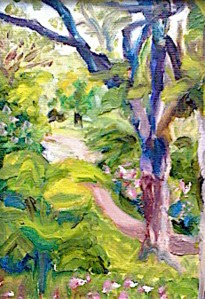
Looking Down Upon the Path - 5"x7" oil on canvas

Looking Down Upon the Path - 5"x7" oil on canvas

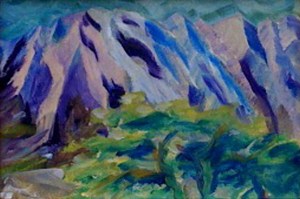
Usually I sketch a scene before blocking it out on a larger canvas. This drawing is like a dry run. Sometimes I sketch in oil. Sometimes I like the sketches better than the larger paintings. “Blue Koolau Mountains” and “Looking Down Upon the Path” are two examples made from the Hoomaluhia Botanical Garden Visitor Center on Oahu in the area called Luluku. This is a lovely place to visit, walk, and camp if you want to up your green quotient. I’m going out there again tomorrow. On Friday 10/2, I will be at the Pohai Nani health fair from 9 to 1 with my Reiki table. Come for a demo with Oe-Len. There’s a fabulous view of the mountains.  ~ RebekahBlue Koolau Mountains by Rebekah Luke

Blue Koolau Mountains - 5"x7" Oil on Canvas

Copyright 2009 Rebekah Luke


From national park to national park

28 09 2009

Watching Ken Burns’s “The National Parks: America’s Best Idea” on PBS last night reminded me of two great trips we took in 2004 across parts of the continental U.S. where some of the parks are located.
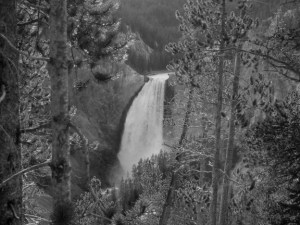
Lower Falls at Yellowstone

Lower Falls at Yellowstone

This excellent PBS-TV program about the national parks continues every night this week through Friday, 8 to 10 p.m. HST, and repeats at 10 p.m.  I highly recommend watching/taping it.

That year, 2004, we decided to meet and enjoy some of our family on Moku Honu (North America, Hawaiian for Turtle Island as Native Americans call it)—an idea inspired by the fact that my father, my hanai (adopted) father, and darling husband’s mother and father all passed over in 2003.

I used the internet and telephone to make all the travel arrangements myself.

The first trip was in May. We had a date with DH’s brother and sister on Memorial Day to spread their father Walter’s ashes at Mount Nittany on the Penn State campus per his request. We started to entertain the idea of driving ‘cross  country, but which route?

We also wanted to call on uncles and aunts and their families who DH seldom saw and who I had never met. Walter had two brothers, Uncle Lee in Texas and Uncle Ron in Virginia. Let’s go visit!

We got out the road atlas. I plotted the towns and thought of who else we could call on between Texas and Pennsylvania. I thought of Cousin Eddy in Memphis, Tennessee, of my mom’s side of the family, and my brother-in-law Paul in his new house in North Carolina.

Upon further examination of the map, I could see that we could plan a route and visit a couple of national parks and other visitor attractions too. We agreed we would drive short distances, maybe four or five hours at a time, not all day, then stop and stay no more than three days at each place. We didn’t want to wear out our welcome.

Here is the route and the itinerary, in case you’ll be in the vicinity and want some ideas:

Fly from Honolulu to Dallas. Visit Uncle Lee and family in Plano and Tyler, Texas.

Pick up a rental car in Tyler, drive to Hot Springs National Park in Arkansas, then to Memphis. Turn in the car.

Tour Memphis with expert tour guide Cousin Eddy. (I have to mention the famous Memphis barbecue, Graceland, Sun Studio, Stax Museum, National Civil Rights Museum, Beale Street (rockabilly music by the Dempskys), soul food, Memphis in May festival, plus a drive to Ripley, Mississippi, to visit Eddy’s aunt and eat pie!)

In Memphis, buy a lot of music CDs. Go pick up the next rental car. (Would we mind driving a van that needs to be delivered to Philadelphia for the same rate? As long as it has a CD player, no problem!)

Listening to our music, drive the length of Tennessee to Nashville, attend the Grand Ol’ Oprey.

Enjoy the Great Smoky Mountains National Park from Gatlinburg, TN, and over the border to Cherokee, North Carolina. Drive slow along the very scenic Blueridge Parkway from Cherokee to Blowing Rock, NC. Stay at Chetola Lodge for the Celtic Music Festival.

Turn right (east) to visit Paul and family in Summerfield, NC,  head up to Virginia to visit Uncle Ron and Aunt Marge, and then on to Sister Penny’s in Collegeville, PA.

At the end of week no. 3, after spreading Walter’s ashes, we were in the Nittany Valley in the exact center of Pennsylvania. We located DH’s grandmother’s old farmhouse of his childhood, and we ran into his other cousins, all still farmers, of a family who has remained in the area since their ancestors arrived from the old country. This trip to the Nittany Valley was the first time DH, his brother and his sister traveled together as adults. I’m sure they will always remember it.

The second road trip was in September. We enjoyed the May experience of driving so much that we decided to meet the Luke relatives before meeting up with two of the Sinclair sisters on their annual pilgrimage to Yellowstone National Park.
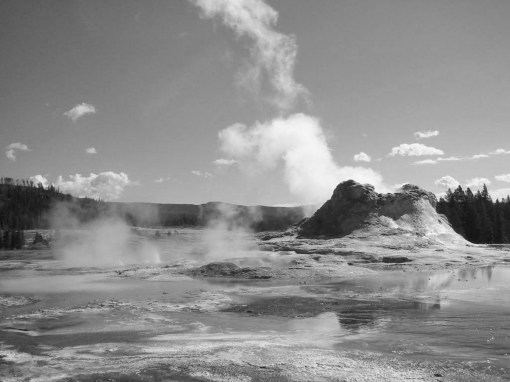
Steamy landscape at Yellowstone

Steamy landscape at Yellowstone

I wanted to visit Aunty Julia, my father’s last surviving sister who lived with her daughter Loris’s family in Stockton, California. We started in San Francisco and met Cousin Laureen and family. Together we drove to Stockton to see Julia and Loris. Another cousin Lorene, not to be confused with Laureen, and her husband drove from Sacramento bringing dim sum for lunch. Throughout the afternoon Loris’s several kids stopped in with their kids, and we had a really nice reunion.

Loris has a sister, Bee, who lives in South Fork, Colorado. So next morning we flew from Oakland to Albuquerque and drove to Santa Fe, New Mexico. (In Santa Fe I can recommend El Paradero B&B, El Farol restaurant, and the Georgia O’Keeffe museum and café.) From there we went to Mesa Verde National Park, then to Durango where we rode the narrow gauge railroad to Silverton and back. We continued to South Fork (of the Rio Grande) to visit Bee and her husband.
Birch and evergreen

Aspens and conifers

To get to Yellowstone National Park, we drove the highway that runs along the top of the Colorado Rocky Mountains from south to north. We had dinner with Bee’s son Bret in Steamboat Springs. Next morning we entered Wyoming. There’s a lot of Wyoming before you get to the park’s north entrance. Ruth and Kathy came in from Idaho.

We thoroughly enjoyed our rendezvous, the beauty of the park, its geological features, and all the wildlife.
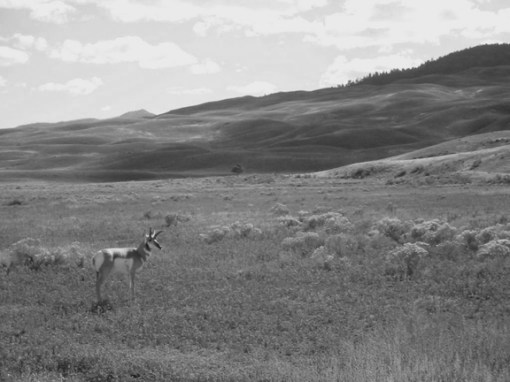
Pronghorn antelope

Pronghorn antelope

As it is adjacent to Yellowstone, we also visited Grand Teton National Park in Jackson, WY.

Thus ends my post of our 2004 tour of the national parks by way of some quality time with our families.

Some reflections:

When I was in the third grade at Schofield Post Elementary School, our lessons included listening to the Standard School Broadcast radio program about the national parks, featuring a different one each week. That’s how I first learned about these places that were wisely set aside for our benefit and enjoyment. I imagine the Ken Burns films will provide additional education today.

Why did we wait until our parents died to call on our uncles, aunts, and cousins? Because our parents didn’t want to. Now I think, that’s silly. Lee, Ron and Julia have since left the earthy plane as well. I am so glad we visited them in 2004. Now for both DH and myself, our generation is the oldest in our respective families. Gratefully, we still have our cousins, siblings, daughter, nieces and nephews.

Three weeks is long enough to be away from home; three and a half weeks is too long.

When time and finances permit, we ought to do a trip like this again—family and the national parks. Perhaps sooner than later.

Copyright 2009 Rebekah Luke


FAQs about my art: an interview with self

25 09 2009

Rebekah, what is your medium? Oil.

What kind of painter are you? Mostly plein air (French, literally, open air). I go on location outdoors, into the field, and study the light.

How would you describe your style? Impressionistic representationalism. Sometimes abstract.

What is your subject matter? Hawaiian places; landscapes; Hawaii nei. More recently, I’ve added still life, and I am doing some seascapes. I paint subjects I think people would like to hang on their walls.

Do you paint from photographs? Rarely. I always felt if I painted from a photograph, the painting would look like a photograph. Sometimes I’ll make a black-and-white photo to see the values (range of darks to lights). I prefer painting en plein air or from life.

How long does it take to finish a painting? It depends on a lot of things, but on average about four or five times out on location. Some may take five hours, others five years.

Is your work in galleries? It used to be, but not at the present time. I am seeking a good venue and good representation.

Where can I see your work? Right here on Rebekah’s Studio! Come and visit my virtual gallery. Click on Paintings on the menu bar. To see the actual original painting, please contact me and we can make an appointment to see it. I’d love to show you!

How did you learn to paint? I took lessons, primarily from Gloria Foss. Before that I took the required art history classes in high school and college. I also studied art as part of the photography program at Art Center College of Design in Pasadena.

When and where did you start showing your work? In earnest at the Honolulu Zoo Fence on Monsarrat avenue and at Arts of Paradise gallery at the International Market Place, both in Waikiki in the later 1980s, and at invitational and juried shows. You might like to read my August 26, 2009, post “I wasn’t always a painter.”

What are your prices, what does a painting cost? An example would be U.S. $600.00 for an original 16″ x 20″ landscape in oil, frame included. Smaller ones are priced less, larger ones more.

How do you price your work? Besides the general guide in the above Q and A, I look at the overall piece, the thing. I imagine a price and I imagine selling the piece for that price. If I experience an awful feeling in my stomach, then the price is too low. I also go to galleries and shows and look at other artists’ works and prices for comparison. I think my prices are realistic.

Does the price include shipping? No. The customer pays for shipping and delivery. I take care of the packing and packaging.

Why is art so expensive to buy? The materials don’t cost that much. Artists are like actors. We don’t work every day. (Actually, we do, but we don’t sell every day; you get the idea.) This is how we earn our living—you know, food, shelter, gas, not so much clothing.

I love your work, but I don’t think I can afford to buy it. Can I? Sometimes for things we really want, we need to sacrifice. I have a layaway plan, normally three monthly payments each of 1/3, 1/3, 1/3. It’s possible to stretch payments out longer. The customer does not get the painting until it is paid in full. The installment payments are not refundable. That’s the deal. Several collectors of my paintings purchase on layaway, and they are able to enjoy enduring original art that way. If your finances can’t handle the layaway plan, then you probably can’t afford the painting.

Do you make reproductions? I’m wondering if I should manufacture some more. I have a giclée entitled “Mele’s Beach” that’s almost sold out.

Do you accept credit cards? Yes, through PayPal.

Who buys your paintings? Anyone. I have customers, patrons, and angels. 😉

Do you teach painting? Not formally. I’m happy to have people watch me paint and answer their questions, give a demo and talk about my art. My best audiences/pupils are kids. I might offer some tips on this blog.

Do you ever donate your artwork to a benefit auction event of a non-profit organization? Only if I can have part of the income. The reasons are: The non-profit receives merchandise and a donation for the painting if it is sold. The winning bidder gets a painting and a charitable tax deduction. The artist receives no income and can deduct only the cost of materials (i.e., canvas, paint, frame, wire). The public gets the erroneous idea that artists don’t mind donating their work. When I participate, I suggest this arrangement: Set an upset price of an amount I would like. The organization may keep the difference between the upset price and the winning bid. If the painting doesn’t sell, then I get the painting back.

Why aren’t there any new paintings in your virtual gallery? I keep checking back and see the same images. I would love to install new ones as fast as I can. And I’m glad you’re checking back. The thing is, oil paint takes a long time to dry, especially in a humid climate like Hawaii. Only when the painting is bone dry does it get a finishing varnish coat. Then that has to dry, then I photograph it, and then the painting gets a frame. It could take up to six months from the time I finish a painting to when it’s put on display. So, please stay tuned! I value your interest.

Thanks, Rebekah. And thank you! If you have other questions, you may Leave a Comment below or contact me by email. RL

Copyright 2009 Rebekah Luke


Hokusai at the Honolulu Academy of Arts

24 09 2009
Honolulu Academy of Arts

Honolulu Academy of Arts

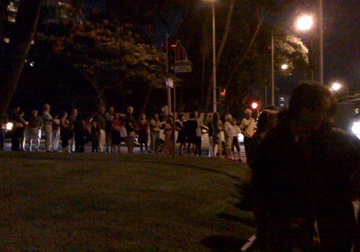
It felt like all of Honolulu came to see the 36-plus views of Mount Fuji at the Honolulu Academy of Arts last night. More than 900 people stood in line to enter the opening of “Hokusai’s Summit: Thirty-six Views of Mount Fuji” at our city’s art museum.

I skipped my tai chi class to meet my friend Becky at the corner of Victoria and Beretania, and at 7 o’clock the line extended around the block. Neither of us had eaten dinner, but it was so crowded that we opted to bypass the refreshments and headed for the gallery.

Hokusai-exhibit-line

This special exhibition that will extend for several months from now and into 2010 offers the opportunity to study the work of Japanese artist Katsushika Hokusai (1760-1849), who lived during the Edo period when a new art called ukiyo-e emerged. It is believed that he made 30,000 works of art and published more than 270 books. His life was dedicated to drawing.

The Honolulu Academy of Arts is known for its fine Asian collection, within which there are more than 10,000 Japanese woodblock prints. The collection includes a rare complete set of the famous Thirty-six Views of Mount Fuji series by Hokusai. This is what the Academy of Arts has put on public display.

The exhibit is rounded out by items about the woodblock printing process, about Hokusai’s stylistic development, of Mount Fuji by the artist Hiroshige, and of Mount Fuji by other painters. Reading the “Visitors’ Guide” handout and the labels next to each piece of art when I have more time will give me a working knowledge of the subject for sure.

What impressed me last night was how woodblock printing lends itself to simplicity and a limited color ink palette, something I can try in my own work. Hokusai was so skilled in drawing, he could incorporate the detail of human activity that I found delightful and often amusing. And, of course, it was fun to see all the different treatments of Mount Fuji.

I also was very impressed by the turnout! In the crowd I bumped into my high school journalism teacher, former work associates, other artists and writers, my cousin, “the ants” (like ants at a picnic), and many whose faces I’ve seen around town but couldn’t place because of the different venue. When Becky and I were tired of rubbing shoulders, literally, we decided it was refreshment time: sake-tasting, fruity punch, cubed cheddar, cubed pepper jack, lavosh, and sweet gingery senbei crackers. Becky, who is a member of the Academy of Arts, said there are three or four major exhibitions a year and that the openings are popular events. You can say that again. Long live the arts!

Copyright 2009 Rebekah Luke


Announcing Reiki Fridays

22 09 2009

UPDATE 11/29/09 —My regular Reiki Fridays services in Kaaawa will resume in January 2010. Thank you ~ Oe-Len

UPDATE 9/25/09 — On Friday, October 2, 2009, I will be giving Reiki demos at the Pohai Nani Health Fair, 45-090 Namoku Street, Kaneohe, Oahu. The event is open to the community. Come and check it out. While there you can view Ipo Nihipali’s “KOOLAU!” Refer to the post “Sweet memories and coming home, part 2.”

For new and returning visitors to Rebekah’s Studio, I cordially announce again that Oelen’s healing space in Kaaawa, Oahu, is open regularly for Reiki sessions on Fridays, except in the month of December. Appointments are appreciated, and free will donations are accepted. Please click on Reiki Healing by Oelen in the menu bar for details and contact info. In addition, my 9/3/09 post “Learning about energy healing” provides more background. I invite you to take advantage of the service. Leave your cares of the week behind and start the weekend relaxed, balanced, and with renewed energy! Thank you ~ Oe-Len


My dog is magical

20 09 2009

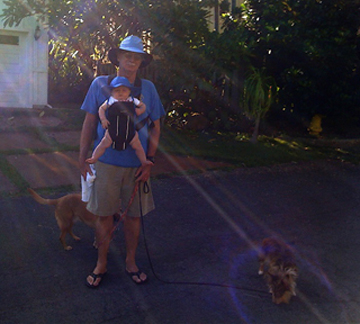
Relative to the Violet Flame in the articles I linked to near the end of my previous post on Gratitude, take a look at this photo that captures my doggy’s aura! Can you believe it?!

They are ready for their morning walk

Ready for their morning walk: (L to R) guest dog, darling husband, Miss Marvelous and Alice Brown with violet halo

That is Alice Brown who greets you at the top of this blog each time you visit Rebekah’s Studio. This is a straight photo from my iPhone, I swear.

Alice Brown is a Kahuku girl who was given to us by my late father’s caregivers. She is a mix of silky terrier (mom) and “the fat hot dog down the road” (dad). She’s a long dog with great hair, and she’s very entertaining.

Thank you, Alice Brown, for coming into our lives. You bring blessings and joy to us and everyone you meet.

Copyright 2009 Rebekah Luke