In Hawaii, May Day is Lei Day

1 05 2010

The art of lei making is showcased today with the annual lei contest at Kapiolani Park in Waikiki. May Day is Lei Day in Hawaii after all. The public can see different styles of lei in categories of colors and age groups of the lei makers.

Last year’s 2009 grand prize winner was a drape of many strands of plumeria buds cleverly snipped and strung kui style. So simple, but different, and what an elegant statement!
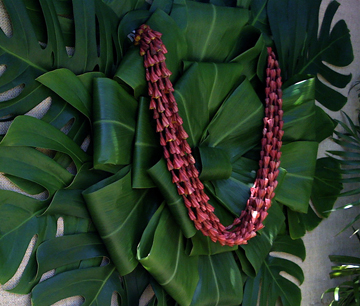
Plumeria comprises the 2009 grand prize winner

The blue ribbon in last year’s mixed category was this beauty:

I apologize, I did not record the names of the lei makers, but I’m betting they are entering their creations again today.

Once, in the 1970s when we both did work for Sunset‘s Hawaii office, I had the pleasure of accompanying horticulturist Horace Clay who identified the plant materials in each lei as the contestants brought in their entries early on May 1. They came in from all islands, and Horace had a great time telling anecdotes about the plants and where or how far someone had to go to gather the material. The lei makers were so happy and proud of their lei. They had stayed up into the wee hours of the morning making them. I thought all of them were magnificent.

My friends Kamakea and Kai who come from a long family line of Hawaiian lei makers made these blue marble lei in the next photo to look like jewelry. I saw them for sale at last Saturday’s hoolaulea at Hauula Elementary School. Hawaiians use all sorts of natural plant materials, not just flowers, to adorn themselves. What looks like carved round Oriental wood beads is actually the inside of a blue marble (Elaeocarpus grandis) fruit.
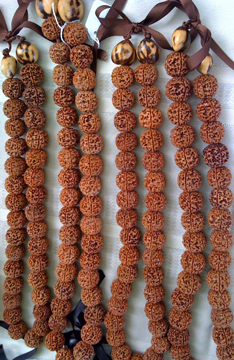
Blue marble lei — by Kamakea & Kai

The brilliant blue skin is peeled away, revealing a fuzzy hairy seed. Kamakea and Kai wire brush and wash away the fuzz—a time-consuming job. They further clean out the indentations of each sphere with a Dremel tool. They drill holes for stringing and finish the necklaces with two polished kukui nuts and ribbon. Before all of that, however, they gather a supply of blue marbles. It’s a lot like fishing: seed lei makers don’t tell where their favorite spot is!

If you have time today, head on down to Kapiolani Park to see this year’s beautiful lei. They could inspire you in your own art work, in lei or other medium. In the event the judging takes a while, be prepared to wait for the viewing to open. There are other related Lei Day activities in the park to see, such as crafts and food and Hawaiian music and hula dancing.
Copyright 2010 Rebekah Luke


Perpetuate the Hawaiian national anthem

25 04 2010

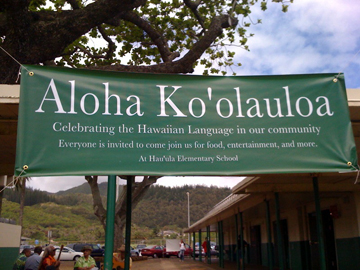
Yesterday’s long menu of activities all around the island was a feast for anybody interested in going and doing. Pick any venue, and one was sure to be entertained. I committed to a hoolaulea (country style backyard fair) at Hauula Elementary School, helping out at the Hawaiian civic club booth. Live Hawaiian music and hula, craft booths, local Hawaiian-style food, community exhibits, free parking.  The event drew attention to the Hawaiian language immersion schools on our coast.

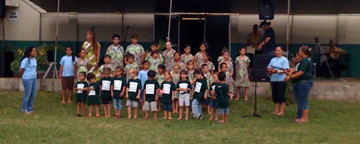
The singing of “Hawaii Ponoi” by the children impressed me the most. “Hawaii Ponoi” is our national anthem, and we stand when it is played or sung. When I was a kid, we learned the words to the first verse and the chorus, and we sang the chorus two times. Yesterday, I was blown away when, after the chorus, the children of Aha Punana Leo and Ke Kula Kaiapuni sang the other verses. Wow, that’s so maikai (good)! A proud, chicken-skin moment!

Haumana (students) and kumu (teachers) of Ke Kula Kaiapuni o Hauula, Ke Kula Kaiapuni o Kahuku, and Aha Punana Leo o Koolauloa

Here are the “Hawaii Ponoi” lyrics written by King Kalakaua to music composed by Henry Berger. They were first sung in 1874 at Kawaiahao Church.

(1st verse)
Hawaii ponoi
Nana i kou moi
Ka lani alii
Ke alii
============
(Chorus)
Makua lani e
Kamehameha e
Na kaua e pale
Me ka ihe
============
(2nd verse)
Hawaii ponoi
Nana i na alii
Na pua muli kou
Na pokii
============
(3rd verse)
Hawaii ponoi
E ka lahui e
O kau hana nui
E ui e
Copyright 2010 Rebekah Luke


Watching the tide, planning my day

25 04 2010

When the tide is low I can walk far along the beach and hardly notice any bothersome civilization on Kamehameha Highway.

Not a minus tide, but a slow gradual ebb to just zero, long enough to walk from Swanzy Beach to Kalaeokaoio and back, completely on the sand, at least two miles worth.

The air is so cool.

The few houses between the water and the road and the rustling of coconut palm fronds muffle any traffic sounds. It’s easy to notice the bird songs mixed with the audible rhythm of waves breaking on the horizon reef and the quiet crackles-and-pops from the emerging tide pools.

The wide beach lures out kids and grownups one by one to play. An older couple in bathrobes enjoys coffee and scenery from their lawn chairs. A kolea pauses.

Smells of limu. Tastes of salt.

On the return trip I rescue flowered lavender flip-flops left by a little girl playing in the sand.

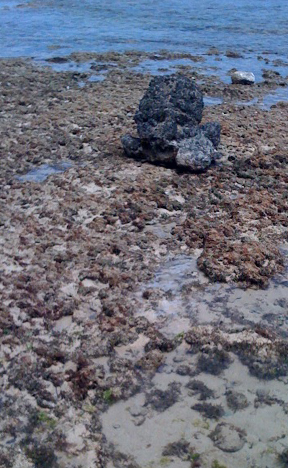
An amusing sculpture surprises. Oh, … hello!

Back in the studio and examining the tide calendar, I see the next similar low tide will be next week on May 1, 2 3, 4 and 5 — in the morning. If you go, give thanks and always keep a watchful eye on the sea.

Copyright 2010 Rebekah Luke


Artist’s unforgettable memoir

15 04 2010

Once upon a time in 1994, not too long ago, I went to a Hawaiian place, a place of healing.

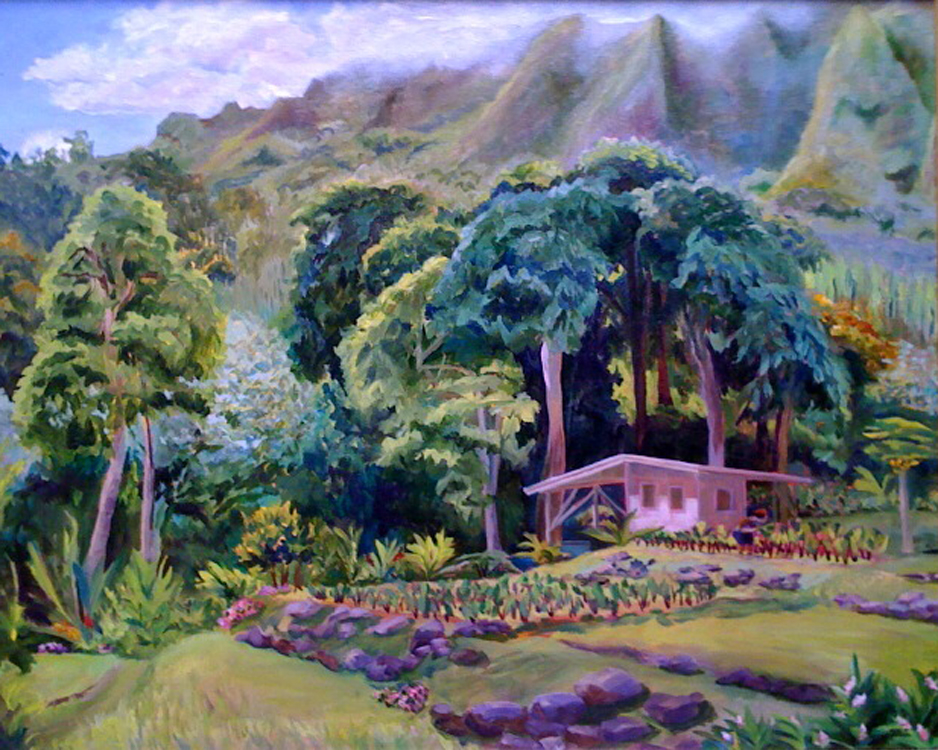
Through the treetops I could see glimpses of the Ko‘olau mountains. Patches of sunlight danced on colorful impatiens, and the sound of civilization gave way to the melodic symphony of the shama thrush. How enchanting, I thought. This feels like paradise. The trail skirted dense bamboo on one side and cultivated ti plants on the other. I could hear the stream running, and farther along, soft voices below. When the view finally opened up I saw up close the back of an amphitheater-headed valley, and, below me, a stretch of green terraces planted with kalo. To the left was a small house. This was unforgettable ‘Ioleka‘a, and Anita lived here.

Anita’s Place Kaiwikee Edge of the Forest

Anita was an inspiration to me. I met her through our work with Ka Lahui Hawaii. She took care of the land, and it took care of her. I met the family members who together with Anita own the private Native Hawaiian kuleana, and after a while they welcomed me in to paint the landscape.

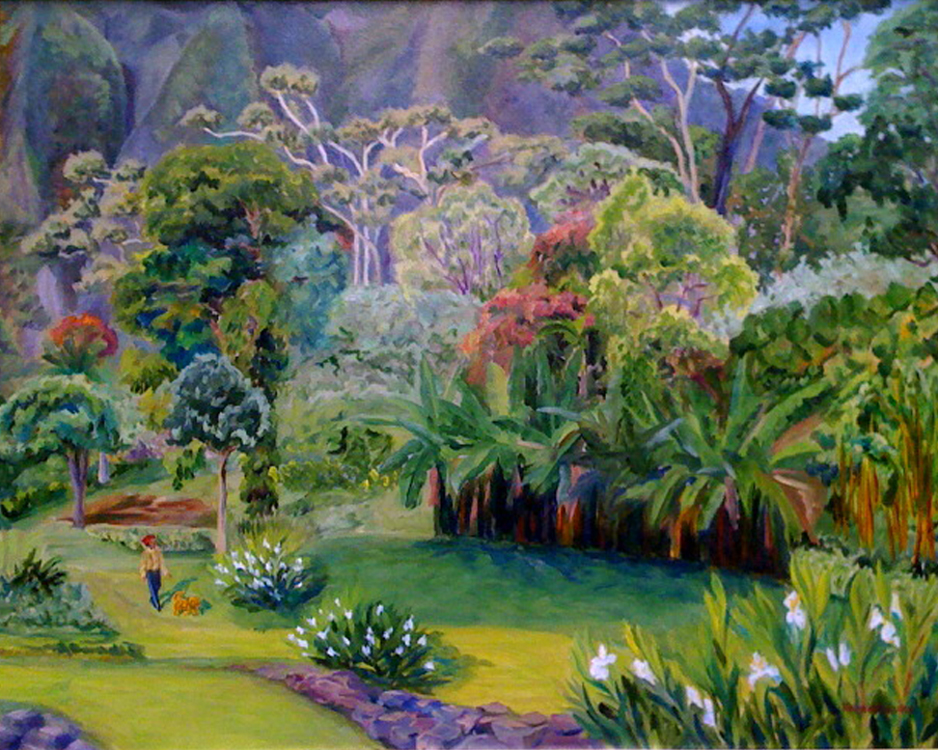
Over ten months, starting in February when the ‘awapuhi ke‘oke‘o (white ginger) bloomed — I still recall the sweet scent — and until a solo show exhibiting the work opened,  I hiked in and out many times and made more than a dozen oil paintings, starting with “Anita’s Place” that developed into the triptych above.

I attached pontoons to my easel to prevent the legs from sinking into the mud of this lo‘i land. I learned to smell and listen for the rain, just in time to cover my palette and don my rain gear. Sometimes Ei Nei the golden retriever would keep me company, but only until the mistress returned.

On November 5, 1994, a day after the show opened, I wrote:

I am so glad I made these paintings. Things are different at Ka ‘Ili ‘Ioleka‘a now. The goat’s gone. Got loose and took off. The papaya tree’s down. A couple more lo‘i are being prepped for planting. One of the mango trees on the trail fell. More people and the laws of nature bring constant, dynamic change.

Anita and I picked ho‘i‘o for the art show reception. One needs a good eye to spot those fern buds. Anita refused payment, even though I explained that was her income. A gift from the ‘aina, she said.

For a month the paintings are on exhibit at Leeward Community College. People like them. They really look at them. It is as though some folks have never seen a painting. It’s refreshing to see some of the green of the windward side of the island over here where it is drier. Sort of like a shot of menthol, a visitor said. When art evokes an emotional response, when it communicates, then it is successful. These images are.

These images stop people. They are scenes that people can relate to. They bring back memories and stimulate discussion. Instead of talking about budgets and college programs, they talk about their childhood experiences in the lo‘i, or on the ‘aina, on a neighbor island, when they went hiking, or … What more can one ask for in a response?

Gloria Foss, my teacher, attended the opening, and I asked her for a critique. She said there was almost no blue or violet as local color, but predominantly greens and reds, although I used blue and purple in the mixtures. In other words, it appeared that I’d used a limited palette. “Push the green as far as it will go, into blue,” she said. “Use cloud shadow to put more violet in the mountains. Use more cloud shadow everywhere to develop focal points. Focal points, yes. Work on developing those. That’s why the piece “Anita’s Place” works well. You’ve set up the little house as the focal point.”

The Leeward Community College Foyer Gallery was set up by Melvyn Sakaguchi when he was provost as a place where emerging artists could show their work and receive a little technical assistance from the college before heading out further on their own. Alan Leitner, the curator, thinks the campus galleries will become more important because they will be the places where the reviewers and critics go to see art.

Most of the ‘Ioleka‘a paintings went to buyers on opening night, and I donated some of the proceeds to Ka Lahui Hawaii. I still have the 90-inch-by-24-inch triptych and a couple of favorites in my collection.

Copyright 2010 Rebekah Luke


5K family fun run/walk in Kaaawa Valley

10 04 2010

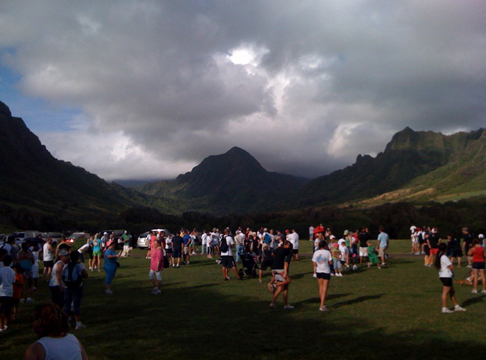
Kaaawa Valley with Puu Ohulehule beyond

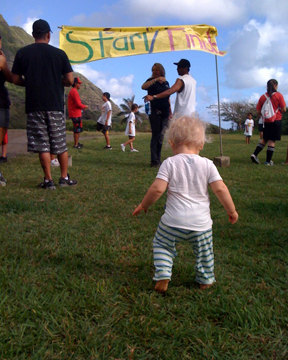
This morning was perfect for the “1st Annual Kaaawa Elementary School Ocean Warrior 5K Family Fun Run/Walk” in Kaaawa Valley, a short ways down the road from the studio. The film industry uses this location for movies and TV shows. This is the beautiful place where Miss Marvelous’s parents wed.

Many thanks to the Kaaawa Elementary School PTO Committee and Kualoa Ranch for coordinating a successful community event. The entry fee bought access to the course trails, the event t-shirt, a bottle of water, and a coupon for 50% off of three different activities at Kualoa Ranch. Shave ice, spam musubi, cotton candy, music, and the great outdoors made for a great party!

We could have brought Alice Brown and Pua (guest dog), as plenty of other people brought their canines, and the event folks offered free poop bags, but, alas, we had left the pooches home. I brought my easel and took the opportunity to sketch out a new painting of the vista. Miss Marvelous was among the youngest entrants to show off her new walking skills. Congratulations, Kaaawa! Everyone had a good time!

Miss Marvelous approaches the line

Copyright 2010 Rebekah Luke


Beach swings

5 04 2010

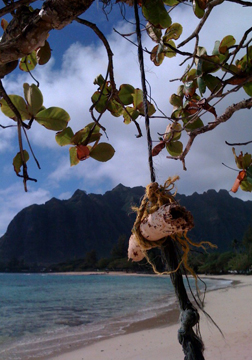
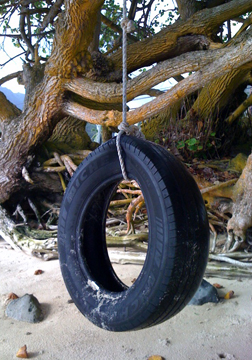
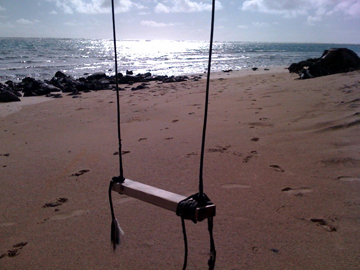
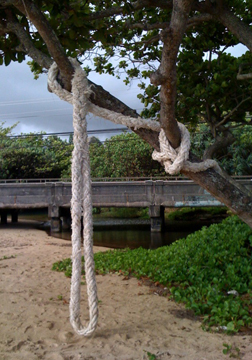
No sooner than I reported the rope swing gone (see my painting “The Rope Swing”), several new ones appeared! We ran into them on a morning walk along Kaaawa beach this week with our almost-seven-year-old puppy Alice Brown. The large white rope must have drifted ashore.

Driftwood Swing

Tire Swing

Board Swing

White Rope Swing


Happiness from the Easter bunny

4 04 2010

The creatures at Rebekah’s Studio send you blessings and wishes for a Happy Easter Day!