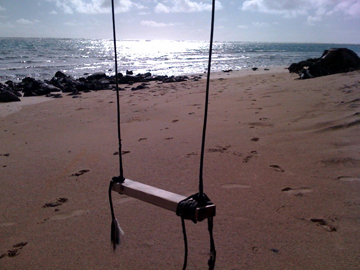
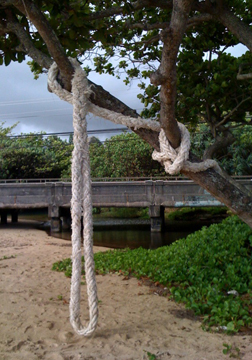
Watching the tide, planning my day

25 04 2010

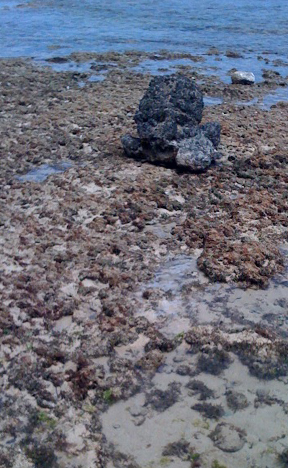
When the tide is low I can walk far along the beach and hardly notice any bothersome civilization on Kamehameha Highway.

Not a minus tide, but a slow gradual ebb to just zero, long enough to walk from Swanzy Beach to Kalaeokaoio and back, completely on the sand, at least two miles worth.

The air is so cool.

The few houses between the water and the road and the rustling of coconut palm fronds muffle any traffic sounds. It’s easy to notice the bird songs mixed with the audible rhythm of waves breaking on the horizon reef and the quiet crackles-and-pops from the emerging tide pools.

The wide beach lures out kids and grownups one by one to play. An older couple in bathrobes enjoys coffee and scenery from their lawn chairs. A kolea pauses.

Smells of limu. Tastes of salt.

On the return trip I rescue flowered lavender flip-flops left by a little girl playing in the sand.

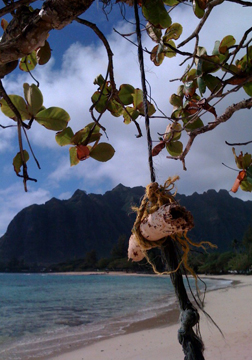
An amusing sculpture surprises. Oh, … hello!

Back in the studio and examining the tide calendar, I see the next similar low tide will be next week on May 1, 2 3, 4 and 5 — in the morning. If you go, give thanks and always keep a watchful eye on the sea.

Copyright 2010 Rebekah Luke


Artist’s unforgettable memoir

15 04 2010

Once upon a time in 1994, not too long ago, I went to a Hawaiian place, a place of healing.

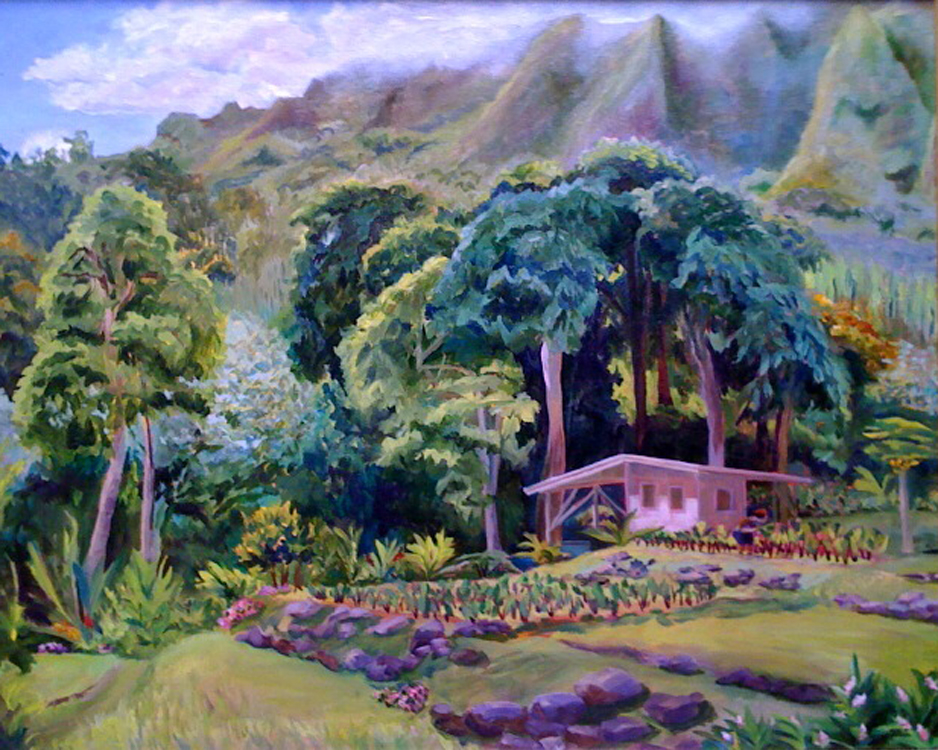
Through the treetops I could see glimpses of the Ko‘olau mountains. Patches of sunlight danced on colorful impatiens, and the sound of civilization gave way to the melodic symphony of the shama thrush. How enchanting, I thought. This feels like paradise. The trail skirted dense bamboo on one side and cultivated ti plants on the other. I could hear the stream running, and farther along, soft voices below. When the view finally opened up I saw up close the back of an amphitheater-headed valley, and, below me, a stretch of green terraces planted with kalo. To the left was a small house. This was unforgettable ‘Ioleka‘a, and Anita lived here.
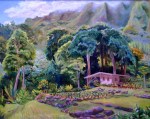
Anita’s Place Kaiwikee Edge of the Forest

Anita was an inspiration to me. I met her through our work with Ka Lahui Hawaii. She took care of the land, and it took care of her. I met the family members who together with Anita own the private Native Hawaiian kuleana, and after a while they welcomed me in to paint the landscape.

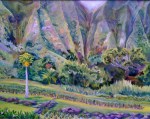
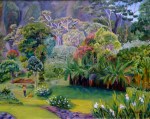
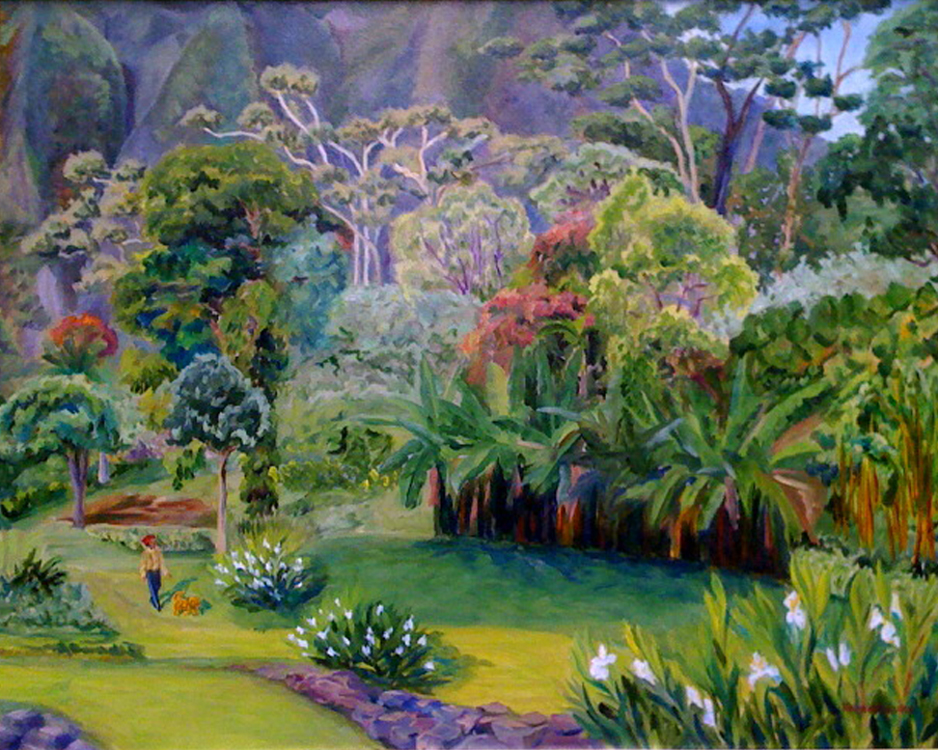
Over ten months, starting in February when the ‘awapuhi ke‘oke‘o (white ginger) bloomed — I still recall the sweet scent — and until a solo show exhibiting the work opened,  I hiked in and out many times and made more than a dozen oil paintings, starting with “Anita’s Place” that developed into the triptych above.

I attached pontoons to my easel to prevent the legs from sinking into the mud of this lo‘i land. I learned to smell and listen for the rain, just in time to cover my palette and don my rain gear. Sometimes Ei Nei the golden retriever would keep me company, but only until the mistress returned.

On November 5, 1994, a day after the show opened, I wrote:

I am so glad I made these paintings. Things are different at Ka ‘Ili ‘Ioleka‘a now. The goat’s gone. Got loose and took off. The papaya tree’s down. A couple more lo‘i are being prepped for planting. One of the mango trees on the trail fell. More people and the laws of nature bring constant, dynamic change.

Anita and I picked ho‘i‘o for the art show reception. One needs a good eye to spot those fern buds. Anita refused payment, even though I explained that was her income. A gift from the ‘aina, she said.

For a month the paintings are on exhibit at Leeward Community College. People like them. They really look at them. It is as though some folks have never seen a painting. It’s refreshing to see some of the green of the windward side of the island over here where it is drier. Sort of like a shot of menthol, a visitor said. When art evokes an emotional response, when it communicates, then it is successful. These images are.

These images stop people. They are scenes that people can relate to. They bring back memories and stimulate discussion. Instead of talking about budgets and college programs, they talk about their childhood experiences in the lo‘i, or on the ‘aina, on a neighbor island, when they went hiking, or … What more can one ask for in a response?

Gloria Foss, my teacher, attended the opening, and I asked her for a critique. She said there was almost no blue or violet as local color, but predominantly greens and reds, although I used blue and purple in the mixtures. In other words, it appeared that I’d used a limited palette. “Push the green as far as it will go, into blue,” she said. “Use cloud shadow to put more violet in the mountains. Use more cloud shadow everywhere to develop focal points. Focal points, yes. Work on developing those. That’s why the piece “Anita’s Place” works well. You’ve set up the little house as the focal point.”

The Leeward Community College Foyer Gallery was set up by Melvyn Sakaguchi when he was provost as a place where emerging artists could show their work and receive a little technical assistance from the college before heading out further on their own. Alan Leitner, the curator, thinks the campus galleries will become more important because they will be the places where the reviewers and critics go to see art.

Most of the ‘Ioleka‘a paintings went to buyers on opening night, and I donated some of the proceeds to Ka Lahui Hawaii. I still have the 90-inch-by-24-inch triptych and a couple of favorites in my collection.

Copyright 2010 Rebekah Luke


5K family fun run/walk in Kaaawa Valley

10 04 2010

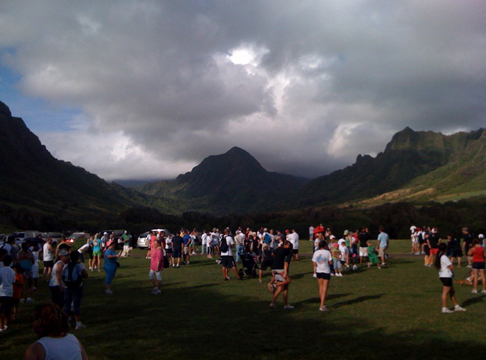
Kaaawa Valley with Puu Ohulehule beyond

This morning was perfect for the “1st Annual Kaaawa Elementary School Ocean Warrior 5K Family Fun Run/Walk” in Kaaawa Valley, a short ways down the road from the studio. The film industry uses this location for movies and TV shows. This is the beautiful place where Miss Marvelous’s parents wed.

Many thanks to the Kaaawa Elementary School PTO Committee and Kualoa Ranch for coordinating a successful community event. The entry fee bought access to the course trails, the event t-shirt, a bottle of water, and a coupon for 50% off of three different activities at Kualoa Ranch. Shave ice, spam musubi, cotton candy, music, and the great outdoors made for a great party!

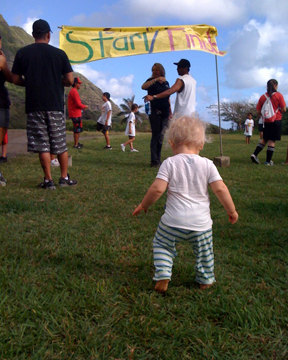
We could have brought Alice Brown and Pua (guest dog), as plenty of other people brought their canines, and the event folks offered free poop bags, but, alas, we had left the pooches home. I brought my easel and took the opportunity to sketch out a new painting of the vista. Miss Marvelous was among the youngest entrants to show off her new walking skills. Congratulations, Kaaawa! Everyone had a good time!

Miss Marvelous approaches the line

Copyright 2010 Rebekah Luke


Beach swings

5 04 2010

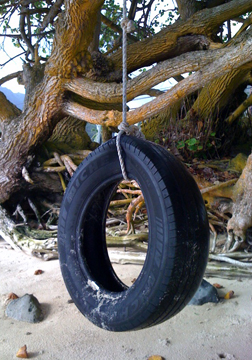
No sooner than I reported the rope swing gone (see my painting “The Rope Swing”), several new ones appeared! We ran into them on a morning walk along Kaaawa beach this week with our almost-seven-year-old puppy Alice Brown. The large white rope must have drifted ashore.

Driftwood Swing

Tire Swing

Board Swing

White Rope Swing


Happiness from the Easter bunny

4 04 2010

The creatures at Rebekah’s Studio send you blessings and wishes for a Happy Easter Day!


Stories as legacy

27 03 2010

Stories can be legacies. I was reminded of this when my cousin Galien sent me the Hawaii island press photos and story of Kalahikiola church with a note, “It shows you how Kohala takes care of its own, rarely waiting for the government or others to do their needs.”

The photos show the congregation seated in pews of a renovated interior. The news article reports that on February 27, 2010, while most of Hawaii waited for a potentially damaging tsunami from an earthquake in Chile, the people of North Kohala were in church to dedicate their newly rebuilt Kalahikiola church building, a casualty of an earlier natural disaster: The earthquake on October 15, 2006, off the coast of the Big Island of Hawaii caused the stone walls of the church, located at Kapaau, to crumble.  A dramatic photo showed the damage to the world.

Among the relatives of my mother’s side of the family, what we noticed in the 2006 photo was that the bell tower was intact. (Click on “dramatic photo” in the above paragraph.) Growing up, we were told the story of how our grandfather — who managed the grounds of Dr. Benjamin D. Bond’s estate that included the church — repaired the bell tower in the early 1900s, replacing rotted timbers one by one.

Yet, actually, someone read and quoted the anecdote in Father Bond of Kohala: A Chronicle of Pioneer Life in Hawai‘i by Ethel M. Damon (Honolulu: The Friend, 1927) about “Ah Nee, the faithful Chinese workman,” the only carpenter who dared to undertake the repair. (He was called Ah Nee, which means Two for the second son, but his correct name was Chong How Kong.) And that quote is re-cited in our cousin J. H. Kim On Chong-Gossard’s The Chong Family History (Kaaawa: Chong Hee Books, 1992).

Our grandfather died in 1930, but when we saw the 2006 photo of the church with the untouched bell tower, we patted him on the back anyway. We cherish this connection to Kohala. It’s the story we pass down, even though there are so many more stories, given that my mother and her 14 siblings were born and began their lives there. But that’s the story we know about our grandfather.

Accuracy is part of my training and experience. My 6th grade teacher taught how to use a dictionary, how to outline, and drilled us on “speed and accuracy.” When writing the daily news, it’s customary to check facts with more than one source; two to concur, but three are better. In the Sunset test kitchen we made a recipe a minimum of three times before publication.

Recently I became involved for five years in designing and managing the publication of bi-lingual children’s story books in Hawaiian and English for a non-profit educational organization in our area. The stories were to ring true to the Hawaiian culture, places, customs, heritage, etc.

The storybook project was by the indigenous community and involved many partners, writers, reviewers, elders, editors, photographers, designers, and translators. While allowing an author’s voice, I lobbied my darndest to avoid what I felt were inaccuracies, but sometimes I wasn’t successful.  In the end I relaxed and said okay to some things that I’d now regard as modern myth.

This past week the publisher, Na Kamalei – K.E.E.P., released its Hawaiian-culture-based early childhood education curriculum for families. It’s wonderful, and it integrates 20 of the story books into the lesson plans. It is for use by family and child interaction learning programs.

I still feel accuracy is important, so as not to perpetuate something that’s not so, thereby creating a myth.

What stories do you remember? What stories will you write or tell? What legacy will you leave?

Copyright 2010 Rebekah Luke


Ready for buyers

18 03 2010

Aloha! Today I picked up two paintings from the framer. You’ve seen them before in previous posts, but now the canvases are dry and the frames finish them off nicely. I chose a classic linen liner and koa for “The Rope Swing” and a simple antique silver-colored frame for “View of the Koolau Mountains.” If you wish to invest in any of my paintings—these are originals—I can work out a payment schedule with you. Please click on PAINTINGS tab in the menu bar. I would love for you to see them in person. Just contact me for an appointment. Thank you for visiting my gallery and studio! Rebekah