Japanese food art

26 08 2010

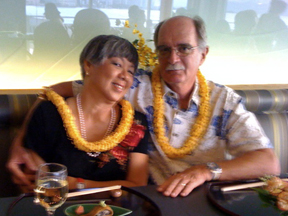
For special occasions, a fine meal may be in order. One of those times was last evening to celebrate my wedding anniversary with DH (darling husband). The fine meal was the kaiseki prix fixe menu at the Japanese restaurant Miyako in The New Otani Kaimana Beach Hotel at Sans Souci Beach at the foot of Diamond Head.

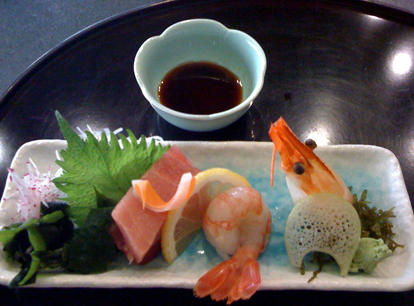
Sashimi. Everything on the plate in this beautiful presentation is edible.

The artistry in the presentation of all seven courses served one at a time over two hours was a treat—a reminder to incorporate good design in everything we do 😉 —as were the flavors from the food. It reminded us of TV’s Iron Chef. The difference was that we ate everything and sipped sake to softly played music while enjoying the view of Waikiki and the spectacular sunset.

Anniversary couple

Copyright 2010 Rebekah Luke


August means avocado

18 08 2010

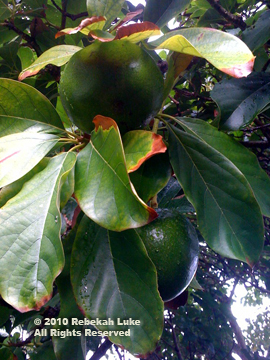
Luscious avocados

Hi Everybody,

Our 2010 avocado season is one of the better. These luscious gems are overhanging the healing space near the studio right now.

It’s an awesome sight to me. I can just reach up and pluck them to eat, in about 7-10 days. They will be so yummy. This year there are twice as many than years past.

Who knows why, but I’m not complaining. Is the big old rusting anchor next to the tree finally providing enough iron? Or ditto the VW bug left there by DH 20 odd years ago? Did my cleaning out the heliconia patch allow it to breathe more? Or did the March winds blow off fewer flowers? Perhaps the tree liked the fertilizer left by the chickens and the peacocks.

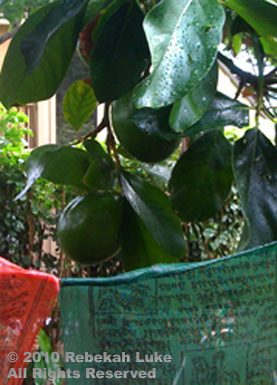
My neighbors have beaucoup limes on their tree, so likely we will trade and make guacamole. But most of the time I prefer eating avocados with a spoon plain, in their own natural bowl, all the way to skin, with just a little salt and pepper.

Prayerfully in gratitude we await

Copyright 2010 Rebekah Luke

Click below for related posts, then click on your back button to return to this page

Avos and cocos October 11, 2009

Gratitude for my abundant garden September 8, 2009


Lifelong learning about my art process

10 08 2010

Kaaawa Valley Morning

Some things take a long time. Waiting for an oil painting to dry is one of them. Here is “Kaaawa Valley Morning.” I painted it in May and varnished it this week. It’s already sold to a happy family waiting patiently to hang it in their home!

Oil paint takes at least three months to dry. A painted canvas should be bone dry before adding a protective varnish coat, for best results. So when commissioning an original painting, allow at least six months for delivery. That would be the technical aspect. As for the practical aspect, each artist has his/her own process that varies from artist to artist. Perhaps plan on a little longer.

Last Thursday I was happy to see Kit Kowalke, among other lovely friends, at our art reception at Ho‘omaluhia Botanical Garden. I first met Kit, an artist and art educator, when she was teaching at Honolulu Community College and I was in university relations. She was always cheerful, always a pleasure to be around, always sharing and helpful, always fun! And she still is.

She asked what medium, I said oil, she asked how do I paint, I said one at a time. That is, I like to finish one painting before starting another. And that my paintings take a long time to dry. Oil painters often switch to acrylic because the medium dries quickly, and they can get their work out on the market faster. Personally, I’ve been partial to oil because of the way the colors mix and look.

What I didn’t say was that I don’t like the state of unfinished-ness, or that unfinished projects are stressful to me.

“Oh!” Kit told me, “no need to paint one at a time, you can paint more than one at a time. Like two or three.”

“I can?!” 😕

“Yes!” she said. “Sometimes you might want to let an oil dry before painting on it some more. While you wait, start another one. Go back and forth.”

Well, that’s a perspective I’ll consider. And, I think that will ease my stress over things like unfinished home and garden remodeling projects. I can think of them as works in progress!

She asked more questions and gave me more tips, even volunteered which classes and workshops I could attend nearby. Which is what my intention was when I first left art school—to regularly keep my eye in training by always taking part in a studio class.

It is the advice given also by my tai chi sifu Alex Dong, who advocates not waiting until you have mastered a set before learning a new one because there are aspects of each set that help in understanding other sets. Or, (my interpretation) you will always be improving on the basics. Clicking on the above link to his website takes you to his journal article about the subject.

Somewhat similarly, when I was taking beginning kumidaiko (Japanese ensemble drumming) lessons and had an interest in composing, I asked the master Kenny Endo at what level one could start composing. How long must I study taiko before I would have enough knowledge to write drum music? He replied he believed one could start composing at any level.

Some things to think about. In my case, they still may take time because that’s my process. So far.

Copyright 2010 Rebekah Luke

Quite a few images are ready to leave the studio; these paintings are dry!  See my PAINTINGS page. If you are on Oahu, visit the art show at Ho‘omaluhia Botanical Garden during August 2010. Please see my previous post about seven artists.


Seven island artists paint and show works at Ho‘omaluhia

3 08 2010

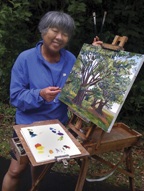
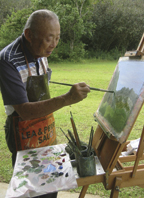
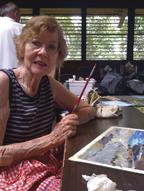
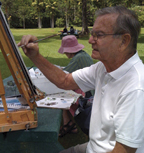
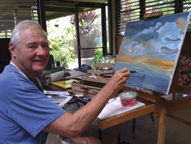
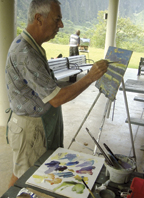
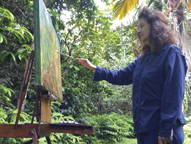
Our “If it’s Thursday, it must be Ho‘omaluhia!” public exhibit of paintings opens today at Ho‘omaluhia Botanical Garden visitor center and extends to August 30, 2010. The show displays the works of local artists Alex Weinstein, K.Y. Lum, Naomi Weinstein, Noreen Naughton, Richard Guy, Val Saban, and yours truly Rebekah Luke. The collection looks great!

Photo of me by Noreen Naughton

Every Thursday for the past 10 years, more or less, our group has painted in the peaceful landscape that is Ho‘omaluhia, located at Luluku, at the base of the majestic Ko‘olau mountains in windward Oahu. We come from different backgrounds and for different reasons to enjoy the garden and each other’s friendship.

This the first exhibit of paintings for four of our group. All but one of the 42 works in oil and acrylic may be purchased, with prices ranging from $75 to $2,800. Most prices are reasonable and realistic for original art, so it’s a good opportunity to start or add to your collection. Interested buyers should contact the artists directly (lay away plan of installments considered), as no sales transactions are permitted on the city property.

How we met (excerpt from catalog)

In the 1990s, art professor Noreen Naughton frequented Europe with summer abroad courses. K.Y. Lum, a psychiatrist, and his wife took the “Drawing in Italy” tour, visiting Rome and Tuscany to take in Renaissance art in hill towns and obscure churches. When they went a second time to Italy, Naomi and Alex Weinstein joined Noreen’s group. Alex, an architect, is a good sketcher, and Naomi, a retired educator, was a ceramist.

They all went with Noreen again to paint in France, “Following the Path of the Impressionists” from Amsterdam to Paris.

K. Y. Lum

Naomi Weinstein

Alex Weinstein

Richard Guy

When they returned to Hawai‘i they continued to paint with Noreen in the landscape. Ho‘omaluhia Botanical Garden became a favorite venue. K.Y. and the Weinsteins are the only ones from Noreen’s original group who continue to paint together on Thursdays.

The others: Val Saban, former international trader and industrialist, lives in the same building as K.Y., and the two swim together.

Rebekah Luke (that’s me) who studied painting with the late Gloria Foss, and K.Y. are first cousins. Richard Guy, retired chief justice of Washington state and a local arbitrator and mediator, joined the group after being introduced by Naomi who is in the same book club as his wife.

Val Saban

Noreen Naughton

If you go (and we hope you will)

The park entrance is located at the end of Luluku Road in Kaneohe, Oahu. The art will be on view every day from 9 a.m. to 4 p.m. through August 30, 2010.  Exception: The park is closed on Aug. 6 and 27.

Thursday is the theme. You can meet the artists at a punch-and-cookies reception on Thursday, August 5, from noon to 2 p.m. Most of us will be there on the other Thursdays in August in the mornings only.

Allow time to enjoy the rest of Ho‘omaluhia Botanical Garden’s plants, trails, picnic areas, lake, camp sites, and overall Hawaiian tropical scenery.

Thanks for visiting!

Copyright 2010 Rebekah Luke


Now, today, this moment

28 07 2010

Waiting for information, I received an email from Beverly this morning. It contained the article below by Lauren C. Gorgo, who published it yesterday, Tuesday, July 27, 2010. So far the policy at Rebekah’s Studio is to publish original writings of my own, but Lauren’s message resonated with me greatly. I am re-publishing it here, with permission, in hopes that it may assist visitors to the the studio. I invite you to come with me. As Beverly wrote to me, “Hang in there!” ~ Rebekah

The Active Death Zone-doorway to the other side By LAUREN C. GORGO ThinkWithYourHeart.net

In the last energy update I mentioned that July 26th was a powerhouse of a portal and that we are approaching the end of the end.

Today, the unseens are adding that the whole week is a powerhouse…that we are journeying through a very important (translation: challenging) week and that if we are aware of what is transpiring, the journey to the other side will be much easier to travel.

“For those who understand this passage fully, this can be a time of great release and purification. Let yourself feel the expansion and freedom of the present moment knowing that all is exactly perfect in your world.” -Pleiadians

Apparently this week is a ginormous passage and one that will result in great expansion coupled with the completion of many wayward elements of our past.

We are seemingly in what feels like an active death zone.

Similar to a physical death, and right before rebirth, we must first release all emotional attachments to get to the other side where love will abound in greater measure. Because of this necessary detachment process, this week we are being “encouraged” (aka: forced) to let go of any and ALL expired elements and remaining attachments so we can fully access the next level of our personal creations.

This basically means that whatever we are still holding on to will be in our face this week showing us exactly what we need to neutralize in order to pass go. The unseens are calling this passage a check point of sorts, designed with the purpose of stripping us of anything left that is not authentic and true.

So no, it’s definitely not looking like an easy week, but a necessary and divinely ordered one in order to pass over from this life to the next. The one thing we do have going for us seems to a be well-designed protective field of apathy that is enabling us to transition with some semblance of stability. Kind of like we are emotionally unplugged from a life that is ending so we can plug into the one that is beginning.

Because of this emotional disconnect…and since the full moon on Sunday…you may be suddenly dealing with some major fears or unresolved emotional issues, but while somehow able to maintain balance, peace and objectivity.  A welcomed gift if you ask me.

I also think this is what the Spiritual Hierarchy was referring to in the last transmission when they said:

“The realization of this momentous event can be heralded through your subtle, but growing ability to stabilize in these incoming and unprecedented frequencies as you find the increasing capacity to remain in a state of emotional calm, despite the intensity that surrounds you at this time.”

How to Pass Go

With detachment always comes the need for great mental discipline. Not that we will be tested persay, but we will need to pull this well-honed tool out of our arsenal of spiritual supplies to help us transition with the greatest ease possible.

Much of our lives we have been running from that which causes us pain, allowing ourselves to remain in a state of paralysis from our fears and now…through this powerful gateway (and tons of soul work)… we finally have the opportunity to free ourselves from these expired energies and fully realize our potential to create despite the many external circumstances that threaten to derail us.

And that is what this week will be for…to test our skills in holding our center despite those deep emotional triggers that will come up for us to deal with (if they haven’t already).  If we can achieve this, if we can walk through this VERY narrow doorway, fully present and completely void of an agenda, we will experience a major shift on many levels.

How to Deal

I am being given 3 key requirements to pass through this gateway with ease:

1) Let go, let go, let go…then let go some more. Anything that keeps you emotionally bound will challenge you greatly.

2) Stay Present. Allow yourself to find and keep the mental space required to surrender fully into each moment. If you slip into past (woulda, coulda, shoulda) or future (what if?) thinking, you will be met with great suffering. Stay with each moment as it arrives.

3) Allow what is to BE… without resistance. Free yourself of dross by realizing that all is perfectly well in this and every moment. Release yourself of the responsibility (attachment) of all others while fully understanding that their path is unique to them as yours is to you.

Above all, we are being urged to remember that to complete this journey, there is only one thing left that is required of us…full presence in love.

This passage is all about BEing…being free, being clear, being present, being authentic, being love.

After so many years of purifying, love is really all that is left and all that we will take with us…but not love in the form of attachment, love in the form of true freedom.  This week will ensure that we are well equipped to completely let go in love.

And if ever it was mandatory to listen to your inner guidance, that time is definitely now!

“Release your fears, release your worries, release your guilt, release your feelings of incapability. You are being guided through this with the utmost care and protection and if you love yourselves fully and completely, this gateway will open wider than the heavens to welcome you home!”

See you on the other side…
Lauren
ThinkWithYourHeart.net

Did u enjoy this post?  Now U can thank me with a donation!

Have you heard? I’m COACHING again!

Copyright © 2009-12. Permission is granted to copy and redistribute this transmission on the condition that the content remains complete and in tact, full credit is given to the author(s), and that it is distributed freely.

End of Lauren C. Gorgo’s article. Thank you.


A wedding, a memorial & a nod to John McClatchy

25 07 2010

The energies for this month require us to be strong. Yesterday, I had the honor and pleasure of performing the marriage ceremony for a delightful couple who I met six days ago. They chose a very small, quiet wedding with members of their blended family attending. In all there were twelve of us at Kualoa on a gorgeous morning.  Yes, I am an ordained minister with the Universal Life Church and licensed by the State of Hawaii to marry couples. The two tenets of the ULC are: freedom of religion, and do the right thing.

Later, I drove over to Punahou School to rehearse some songs and hula that the Punahou Alumni Glee Club will be performing at the Celebration of Life for Hattie Eldredge Phillips, 62, our kumu (director and teacher) who passed over on July 13. It will be a large funeral in the school gym with visitation starting at 9 a.m. The live video of the memorial service will begin at 12 noon, and you may go to this link to view it. Hattie was beloved by all and leaves a legacy of developing the Hawaiian culture across the curriculum, along with her late brother David Eldredge, at our alma mater. You may revisit my blog about her: type in Guardians of Tradition in the search box in the righthand sidebar below.

And sadly, my hanai sister’s husband John McClatchy of Idaho passed on July 22 after aggressive cancer. He had opted out of surgery. A very nice article by Sabina Dana Plasse of the Idaho Mountain Express tells about his life and popularity in Idaho. To read, click here. He and Kathy were married in Honolulu. He came here just a few times to visit over the years. He wondered why DH and I never went to visit them in Idaho. I wonder why, too.

Copyright 2010 Rebekah Luke


The story of the boat lei

21 07 2010

Every two years in July about 50 sailing yachts compete from San Francisco Bay to Kaneohe Bay for the Pacific Cup, “the fun race to Hawaii.” It’s organized and hosted by Pacific Cup Yacht Club in Northern California and Kaneohe Yacht Club in Hawaii. The boats have handicap starts and sail under the Golden Gate Bridge and across the sea to arrive around the same time, hopefully, and in time for the parties ashore on Oahu.
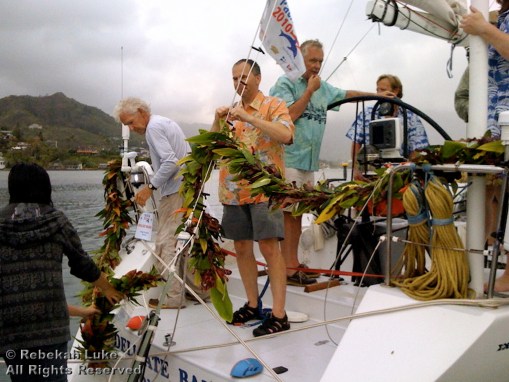
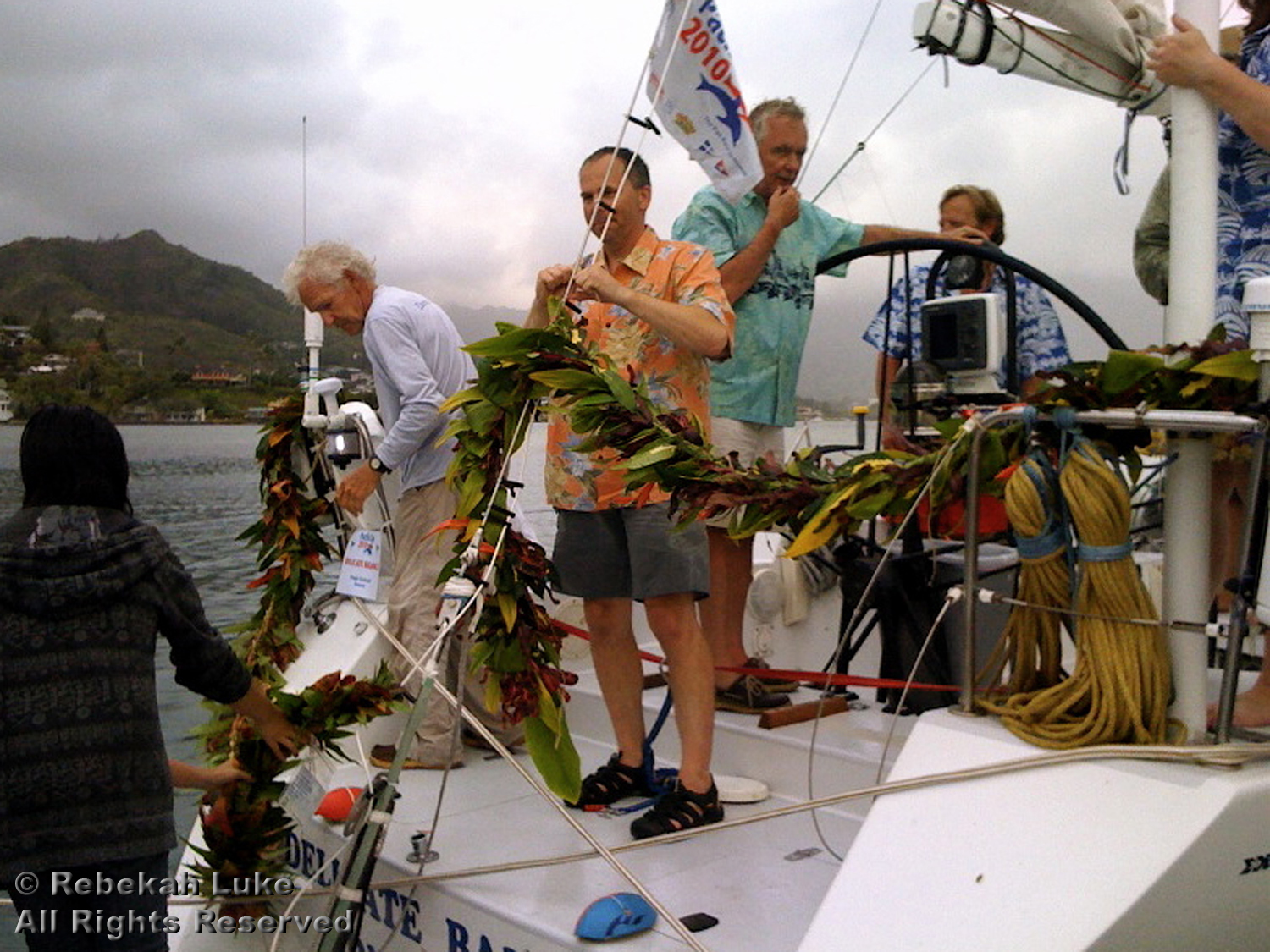
Delicate Balance arrives at Kaneohe on a cloudy afternoon. Two boat lei welcome her.

Many years ago I became the volunteer chair of the Boat Lei committee for KYC. I’m affectionately known as the Boat Lei Lady! A boat lei is a giant 12-foot garland of fresh, tropical foliage to greet and honor the vessel that carried her skipper and crew safely across the ocean.

Some call it a bow lei because it is attractive draped over the front end of the boat. Because most of the Pacific Cup yachts tie up stern to, we renamed it boat lei. It may be fastened anywhere as a decoration. The custom of presenting the lei has become a Pacific Cup tradition.

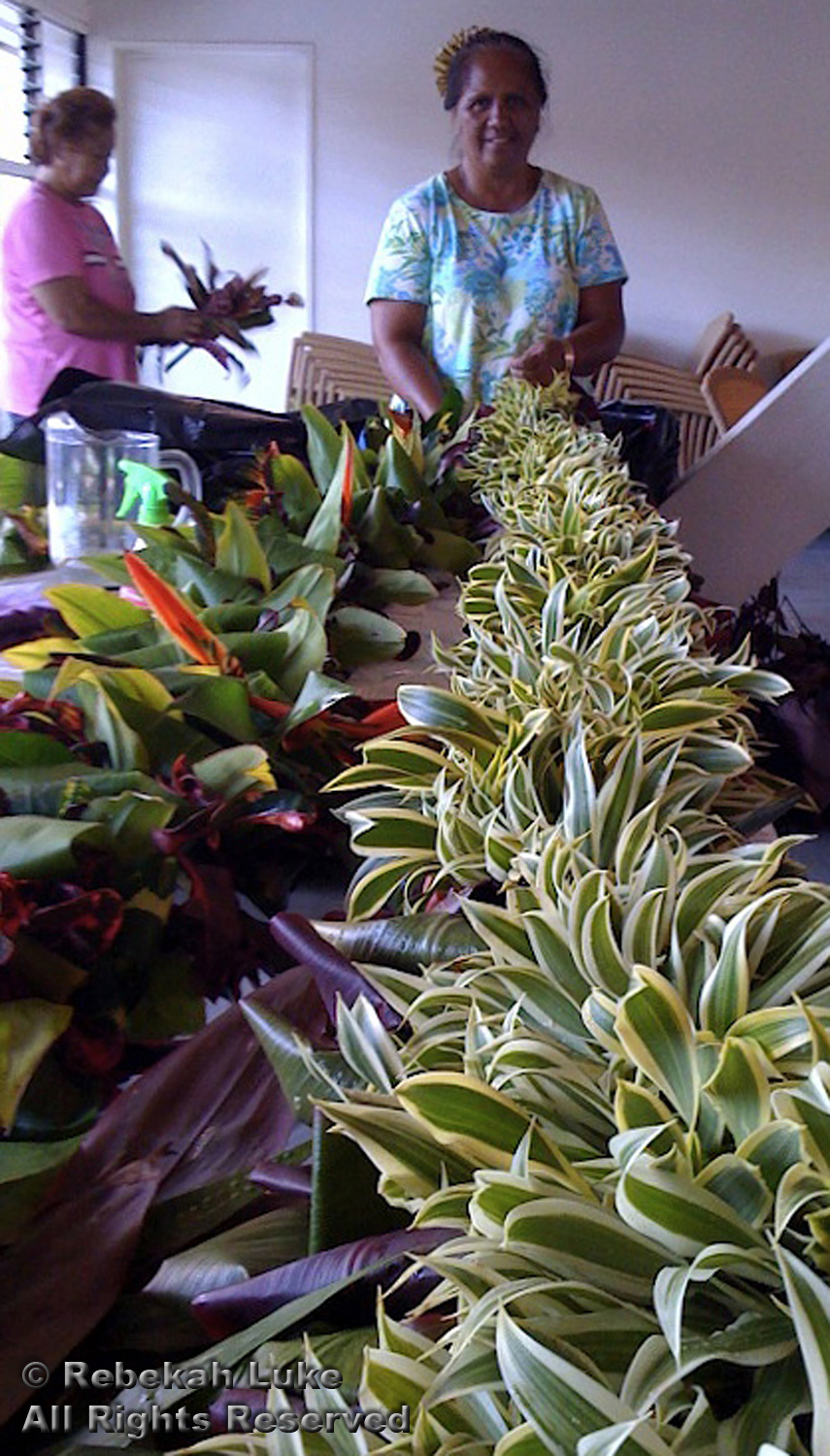
It takes many hands to make the boat lei for this event. The finished products are beautiful works of art and much admired. Event organizers inform the racers, family and friends they may pre-order the lei so it’s ready for their favorite boat when it arrives.

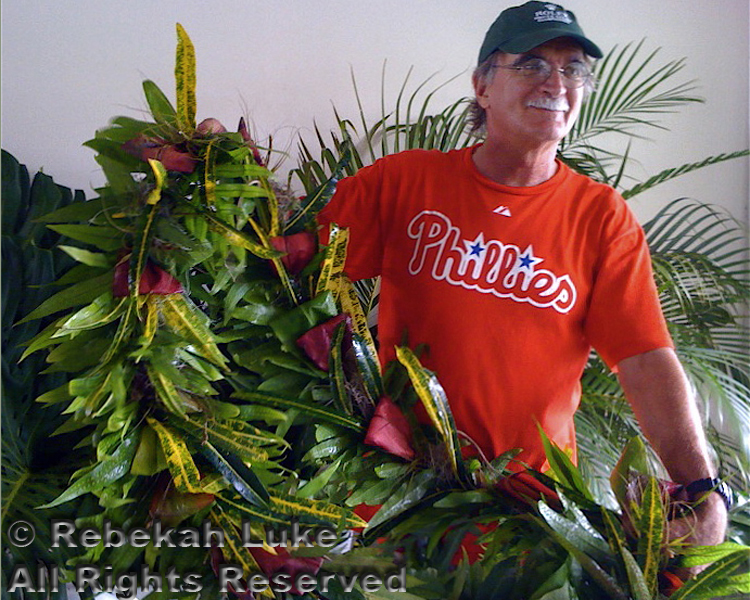
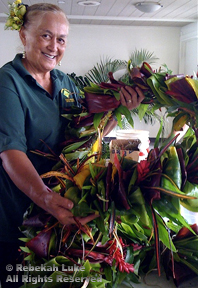
Last Friday, Saturday, and Sunday my crew made 45 boat lei! Many thanks to Michael and Bobbi for the promotion in California and for handling the sales from the e-store. That was a big help. Thanks to Kaneohe Yacht Club for lending the workspace. And, of course, mahalo (thanks) to all the lei artists for their remarkable team effort. Some KYC members also pitched in, and we are grateful for their contribution.
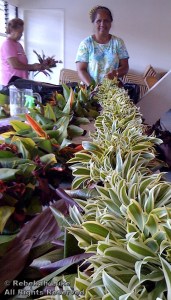
Haleaha finishes her 12-foot lei made with variegated Song of India clusters and red ti leaves

How do we make the lei? And how are we able to make so many? I’ve been asked. I will tell you! But first a little history and a funny story.

LITTLE HISTORY. In the early years I worked with  members of Hale Kuai Cooperative, a Native Hawaiian organization, to design the basic lei. We wanted cut foliage that would hold up in the sun, rain, trade winds, and salt air and look pretty for at least a couple of days in the elements.

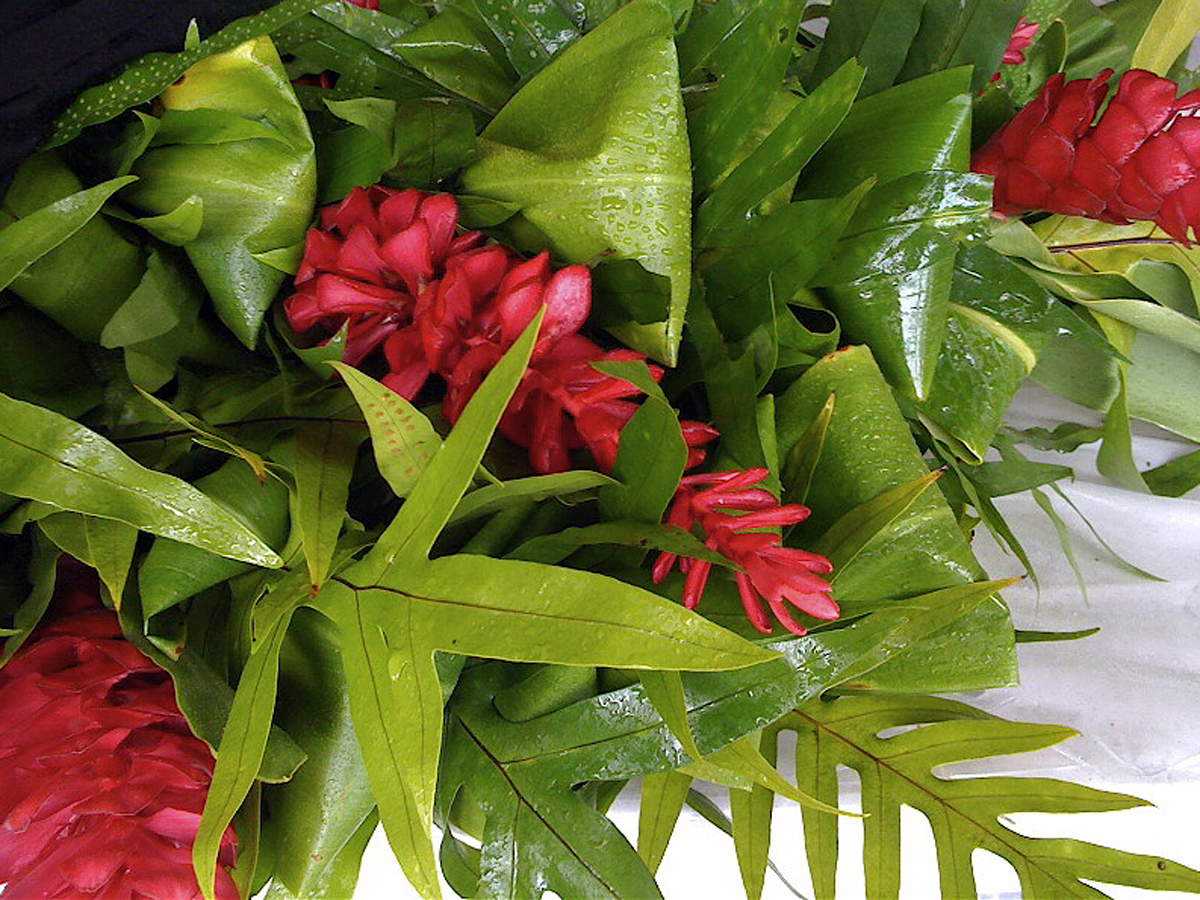
We settled on lai (say LAH-EEE, leaves from the ti plant), lauae (say LUH-AU-AY , a fragrant yet sturdy fern … Phymatosorus scolopendria, syn. Microsorium scolopendria), and multi-colored croton leaves. Our friend Kapa showed us how to use floral wire to bind the foliage; she learned the use of wire from her kumu hula. And Aunty Havana, who is a master at making hat lei, showed how to combine everything into lovely creations, once she figured out how to translate small to big. The lei became a product of the Co-op.
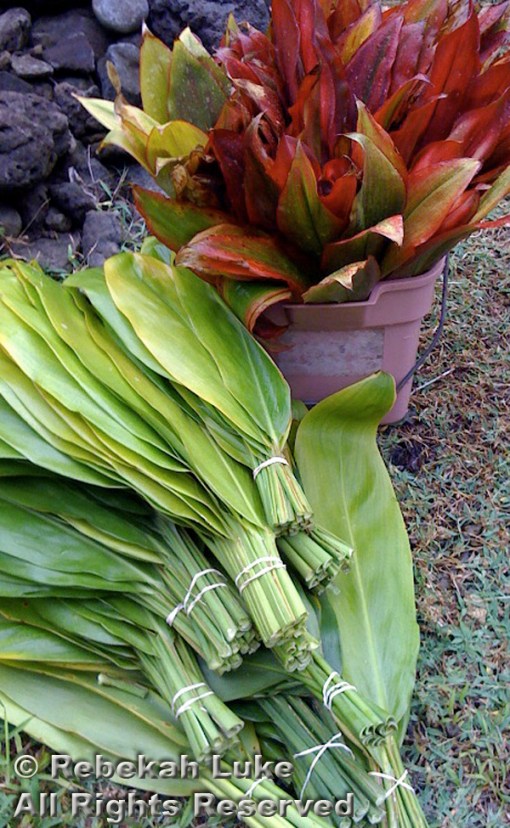
Green and red ti leaves. When picked from the stalk, they are called la‘i.

In more recent years, I have partnered with Koolauloa Hawaiian Civic Club to supply the boat lei. Volunteer members and friends gather the plant material from their gardens and from the mountains, donating the material and their time to the project. Other members and friends, who are artistic and enjoy lei making, work professionally as floral designers for a few days and assemble the lei.  The net proceeds from the sale of the lei provide scholarships for Native Hawaiian club members and/or their children.
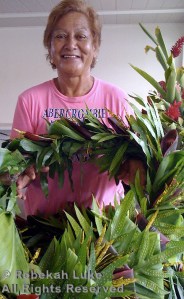
Clover's lei

FUNNY STORY. The very first year of my boat lei experience, we made the lei fine, but I had not given any thought to delivering the lei. I was so involved in providing a product that it did not occur to me that the boats would arrive at any time of day or night, 24/7. OMG! It was too late to organize any shift work.
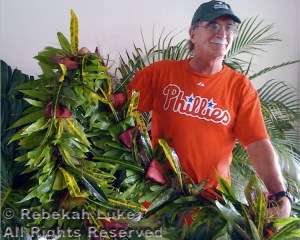
Pekelo's lei. Yellow-and-green croton and red ti provide accent color among the other greenery.

DH (Darling Husband) has a sailboat moored at the yacht club. He and I monitored the ETAs, and for an evening arrival, we would catnap on his little Mugquomp and wake up as the radio crackled to announce a boat had crossed the finish line. As we climbed out of our bunk and put on our jackets, for it was cool and a little rainy, we were fascinated and impressed by the radio conversation between Iwalani of the Escort committee and each arriving yacht. In her very calm, reassuring, professional, and gracious way, Iwalani gave the information and instructions on how to enter and come down the channel (with coral reef on both sides) to the dock at night. We had enough time on foot to greet the boat with a big lei.

DH and I were very short on sleep that year. Someone later suggested that we arrange for the Leis and Trays committee to deliver the lei. Brilliant! That committee is much larger and greets the boats with Hawaiian music, lei and mai tais for the captain and crew. Why not the lei for the boat too?

HOW TO MAKE A BOAT LEI

The style of the lei is known as wili (say WEE-LEE), meaning to wind. We wind by hand—one must have strong hands to tug—using wire instead of a natural twine or raffia traditionally used to make a hat or neck lei. Wire allows us to put the work down and makes it easier on our hands. Our lei are 12 feet long, but shorter lengths make lovely bouquets, wreaths, and table decorations. Allow enough time to gather & prep the materials and make the lei. It takes about two hours to make, excluding time to gather.

Each artist has his/her “line,” so do not worry that your lei does not look like someone else’s. It won’t. The variables are selection and placement of the plant material as well as the available supply of the greenery and flowers. Here is the basic way to construct the lei.
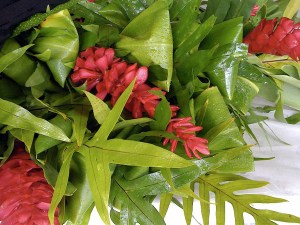
Ti, lauae, and red ginger combo

Materials to make one 12-foot lei:

1 kaau (which is 40) each of ti leaves, lauae, croton leaves. Be sure to leave about 4 inches of the stem on. The stems provide the slightly stiff backing for the lei. Do not strip the mid-rib from the ti leaf.

A few tropical flowers—such as, heliconia, red ginger, bird of paradise, bougainvillia clusters—with 6-inch stems to intersperse throughout the lei (optional)

One 24-gauge paddle wire from the floral supplier or craft store. One paddle is enough for one and a half lei, or approximately 18 feet total.

String to tie on the finished lei to the boat

Gloves (optional) to protect hands from croton stains

33-gal. plastic trash bag (optional)

Ululani's lei

Tools:

Work surface such as a table or floor, hand clippers, scissors, spray bottle of water

Step 1. Gather and prep materials by sorting by color and size, cleaning, and bundling.

Step 2. Pick a palette of 3 or 4 types of leaves if you have a wide choice. Include ti and lauae in your palette.

Step 3. Take the tip of a large ti leaf and turn it under to meet the stem, shiny side out, bending it in half but not creasing it. Fasten the tip to the stem with the wire, winding it around the leaf 5 inches from the ends. Begin winding about 5 inches from the beginning of the wire, securing both the ends of the leaf and the wire together. Grasp the two ends of the leaf and the end of the wire with one hand (if you’re right-handed, use your right hand), and wind the wire with the other hand, going around about 5 times. Be sure to pull the wire taut. This is the start. You will use one continuous length of wire and not cut it until the end (unless the wire accidentally breaks).

Step 4. With the tip of the ti leaf facing up and pointing toward you, place a lauae leaf on top with stem pointing toward you. Wind the wire around 1/2 inch down from your start 3 times, again pulling taut. Next add some croton in the same way, 1/2 inch down. Then add another ti leaf. This grouping forms your pattern.

Step 5. Repeat Step 4. Alternate placement right and left, if you wish, to cover the sides. With each addition, come down about 1/2 inch. Remember to pull the wire taut as you wind so that your lei does not come apart.

Keep the width of the lei the same by checking the sections you did earlier. If your lei is getting wider (this is common with beginning lei makers), allow less material to show or leave more space as you add. Just be sure your wire is wound every 1/2 inch, catching all the stems. From time to time, turn your lei over to examine the back. Hold your lei up with one hand and give it a good shake to make sure it is secure. From time to time, spray the lei with water to keep it fresh.

Step 6. After the lei is the desired length, end it by winding the wire around itself about 10 times. Snip wire with scissors. Tie string with a square knot to the lei at 4 or 5 points as a way to fasten the lei to the boat.

Step 7. Keep the lei cool until ready to decorate. A cold air-conditioned room is ideal. Mist with water.

Step 8 (optional). For transporting or brief storage, roll the lei into a wreath and place in a 33-gallon plastic trash bag. Leave an opening for the lei to breathe.

And that’s the story of the boat lei. Enjoy your creation!

Copyright 2010 Rebekah Luke