Popo goes to Italy

28 09 2012

Pretty soon I’ll be posting from Italy! I’ve been getting ready for the long vacation from Rebekah’s Studio, but I’ve arranged for you to follow me on my new blog Popo Goes to Italy. I apologize so very much for being missing in action here.

DH and I are preparing to make our house guests and house- and pet-sitter welcome and to enjoy the next week and a half with friends and students.

Tomorrow we’re bicycling from Jim and Sharon’s house to see the Blue Angels fly over Kaneohe Bay. Taking the tandem.

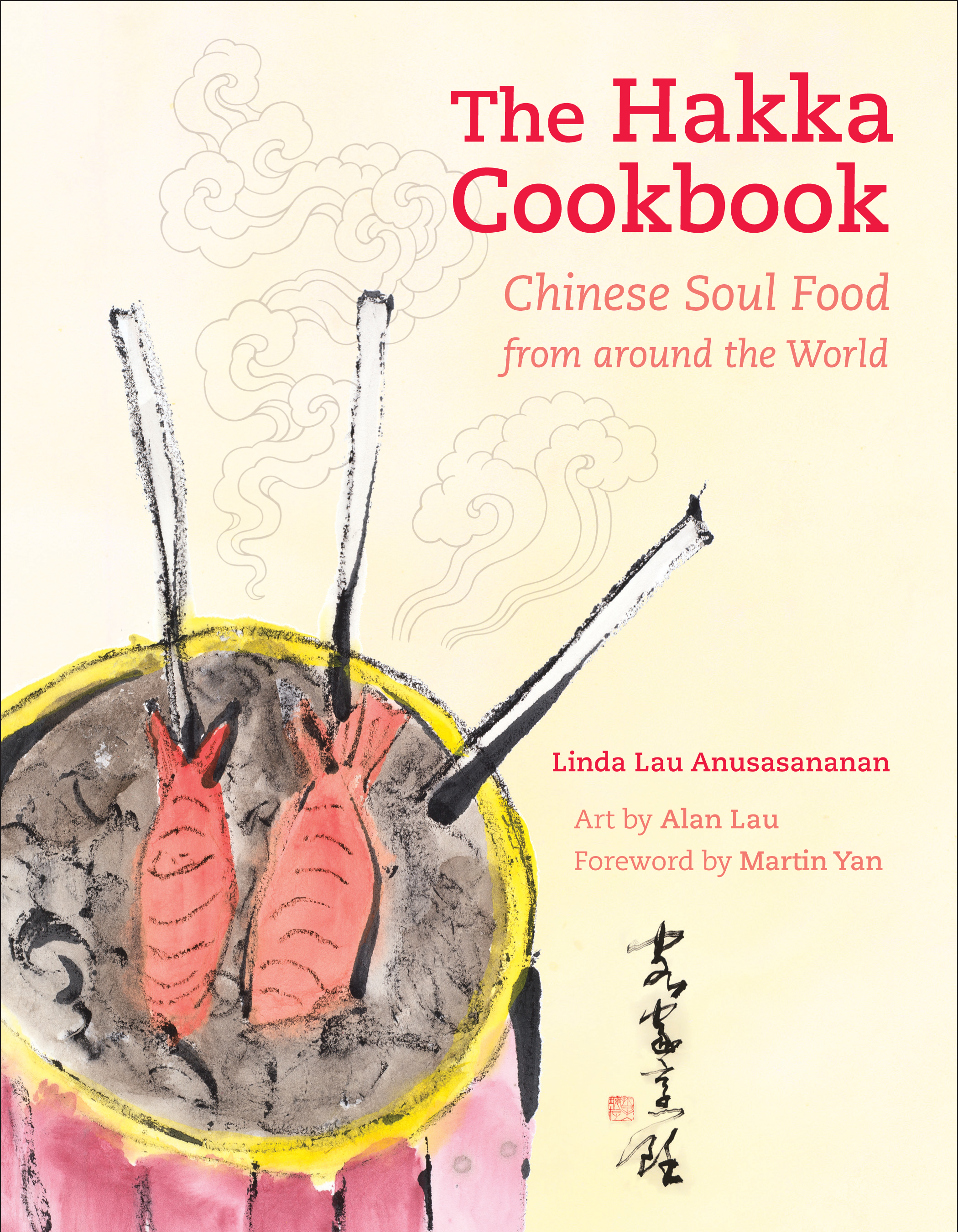
My friends Linda, Lisa, and Sofia arrive from San Francisco on Sunday. Linda is the author of The Hakka Cookbook: Chinese Soul Food from around the World (University of California Press, 2012), and she’s scheduled to do a book signing at the Tsung Tsin Association‘s Autumn Banquet in Honolulu that we’re all attending.

DH and I had the pleasure of traveling with Linda to China as she went from place to place, restaurant to restaurant, talking to chefs, researching and eating Hakka dishes, and finding out more about our Hakka heritage in our grandparents’  homeland. We each included each other in our respective publications—mine is The Chong Family in a New Millennium.

We’ll have a lot of fun with Linda’s daughter Lisa, who was on the China trip with us, and almost-three-year-old granddaughter Sofia. We need a toddler fix. Lisa lived in Italy and married an Italian.

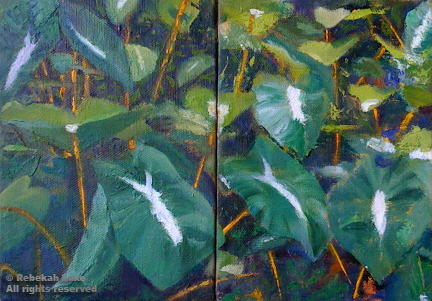
DH and I will have time to attend the First Birthday Luau for Eva and Kingston, girl-and-boy twins, who live down the highway. Special family friends too, so a very special gift is in order—my Kalo Diptych. Shh, it’s a surprise!

Kalo diptych / 10″ x 7″ / oil on canvas / each panel framed separately

My painting students have two more classes with me before a break. They’ll be painting on their own while I’m away.

Then we’ll greet Joe who’s ready at the drop of a hat to come from Florida to take care of Ula, Alice Brown, Pua, and the house. Because he just loves Hawai‘i! It’s all arranged.

Thank you so much for checking in. Be well. I’ll be in touch as Popo Goes to Italy.

Copyright 2012 Rebekah Luke


Growing up in Napoli

10 09 2012

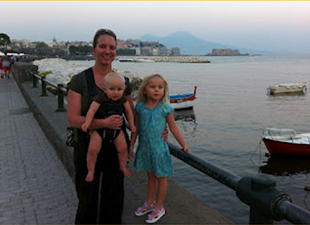
Family in Napoli

Oh, how they’ve grown in six months! Miss Marvelous and family moved from Ka‘a‘awa to Naples, Italy, where her dad works. Here is a photo he made over the weekend of her mom, her baby sister, and her at the bay of Napoli. That’s Mount Vesuvius in the background.

Papa and Popo (DH and me) will visit and tour with them in October on the days when the child is not in school.

Our granddaughter, 3, attends Italian school. She is one of two Americans in her class of 16 children. This year they are learning Italian and English; the English teacher is from England. Her parents have enrolled her in a special afternoon music program, too.

When I visit, I’m planning to play with the kids, do some sketching and painting, eat pizza, learn some necessary Italian phrases, explore my surroundings, and drink Chianti while watching the sun set as it rises in Hawai‘i half way around the world — not necessarily in that order.

Copyright 2012 Rebekah Luke


In the mood for fresh guacamole

8 09 2012

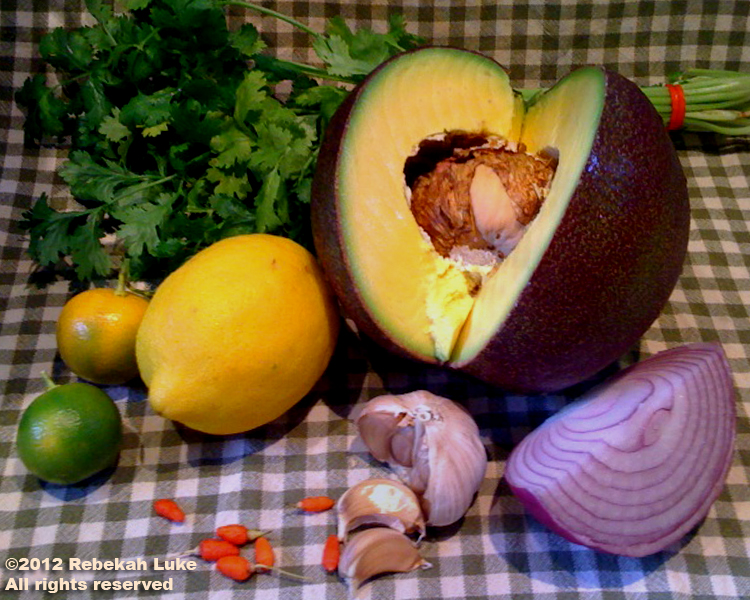
The avocado, calamansi, and Hawaiian chilies are from my garden. So abundant!


Grapes and drapes painting lesson

5 09 2012

Grapes and drapes still life setup, Painting II, Rebekah Luke, instructor.

Today my Painting II class is painting “Grapes and Drapes.” This lesson, originally from Gloria Foss, is practice in the studio for painting the Ko‘olau Mountains and trees in the landscape later on.

We pay attention to where the light is coming from in the scene and turn the form with values from light to dark.

We review the “Tomato Theory” we learned in Painting I, that is lightening and darkening the form with colors that are analogous on the color wheel instead of adding white or black, or instead of adding the complement to darken. In addition, we remember the mantra, “Warm it in the light; cool it in the shade.”

“Tomato Theory” can be a hard to get used to at first, but practicing it makes objects pop with vibrance and gives the overall painting more pizazz.

I find it satisfying to be able to pass on the techniques I learned from my own teachers Vicky Kula and Gloria Foss. What they taught me and what I am passing on to my students is the logic of light.

Copyright 2012 Rebekah Luke


Art and architecture where Hotel and Richards intersect in Honolulu

1 09 2012

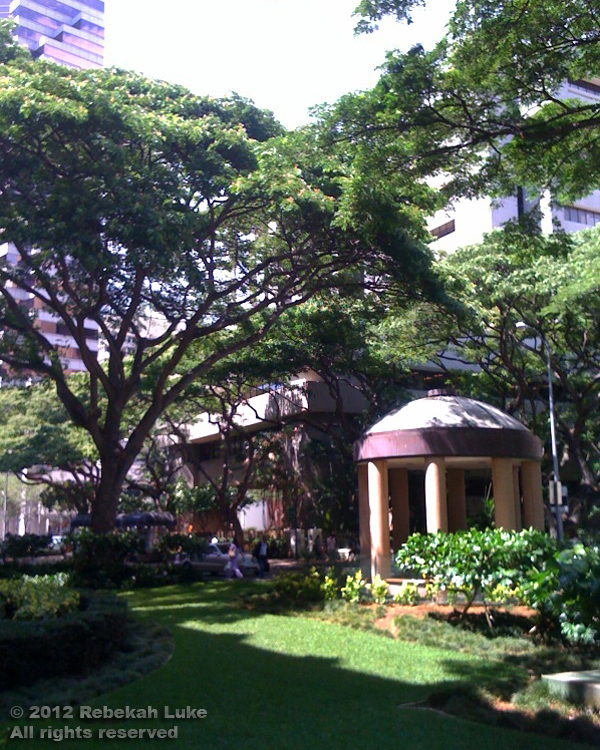
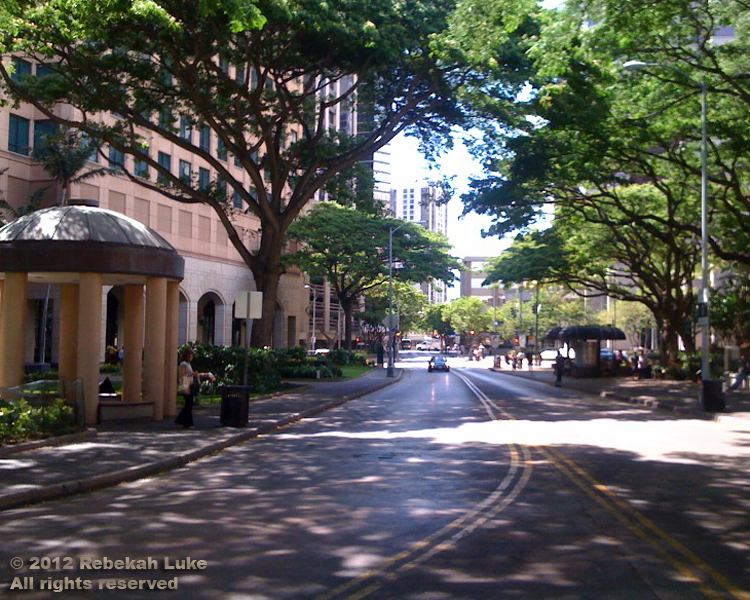
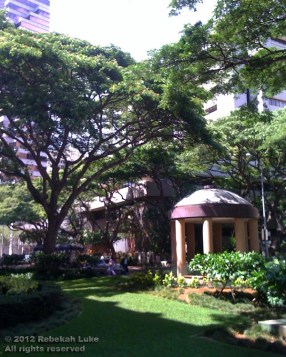
The charming gazebo at Hotel and Richards streets that caught my eye.

After lunch downtown last week with Becky at Café Julia, that got the vote for best downtown place for “breakfast and lunch only,” I strolled up the street, intending to visit the Hawai‘i State Art Museum (HiSAM). Becky suggested I take a look at what happened to the old Armed Services YMCA swimming pool.
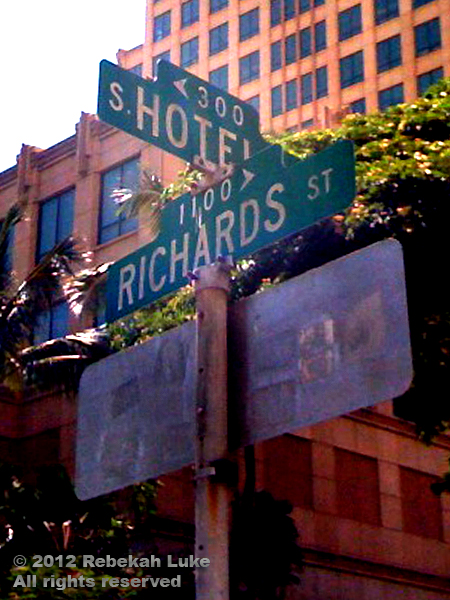
Approaching the intersection of Hotel and Richards, the loveliness of dappled sunlight through the monkeypod trees stopped me.  Pause for photos.

I saw four familiar buildings differently than before, and I reflected on their noteworthiness, all in proximity in this small area. Later, it occurred to me that on my little walking tour, I had focused on the historical architecture and fine art of these buildings, making for a very pleasant afternoon by myself . . . while Becky went back to her office to work.

Hawai‘i State Capitol

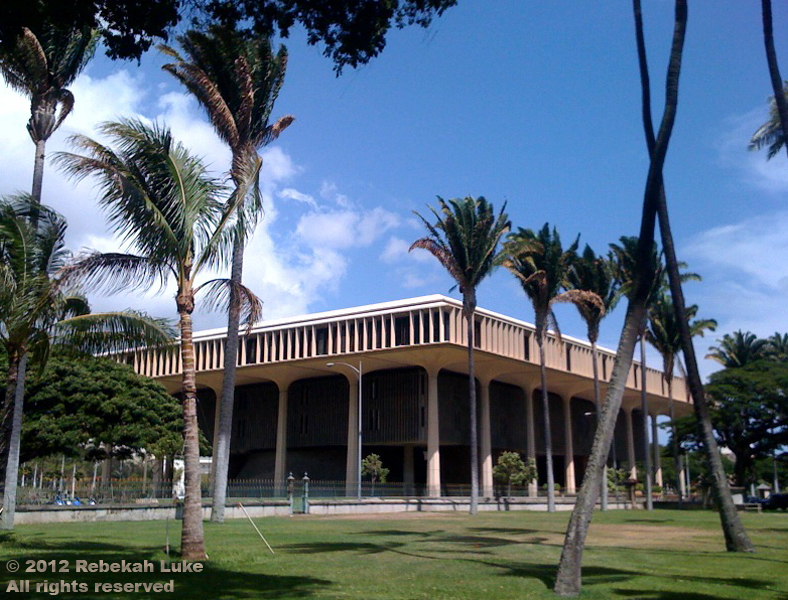
Kitty corner to the gazebo is the Hawai‘i State Capitol designed by Belt, Lemmon & Lo and John Carl Warnecke & Associates. Its columns represent coconut palm trees, and the two cone-shaped legislative chambers represent volcanoes emerging from the reflecting pools that depict the Pacific Ocean.

In the courtyard floor is a round artwork “Aquarius,” an Italian glass tile mosaic by Tadashi Sato. There are two noteworthy statues at the Capitol: one of Father Damien of Moloka‘i on Beretania street, and one of Lili‘uokalani, Hawai‘i’s last reigning monarch, on the opposite side facing ‘Iolani Palace.  Inside the chambers there are large tapestry weavings by Ruthadell Anderson.

Looking makai (toward the sea), notice ‘Iolani Barracks (1871) that housed the Royal Guard on the royal palace grounds. Hawaiian kings and queens lived in the ‘Iolani Palace (behind the Barracks in my photo) until 1893 when Lili‘uokalani was overthrown and imprisoned in her room. Today both buildings are museums worth touring.

‘Iolani Barracks, moved to this site in 1965 to make room for the new State Capitol.

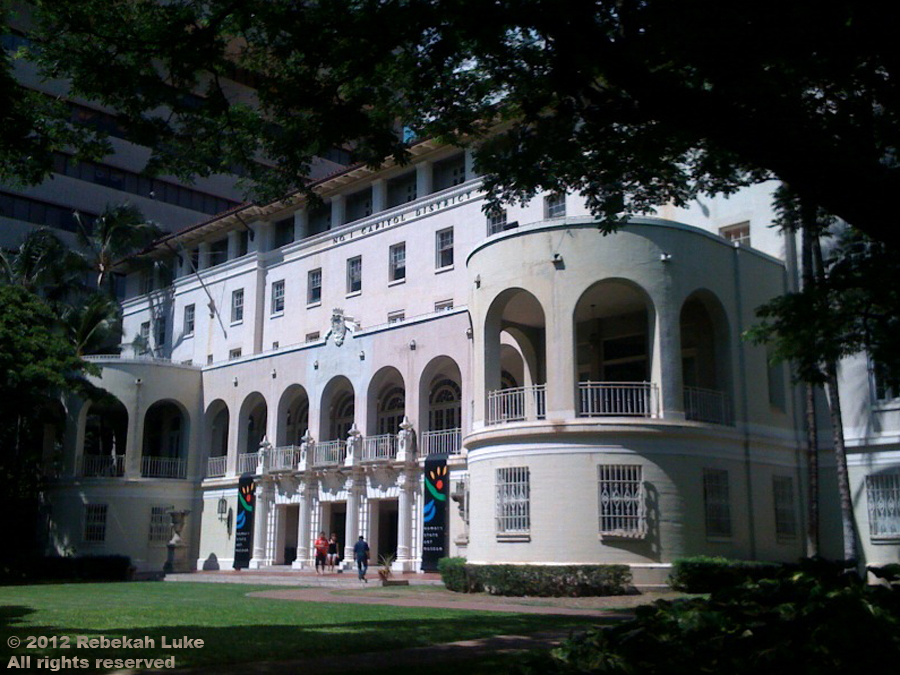
When I was in my twenties, I came to the Armed Services YMCA once a week to rehearse with the Honolulu Chorale. In 1927-28 that building was erected to replace the second building of the original Royal Hawaiian Hotel (Hotel Street was named in 1850; the original hotel was demolished in 1882 and rebuilt). I thought it was grand as a functioning Y and imagined what it must have been like in its heyday. Today the building is renovated, housing State offices and the Hawai‘i State Art Museum on the second floor, my destination.
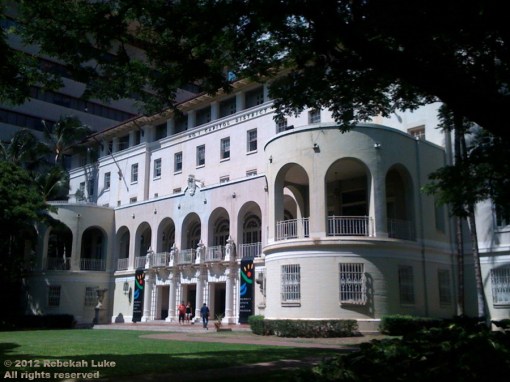
No. 1 Capitol District Building is the former Armed Services YMCA built in 1927-28. The former swimming pool and deck  in the middle of the U-shaped building is now a sculpture garden with a pretend swimming pool.

“Visions and Portraits of Hawai‘i” in the Ewa Gallery (toward Chinatown) contains representative work of Hawai‘i’s well-known artists, as defined by the State Foundation on Culture and the Arts. This display is eclectic, in that there is generally one work per artist. But Hawai‘i, since settled by non-natives, is eclectic!

Two stand-out works for me on this visit were the main piece as you enter the area — a painting of Waimea Canyon on Kaua‘i by D. H. Hitchcock (1861-1943) whose impressionistic works I admire greatly, and the painting of women, thickly painted by Madge Tennant.

The theme of the exhibit in the Diamond Head Gallery opposite is “Recent Acquisitions.” What I remember most is the nature photography of Wayne Levin. Three stunning images: an underwater shot of a diver chased by an ulua (I think), one aerial of Hawaiian monk seals at the tidal line (“Monk Seals and Surf, Derby’s Beach, Nihoa”), and one straight-on of birds and clouds (“Approaching Sooty Terns”). Classic clouds for my painting students to study!

Both galleries display impressively large wooden ‘umeke, or calabashes, turned by Robert W. Butts.

On the ground level, passing by the museum gift shop and through Downtown @ HiSAM restaurant, doors opened to the Sculpture Garden in the former swimming pool area. Artist Doug Young created a glass marvel in 2D with such visual depth that it seems as a 3D pool. I got dizzy staring down at it! Interesting. The restaurant staff began setting up for an outdoor garden party, and I moved on . . .

. . . Back to the Richards Street YWCA, half a block toward King street where Becky and I ate lunch. This attractive building was designed by architect Julia Morgan, who also designed Hearst Castle at San Simeon, California. Before I headed home, I revisited a Lau Chun painting hanging above the grand piano in the lobby. It was of the YWCA building as viewed from the palace grounds, and with the street and cars edited out.

His strokes of thick paint are of every color, you’ll see when you examine the painting closely. It’s as Miss Marvelous’s mother, when as a youngster she looked at my oil paintings, said: “I can’t figure out how, when you look at it close up, it’s just paint, but when you step back it’s a picture.” Lau Chun’s painting is an example that value (shades of light to dark) is more defining than hue (color) in a painting.

It can be useful and educational to look at other artists’ work. But more than that, I can pick out those things that are inspirational. Often, looking at other artists’ work usually frustrates me, and I’m only inspired to return to the studio to make my own creations. This time, I enjoyed the things I selected to see in a new light.
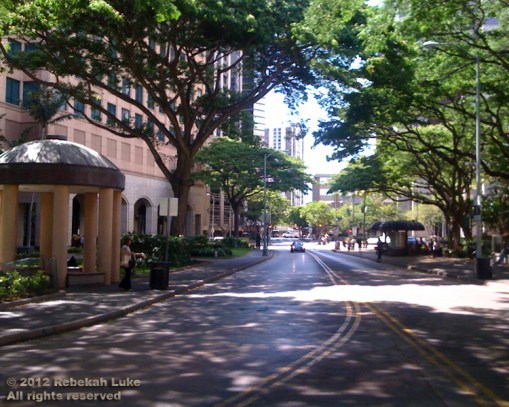
Looking north on Hotel street. Ali‘i i Place, primarily an office building, has a convenient municipal parking garage with cheap rates. The lobby and Alakea street pedestrian entry feature several fine, large paintings by John Wisnosky.

Copyright 2012 Rebekah Luke


A blessed gift from the kou tree

25 08 2012

Happy Anniversary, Honey! Thanks for the years together!

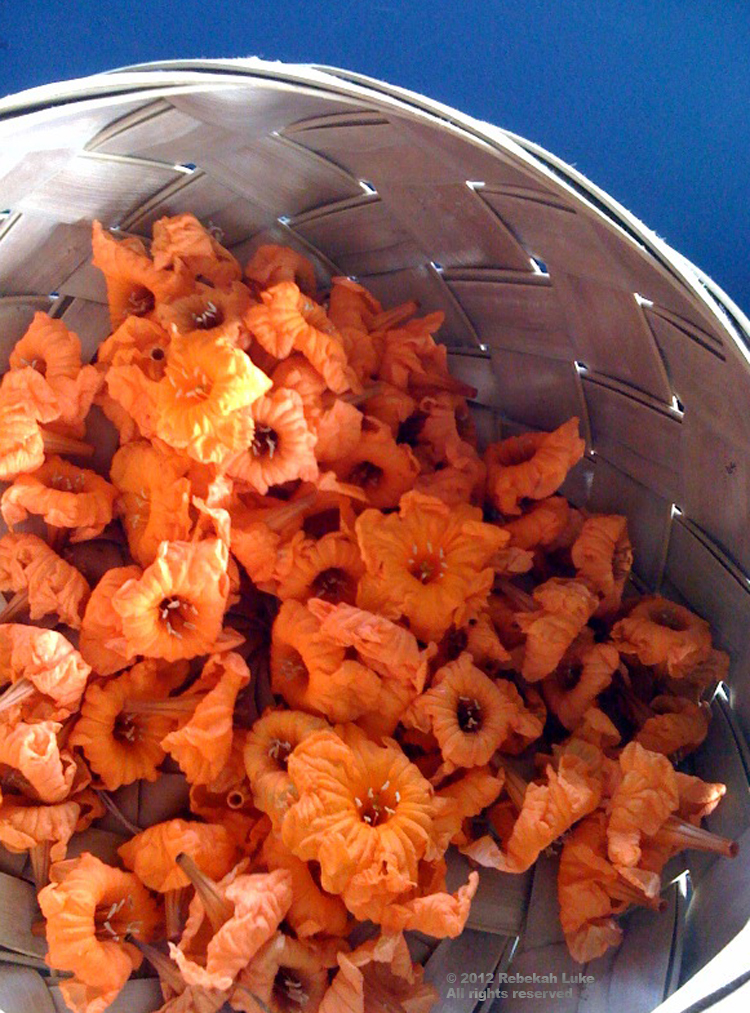
. . . and the kou tree said, “Your Darling Husband has been good and kind to you and me. I will provide the flowers from which you can string a lei for him on this, your wedding anniversary, day.”

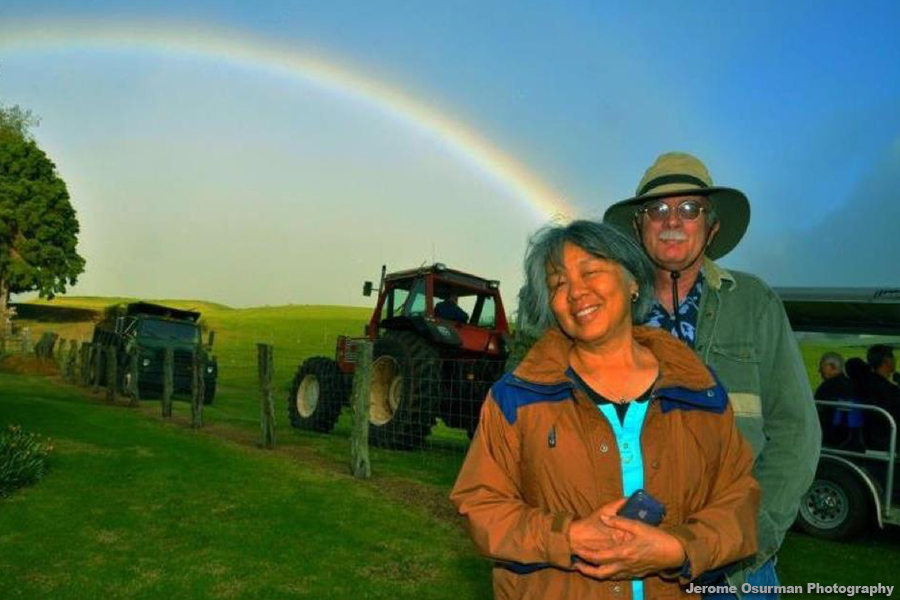
Me and DH, who is my easel, at Kāhua Ranch in Kohala earlier this month.


New book, new millennium

20 08 2012

Click to zoom into coverJust released! In time for my family reunion: The Chong Family in A New Millennium, by James H. Kim On Chong-Gossard and edited by yours truly (Chong Hee Books, 2012). This is the project that kept me busy in the studio for the past several months!

Author Chong-Gossard is my first cousin once removed and the family genealogist, the keeper of the family tree. He wrote the main text that tells the family story beginning with my maternal grandparents emigrating from China to Kohala on Hawai‘i island and how they reared 15 children. Other articles, anecdotes, essays, family photos, genealogy charts, and a memorial section round out the story to bring the reader up to the present day.

I’d like to share the book with you. To read an electronic version, head over to chongfamily.wordpress.com. The printed book is available at blurb.com/bookstore/detail/3506522.

PUBLISHING NOTES, OR THE MAKING OF . . .

A family reunion and another book seemed right for 2012, Jim Chong-Gossard and I agreed. We would plan both for the 20th anniversary of The Chong Family History that he authored and that launched Chong Hee Books in 1992. (Chong Hee means long-winded in Chinese. ;-))

Cousin Jim was and still is the most literate person in publishing I’ve had the pleasure to work with in my career. We simply speak the same “language,” and he can read my mind or even answer my next question before I ask it. I don’t have to blue-pencil his manuscripts much.

We started by discussing what we wanted our book to accomplish. I had some concepts and visions swirling in my mind that Jim was able to merge with his own insights, giving them focus. As author he’s quick to grasp the ideas and articulate them. We spent two long weekend evenings during Jim’s faculty leave, separated by about six weeks, working together at the studio to set up the direction of the book. We had lunch with a few other relatives to test our method.

I was looking for a story that was fresh, candid, current, spontaneous and loving. Then Jim went back to Australia to teach at the University of Melbourne, and I began to scour my cousins’ Facebook albums for images and postings that told a story.

The technology of Facebook and blurb.com have changed publishing, and The Chong Family in A New Millennium is an example of how. I wanted to try an e-book as well as the usual ink-on-paper. I did enough research to decide the book did not have to be an e-book per se; I just wanted readers to have access to it from the internet. If I could create Rebekah’s Studio using wordpress.com, then I could use the same free blog service and software — something I was already familiar with — for the new book.

I created the genealogy charts on Excel with the data Jim collected from family. No need for fancier software. To have a family tree appear as a chart on the screen and not a link that viewers would have to click on and then leave the site, I converted it to a pdf and then used scribd.com — a tip from the wonderful volunteer techie on the wordpress.com Forum (quick help when you need it).

I picked a simple theme (layout) for the electronic version because I wanted the text and photos to translate easily to print. Somewhere I had read about “blog to book” and I began to research the possibilities. I settled on the book service of blurb.com, mainly because blurb has been around for awhile, and the description of the service was comparatively easy to understand.

I read the entire site before taking a leap of faith and downloading the free software application called BookSmart, one of several to choose from. The software one picks depends on the original format that the book is in. In my case, it was a blog that BookSmart would “slurp” (new vocabulary word) into a layout template that I chose.

The advantage of going this route and not supporting my local printer was the time I saved, especially as I had a hard deadline. I wanted the books available at our family reunion. Once I thought every page was perfect, I clicked the Order button for one single copy—you can order one or more than one—and the book immediately was on the printing press and delivered in about 10 days. This is called “print on demand” for small runs. The single copy served as my proof copy that I gave to my detail-oriented friend Rosemary to read before I made final corrections and placed a larger order.

Understand that there is a learning curve. BookSmart is just an editing and publishing tool, after all, and I was fortunate to be from the old school of cut and paste with rubber cement. But what a tool! The technology is exciting! If the resolution of a photo is not correct, for example, it will suggest that you fix it. Just click on the Fix button and voilà! If it is totally unusable, it will say so as well. The application allows you to drag and drop into your layout, and you can even edit the layout (though I did not take the time to learn how to do that; the choices of existing layouts worked fine for my needs). I am very happy with the results.

Here’s the best part. Blurb.com has an online bookstore and will take care of everything, right down to depositing money into your PayPal account. Now, how cool is that?!

Copyright 2012 Rebekah Luke