Let’s meet at the Native Hawaiian Arts Market at the Bishop Museum

14 05 2010

Welcome Spring

Looking for a venue to show my paintings, I asked for and am granted a spot at a two-day Hawaiian native arts fair—the Native Hawaiian Arts Market & Keiki Art Festival. I can’t say how many artists are showing in this 5th annual MAMo (Maoli Arts Month) event, but anytime there is a gathering of Hawaiians expressing themselves it’s worth noticing, especially if one lives in the Islands. It’s a good thing to keep up with the host culture of where you live.

So please save the dates: May 22 and 23, Bishop Museum grounds, entrance on Bernice street between Kalihi street and Kapalama avenue in Honolulu, 9 a.m. to 5 p.m. Special admission (see below).

With Native fine art and craftmanship, art that is now and art that is part of our ongoing living history, one can appreciate how the indigenous, or maoli, peoples, are evolving and what we have to say about ourselves, our land, and the universe.

The artwork you see will be for sale. It is a joy to support Native Hawaiian made products in Hawaii. At the Arts Market buyers can know that the Hawaiian artists can keep all the money earned from their original creations, as opposed to giving a commission to a gallery. Several sponsors and grant makers, led by the PA‘I Foundation, make this possible.

My own paintings, the ones on the PAINTINGS link of this website and several new canvases, are in the studio in different stages toward completion, gearing up for this event. The last time I exhibited actual pieces in a public gallery was in 2007 in a group show with my hapa Chinese cousins at Gallery on the Pali in Nuuanu. So, I’m very excited to return to the art scene in Honolulu.

This week I’ll be signing, varnishing, framing, inventorying, and pricing the work while DH builds a few more display easels. DH is my main easel, and perhaps he will take a break from his Bishop Museum docent gig to join me in greeting you when you come next Saturday and Sunday.

You’ll have a fabulous time. Meet the artists and talk to them about their work. Bring $5 admission. That will get you into the Bishop Museum galleries including the new Hawaiian Hall, as well. Bring a lot more kala (money) to buy some art. Artists have to eat too. 😉 Thank you and all the organizers and supporters of Maoli Arts!

Copyright 2010 Rebekah Luke


Movies on a rainy day – these filmmakers are Hawaiian

2 05 2010

More and more indigenous Hawaiians are finding not only their voices but their audiences. I find that exciting. The Oiwi Film Festival opens today at The Honolulu Academy of Arts Doris Duke Theatre. The festival features the collective voices of Native Hawaiian filmmakers and runs through May 26, different movies on different days. Tickets are affordable at $8 with a dollar off for students, seniors and military. If you’re a member of the Academy of Arts, five bucks gets you in. I posted more information on kalahuihawaii.wordpress.com.


In Hawaii, May Day is Lei Day

1 05 2010

The art of lei making is showcased today with the annual lei contest at Kapiolani Park in Waikiki. May Day is Lei Day in Hawaii after all. The public can see different styles of lei in categories of colors and age groups of the lei makers.

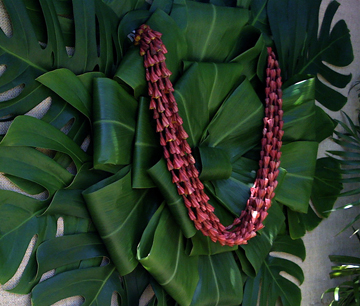
Last year’s 2009 grand prize winner was a drape of many strands of plumeria buds cleverly snipped and strung kui style. So simple, but different, and what an elegant statement!

Plumeria comprises the 2009 grand prize winner

The blue ribbon in last year’s mixed category was this beauty:

I apologize, I did not record the names of the lei makers, but I’m betting they are entering their creations again today.

Once, in the 1970s when we both did work for Sunset‘s Hawaii office, I had the pleasure of accompanying horticulturist Horace Clay who identified the plant materials in each lei as the contestants brought in their entries early on May 1. They came in from all islands, and Horace had a great time telling anecdotes about the plants and where or how far someone had to go to gather the material. The lei makers were so happy and proud of their lei. They had stayed up into the wee hours of the morning making them. I thought all of them were magnificent.

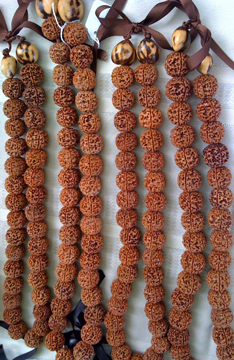
My friends Kamakea and Kai who come from a long family line of Hawaiian lei makers made these blue marble lei in the next photo to look like jewelry. I saw them for sale at last Saturday’s hoolaulea at Hauula Elementary School. Hawaiians use all sorts of natural plant materials, not just flowers, to adorn themselves. What looks like carved round Oriental wood beads is actually the inside of a blue marble (Elaeocarpus grandis) fruit.

Blue marble lei — by Kamakea & Kai

The brilliant blue skin is peeled away, revealing a fuzzy hairy seed. Kamakea and Kai wire brush and wash away the fuzz—a time-consuming job. They further clean out the indentations of each sphere with a Dremel tool. They drill holes for stringing and finish the necklaces with two polished kukui nuts and ribbon. Before all of that, however, they gather a supply of blue marbles. It’s a lot like fishing: seed lei makers don’t tell where their favorite spot is!

If you have time today, head on down to Kapiolani Park to see this year’s beautiful lei. They could inspire you in your own art work, in lei or other medium. In the event the judging takes a while, be prepared to wait for the viewing to open. There are other related Lei Day activities in the park to see, such as crafts and food and Hawaiian music and hula dancing.

Copyright 2010 Rebekah Luke


5K family fun run/walk in Kaaawa Valley

10 04 2010

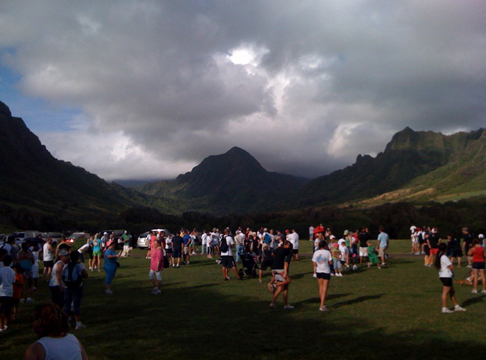
Kaaawa Valley with Puu Ohulehule beyond

This morning was perfect for the “1st Annual Kaaawa Elementary School Ocean Warrior 5K Family Fun Run/Walk” in Kaaawa Valley, a short ways down the road from the studio. The film industry uses this location for movies and TV shows. This is the beautiful place where Miss Marvelous’s parents wed.

Many thanks to the Kaaawa Elementary School PTO Committee and Kualoa Ranch for coordinating a successful community event. The entry fee bought access to the course trails, the event t-shirt, a bottle of water, and a coupon for 50% off of three different activities at Kualoa Ranch. Shave ice, spam musubi, cotton candy, music, and the great outdoors made for a great party!

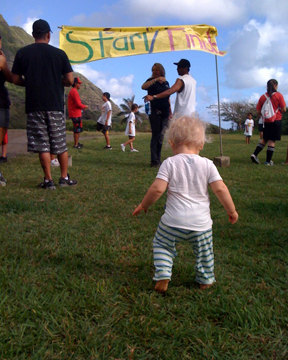
We could have brought Alice Brown and Pua (guest dog), as plenty of other people brought their canines, and the event folks offered free poop bags, but, alas, we had left the pooches home. I brought my easel and took the opportunity to sketch out a new painting of the vista. Miss Marvelous was among the youngest entrants to show off her new walking skills. Congratulations, Kaaawa! Everyone had a good time!

Miss Marvelous approaches the line

Copyright 2010 Rebekah Luke


Beach swings

5 04 2010

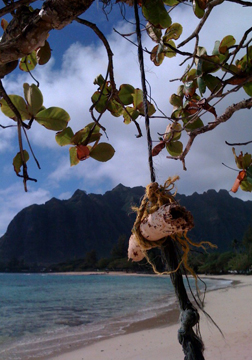
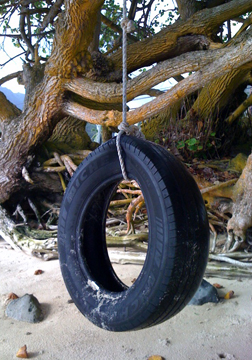
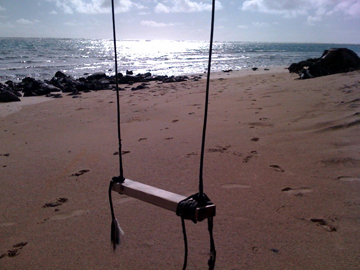
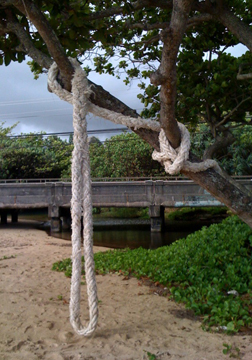
No sooner than I reported the rope swing gone (see my painting “The Rope Swing”), several new ones appeared! We ran into them on a morning walk along Kaaawa beach this week with our almost-seven-year-old puppy Alice Brown. The large white rope must have drifted ashore.

Driftwood Swing

Tire Swing

Board Swing

White Rope Swing


Today’s my birthday, I feel like a wreck

9 01 2010

Today’s my birthday, and I feel like a wreck.

Yesterday Pat, Irma, and Becky came to cheer me up. They brought flowers, smoothies, presents, and cupcakes! That did make me feel better, and DH said he hadn’t seen me that lively since we came home from our trip.

That was around Dec. 27. Although home, sweet home, and having had a ball on a once in a lifetime vacation, my body experienced an excruciating  pain that I can’t recall ever having in my life. My body is crooked, and my range of motion limited. I feel weak.

A trip to the emergency room and a follow-up visit to an M.D. pronounced it’s not H1N1 but likely a virus or a combination of things. Viruses last about 7 to 10 days, she said. Today is day 14. So I’m baffled. Not a whole lot of change.

Michael, my neighbor, claims he had the bug, and that Sandra, his wife who is a flight attendant, had it twice. It’s from the airplane, he said. And coming home from Vienna to Honolulu, I was on a lot of planes. Will the pain go away? He promised it would.

Heal thyself, DH reminds me, the Reiki master. Right. My reading of the spiritual CNN says the first half of January will be rough. No kidding!

I’m so grateful for my family and friends and that I’m where the climate is warm.

I do have an appointment with my naturopath today who’s fixed me up before. I am wondering if it could be something mechanical (something of my body physically out of line) or an underlying allergy that might be preventing me from being well. Dr. Burke practices acupuncture, that works with the same energy as Reiki, and Chinese medicine too.

I have my hopes up for some relief to bring me back into balance. That would be a wonderful birthday present.

Copyright 2010 Rebekah Luke


Dressing like an onion: winter apparel for a Hawaiian

5 01 2010

If you’re warm-blooded and live in Hawaii or another subtropical-to-tropical climate, and you’re headed to where it’s cold and snowing in winter, here are some tips on the art and science of staying warm. If you’re not warm, you’ll be miserable, and that’s no fun!

Winter sports enthusiasts know this, and every first-year college student from Hawaii to North America masters this by year two, but if you’re my age or haven’t been away from the Islands for a few years, perhaps a refresher will help.

I was quite comfortable last month in Austria on a riverboat and on land of the ports of call (see my December 2009 blog posts). It snowed every day. My friends Kaylene and Rosemary asked what I wore and how I kept warm, so here goes.

I learned that:

• Winter apparel is not the same as fall-spring apparel. Leave the fall clothes behind; they are too hot for inside and not warm enough for outside. They just take up space in your suitcase.

• Dressing like an onion works. The layers trap insulating pockets of air to keep you warm. Invest in thin apparel made of new high-tech fabrics. It’s worth it, and you’ll be all set for the next time. Stay away from cotton because it doesn’t wick moisture, like perspiration, as well.

See my layering details below. Five or six layers, count ’em! There are variations, but this is what worked for me. You want thin clothes so you can still move, button your pants around the waist, and have your footwear fit with all the layers on. If it warms up for you, you can shed a layer. Better to have too many than too few.

• You can always go back indoors. Each time you do, be sure to peel off the outer layers of your clothes, if only for a short while. It’s a humbug, particularly when you go to the bathroom, but you’ll get used to it. Then layer back on when you go outside again. If you don’t do this, you’re liable to get sick.

My friend Dave noticed I had to think about it, that is, what layer goes on next?—well, yeah!—versus people from cold climates for whom it’s automatic. You’ll need a few more minutes to get dressed too.

• Lathering your body with lotion after a warm bath or hot shower will keep your skin from drying out and getting itchy. My pharmacist recommended Vaseline total moisture conditioning body lotion. The lotion is for your whole body, not just your face. My momma who went to school in Chicago and Shanghai taught me this years ago.

• You can use a nasal spray or neti pot to keep your nose from drying out and bleeding. Consult the pharmacist.

• Hand warmers, those magical packets of warmth that activate when exposed to air, in your gloves are “life savers.” Mine came from Dick’s Sporting Goods store in Pennsylvania, but you can get them online at http://warmers.com.

• It’s best to eat just before you go outdoors. Digestion generates heat.

And if, say next winter, you visit the outdoor Christmas markets in Central Europe, head for the glühwein hütte for a mug of hot mulled wine or cider!

DRESSING LIKE AN ONION

Layer 1 (innermost)—Your regular underwear. For women, this includes pantyhose or tights. Apply lotion first.

Layer 2—Long underwear a.k.a. long johns. I brought two sets:  one silk set from REI with long leggings, sleeveless top and long-sleeve top; and one set of capilene from Patagonia. This is your “baselayer.” If it is colder than cold, you can double up on this layer.

Layer 3 — Pullover top (e.g., silk, nylon, polyester), blouse or shirt with long sleeves. Wool trousers with lining. My DH got away with heavyweight jeans, but only with long underwear underneath. Plus a pair of thin warm socks.

Layer 4 — Wool sweater; I wore a long-sleeved V-neck cashmere.  I alternated that with a long colorful Coogi wool sweater vest from Australia (a gift) that covered all the way down over my hips. Smartwool brand knee socks of merino wool; the brand matters. Visit smartwool.com.

Layer 5 — Fleece vest with pockets and a little longer in the back below the waist where there is no body fat (on me, anyway). Scarf—mine was pashmina from China—or neck warmer (a tube that looks like the neck only of a turtle neck; I found this easier to wear than a scarf, and you can pull it up to cover your nose). It’s very important to keep your neck comfortably warm, or risk a sore throat. When not wearing the neck gear, you can stow it in the vest pocket. When indoors, my closed-toe slip-on Birkenstocks (I’m unable to wear flats or heels comfortably). DH wore Crocs on the ship.

Layer 6 — Knee length heavy wool overcoat with pockets, or other outerwear jacket, like a ski jacket. Hat. Gloves. Snow boots or waterproof shoes with thick soles.

I inherited the wool coat from my cousin Dee who was a frequent traveler. I preferred this to a fleece-lined, hooded Gortex jacket. I found my Dale of Norway hat at the Salt Lake City airport when I passed through in 2002, a winter Olympics year. The program directors of the ship wore knitted hats with extensions that covered their ears and cheeks and ended up in yarn braids; really cute. My fall gloves were not warm enough, even with liners. Mittens are warmer. At the last minute I bought pop-top mittens designed for hunters from Dick’s in Pennsylvania. (Thanks for finding them, Richard!) These allowed me to remove the mitten half when I wanted to shoot—my camera! The mittens came in camouflage-colored yarn, but who cares when warmth is the objective. I would have gotten them in bright hunter’s orange, but they didn’t have them in my size. When not wearing, stow your hat in one pocket and the gloves in the other pocket. I got my purple lace-up Sorel snow boots many years ago from Lands’ End for my first Alaska trip, and they still work great. I just love them.

Bonus frosting on the cake —Remember to pick up some hand warmers.

If with these tips you still don’t want to guts real winter, well then, lucky you live Hawaii!

Copyright 2010 Rebekah Luke