Ready for the next phase

31 01 2013

Where, oh, where is Rebekah? Missing in action, making peace with my past. I’m going down memory lane, culling through old stuff for cherished souvenirs to keep (again), and tossing out a LOT. Streamlining the studio and getting ready for the new lunar year.

Three art classes and one music workshop to teach loom. I must create the proper space for new pupils! My life has turned a corner, for sure, and I can’t wait for the unfolding.

I’m glad I asked for help. I put out the call to my Facebook friends who gave me some good ideas on how to make more room and deal with the remnants of my many and varied life phases. Haha, I can call them that now. Phases.

My wish for you is that you, too, will throw away some clutter today, let go of the past that no longer serves you, be present, and be well!

Copyright 2013 Rebekah Luke


The Hakuoh University Handbell Choir

16 02 2012

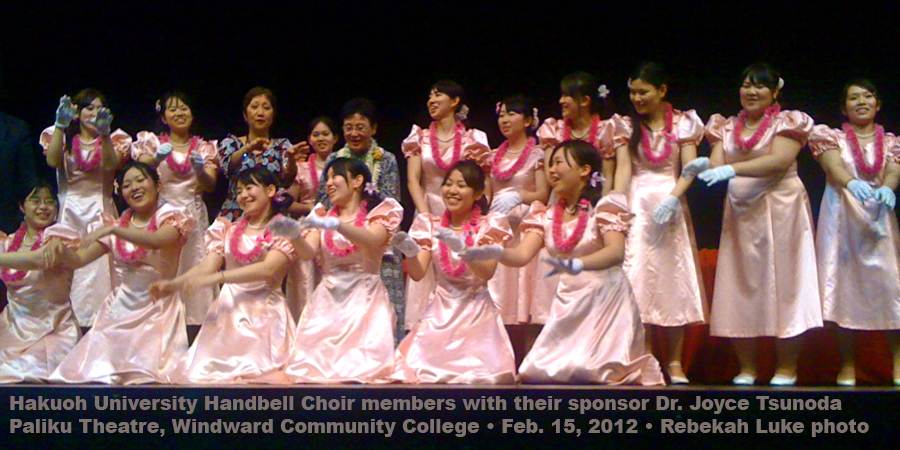
Handbell choir members talk to audience on stage after the performance. Here are some of the bigger bells. The largest, a low C, weighs almost 15 pounds.

I skipped out early from my Windward Community College Tai Chi Class last night to hear the Handbell Choir from Hakuoh University (Oyama City, Tochigi Prefecture, Japan) in a free public concert at Paliku Theatre on the same campus at 7. It was the choir’s 21st Goodwill Tour of Hawaii, but the first time I’d heard their music.

The beautiful full sound of another bell choir at a music festival in 1987 captivated Professor Hirotaka Arai so much that he was moved to start the all-female choir. Today’s choir can ring seven octaves of handbells with 100 to 120 separate pieces.  Of the 11 numbers last evening, Music Director Arai arranged six of them.

Listening to handbells is a rare treat. Watching 19 young women ring them is very interesting. There is more than one way to play the bells. Grasping them by the handle and shaking them in the air, hitting them on the table, or laying them on their side and playing them with drum mallets. One at a time, or up to four at a time.

I closed my eyes occasionally, just to listen to the music without watching the performers or the director, and I found I could get lost in the sounds and songs of the bells. Especially during “Jupiter” by Gustav Holst and Leonard Bernstein. I got way out there!

The Hakuoh Handbell Choir sings and dances hula to “Pearly Shells” while waiting for official photography. Their sponsor in the back row with the light-colored lei is Dr. Joyce Tsunoda, past head of the University of Hawaii Community Colleges system (and my former boss. It was great to see her!).

Copyright 2012 Rebekah Luke


Musical conducting from my dan tien

19 04 2011

Thanks for visiting again! I’ve been away from the studio a bit, doing some cool stuff. It’s never too late to learn something new!

As my Facebook friends already know, I went to a choral conductors workshop one weekend and a food forum with farmers and chefs the next.

Back in the studio I’m preparing for a visit from the Easter bunny, a group art show, a trip to Kohala to scout for a family reunion in 2012, and summer drawing classes for the neighborhood kids. Today’s story is …

CONDUCTING FROM MY DAN TIEN

A last-minute private plea to attend a choral conductors workshop appeared in my e-mailbox, saying only five conductors and four singers had signed up.

What a shame, because a delightful gentleman named Rodney Eichenberger was in Honolulu to show and teach how a choir director’s posture and hand movements produced a corresponding sound from a group of singers. A conductor’s conductor, the professor was now in his 80s; and who knows when he would come to the Islands again. Would I consider attending?

With 30 dollars I registered as a singer for two days (Conductors need singers!), with meals included. To me, this was a good deal, to learn from the best! I enjoy choral singing: school choirs, church choir, pit chorus, Honolulu Chorale, lunchtime choir, glee club, neighborhood Christmas carolers. If the opportunity presents itself and it feels right in my heart, I’m there.

Before teaching us his bag of tricks, Rod Eichenberger shared his rules for conductors:

No talking. Except to identify the title of the piece, line or measure. The time spent talking is put to better use singing.

No playing of individual voice parts. Just start right in and sing the piece start-to-finish two times. This encourages sight-reading, he said. For those singers who have personal issues with the music, they will resolve the issue by the end of the second time through. We had just one exception to this rule when the accompanist pointed out that the melody line was not being sung correctly.

Conduct from your energy power center, your dan tien, not any higher or lower. Dan tien is a Chinese tai chi term referring to the area of your body about the size of your fist, below your navel and toward the curve of your back. Described another way, when conducting keep your hand movements directly in front of you, about waist level and below while standing perfectly straight.

*Trust the singers. They are here to sing and will deliver.

Each conductor took a turn at conducting a new piece. Then Rod would explain and show how to make it better. A turn of the wrist here. A tiny pinch with the fingers there. He found something to improve in each conductor’s style. In a second rehearsal each conductor could review a challenging passage with the singers, and Professor Eichenberger would suggest further changes.

The workshop results were so remarkable, our teacher had all of us giggling! So easy, so much better, and so much fun! In the end, I recall, say, eight conductors each with just a few minutes of instruction, eight new pieces music, and three dozen singers learned remarkably simple and logical choral technique. With an amazing piano accompanist who was reading the music the first day for the first time herself, we performed a concert at 8 p.m. on the second day. We were good! I feel so lucky to be a part of this group experience.

Copyright 2011 Rebekah Luke


Punahou Carnival 2011

31 01 2011

This Friday and Saturday, Feb. 4 and 5. All the fun is bounded by Punahou Street and Wilder Avenue in Honolulu, from 11 a.m to 11 p.m., and I’ll be there. If you’re visiting, this is a great travel tip!

The big tent and the thrill rides are up, and they’re getting ready for the Punahou Carnival again. I’m here to plug my alma mater, with notes on my contribution and my favorites. It’s a humongous fundraiser put on by the junior class to raise scholarships. First-timers wonder how they do it. I’ll tell you how.

The school ropes in all the parents of the junior class and alumni to donate their time, labor, talent, and supply goods so that everything spent at the Carnival is profit for students.

The Carnival is such a bonding experience, you remember it for life and return every year to support it. There’s fun for all ages.

Banyan in the Park, an original oil on canvas by yours truly, for purchase at the Punahou Carnival Art Gallery. 16″ x 20″.

My contribution

For the past several years I’ve placed my paintings in the Art Gallery—50% of sales goes to the school, and put my time in at the Hawaiian Plate “booth.” I also help serve up the meal (5 to 8 p.m. Saturday).

Last year my graduating class was the second oldest still working the Carnival. We report to Dole Cafeteria and don aprons and hats to plate the meal of Hawaiian food. For anyone not of school age who isn’t interested in the midway carnival rides, it’s a nice place to relax because there is air-conditioning, there is continuous live music, and there are real bathrooms.

We used to prep and cook the food, and in years before that we worked the famous malasadas booth with Mr. Bowers until we were banned for making non-regulation sizes and shapes ;-). And frankly, I don’t remember what we did prior.

My favorites

Usually I carpool with DH and his daughter, also an alumna. We each arm ourselves with an empty shopping bag and an umbrella. We go to a secret parking place if the lots on campus are full. Tip: take the bus if you can or prepare to park and walk from neighboring streets.

These are some of our favorites:

  • Silent auction—Items vary from year to year, and sometimes we’re lucky. We scope this out first.
  • Art gallery—Always like to see what other island artists are doing; it just makes me want to paint more, though. A great collection.
  • Plant booth—I’ve donated bromeliads and small avocado trees. For my garden I’ve bought herbs, red and pink ginger, native Hawaiian species, water plants, and turf grass. They will hold your purchase for you to retrieve later, if you wish.
  • Malasadas—Of course, with a hot cup of coffee at night.
  • Jams and jellies—E.g., red pepper jelly and mango chutney. I think it sells out in the first hour on Friday 😦
  • Books—At the end you can fill up a bag and get it all for something really cheap.
  • White elephant—Quick survey. You never know what you might find.
  • Food—Whatever your heart’s desire, a separate booth for each. Gyros, corn on the cob, fruit smoothies, fried noodles, pizza, teriburgers, veggie stuff, Hawaiian food, chicken, Portuguese bean soup, ice cream, saimin and meat sticks … oh la la.
  • Produce—A crew goes to the Big Island to pick. I do my next week’s fruit and veggie shopping here.
  • Games—The kiddie games are a world apart. It’s fun to watch the little ones. I think it’s time to take Miss Marvelous there. There are games for older students and teens too. My Facebook friend Yo and her husband are parent chairs of the prizes this year.
  • Will call—You can check your loot here until time to go home.

So c’mon to the Punahou Carnival, alumni or not. Spend your money. It’s for a good cause!

Copyright 2011 Rebekah Luke


Aloha Uncle Walter and Mr. Bowers

8 01 2011

I am mourning and celebrating the lives of two greats today:

Walter Kau, wonderful friend to my mother’s family, died on Dec. 20, 2010.

“Uncle” Walter was a very dapper fellow with so much talent, impeccable taste, friendship, love and light. Really a wonderful man. He taught my mother organ. I remember the stage musicals he played for and directed. I remember the dinners he cooked for my aunties and uncles on Monday nights in Kailua, and I remember the day he wrote a check for my oil painting — I think he was my first customer — straight out of the trunk of my car. What an honor! I remember bumping into him not too long ago down at Ward Center and he told me he was buying new shoes. For dancing, no doubt! He was a great friend of our family. His obituary (click on his name above) recalls just the headlines of his full life.

Francis “Miki” Bowers, long-time teacher and friend of Punahou School, passed on New Year’s Day. My contemporaries called him Mister Bowers from the time he was their math teacher. Later our alumni class made malasadas for Carnival under his watchful supervision until we were banned for making non-regulation sizes and shapes. Most recently I had the pleasure of singing in the alumni glee club with Miki, who played ukulele and anchored our group sound. Sometimes he was the entire bass section. He was a trouper. In failing health, he attended last month in wheelchair with oxygen tank to perform at our last Christmas gig of the season.

Punahou president James Scott sent out to the school community a message that I quote, in part,

“It is with great sadness that I share the passing of Dr. Francis “Miki” A. I. Bowers  . . . on January 1, 2011.  Miki was our beloved Academy math faculty who retired in 1998 with 41 years of service.

“A 1945 Punahou graduate, Miki lettered in football and swimming and was student body president his senior year, the same year John Fox started as President.

“In his 41 years at Punahou, Dr. Bowers taught every math course offered, served as department chair for 12 years, supervised Punahou’s SAT testing program for 25 years, and revolutionized math instruction by creating a highly successful AP Calculus program.  He also coached swimming, water polo and volleyball.

“In 1957 Miki inaugurated the famous Carnival malasada booth and was fondly known as “Mr. Malasada.”  For over 50 years he worked with student, parent and alumni volunteers to ensure that fresh, hot, and uniform sized malasadas kept up with demand.

“In 1999, Miki was awarded the “O” in Life by the Punahou Alumni Association, its highest award to an alumnus – recognizing outstanding continuing service to Punahou and Hawai‘i that exemplifies the school’s tradition, spirit, and ideals.

“Proud of his Hawaiian heritage and raised in a home filled with Hawaiian music, Miki was known for his booming bass voice.  In the mid-1960s, he had a Sunday night television show called “Sing Along with Miki”, a live, call-in request format.  Miki also was an active member of the Punahou Alumni Glee Club and the Prince Kuhio Hawaiian Civic Club where he was a Director and a member of their choral group.

“Miki leaves Punahou a legacy of excellence and reminds all of us to, “Take charge of your own education, aim high, and don’t be discouraged.”

Aloha dear friends. Mahalo nui. You gave us so much. A hui hou.

Copyright 2011 Rebekah Luke


Not sure how to sum up Thursday, but …

1 10 2010

… That was fun. A nice ending to a full day! The venue for my cousin Toy’s going away party was Terry’s Place in Honolulu Chinatown where another cousin, Sunway, and her band performed last night. I stopped by the bar after my glee club rehearsal and caught a couple sets with the relatives. Really good pop music. Good eats and fine wine.

Sunway giving it her all

The day started with driving four neighborhood aunties and the baby (Miss Marvelous) from our moku (district) on the windward side of Oahu to Honolulu.

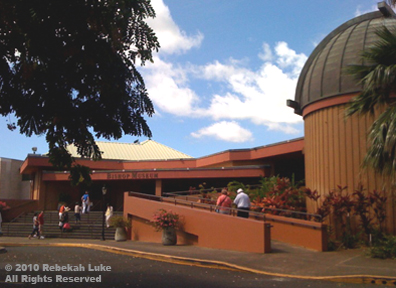
I skipped my usual morning of painting. Aunty Cornelia, Aunty Mercy, Aunty Ramona and Aunty Dot wanted to see the milestone exhibition of the three wooden images of the Hawaiian god Ku on display together at the Bishop Museum through October 4—just three more days.

One carved image resides at the Bishop Museum, one is on loan from the Peabody Essex Museum in Salem, and one is on loan from the British Museum in London. Museum literature states that two hundred years ago the Ku stood on heiau (temples) on the island of Hawaii.

Bishop Museum

DH (darling husband) who volunteers as a docent was delighted to give the aunties a tour, and we both were happy to provide the rides.

I used the time they were at the museum to grab some lunch, get my hair cut by Arlene and have photos taken for a new passport. I came back in time to catch Lokomaikai’s very enjoyable moolelo (story) about the hula before heading back over the Koolau mountains.

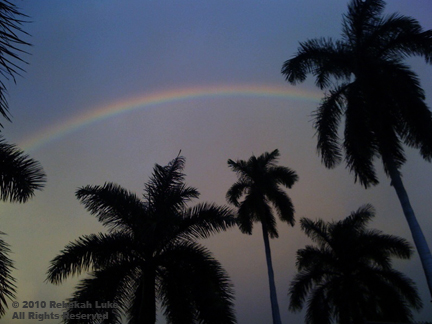
It rained some today, and as I drove down Palm Drive at Punahou on my way to glee club practice, I saw the rainbow over Manoa Valley.

Rainbow over Manoa

Copyright 2010 Rebekah Luke