Season’s greetings from Rebekah

21 12 2010

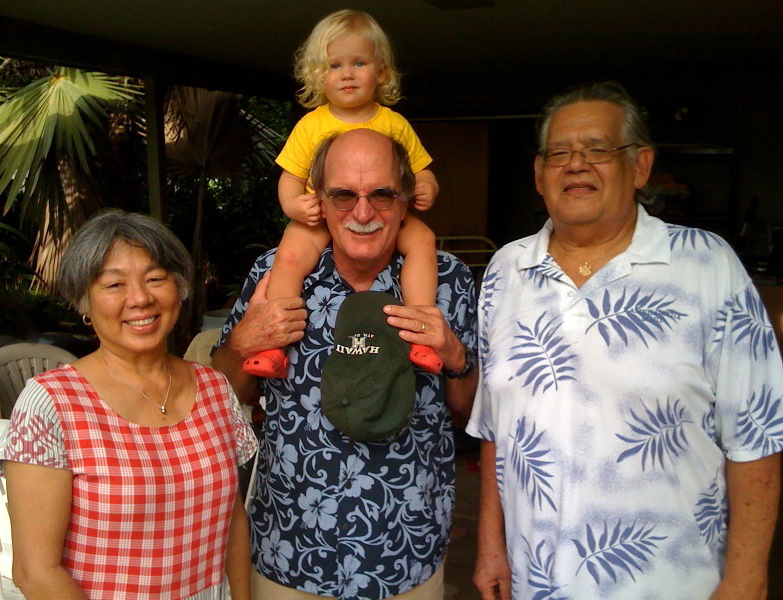
The moment I made this photo of Miss Marvelous and her mom, I knew I had our Hawaiian greeting card for this year.
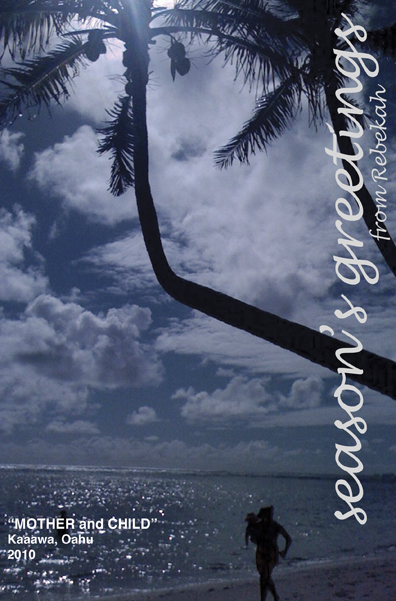
Everyone at Rebekah’s Studio—DH (Darling Husband), Alice Brown, Ula and I—wish you a Happy Winter Solstice!

I hope you don’t mind a re-post from 9-11-2009 that tells how we celebrate:

“With the winter holiday season upon us, most families are starting to get into the spirit. The signs include that real or imagined cold snap on Halloween night, slick merchandising catalogs overflowing from our mailboxes, store mark downs everywhere, and the lure of local craft fairs and festive events.

“Conversations now include, “What are you doing for (fill in the holiday)?” and newspaper features carry tips on how to remain stress free. We want to remember family and friends and hope no one is left alone. As families extend generationally, geographically, and by marriage, there can be many decisions to make.

“DH and I have a couple of philosophic ideas and old-fashioned traditions that give us a sense of peace. They link to our respective roots—Hawaiian Islands for me and Pennsylvania (Delaware County) for him.

“One is to acknowledge and be mindful of the Hawaiian Makahiki season, roughly from mid-November through January (exact dates depend on the moon). The planting season is over, work is pau (finished), and warring ceases. It is the time of the god Lono.

“The best of the harvest is dedicated to Lono in the form of ho‘okupu (offerings). The people give thanks, relax, socialize, play outdoor games, and generally enjoy themselves. No stress. It’s officially okay to play!

“The other is adopted from Winterthur, Delaware, not far from DH’s birthplace. As tourists we visited Winterthur, a museum and the former country estate of Henry Francis du Pont. During his life H. F. du Pont collected whole room interiors of various periods, not to mention whole street fronts, and installed them in his mansion.

“The museum decorates the rooms of this big house for Yuletide, and visitors can tour them around the same months of Makahiki in Hawaii. The holiday decor matches the period style of each different room. It’s educational and very festive.

“When we visited, our favorite room showed how du Pont’s own family celebrated in the first half of the 20th century. The story was told that Yuletide, the time around the Winter solstice, was a time to visit and entertain friends, to rest and to celebrate a successful harvest. Children were seen but not heard.

“Decorations consisted of a small table-top evergreen—adorned simply with cookies, candles and strands of popcorn and cranberries—that was set atop a pie crust table. Gifts were exchanged among immediate family members only and placed in a basket for each person. If the children behaved well, they could have the cookies!

“We liked the idea so well that we brought home a furniture piece similar to a pie crust table for ourselves, in a nod to the East Coast style and DH’s regional heritage. Each year we hang on a small tree the wooden ornaments crafted by DH’s parents for their first granddaughter on her first Christmas.”
Copyright 2010 Rebekah Luke


It’s rock-star snowing on Lanikai Beach

1 12 2010

I do believe it’s snowing here at Rebekah’s Studio! Just look at the snowflakes falling! And right after I posted this photo on my Facebook page with the caption “Thanksgiving weekend & no snow!” 🙂

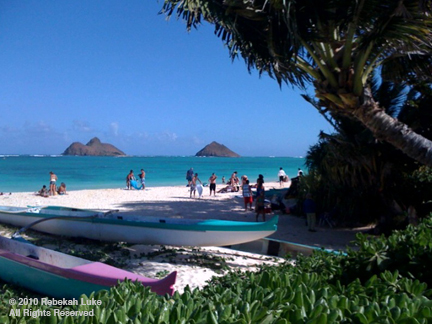
Lanikai Beach - Thanksgiving weekend & no snow!

I’ve been staycationing with family all weekend down the coast of Oahu at my hanai brother’s and sister-in-law’s fancy beach house. I spent a few hours there on Tuesday and will likely go again tomorrow. I’m making a painting that’s a variation of this classic Hawaiian beach scene and the Mokulua (two islands). DH suggested I do some rock-star paintings. Is this rock-star enough for you?

And, thank you WordPress.com for a rock-star visual effect!

Copyright 2010 Rebekah Luke


Mauna ‘Ala, burial place of the ali‘i

18 11 2010

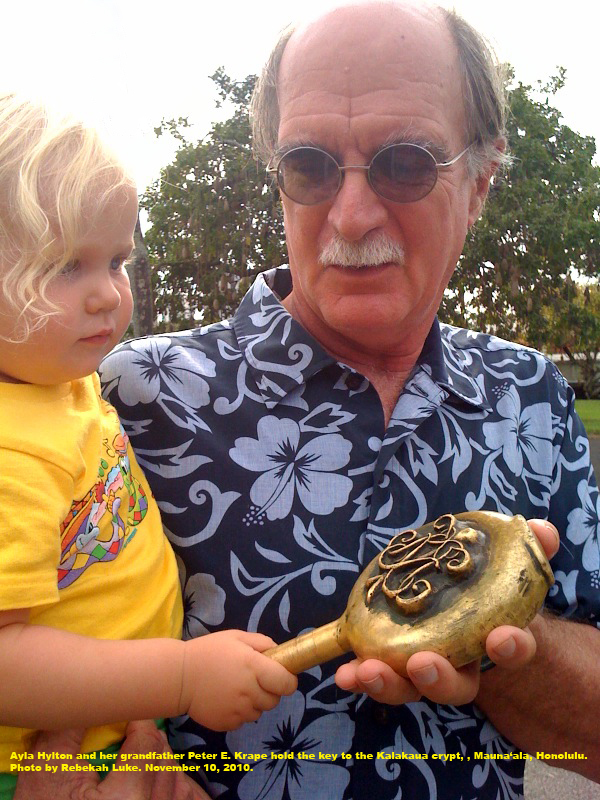
Miss Marvelous with her Papa entering the Kalakaua crypt

If they arrange ahead, Honolulu visitors to Mauna Ala, site of the Royal Mausoleum in Nuuanu, can have a guided tour by its curator William John Kaiheekai Maioho, the kahu of the iwi (bones) of the alii (royalty) and high chiefs—namely the Kamehamehas and the Kalakauas.

I and Miss Marvelous tagged along recently with DH and a group of volunteer docents from the Bishop Museum. Bill Maioho’s presentation—full of details and anecdotes, talk story style—included a chronology of the Hawaiian royals and others who are buried at Mauna Ala, information about the chapel building and how its use changed over the years, and a look inside the gates of the Kalakaua crypt.

Holding the key to the Kalakaua crypt

Bill Maioho descends from the Taylor family whose kuleana (responsibility and privilege) is to care for the iwi at Mauna Ala. You can find his story as an oral history article in Pacific Worlds, an excellent website with information about Polynesia. Please click on the link.

Mahalo to Uncle Bill.

Remembering Charles Reed Bishop

Me, Miss Marvelous, DH, and Bill Maioho

Copyright 2010 Rebekah Luke


’Bye ’bye Norfolk Island pine

12 10 2010

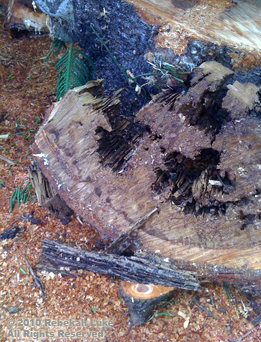
The old Norfolk Island pine tree is no longer at the Manoa Valley homestead where my hanai (adopted) mom lives. Mom decided to have the tall evergreen sentinel, damaged by termites and dry rot, cut down this past weekend before it fell down. With the wet and windy season approaching, I think Mom did the right thing.

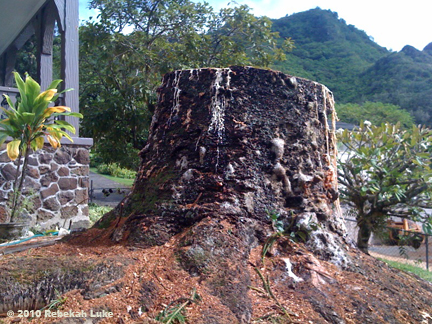
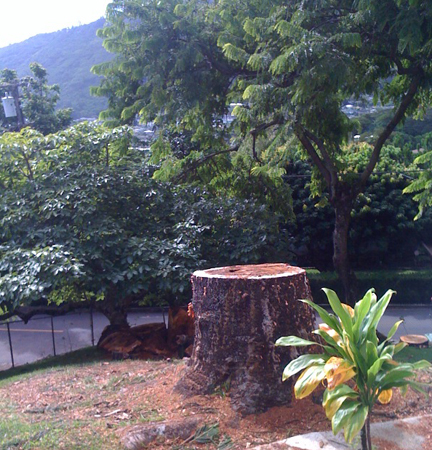
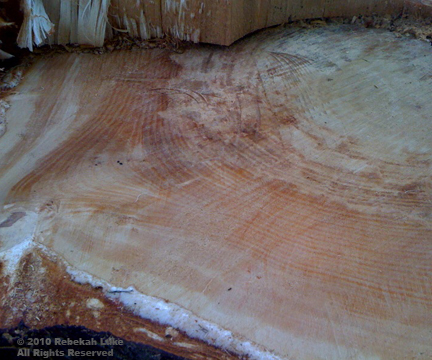
This tree was big. The existing stump measures about 40 inches in diameter. I counted the rings and estimated the tree was about 80 years old. Termites used to live in the lower part of the trunk. Sections from further up, however, are still good and useful to woodturners.

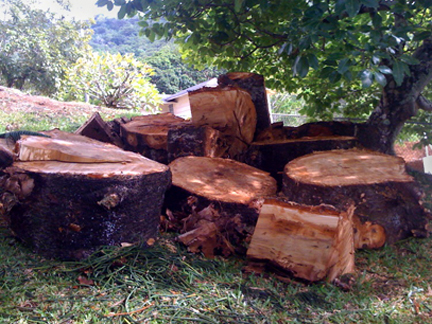
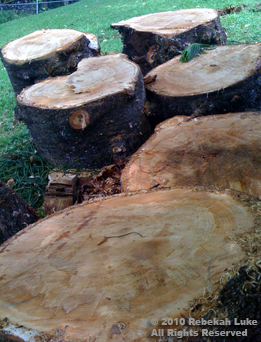
By the time I arrived at Mom’s yesterday to make these photographs, she had given away some of the choicer sections to the tree cutters. There’s still plenty more wood.

I eyeball the diameter of the Norfolk Island pine to be about 40 inches. Tree sap still oozes from the cut

Sections of the trunk

Termites used to live here

More trunk sections, still good for making art

The dark and blond two-toned shades are characteristic of Norfolk Island pine wood

New view from the front porch

I counted the rings. Each represents one year of life, right?

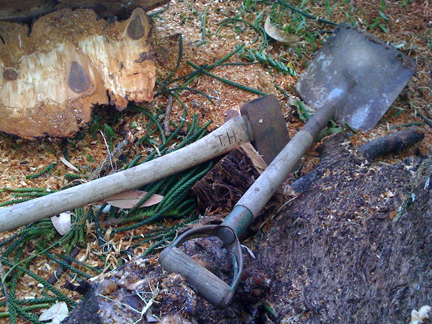
Workers left their tools behind; they're not pau (finished) yet

Copyright 2010 Rebekah Luke


Not sure how to sum up Thursday, but …

1 10 2010

… That was fun. A nice ending to a full day! The venue for my cousin Toy’s going away party was Terry’s Place in Honolulu Chinatown where another cousin, Sunway, and her band performed last night. I stopped by the bar after my glee club rehearsal and caught a couple sets with the relatives. Really good pop music. Good eats and fine wine.

Sunway giving it her all

The day started with driving four neighborhood aunties and the baby (Miss Marvelous) from our moku (district) on the windward side of Oahu to Honolulu.

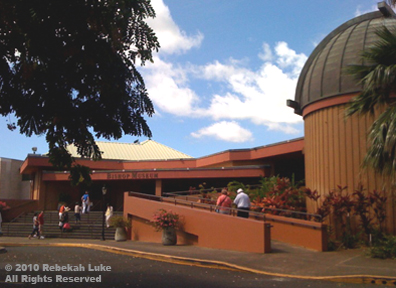
I skipped my usual morning of painting. Aunty Cornelia, Aunty Mercy, Aunty Ramona and Aunty Dot wanted to see the milestone exhibition of the three wooden images of the Hawaiian god Ku on display together at the Bishop Museum through October 4—just three more days.

One carved image resides at the Bishop Museum, one is on loan from the Peabody Essex Museum in Salem, and one is on loan from the British Museum in London. Museum literature states that two hundred years ago the Ku stood on heiau (temples) on the island of Hawaii.

Bishop Museum

DH (darling husband) who volunteers as a docent was delighted to give the aunties a tour, and we both were happy to provide the rides.

I used the time they were at the museum to grab some lunch, get my hair cut by Arlene and have photos taken for a new passport. I came back in time to catch Lokomaikai’s very enjoyable moolelo (story) about the hula before heading back over the Koolau mountains.

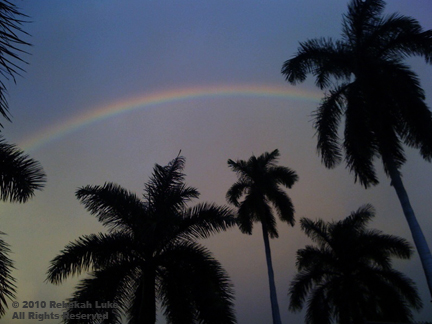
It rained some today, and as I drove down Palm Drive at Punahou on my way to glee club practice, I saw the rainbow over Manoa Valley.

Rainbow over Manoa

Copyright 2010 Rebekah Luke


Gathering kukui nuts and re-landscaping for a play space

18 09 2010

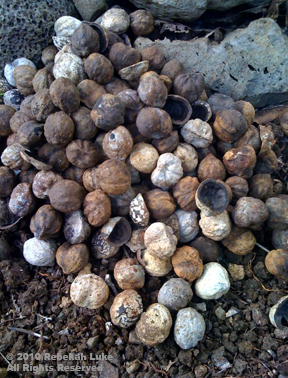
Aged kukui nuts prior to cleaning and polishing into Hawaiian jewelry

The studio and its surrounding garden of fruit trees and raised vegetable beds is not my choice for a toddler to play in, so I’ve cleared out the heliconia under the avocado tree to plant a soft thick green ground cover of clover with Miss Marvelous in mind. She likes to explore and play in the outdoors.

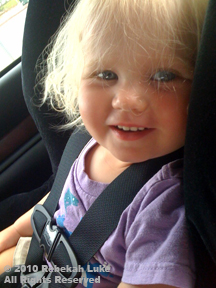
Those following the progress of Miss Marvelous may see what she looks like at 16 months this September. I snapped this image in the car on a shopping trip. She loves shopping!

The heliconia patch was there since purchasing our place. It has survived with not much care for more than 26 years. When the patch was full and thriving, gathering the fallen avocados in August was like hunting for Easter eggs in a forest.

Off and on since trimming the plants to the ground I’ve dug up roots, runners, sprouts, as well as rusty iron pieces from the old VW bug, now in its last disintegration phase.

Just by running my fingers through the coarse soil, I found lots of old, old kukui nuts, whole ones and halves of different colors—black, brown, white, multi—from the neighbor-in-the-back’s tree on the other side of the panax hedge. They were easy to find, a meditative search akin to shell seeking.  In all our years here I never gathered many.

Today I thought I’d rescue the nuts for my friend Kamakea who turns them into jewelry, and I saved them for her.

The kukui fruit with its outer skin covering or husk still intact. On the tree they are a gray-green color.

Next I looked for kukui nuts that were freshly fallen for another friend, Cathy, who makes inamona, a roasted nutmeat relish mashed with paakai (salt) and used in Hawaiian cuisine.

It is a long process to prepare inamona, about as long as it takes to make kukui nut jewelry. Cathy said, as long as the outer covering is still intact, it’s good for inamona. Kukui nuts are seasonal, and they are starting to fall now.

Sure enough, in and among the fallen dried leaves in the corner of the lot were these round fruit. So I scooped those up too. When I have a few more, I’ll deliver them to Cathy.

The kukui tree (Aleurites moluccana) is amazing. It has many uses. It is a canoe plant originally brought to the Hawaiian Islands by Polynesians who arrived here by canoe. You can spot the tree in the mountains by looking for light, mint-green-colored leaves.

In Hawaiian culture the kukui is one of the kinolau (forms taken by a supernatural) of the Hawaiian pig god Kamapuaa; the shape of the leaf resembles the head and ears of a puaa (pig). Freshly plucked leaves with stems on are arranged together by knotting the stems make beautiful lei (wreaths). In laau lapaau (Hawaiian medicine), the mashed kernel, as in inamona, is a laxative and prescribed for relieving constipation.

It is often called the candlenut tree. Kukui means light. Hawaiians skewered the oily kernels and burned them for light. The oil is the preferred oil for polishing wooden utensils for food, such as umeke (bowls) and platters. You can now find the oil on the commercial market as a cooking oil and in cosmetics.

The kukui tree also provides wonderful shade. Mahalo e ke Akua! Combined with the canopy of the avocado tree and a ground carpet of hardy clover, I envision a delightful play space for Miss Marvelous. She’ll just have to duck during the month when the fruit fall.

Copyright 2010 Rebekah Luke


A little piece of paradise . . .

8 09 2010

. . . AND SOME HAWAIIAN PLACE NAMES

Not only am I lucky to live in Hawaii, I’m lucky to live in Hawaii to go sailing!

This past Labor Day DH and I spent most of the day on Kaneohe Bay off Oahu with our good friends Ken and Georgia aboard their 38′ sloop Mariah.

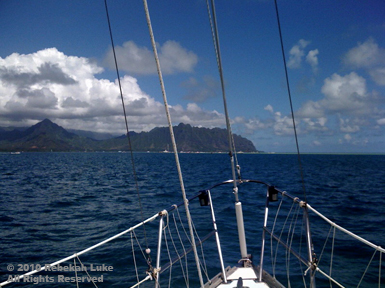
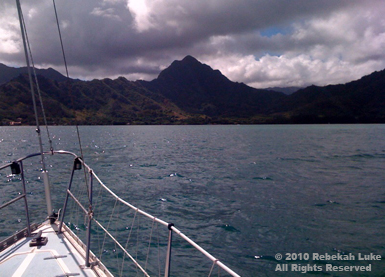
We sailed with main alone, and not having a headsail up meant wider unobstructed views of the shore. This is the view from the bow after leaving the yacht club mooring and passing Moku o Loe (aka Coconut Island). Puu Ohulehule is the triangular peak on the left, and the peak and ridge named Kanehoalani is about 10 degrees to port (left) of the bow.

We’re headed toward Ahu o Laka, a 3.1 acre islet off Kahaluu popularly known as “the sandbar” that is awash at high tide. It’s a popular destination for boats and various water craft on weekends and holidays, and last Monday it was a “zoo!” We opted to sail on by to a quieter spot farther north to anchor for lunch and some kayaking before continuing on to Hakipuu and Kualoa.

Passing the sandbar, from left, Georgia, DH, and skipper Ken. The hill beyond the sandbar in the distance on the left is Puu Hawaiiloa.

Kaneohe Bay is full of reef and shallow areas. In addition to spotting the white reef stakes, the red and green channel markers, and noticing landmarks, local knowledge is a must for piloting one’s way to where we were going. No worries, skipper Ken knows the way!

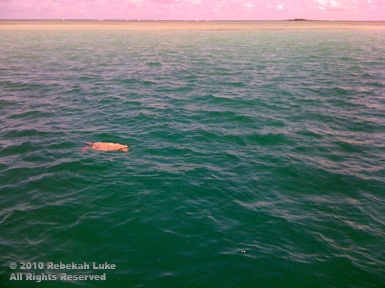
We sailed among a herd of honu (turtles), big ones. Every few minutes we passed another one. Fresh breeze, calm sea. What a lazy afternoon!

Honu enjoying the habitat of Kaneohe Bay

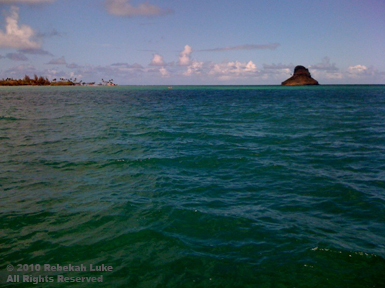
Soon we could make out Mokolii . . .

Mokolii

. . . and some activity at Hakipuu and Kualoa.

The tallest peak and the ridge extending diagonally left to right from the peak down to the flat land are Kanehoalani. The ridge points to Puu Hawaiiloa across the bay. Hakipuu is on the left of the ridge, and Kualoa is on the right.

Sailing in to Hakipuu beneath majestic Puu Ohulehule. Local knowledge required. We're careful to not run aground!

Ken tells us this little piece of paradise in Kaneohe Bay is just like Tahiti. You wouldn’t have known it was Labor Day weekend.

Copyright 2010 Rebekah Luke

For another look at sailing on Kaneohe Bay, view the video on https://rebekahstudio.wordpress.com/2010/02/28/flying-moths-over-kaneohe-bay/