Remaking an oil painting

11 09 2011

As an oil painter I’m often asked, “How long does it take to finish a painting?” In the same vein artists will remind each other, “You have to know when to stop.” We like to avoid overworking a piece.

My “Clouds Lifting Over Lanihuli” demonstrates these points. First is a photo of the painting mid-way, in the field. On a clear day, there are no waterfalls in the scene, but just after a big rain when the clouds lift, there they are! To paint en plein air I headed to this place to study the scene when it was raining, time after time. I took this snapshot from the trunk of my hatchback where I’d taken shelter.
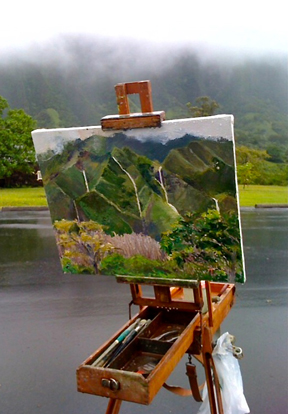
In the field, in the rain

I wanted so much to finish the painting. Below is what I published, i.e., what I thought was ready for market, a few weeks ago. Oils take a long time to dry—up to six months before they can be varnished. In the meantime I can look at a painting every day. As I kept staring at this piece (it’s staged above the TV cabinet) something bothered me. It wasn’t finished.
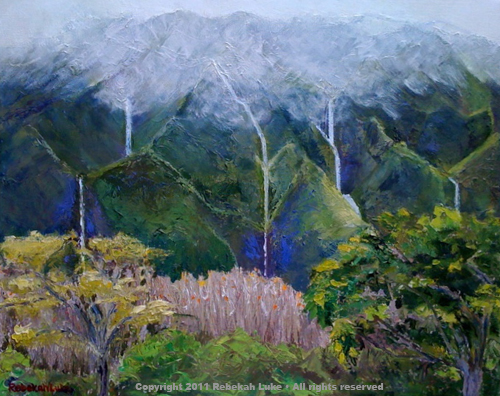
Not quite finished

I decided to correct the areas of the painting that were “wrong.” In a representative piece, although it is impressionistic (I label my style as “impressionistic representationalism”) I want to paint a scene so that it looks logical.

To really finish and complete this painting, I did three things:

1) I added pigment to the center clouds area to hide the waterfall behind it.

2) I widened the same center waterfall at the bottom because it is closer to the viewer (and so should appear larger).

3) In addition, by very very carefully scraping with the long edge of a palette knife, I knocked down some objectionable relief areas I originally painted of the mountain ridges at the top and touched up the clouds to make them softer and smoother looking.

“Clouds Lifting Over Lanihuli” looks better now. I hope you agree!

Finished: "Clouds Lifting Over Lanihuli," 16" x 20" oil on canvas

Copyright 2011 Rebekah Luke


Clouds lifting over Lanihuli

5 08 2011

I wonder if it is true that in olden times the waterfalls of windward Oahu ran all the time. Olden times meaning before water was diverted to the Ewa plain for sugar cane and land development. At the present intersection of Kahekili and Likelike highways, while waiting at a red light, a rain storm typical of our wet season had just stopped and the clouds lifted to reveal a spectacular scene of the Koolau mountains. I was on my way to Hoomaluhia Botanical Garden at Luluku and made up my mind to hold the vision in my memory so I could paint it. For in just a few quarters of an hour the sun came out again and the waterfalls disappeared.

"Clouds Lifting Over Lanihuli" 16" x 20" Oil on Canvas (unfinished)

UPDATE, September 11, 2011: As you will see in my 9/11/2011 post, I have made some changes to this painting, and I think you may like the finished work better. Thanks for visiting Rebekah’s Studio.

Copyright 2011 Rebekah Luke


Green and healing

15 07 2011

The Transpac yacht race is nearing the finish line, and I’ll be delivering some boat lei today. But first I have to make them. One is 20 feet long! I gathered the lauae yesterday afternoon from my patch.

Lauae patch

This morning while it’s cool I’m picking the ti leaves. I’ll be putting the lei together all day long. The boats, racing from Los Angeles, finish at Diamond Head buoy and then cruise into Ala Wai Boat Harbor in Waikiki. The first boats have already finished, so I’d better get busy.

Then, tomorrow from 9 to 2 I’m giving Reiki sessions at the Kaneohe Yacht Club Green Market Day while DH, Miss Marvelous’s mom and family will be showing folks how to make a ti leaf lei. We’ll be in the longhouse.

Ti leaves. Easy to grow, and so many uses!

Ti leaves

Copyright 2011 Rebekah Luke


Images of the farm fair

9 07 2011

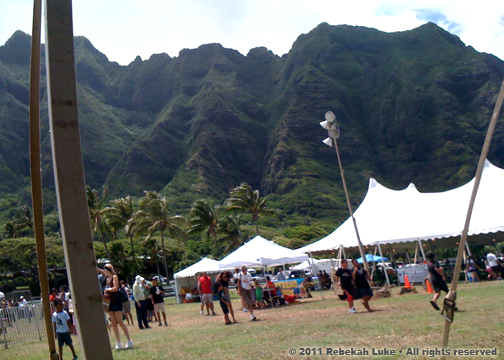
Posting my favorite farm fair photos from the 2011 Hawaii State Fair and 4-H Livestock Show at Kualoa Ranch today. We all like the fair because we get to see the farm animals. And I think the windward Oahu ranch is a great place to stage it, don’t you?

Kualoa Ranch provided the venue for the weekend fair. Not bad, eh?

“Made in Hawaii” and “buy local” seemed to characterize the food choices in both the farmers market and the food booths, including Kualoa Ranch All Natural Grass-fed beef, Kahuku corn, and OnoPops.

Check out all the local Hawaiian flavors of this frozen treat. I had "surinam cherry clove." The list includes "mango lime habanero," "watermelon hibiscus," "pickled green mango" and "starfruit lemongrass."

I love Kahuku corn!

These are my photos of the animals:

Our friend Oliver and a miniature horse named Buttercup

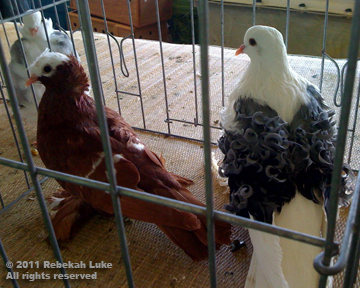
Some of the several kinds of fancy pigeons

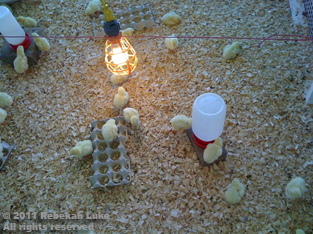
Newly born chicks

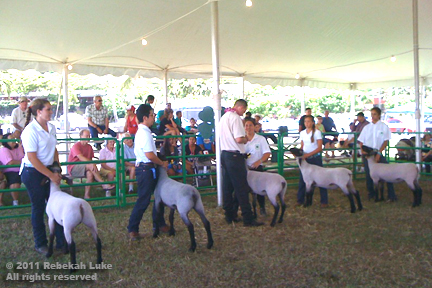
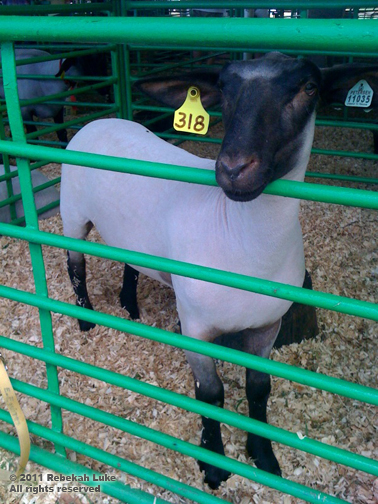
The out-of-town judge from Texas gives pointers to these 4-H'ers exhibiting their lambs. The champion is the one on the left and in the photo below.

"Slick" is the name of this champion market lamb, exhibited by Sydney Porter, 15, and bred by Paul and Vera Eguires.

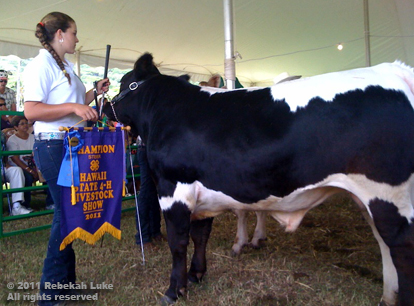
Here's Sydney, again, exhibiting "Major," the champion market steer.

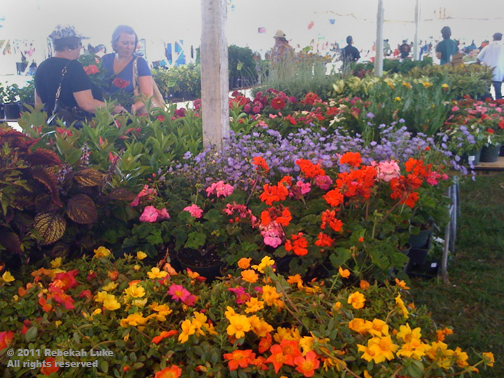
Besides eating the food and viewing the animals, there was a tent full of plants for sale.

Flowers and bedding plants galore

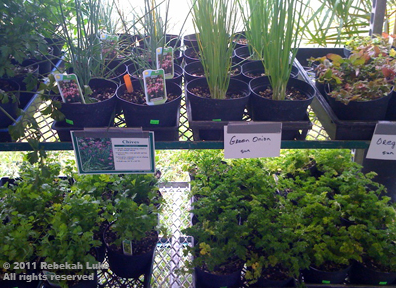
Fresh herbs for our recipes

Among the educational exhibits & demonstrations, I learned about aquaponics (e.g., raising tilapia and organic vegetables in one closed system)—something I’d like to invest in at the studio—from Olomana Gardens, and DH picked up some fresh garlic herb butter from Naked Cow Dairy.

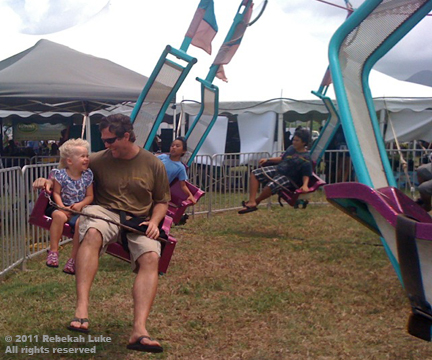
For the small kiddies there were the ubiquitous inflatable bouncies, horseback rides, and a couple of carnival rides. Before we left, Miss Marvelous and her dad had to spend their tickets one one last ride.

So much fun on the whirly ride! Wheeee!

The farm fair continues tomorrow, Sunday, from 9 a.m. to 5 p.m. Admission. I’m not sure if any large animals will be there tomorrow, as the auction takes place this evening. I hope the fair comes here again next year.

Copyright 2011 Rebekah Luke


Rebekah’s Kaʻaʻawa Mountain Apple Pie

3 07 2011

My mountain apple pies

Okay, okay, here’s the recipe. Jeez. I must say, it’s too good to not share. When there was a mountain apple tree outside the studio — Hawaiians call the fruit ʻōhiʻa ʻai (Eugenia malaccensis) — I made these pies every summer, one after another, so many that I froze them to eat later.

One year I was too late, and I could only watch the bulbul birds eat the entire crop in 20 minutes. “Hey fellas, come on over: breakfast!” Another year afterwards, the fruit was just not edible anymore. I think the tree was just old, so we cut it down.

This past Friday, I went to Candy’s house to catch a ride to our art show reception at 1132 Bishop Street in Honolulu. But first she pressed me into service to help pick the mountain apples from her tree for the refreshment table.

Oh, my gosh, I have never seen more beautiful mountain apples!  Candy and her husband had found from a garden shop a solution that repelled the pesky fruit flies that love to sting the fruit (causing the fruit to become wormy. Yecch!)

Clearly, Candy and Ken have a harvest they cannot possibly eat by themselves alone, and I was overjoyed when they offered me the surplus. Thinking about our family potluck gathering the next day, I thought, I’ll make pie!

This recipe has already been published in Everyone, Eat Slowly: The Chong Family Food Book (Kaaawa: Chong Hee Books, 1999). I adapted it from a formula a chef at the Kahala Hilton gave me many years ago when I worked for Sunset. For my recipe, the Betty Crocker brand mix is a must. Yesterday I used 15 very large mountain apples for one 9″ pie. I substituted 3 tablespoons fresh calamansi juice for the lemon juice, and I brushed the top with half-and-half cream for a golden brown finish.

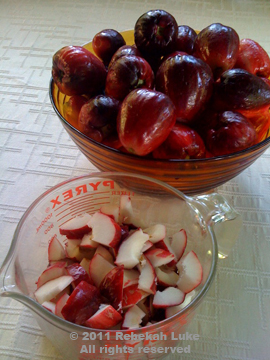
Gorgeous mountain apples, freshly picked and washed. The foreground shows the apples pitted, trimmed, and cut into chunks with a paring knife.

REBEKAH’S KAʻAʻAWA MOUNTAIN APPLE PIE

In Kaʻaʻawa the season for ʻōhiʻa-ʻai (mountain apples) is in June, usually, and it last for about two weeks. The challenge is to harvest them before the birds do. And then, what do you do with them? There are only so many fresh mountain apples one can eat. Now you can try them in a pie! The flavor is a cross between apple and rhubarb.

Betty Crocker Pie Crust Mix
5 cups sliced fresh mountain apples
1/2 teaspoon salt
1 teaspoon cinnamon
3/4 cup sugar
3 tablespoons butter, cut up in pieces
Juice of 1 lemon, or equivalent in lime juice
3 tablespoons tapioca OR 1/4 cup flour

Prepare Betty Crocker Pie Crust Mix for a double-crusted pie.

Combine the mountain apples, salt, cinnamon, sugar, butter, and lemon juice. Cook until the mountain apples are half done, about 10 minutes in the microwave on full power. Remove from heat.

Gradually stir in tapioca or flour. Cool mixture. (Place the mixture in its container in the freezer to cool down fast; be careful not to freeze). Pour into unbaked pie shell. Cut a vent in the top crust and place over pie. Seal the top crust to the bottom crust.

Bake at 375 degrees Fahrenheit for 45 minutes. Remove from oven and cool before slicing. The filling sets as it cools.

Rebekah Luke

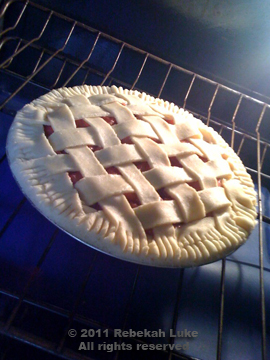
Ready to bake. I decided to make a pretty lattice top like the picture on the box of the Betty Crocker Pie Crust Mix.

Copyright 2011 Rebekah Luke


Seven Polynesian voyaging canoes

25 06 2011
Hōkūle a

Hokulea (photo courtesy of Wikipedia)

In this lifetime I’ve witnessed the revival of the Polynesian voyaging canoe.

One time, a man I was married to—a newspaper reporter and a sail-boater (before DH)—was excited about meeting the artist Herb Kawainui Kane whom he had just interviewed.

He saw Herb Kane’s beautiful paintings of double-hulled canoes under sail. He learned of Herb’s dream to build such a canoe in Hawaii that would make a voyage across the Pacific to the land of his ancestors in the way that the Polynesians first came to the Hawaiian Islands. He had an idea of what the boats looked like, and he was in the process of figuring out how exactly how to build them.

The reporter had crewed for Rudy Choy, a naval architect, from California to Hawaii on the Aikane II, a modern 65-foot catamaran built for his sunset dinner cruise fleet, on its shakedown voyage. He introduced the painter and the naval architect to each other, and that was about the start of the Polynesian Voyaging Society that celebrated the now-famous Hokulea’s 1976 voyage from Hawaii to Tahiti.

I was young and just a “fly on the wall” at the time, but that tidbit is true and a treasured memory of mine.

You can find out about Polynesian voyaging on this Polynesian Voyaging Society website. For more than a generation the organization has educated our island youngsters and the public with the ancient knowledge of traveling across the ocean without modern navigation instruments. PVS has played a major role in showing Native Hawaiians their ocean heritage.

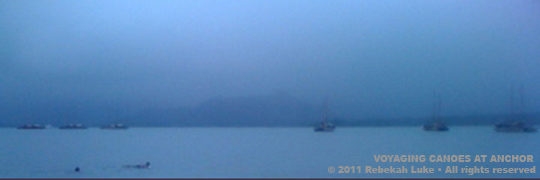
Six of the seven voyaging canoes at anchor in Kaneohe Bay at Hakipuu this afternoon. The blue-toned scene is from a rain squall.

Fast forward 35 years to yesterday afternoon when seven Polynesian voyaging canoes called at “Hokulea Beach,” within Kualoa Park on Oahu where Hokulea was launched originally. These seven canoes began their voyage from New Zealand and are on their way to North America. They sailed from Nukuhiva in the Marquesas on June 2 and called at other Hawaiian islands to the east before reaching Oahu.

It was a wonderful sight to watch them enter Kaneohe Bay. The canoes represent Tahiti, Samoa, Fiji, Tonga, New Aotearoa, New Guinea, Vanuatu, Kiribati, and the Solomon Islands and are sailing together in a voyage titled “Te Mana O Te Moana.”

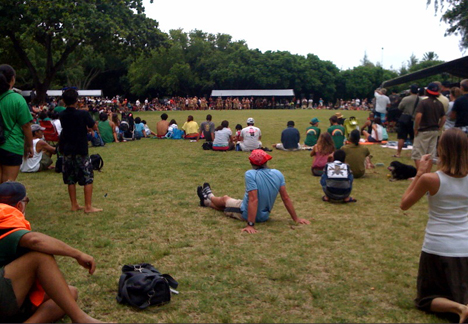
With sails furled and anchors down, the celebration continued on land today, with ceremonies, exchanges of greeting, singing, dancing, and eating.

Oahu islanders and visitors enjoy festivities at Kualoa Park.

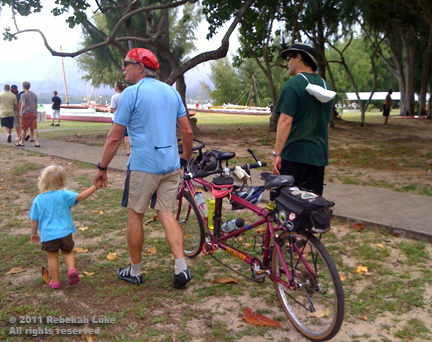
DH and I rode our tandem bicycle from the studio to take it all in.

Our tandem rig. Miss Marvelous and her dad, far right, are anxious to show her Papa (DH) the canoes.

Copyright 2011 Rebekah Luke


All pau & ready for market

8 06 2011

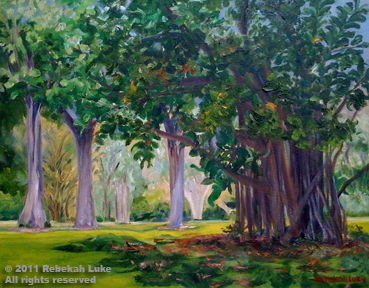
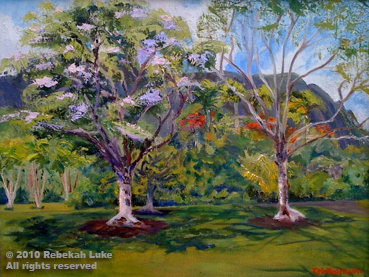
Pau means finished. I finished two more of my landscape paintings. More trees. Patrons tell me they like the way I paint them. “Banyan Shade” needs a final varnishing as soon as it’s bone dry. “Welcome Spring” is framed, wired, and ready to leave the studio.

Banyan Shade, 16" x 20" Oil on Canvas

Welcome Spring, 14" x 18" Oil on Canvas

Please click on the PAINTINGS menu tab for other available art work. Thanks for visiting!

Copyright 2011 Rebekah Luke