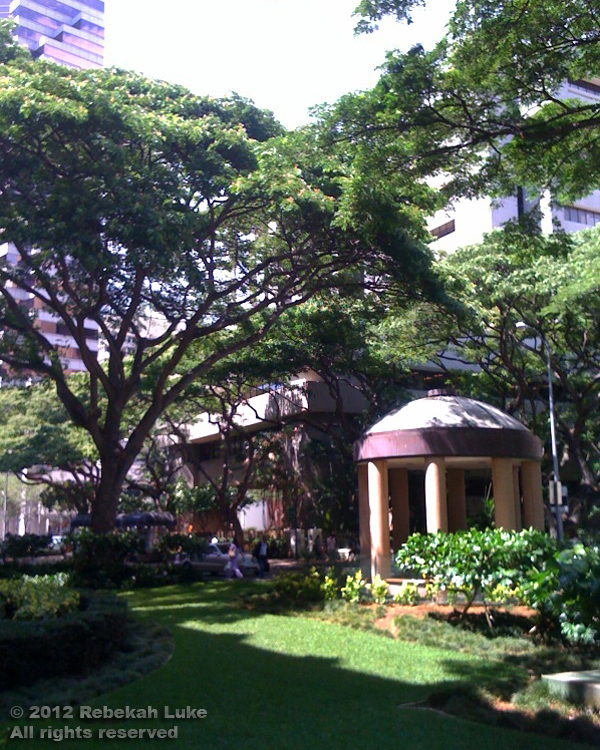
Art and architecture where Hotel and Richards intersect in Honolulu

1 09 2012

The charming gazebo at Hotel and Richards streets that caught my eye.

After lunch downtown last week with Becky at Café Julia, that got the vote for best downtown place for “breakfast and lunch only,” I strolled up the street, intending to visit the Hawai‘i State Art Museum (HiSAM). Becky suggested I take a look at what happened to the old Armed Services YMCA swimming pool.
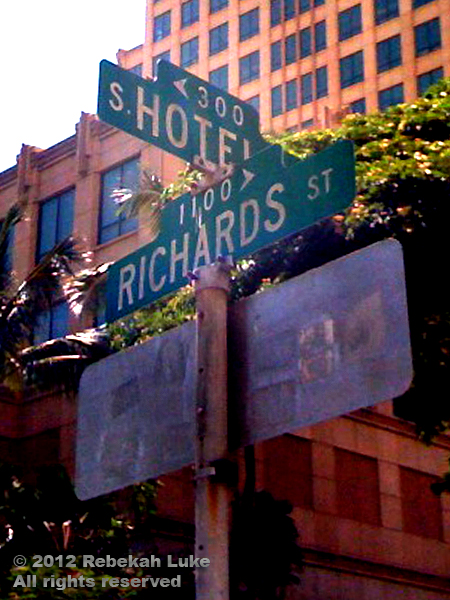
Approaching the intersection of Hotel and Richards, the loveliness of dappled sunlight through the monkeypod trees stopped me.  Pause for photos.

I saw four familiar buildings differently than before, and I reflected on their noteworthiness, all in proximity in this small area. Later, it occurred to me that on my little walking tour, I had focused on the historical architecture and fine art of these buildings, making for a very pleasant afternoon by myself . . . while Becky went back to her office to work.
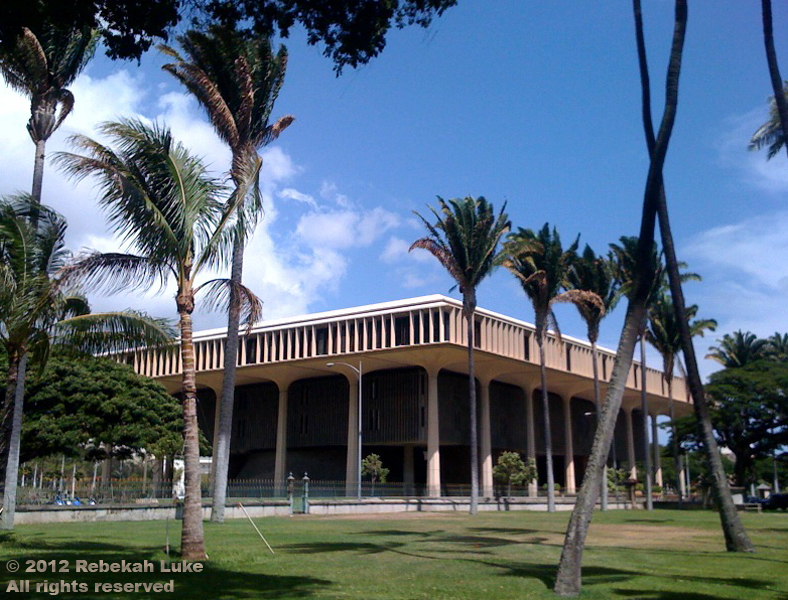
Hawai‘i State Capitol

Kitty corner to the gazebo is the Hawai‘i State Capitol designed by Belt, Lemmon & Lo and John Carl Warnecke & Associates. Its columns represent coconut palm trees, and the two cone-shaped legislative chambers represent volcanoes emerging from the reflecting pools that depict the Pacific Ocean.

In the courtyard floor is a round artwork “Aquarius,” an Italian glass tile mosaic by Tadashi Sato. There are two noteworthy statues at the Capitol: one of Father Damien of Moloka‘i on Beretania street, and one of Lili‘uokalani, Hawai‘i’s last reigning monarch, on the opposite side facing ‘Iolani Palace.  Inside the chambers there are large tapestry weavings by Ruthadell Anderson.

Looking makai (toward the sea), notice ‘Iolani Barracks (1871) that housed the Royal Guard on the royal palace grounds. Hawaiian kings and queens lived in the ‘Iolani Palace (behind the Barracks in my photo) until 1893 when Lili‘uokalani was overthrown and imprisoned in her room. Today both buildings are museums worth touring.

‘Iolani Barracks, moved to this site in 1965 to make room for the new State Capitol.

When I was in my twenties, I came to the Armed Services YMCA once a week to rehearse with the Honolulu Chorale. In 1927-28 that building was erected to replace the second building of the original Royal Hawaiian Hotel (Hotel Street was named in 1850; the original hotel was demolished in 1882 and rebuilt). I thought it was grand as a functioning Y and imagined what it must have been like in its heyday. Today the building is renovated, housing State offices and the Hawai‘i State Art Museum on the second floor, my destination.
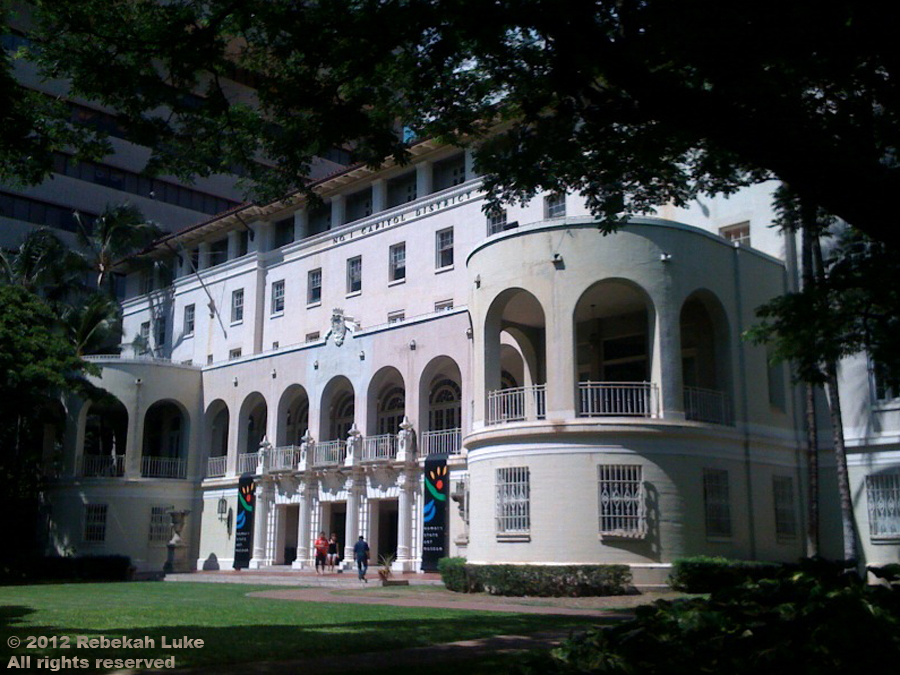
No. 1 Capitol District Building is the former Armed Services YMCA built in 1927-28. The former swimming pool and deck  in the middle of the U-shaped building is now a sculpture garden with a pretend swimming pool.

“Visions and Portraits of Hawai‘i” in the Ewa Gallery (toward Chinatown) contains representative work of Hawai‘i’s well-known artists, as defined by the State Foundation on Culture and the Arts. This display is eclectic, in that there is generally one work per artist. But Hawai‘i, since settled by non-natives, is eclectic!

Two stand-out works for me on this visit were the main piece as you enter the area — a painting of Waimea Canyon on Kaua‘i by D. H. Hitchcock (1861-1943) whose impressionistic works I admire greatly, and the painting of women, thickly painted by Madge Tennant.

The theme of the exhibit in the Diamond Head Gallery opposite is “Recent Acquisitions.” What I remember most is the nature photography of Wayne Levin. Three stunning images: an underwater shot of a diver chased by an ulua (I think), one aerial of Hawaiian monk seals at the tidal line (“Monk Seals and Surf, Derby’s Beach, Nihoa”), and one straight-on of birds and clouds (“Approaching Sooty Terns”). Classic clouds for my painting students to study!

Both galleries display impressively large wooden ‘umeke, or calabashes, turned by Robert W. Butts.

On the ground level, passing by the museum gift shop and through Downtown @ HiSAM restaurant, doors opened to the Sculpture Garden in the former swimming pool area. Artist Doug Young created a glass marvel in 2D with such visual depth that it seems as a 3D pool. I got dizzy staring down at it! Interesting. The restaurant staff began setting up for an outdoor garden party, and I moved on . . .

. . . Back to the Richards Street YWCA, half a block toward King street where Becky and I ate lunch. This attractive building was designed by architect Julia Morgan, who also designed Hearst Castle at San Simeon, California. Before I headed home, I revisited a Lau Chun painting hanging above the grand piano in the lobby. It was of the YWCA building as viewed from the palace grounds, and with the street and cars edited out.

His strokes of thick paint are of every color, you’ll see when you examine the painting closely. It’s as Miss Marvelous’s mother, when as a youngster she looked at my oil paintings, said: “I can’t figure out how, when you look at it close up, it’s just paint, but when you step back it’s a picture.” Lau Chun’s painting is an example that value (shades of light to dark) is more defining than hue (color) in a painting.

It can be useful and educational to look at other artists’ work. But more than that, I can pick out those things that are inspirational. Often, looking at other artists’ work usually frustrates me, and I’m only inspired to return to the studio to make my own creations. This time, I enjoyed the things I selected to see in a new light.
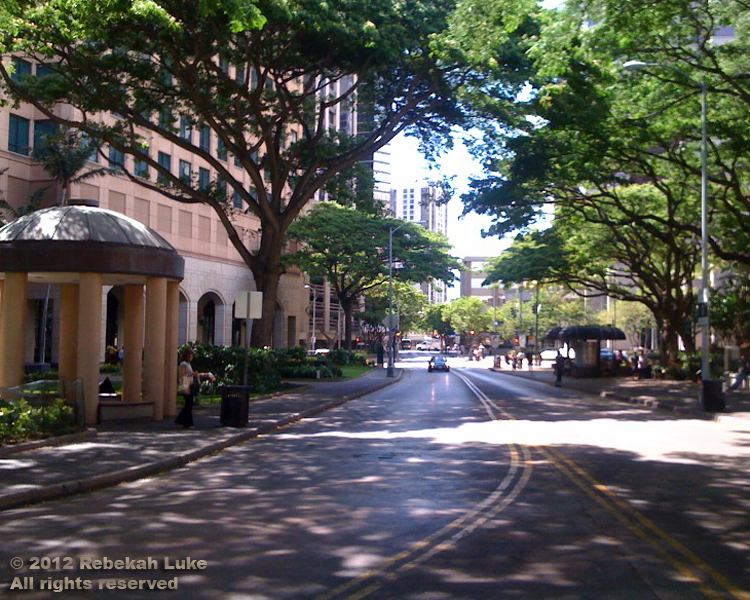
Looking north on Hotel street. Ali‘i i Place, primarily an office building, has a convenient municipal parking garage with cheap rates. The lobby and Alakea street pedestrian entry feature several fine, large paintings by John Wisnosky.
Copyright 2012 Rebekah Luke


From bubble charts to lists

24 06 2012

Things aren’t so bad that I have to make bubble charts. That was last week. Now I’m down to making lists, a lot of lists. Before I know it, summer will be over, and I’ll be off to Italy to see Miss Marvelous. I always seem to have a project going. I’m just wired that way.

The two or three major items are heading up the making of the boat lei for the Pacific Cup yacht race arrivals from San Francisco that tie up at Kaneohe Yacht Club at the end of July, my family reunion in August, and publishing The Chong Family Reunion in a New Millennium (working title) to coincide with the Chong reunion.

Thankfully, I’ve learned to delegate tasks and design activities  for a fun time.

The lei-making project is under control as I’ve alerted my crew to the ETAs of the boats. I’m never really sure about the ti leaf supply and the volunteer labor pool until they show up. It’s touch and go, but very exciting and very enjoyable to welcome these boats. Every two years within a week-long period we make about 50 huge leis, 12 feet long each, and the net proceeds go to the Koolauloa Hawaiian Civic Club scholarship fund.

For some reason I thought 2012 would be a good year to have a family reunion, and started the ball rolling more than a year ago. It’s been five years since all of my mother’s side of the family got together. She was the youngest of 15 children, all born in North Kohala, Hawai‘i. We’re going back to the land of our roots, as well as having some activities on Oahu. Today I just need to hear back from a committee to confirm a venue before sending out another packet of information to my cousins.

The launching point for this year’s Chong Family Reunion was the 20th anniversary of the publishing of The Chong Family History authored by my cousin James H. Kim On Chong-Gossard. It was time for a sequel. So The Chong Family Reunion in a New Millennium is the current work in progress published by my Chong Hee Books. It has evolved into an e-publication that can be viewed on the iPads everyone is getting.

I’ve discovered the main difference of an e-pub versus print on paper, in my case, is the time savings. I’ve chosen the blog software of wordpress.com and the blog-to-book service called Book Smart offered on blurb.com.  I’ll be able to format the publication up until the last minute before “delivery,” and because it is a blog, I can make corrections, additions, and other changes any time. Then, anyone who would like a hard copy can order it.

It’s just as much work, however, as a printed publication, if not more, especially during the learning curve. I’ve experience that challenge already, and now I can see the light at the end of the tunnel.

Meanwhile, I continue to check off items on those lists!

Copyright 2012 Rebekah Luke


Kōlea: thinking about it

20 04 2012

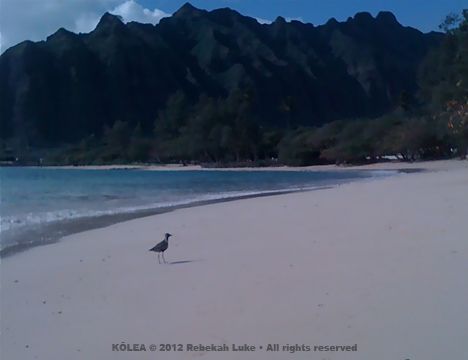
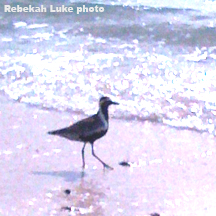
A lone kōlea — golden plover (Pluvialis) — seemed to be testing the water and thinking about a trans Pacific flight from Kaʻaʻawa beach to Alaska this morning. I pretended to be a nature photographer snapping many frames and hoping to get some good shots. Alas, nature photographer I am not, but I thought you would like to see what I made with DH’s iPhone as we walked the dogs. I applied the noise filter in Adobe Photoshop for the effect in the large photo.

Is this a good day for flying?

Shall I go now?

Umm, nope! Maybe later.

Actually, it’s a gorgeous day. The migratory bird no doubt was distracted by my presence and waited until I left. I hope it decided to take flight because conditions are beautiful! Aloha, a hui hou, e kōlea!

Copyright 2012 Rebekah Luke


Koki‘o ke‘oke‘o in bloom

15 04 2012

Image

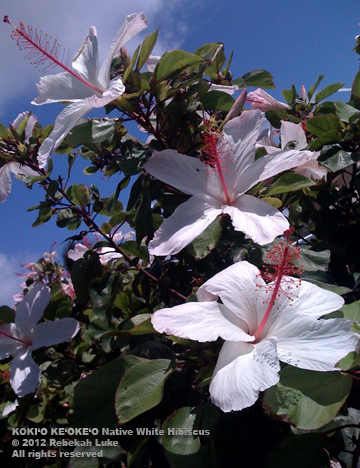
This lovely display of koki‘o ke‘oke‘o (Hibiscus arnottianus), a native Hawaiian hibiscus with white flowers, grows outside The Officers’ Club at the Marine Corps Base Hawaii, located at Mōkapu, Oʻahu. My friend Andrea treated me to a ladies’ luncheon there on Saturday with her Daughters of the Nile group. Finding this hedge in bloom made up for the eyesore of the drained and abandoned swimming pool. Our server said reconstruction work on the swimming pool was halted when iwi (bones) were uncovered at the site.

Copyright 2012 Rebekah Luke


Kuilima Cove

29 03 2012

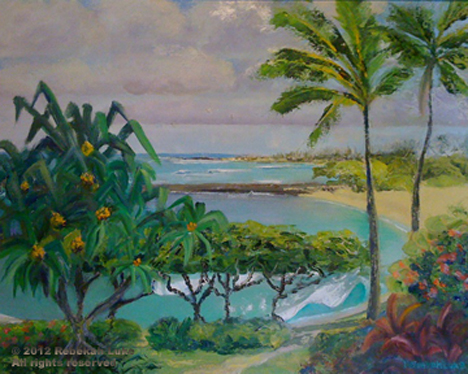
"Kuilima Cove," 16" x 20" oil on canvas, by Rebekah Luke

My most recently finished oil painting — except for the lessons I’ve done with my students the past month — deserves a more visible place than the corner of the studio where I stashed it while waiting to varnish it, don’t you think?

I started it as a demonstration at the Hawaiian civic club convention at Turtle Bay Resort on the North Shore in October — my gosh, was it that long ago?! — and worked on it little by little with my weekly painting group. Okay, I can be a little pokey sometimes.

From the second floor window of the hotel lobby was the sunny morning view of the cove below and the shoreline in the distance. A cultivated tropical garden juxtaposed with a wild undeveloped coast.

In general, I’m less fond of my demo pieces, but I was determined to turn this canvas into something I liked. So I kept at it, correcting mistakes and bothersome spots, and accepting valuable constructive criticism from my painting buddies. Not wanting to overwork it, I put my brush down as soon as it finally felt right.

As I tell my students the same thing my teachers taught me, “Paint what you know [the logic of light], paint what you see, and paint what you feel.”

Copyright 2012 Rebekah Luke


I will plant ʻulu for food and shade

18 03 2012

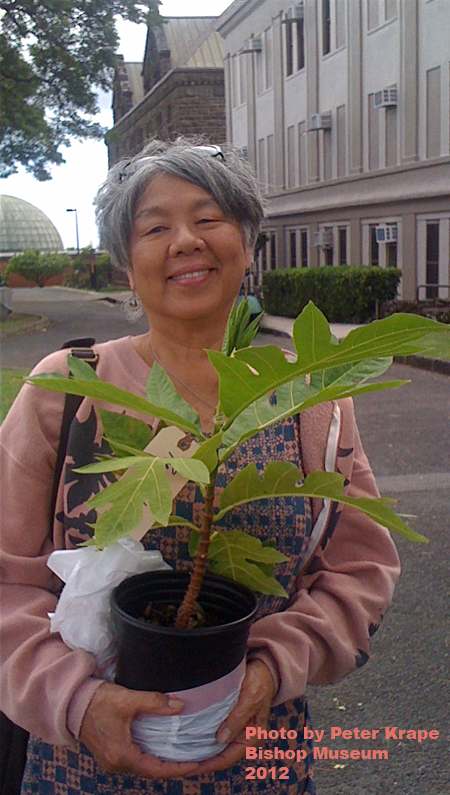
My intention of buying this breadfruit plant from ʻUlu Rockys Nursery is to put it into the ground and have it flourish into a beautiful tree that will provide food and shade for us. This is the clonally propagated Maʻafala variety that requires 10 ft. x 10 ft. of space and will stay compact and productive with proper pruning. Please click on the links in the text for more information about this wonderful plant breadfruit.

Micropropagation technology has been developed to produce breadfruit plants (Artocarpus altilis), or ʻulu, that are healthy and free of disease, I learned yesterday at an engaging workshop at the Bishop Museum.

Dr. Diane Ragone, director of the Breadfruit Institute at the National Tropical Botanical Garden on Kauai, spoke to describe how new methods of propagation, and cooperation with NGOs and the distribution company Cultivaris, now make it possible to distribute plants worldwide and become part of the solution to feeding the hungry.

The Breadfruit Institute promotes the conservation and use of breadfruit for food and reforestation.

Other highlights: author Craig R. Elevitch, who spoke on agroforestry and food security; and speaker Ian Cole, who spoke on how to grow and maintain ʻulu. Ian Cole cares for the National Tropical Botanical Garden’s breadfruit tree collection in Hana, Maui.

Other useful links:

the Hoʻoulu ka ʻUlu project, and the Breadfruit Cookbook.

Copyright 2012 Rebekah Luke


Win win, Ruth says, but I call it bartering!

24 02 2012

All of a sudden, things are starting to move around here, and everyone is tuning in to the new energy. Even Alice Brown and Ula feel the change.  But first, an announcement:

Rebekah Luke is the solo guest artist starting Sunday, Feb. 26, at the residence at 914 Kainui Drive in Kailua! I’m thrilled! My sister Ruth and her colleague Karyn have staged the home for sale with my oil paintings, and I must say, both the house and my paintings look great! Instead of seeing my work in my virtual gallery, people can now see what the paintings look like hanging in their frames and imagine what they will look like in their own home or office. There is really no substitute for seeing the original.

Ruth phoned and asked if they could borrow an easel to set up an area as an artist’s studio. Sure, I said. Then she asked if I had any paintings they could use to decorate the freshly painted walls. Indeed, I’m always looking for opportunities to show my art, and, really, no problem. Ruth, an equestrian, did help me out once by providing a horse I needed for a photo shoot.

DH and I loaded the paintings — nearly all my available inventory — into the car. I wanted a large enough choice from which Ruth and Karyn could select. I also packed up other props, like a palette, some paint tubes, some brushes, even some “leaners” (unfinished or unsaleable canvases).

When I reached the venue I could do whatever I wanted, in any of the rooms, to install an art show! The public would come to see the property, and at the same time they would view the art. The realtor associates needed interior decor, and I welcomed gallery space! “It’s a win win,” Ruth said, quite pleased with herself. I’m loving it too.

I arranged the paintings on the floor in front of the wall they would hang on, and the three of us concurred as to their placement. Naturally, I deferred to my hosts, and I’m so glad I did! All of the paintings are on display!

About the property: Conveniently located at the edge of Kailua, on an avenue lined with coconut palms. Renovated 3BR, 2B, single story, large back yard, new landscaping. The current owner is our mom Ivalee, and the home has been in the family since the 1960s (or earlier) when Grandpa and Grandma Haus lived in it. Ruth can give you the asking price.

About the paintings: My original Hawaiian landscapes and still life in oil. $125 to $800.

If you are on Oahu, I hope you’ll take the opportunity to meet us and see our work.

The Special Showings and Open House dates and times are:

Sunday, Feb. 26, 2-5 p.m.
Thursday, Mar. 1, 9:30 to 11:30 a.m.
Sunday, Mar., 4, noon to 5 p.m.
Thursday, Mar. 8, 9:30-11:30 a.m.
Sunday, Mar. 11, 2 to 5 p.m.
Sunday, Mar. 18, 2 to 5 p.m.

Thanks, Ruth and Karyn!

In the next post I’ll give an update on my teaching adventures, travel adventures, new energy, etc., Meanwhile, here are today’s snaps of the studio animals.

Alice Brown, our adorable puppy, keeps me company in the studio.

Ula, the bossy cat. Look out! She's old now.

Copyright 2012 Rebekah Luke