View of the Koolau Range and the sea

23 11 2009

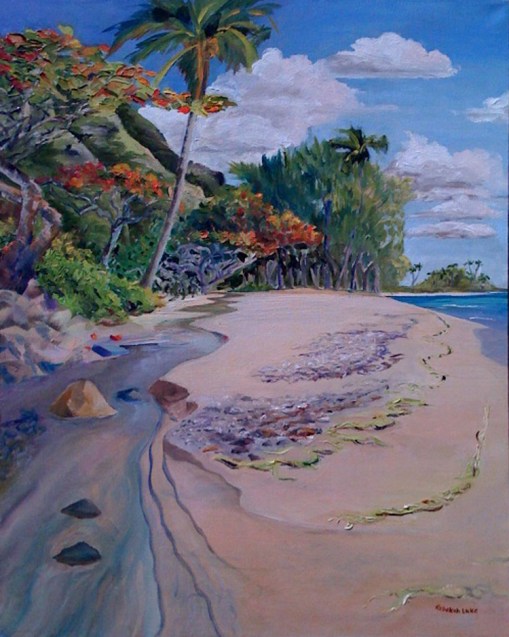
Another view of the gorgeous mountains of the Koolau Range on Oahu is off my easel and waiting for its protective varnish coat and frame. I’m so thrilled that it’s finished, I want to show it to you.

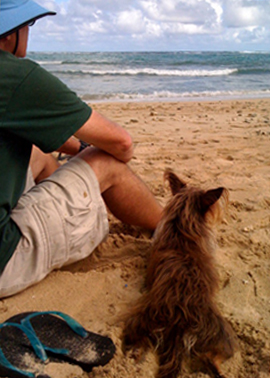
On Sunday we found some time to relax. Here’s a familiar scene of repose at the beach: DH and Alice Brown by the sea.

Sunday at the Beach

Copyright 2009 Rebekah Luke


Taiji for health

18 11 2009

The WCC Taiji Class had a lovely visit from its master Alex Dong this week. He is a fourth generation Taiji master who was born in China, moved to Hawaii as a boy and attended school here. From Hawaii he moved to New York City and opened schools in many parts of the world. He travels from school to school.

I’ve been attending the class at Windward Community College in Kaneohe on the island of Oahu for only about three years. Class is twice a week and tuition is $40 a month. Once or twice annually, Master Dong returns to teach weekend workshops from which we learn the finer points of the Taiji form, that is “Dong Style Orthodox Taiji” evolved from the Yang and Hao styles.

When he’s not in town, his senior students or appointed teachers lead the class. Students may advance their study during the various workshops taught by Master Dong wherever in the world he gives them. Many combine the workshops with vacation travel abroad—New York, Greece, Italy, Croatia, Czech Republic, Brazil, Great Britain, China, Hawaii, for example.

To become more acquainted with Taiji, I’ll refer you to the website alexdongtaiji.com. There I read that Alex Dong comes from a family of Taijiquan masters. His great-grandfather, Grand Master Tung Ying Jie was the national champion of China for many years, and he was a leading disciple of Yang Cheng-Fu, the main proponent of the modern Yang Long Form. Tung Ying Jie also studied with Li Xiang Yuan who was a disciple of Hao Wei Jing founder of the Hao style Taiji. Alex Dong’s grandfather, Grand Master Dong Hu Ling, spread the art in Southeast Asia and the United States, and his father, Grand Master Dong Zeng Chen, is world famous for his skills, especially in Taiji push hands.

Taiji had been recommended to me for exercise, and I do think my health has improved since I began. Balance, concentration and memory, strength, breathing (I am asthmatic, but less so now), energy, grounding, flexibility, posture—these are just some of the aspects of mind, body, and spirit that Taiji addresses.

To give you an idea of how whole Taiji is, I asked the master sifu (teacher) what he did to cross train. He replied, “Nothing. Only Taiji.”

So far I practice all three sections of the slow set and the sabre (knife) set; I practice between classes, read articles and books, and watch the videos of the master performing. My first Taiji teacher Lois explained that learning Taiji is like peeling away the layers of an onion. That is so true! A warm “Thank you!” to all of my teachers.

At this stage of my practice, I have a personal interest in relating the energy work of Taiji to Qigong to Reiki and healing.

For related posts, please see my 9/3/09 entry “Learning about energy healing.”  From the menu bar, Reiki Healing by Oelen, tells about my Reiki practice.

Copyright 2009 Rebekah Luke


Makahiki, yule and gift giving

9 11 2009

With the winter holiday season upon us, most families are starting to get into the spirit. The signs include that real or imagined cold snap on Halloween night, slick merchandising catalogs overflowing from our mailboxes, store mark downs everywhere, and the lure of local craft fairs and festive events.

Conversations now include, “What are you doing for (fill in the holiday)?” and newspaper features carry tips on how to remain stress free. We want to remember family and friends and hope no one is left alone. As families extend generationally, geographically, and by marriage, there can be many decisions to make.

DH and I have a couple of philosophic ideas and old-fashioned traditions that give us a sense of peace. They link to our respective roots—Hawaiian Islands for me and Pennsylvania (Delaware County) for him.

One is to acknowledge and be mindful of the Hawaiian Makahiki season, roughly from mid-November through January (exact dates depend on the moon). The planting season is over, work is pau (finished), and warring ceases. It is the time of the god Lono.

The best of the harvest is dedicated to Lono in the form of ho‘okupu (offerings). The people give thanks, relax, socialize, play outdoor games, and generally enjoy themselves. No stress. It’s officially okay to play!

The other is adopted from Winterthur, Delaware, not far from DH’s birthplace. As tourists we visited Winterthur, a museum and the former country estate of Henry Francis du Pont. During his life H. F. du Pont collected whole room interiors of various periods, not to mention whole street fronts, and installed them in his mansion.

The museum decorates the rooms of this big house for Yuletide, and visitors can tour them around the same months of Makahiki in Hawaii. The holiday decor matches the period style of each different room. It’s educational and very festive.

When we visited, our favorite room showed how du Pont’s own family celebrated in the first half of the 20th century. The story was told that Yuletide, the time around the Winter solstice, was a time to visit and entertain friends, to rest and to celebrate a successful harvest. Children were seen but not heard.

Decorations consisted of a small table-top evergreen—adorned simply with cookies, candles and strands of popcorn and cranberries—that was set atop a pie crust table. Gifts were exchanged among immediate family members only and placed in a basket for each person. If the children behaved well, they could have the cookies!

We liked the idea so well that we brought home a furniture piece similar to a pie crust table for ourselves, in a nod to the East Coast style and DH’s regional heritage. Each year we hang on a small tree the wooden ornaments crafted by DH’s parents for their first granddaughter on her first Christmas.

At a lost for that special gift?

FOR YULE or any other special occasion such as a wedding, a big birthday, an anniversary, or a move to a new home, do consider giving a painting. Yes, a painting! An original oil painting is special and unique, so unexpected, so memorable. It is a one-of-a-kind piece of art, it’s durable, and it can provide years of long-lasting enjoyment. Support the Native Hawaiian artist! I can work with you now on a selection and a payment plan, if necessary. I will be traveling and away from the studio for a good part of December, so if you are at all interested, please contact me. Click on PAINTINGS in the menu bar to see the images. I’ll be installing additional pieces in the next few days too. Thank you!

Copyright 2009 Rebekah Luke

References:

In years past I have participated in the Makahiki observance on Kahoolawe island. You may read about Makahiki on the Protect Kahoolawe Ohana website:

http://www.kahoolawe.org/home/?page_id=7

For more about Winterthur and the du Ponts, click on this link:

http://www.winterthur.org/about/about.asp


A cattleya full of cheer

6 11 2009

I’ve been down with a seasonal bug, but this cattleya plant cheered me up. This morning I noticed five new fragrant blooms that weren’t open last night. This orchid has been in our collection for years and seems to have adapted well to the culture here. Its label is long gone, so I can’t pass on the correct name. I thought you might imagine its sweet scent and enjoy the flowers too.

Cattleya © 2009 Rebekah Luke


Feeling out of sorts

28 10 2009

With information coming in from all around, I’ve been feeling out of sorts these past few days. I’m worried that I’m backsliding to my old ways of allowing outside forces to disrupt my practice of being peace. What happened to being in the present (Eckhardt Tolle), taking 15 minutes to do anything (FlyLady), and going with the flow?

My flow and my routine have been interrupted, but rather than stew about it, I’ve finally decided to write it down in this post. Writing is literary art, and as with any art, one keeps working at it to improve, spending time on task. Like a painting, a piece of writing evolves. Writing can be therapeutic too. So here goes. What might be bugging me?

The information that is coming in is of a spiritual nature, from meditating, dreaming, reading, and other people. It’s from practicing the “relax, open, and smile” of qigong. Seek and ye shall find. Ask and it shall be given to you. Right in front of you. Oh, boy! I trust myself and the messages. I welcome them, but I want to take time to sort them out.

In the past seven days I learned that Alan Holt Jr. (art fan), David P. Eldredge (teacher), and Norman Bode (neighbor) died. I can’t say I was close to any of these Hawaiians, but each did touch my heart in his unique way, and I knew he cared. I guess I’m grieving. I remember what the intuitive Camille said to me: “You came into this life to assist with grief, but it is not appropriate to take other people’s grief.” (Okay)

I’m slightly anxious about my eyes. Nothing serious, but the optometrist recommended I visit the ophthalmologist about a wayward eyelash that’s the apparent cause of chronic irritation. So I’ve made an appointment. (Good)

Regarding my body, some aches have returned. Is it something mechanical like my chair? Not enough tai chi—I skipped a couple of classes—or too much? The TMB syndrome (Too Many Birthdays)? Was it from Stephen’s guided meditation last week when I sent a grounding chord from my root chakra at the base of my spine to the middle of the earth? (Hmmm)

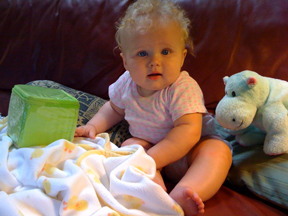
Could the soreness be from carrying our baby granddaughter? Ayla, who is an absolute delight, and her entourage come to the studio four days a week now, and I get to do some weight lifting. It’s a very pleasant distraction, though. This week DH and I introduce her to my favorite food, poi. (Wonderful)

Or maybe it’s the shoes thing. Now that’s a problem. I don’t like to wear shoes, at least not the closed-toe kind. I’m hard to fit, my toes need to be able to wiggle and breathe, and recently I haven’t found any that are comfortable, supportive, and stylish. This matters because in six weeks I’ll be on my way to Austria where I will be on a boat as well as on cobblestone streets, and where both the air and the ground will be much too cold to wear sandals like I do in Hawaii. I have large feet, thanks to my Hawaiian and Hakka Chinese genes combined. They’re not just long, they are wide. Wider than M, but not as wide as W, depending. I’ll probably end up turning my trusty lavender snow boots into all occasion footwear and let it go at that. (Good bet)

Lately, too, I’ve added the Ka Lahui Hawaii website, http://kalahuihawaii.wordpress.com, to my “want to do” list.

I want to make and sell more paintings, and . . .

Hey, you know what?! I think I need some REIKI! Can anybody come out on Friday? It will be my treat.

Copyright 2009 Rebekah Luke

Reiki is a complementary therapy that balances a person’s mind, body, spirit and emotions. For more information, click on REIKI HEALING BY OELEN in the menu bar.  Or view my 9/3/09 post “Learning about energy healing.” Our healing space in Kaaawa is open on Friday. Call first to let us know if you’re coming. 808 237-7185.


Why write? why paint? why heal?

15 10 2009

Rebekah’s Studio features old-fashioned letters, paintings and healing. Why write? Why paint? Why heal?

In the current 42-day world gratitude experiment shepherded by Stacey Robyn, the meditation for Day 27 is “Writes of Passage.” The suggestion is to ponder, “Who am I grateful for?” and write a letter to thank this person without the pressure that it needs to be delivered (because it doesn’t).

Stacey Robyn notes that psychology professor Peterson of the University of Michigan gives students a homework assignment now and then of writing such a gratitude letter, a belated thank you note, if you will. The letter writing “provides long-lasting mood boosts to the writers.” The professor says his students feel happier one hundred percent of the time.

Lately I have been trying to locate a certain Alan who was a fan of my oil paintings when I first started exhibiting my work. He would see the announcements in the paper and show up at the openings. Passing by one day he saw me painting on location at Kaaawa Stream and pulled up along the side of the highway. He cheerfully called out the window, “Let me know when you’re finished with that one, I’d like to see it.”

The painting he admired

The painting he admired

As it turns out, this was quite some years ago, and after a long pause in painting I pulled out the canvas just this spring and completed it. I remembered Alan and set out to contact him. It’s a wonder to me how I remembered his name—his first name, and then after a couple of days, his last name. No luck in the printed phone directory, and initially nothing familiar in various searches on the internet.

My research brought me to a blurb and photo from Hawaii Fishing News, reporting and depicting a fisherman with the same last name and looks who had caught a 100-plus-pound ulua fish in the summer of 1999 and who thanked Alan for his help. Being tenacious in my research, I contacted HFN who kindly gave me the fisherman’s phone number. I left call back messages twice, but no one rang back.

Still wanting to reach Alan, I took to searching the internet again. Last night I came across an esoteric article by T. Castanha, Aia Na Ha’ina I Loko o Kakou (The Answers Lie Within Us),” concerning the “Boricua Migration to Hawai‘i and Meaning of Caribbean Indigenous Resistance, Survival and Presence on  the Island of Boriken (Puerto Rico).”

The article is interesting to me for its insight on the situation of the indigenous peoples of Boriken and the Hawaiian Islands both. The paper was presented in Hilo at the 1999 World Indigenous Peoples’ Conference on Education.

More intriguing to me was that the author dedicated his presentation to his friend, brother and roommate, who recently passed on, the article stated, his friend who had the same name of the Alan I was looking for.

There, then, was the answer for me.

And here, now, is my gratitude letter to a faithful fan: Mahalo, Alan, for encouraging my art. Perhaps our paths will cross again.

Copyright 2009 Rebekah Luke

In a Reiki healing session, we thank our Reiki masters in spirit from the heart. Like writing a gratitude letter, Reiki can help one feel happier. For more information, click on Reiki Healing by Oelen in the menu bar.


FAQs about my art: an interview with self

25 09 2009

Rebekah, what is your medium? Oil.

What kind of painter are you? Mostly plein air (French, literally, open air). I go on location outdoors, into the field, and study the light.

How would you describe your style? Impressionistic representationalism. Sometimes abstract.

What is your subject matter? Hawaiian places; landscapes; Hawaii nei. More recently, I’ve added still life, and I am doing some seascapes. I paint subjects I think people would like to hang on their walls.

Do you paint from photographs? Rarely. I always felt if I painted from a photograph, the painting would look like a photograph. Sometimes I’ll make a black-and-white photo to see the values (range of darks to lights). I prefer painting en plein air or from life.

How long does it take to finish a painting? It depends on a lot of things, but on average about four or five times out on location. Some may take five hours, others five years.

Is your work in galleries? It used to be, but not at the present time. I am seeking a good venue and good representation.

Where can I see your work? Right here on Rebekah’s Studio! Come and visit my virtual gallery. Click on Paintings on the menu bar. To see the actual original painting, please contact me and we can make an appointment to see it. I’d love to show you!

How did you learn to paint? I took lessons, primarily from Gloria Foss. Before that I took the required art history classes in high school and college. I also studied art as part of the photography program at Art Center College of Design in Pasadena.

When and where did you start showing your work? In earnest at the Honolulu Zoo Fence on Monsarrat avenue and at Arts of Paradise gallery at the International Market Place, both in Waikiki in the later 1980s, and at invitational and juried shows. You might like to read my August 26, 2009, post “I wasn’t always a painter.”

What are your prices, what does a painting cost? An example would be U.S. $600.00 for an original 16″ x 20″ landscape in oil, frame included. Smaller ones are priced less, larger ones more.

How do you price your work? Besides the general guide in the above Q and A, I look at the overall piece, the thing. I imagine a price and I imagine selling the piece for that price. If I experience an awful feeling in my stomach, then the price is too low. I also go to galleries and shows and look at other artists’ works and prices for comparison. I think my prices are realistic.

Does the price include shipping? No. The customer pays for shipping and delivery. I take care of the packing and packaging.

Why is art so expensive to buy? The materials don’t cost that much. Artists are like actors. We don’t work every day. (Actually, we do, but we don’t sell every day; you get the idea.) This is how we earn our living—you know, food, shelter, gas, not so much clothing.

I love your work, but I don’t think I can afford to buy it. Can I? Sometimes for things we really want, we need to sacrifice. I have a layaway plan, normally three monthly payments each of 1/3, 1/3, 1/3. It’s possible to stretch payments out longer. The customer does not get the painting until it is paid in full. The installment payments are not refundable. That’s the deal. Several collectors of my paintings purchase on layaway, and they are able to enjoy enduring original art that way. If your finances can’t handle the layaway plan, then you probably can’t afford the painting.

Do you make reproductions? I’m wondering if I should manufacture some more. I have a giclée entitled “Mele’s Beach” that’s almost sold out.

Do you accept credit cards? Yes, through PayPal.

Who buys your paintings? Anyone. I have customers, patrons, and angels. 😉

Do you teach painting? Not formally. I’m happy to have people watch me paint and answer their questions, give a demo and talk about my art. My best audiences/pupils are kids. I might offer some tips on this blog.

Do you ever donate your artwork to a benefit auction event of a non-profit organization? Only if I can have part of the income. The reasons are: The non-profit receives merchandise and a donation for the painting if it is sold. The winning bidder gets a painting and a charitable tax deduction. The artist receives no income and can deduct only the cost of materials (i.e., canvas, paint, frame, wire). The public gets the erroneous idea that artists don’t mind donating their work. When I participate, I suggest this arrangement: Set an upset price of an amount I would like. The organization may keep the difference between the upset price and the winning bid. If the painting doesn’t sell, then I get the painting back.

Why aren’t there any new paintings in your virtual gallery? I keep checking back and see the same images. I would love to install new ones as fast as I can. And I’m glad you’re checking back. The thing is, oil paint takes a long time to dry, especially in a humid climate like Hawaii. Only when the painting is bone dry does it get a finishing varnish coat. Then that has to dry, then I photograph it, and then the painting gets a frame. It could take up to six months from the time I finish a painting to when it’s put on display. So, please stay tuned! I value your interest.

Thanks, Rebekah. And thank you! If you have other questions, you may Leave a Comment below or contact me by email. RL

Copyright 2009 Rebekah Luke