My oil paintings year by year

4 10 2011

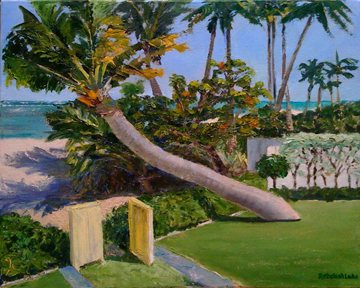
In my second year of oil painting, I did "Kalama Beach" on a canvas panel. 18" x 24". Ariel Krape Hylton Collection. © 1990 Rebekah Luke

Just a few more electronic images to gather, and my Retrospective Collection of paintings will be complete — for the time being. Most of it is installed at Rebekah’s Studio.

I presented “Kalama Beach” to my step-daughter about 20 years ago. When I went back to photograph the work for this collection, I saw I had attached an “artist at work” snapshot of her watching me paint at this very spot. (Sigh.) Time and place. Perhaps Miss Marvelous will inherit the piece one day.

To view more of the collection, just click on https://rebekahstudio.wordpress.com/retrospective-collection. It’s another look back! Thank you for visiting!

Copyright 2011 Rebekah Luke


Latest artworks on view in Honolulu

17 09 2011

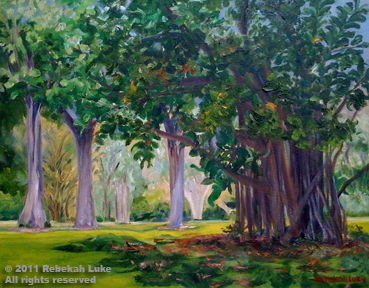
Hello Art Lovers! “Banyan Shade” and “Lanikai Diptych” made it into the juried show of the Association of Hawaii Artists this morning. Ta dah! These are my most recently framed original oil paintings made this year.

Banyan Shade, 16" x 20" Oil on Canvas, $600.00

Having my work selected for a public exhibition encourages me to keep going, and I’m thankful a large audience will see it.

I installed “Banyan Shade” in a dark wood frame. I framed the two panels of “Lanikai Diptych” in a beautiful solid curly koa. (And when is curly koa not beautiful?! ;-))

Come take a look. The art is for sale and will be on display through October 14, 2011. Here’s the rest of the 411:

Event—The 42nd Annual Contemporary Exhibit of the Association of Hawaii Artists; Antoinette Martin, juror.

Dates—Sept. 19-Oct. 14; M-F 8 a.m. to 6 p.m., Sat. 8 a.m. to 2 p.m. (Sunday closed)

Place—Pauahi Tower, 1001 Bishop St., lobby level, downtown Honolulu.

Reception—4:30-6:30 p.m., Sept. 27. You’re invited! Recommended parking is at Alii Place (cheaper rates).

Please let me know if you wish to purchase my original art for your private collection, and I will work with you on a payment plan.

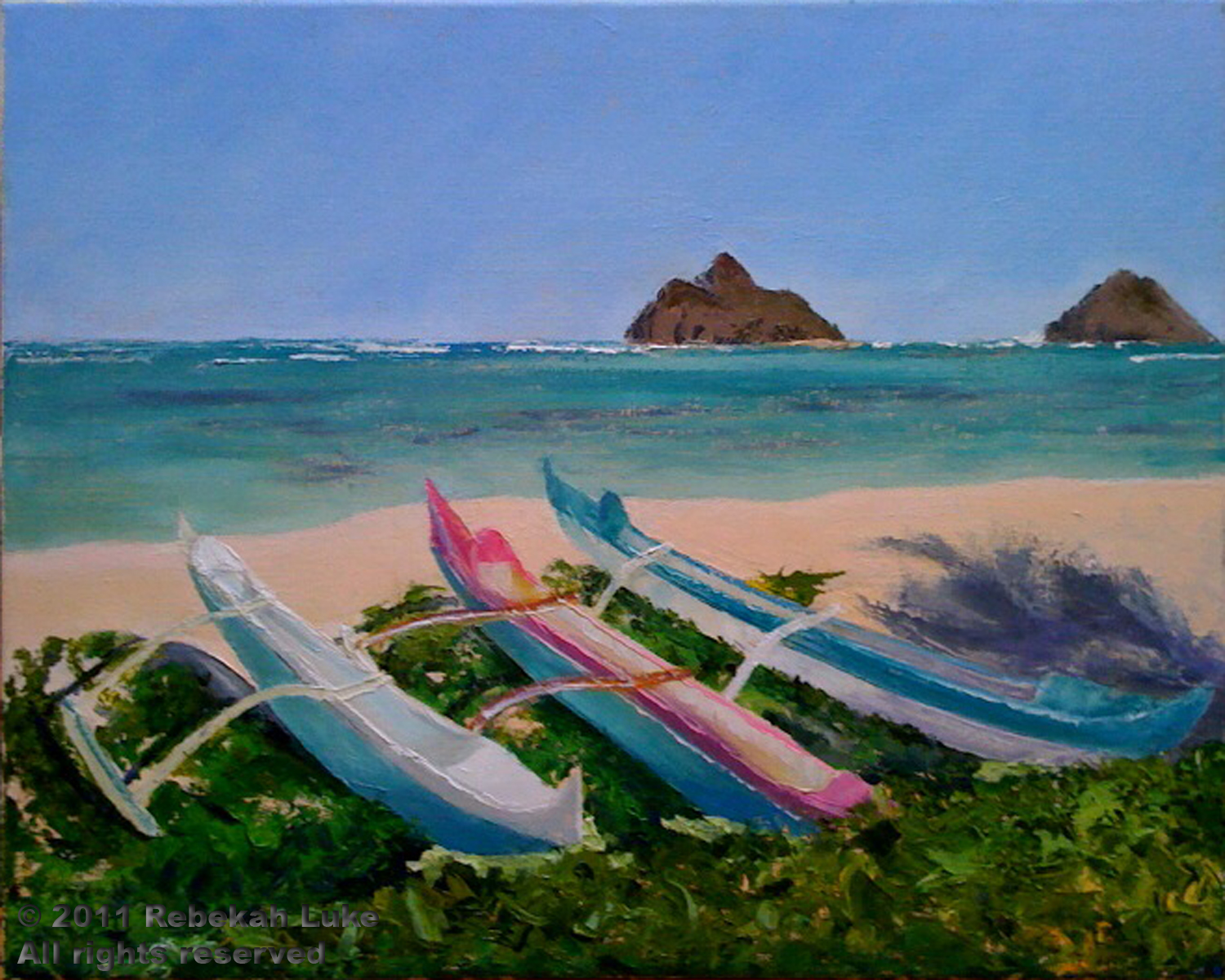
"Wa'a Kolu, Moku Lua," 16" x 20" Oil on Canvas, left panel of "Lanikai Diptych," $1,400.00 for 2 panels

"Julie's Coconut Tree," 16" x 20" Oil on Canvas, right panel of "Lanikai Diptych," $1,400.00 for 2 panels

Copyright 2011 Rebekah Luke


Clouds lifting over Lanihuli

5 08 2011

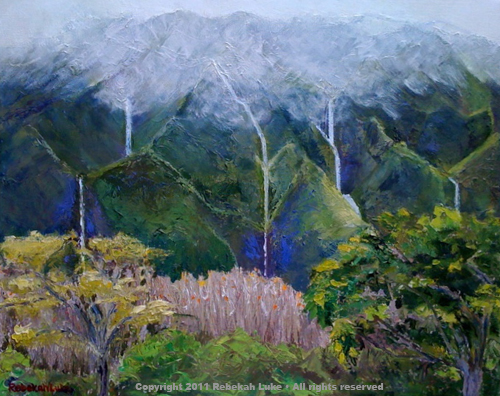
I wonder if it is true that in olden times the waterfalls of windward Oahu ran all the time. Olden times meaning before water was diverted to the Ewa plain for sugar cane and land development. At the present intersection of Kahekili and Likelike highways, while waiting at a red light, a rain storm typical of our wet season had just stopped and the clouds lifted to reveal a spectacular scene of the Koolau mountains. I was on my way to Hoomaluhia Botanical Garden at Luluku and made up my mind to hold the vision in my memory so I could paint it. For in just a few quarters of an hour the sun came out again and the waterfalls disappeared.

"Clouds Lifting Over Lanihuli" 16" x 20" Oil on Canvas (unfinished)

UPDATE, September 11, 2011: As you will see in my 9/11/2011 post, I have made some changes to this painting, and I think you may like the finished work better. Thanks for visiting Rebekah’s Studio.

Copyright 2011 Rebekah Luke


All pau & ready for market

8 06 2011

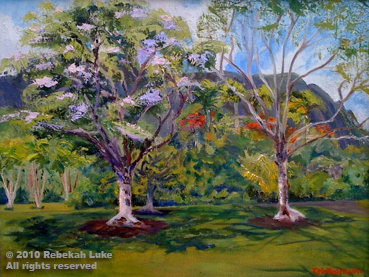
Pau means finished. I finished two more of my landscape paintings. More trees. Patrons tell me they like the way I paint them. “Banyan Shade” needs a final varnishing as soon as it’s bone dry. “Welcome Spring” is framed, wired, and ready to leave the studio.

Banyan Shade, 16" x 20" Oil on Canvas

Welcome Spring, 14" x 18" Oil on Canvas

Please click on the PAINTINGS menu tab for other available art work. Thanks for visiting!

Copyright 2011 Rebekah Luke


Lanikai diptych

11 04 2011

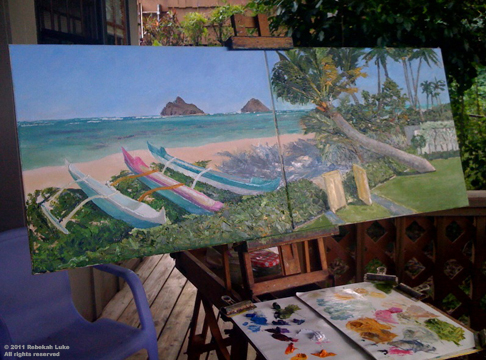
This is my finished painting of Lanikai Beach on Oahu. Oil on canvas. Each panel measures 20″ wide x 16″ high prior to framing. Beach goers are familiar with the iconic outrigger canoes, twin islands, and shady palms. This is the scene from Karl-and-Julie’s. I can’t wait for them to see it. © 2011 Rebekah Luke / All rights reserved

Wa'a Kolu, Moku Lua

Julie's Coconut Tree


Working on a diptych

28 01 2011

Off and on since Thanksgiving I’ve been working on finishing a diptych—an image on two panels, each of which can stand alone. I paint with oil on canvas. After I finish the painting, I’ll wait a long time—several months—for it to dry, apply a coat of varnish, and put the panels in two frames, most likely of koa.

This style is “impressionistic representationalism.” The viewer is able to recognize the scene, in this case, classic Lanikai Beach on Oahu with the Mokulua islets offshore. The paint edges are soft and approximate rather than hard and exact.

I like to paint images of where you might have been and want to remember, or of places where you’d rather be. This diptych began en plein air on location. Thanks to my hanai relatives Karl and Julie for their hospitality on site.

METHOD.  I started by loosely applying very thinned-out oil paint wash, using two or three tints, to the canvases with a 1.5″ brush, in a random pattern, leaving no white showing. I’m trying to leave  about 5 to 8% of this under painting showing to give the finished work a jeweled look.

While waiting for the wash to dry, I did an ink sketch of the scene, including the shadows, in my small notebook.  I made more than one sketch, experimenting with different compositions. Hand drawing a sketch reinforces the scene in my memory with similar results as taking written notes at a lecture.

I also set up my palette, generally arranging the colors following the color wheel order. Then I was ready to block in the scene on the canvas, using a brush and paint and referring to my ink drawing. I was careful to sight the objects to make sure my proportions were correct.  Yes, I actually stretched out my arm and measured with my thumb or a brush handle!

I mixed the “local” colors (middle tones) on my palette, as well as a dark and a light of the color. I painted analogously. That means, to darken a color I mixed in the next neighboring (on the color wheel) cool color for a shade. To lighten a color, I added a little of the next neighboring (on the color wheel)  warm color before adding white.

As a general example, take the local color red. For a dark red that one would see in the form shadow of, say, a tomato, I would mix in alizarin crimson. For a light red, I would add a little orange to the red before adding a little white. In teaching this technique, my teacher the late Gloria Foss called it the “Tomato Theory.”

Gloria taught that painting analogously was prettier than simply adding black or white, or the complement color to darken.

I love the idea of being able to call on your neighbors to help out instead of going  across the island!

When I finally got paint on canvas, I first put in the local colors that had the lightest values—usually a tint of white, and the darkest values. These were the off-white outrigger canoes and the dark coconut palm fronds. I put the lightest and darkest values in first that let me know all the values in between were relative to those two extremes.

As I painted I held up some paint on my palette knife against the object, like the sky and the ocean, to check that I had the hue and value (lightness or darkness) correct. I learned these last two tips from the late painter Peter Hayward.

I painted all over the canvas at once, by hue, considering both panels at the same time, so that the painting would become a tapestry of color. There are color repeats throughout.

In the end, much of the artwork is about the light. What direction is the light coming from in the painting? In plein air landscape painting, the sun moves constantly. What is the logic of light? That is, what does the light do when it hits a certain form? When it reflects?

Copyright 2011 Rebekah Luke

Related post: https://rebekahstudio.wordpress.com/2010/12/01/its-rock-star-snowing-on-lanikai-beach/
Lifelong learning about my art process

10 08 2010

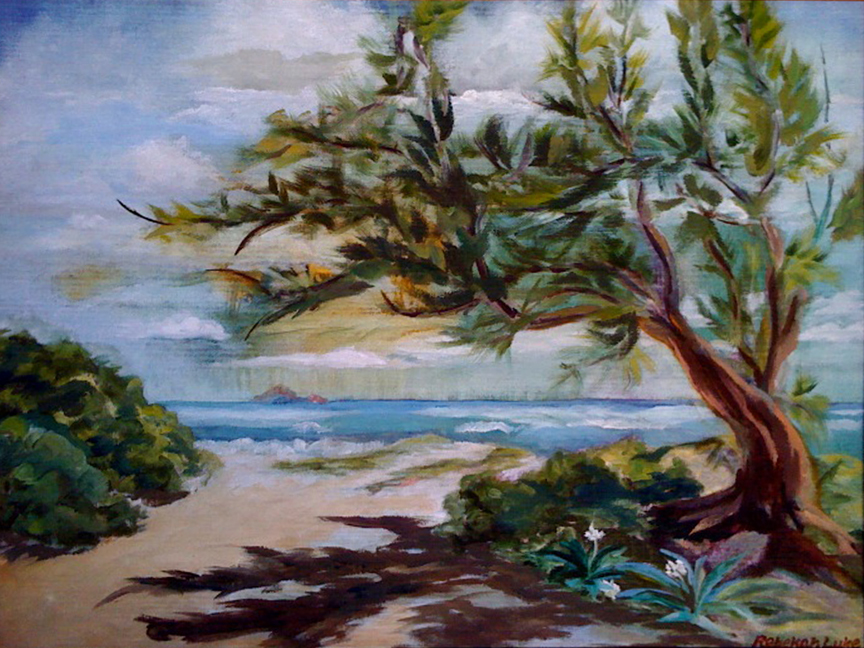
Kaaawa Valley Morning

Some things take a long time. Waiting for an oil painting to dry is one of them. Here is “Kaaawa Valley Morning.” I painted it in May and varnished it this week. It’s already sold to a happy family waiting patiently to hang it in their home!

Oil paint takes at least three months to dry. A painted canvas should be bone dry before adding a protective varnish coat, for best results. So when commissioning an original painting, allow at least six months for delivery. That would be the technical aspect. As for the practical aspect, each artist has his/her own process that varies from artist to artist. Perhaps plan on a little longer.

Last Thursday I was happy to see Kit Kowalke, among other lovely friends, at our art reception at Ho‘omaluhia Botanical Garden. I first met Kit, an artist and art educator, when she was teaching at Honolulu Community College and I was in university relations. She was always cheerful, always a pleasure to be around, always sharing and helpful, always fun! And she still is.

She asked what medium, I said oil, she asked how do I paint, I said one at a time. That is, I like to finish one painting before starting another. And that my paintings take a long time to dry. Oil painters often switch to acrylic because the medium dries quickly, and they can get their work out on the market faster. Personally, I’ve been partial to oil because of the way the colors mix and look.

What I didn’t say was that I don’t like the state of unfinished-ness, or that unfinished projects are stressful to me.

“Oh!” Kit told me, “no need to paint one at a time, you can paint more than one at a time. Like two or three.”

“I can?!” 😕

“Yes!” she said. “Sometimes you might want to let an oil dry before painting on it some more. While you wait, start another one. Go back and forth.”

Well, that’s a perspective I’ll consider. And, I think that will ease my stress over things like unfinished home and garden remodeling projects. I can think of them as works in progress!

She asked more questions and gave me more tips, even volunteered which classes and workshops I could attend nearby. Which is what my intention was when I first left art school—to regularly keep my eye in training by always taking part in a studio class.

It is the advice given also by my tai chi sifu Alex Dong, who advocates not waiting until you have mastered a set before learning a new one because there are aspects of each set that help in understanding other sets. Or, (my interpretation) you will always be improving on the basics. Clicking on the above link to his website takes you to his journal article about the subject.

Somewhat similarly, when I was taking beginning kumidaiko (Japanese ensemble drumming) lessons and had an interest in composing, I asked the master Kenny Endo at what level one could start composing. How long must I study taiko before I would have enough knowledge to write drum music? He replied he believed one could start composing at any level.

Some things to think about. In my case, they still may take time because that’s my process. So far.

Copyright 2010 Rebekah Luke

Quite a few images are ready to leave the studio; these paintings are dry!  See my PAINTINGS page. If you are on Oahu, visit the art show at Ho‘omaluhia Botanical Garden during August 2010. Please see my previous post about seven artists.