This is Waipao (part 2)

25 09 2011

Hau cordage in the making. Hawaiians scrape to clean hau fiber by hand.

HAU KAULA (CORDAGE) WORKSHOP WITH KEN CHING

The foundation of native Hawaiian culture consists of the ability to fill three needs: containers to carry things like water and food, flaked stone for cutting, and cordage to fasten. These were necessary to build a Polynesian voyaging canoe that reached the Hawaiian Islands.

With that important bit of information, Ken Ching on Saturday showed a group of us the native Hawaiian way of making cordage from the bark of the hau tree (Hibiscus tiliaceus L.).

We gathered at Waipao, the site of Papahana Kuaola, on the banks of Haʻikū Stream on Oʻahu. The Papahana Kuaola organization is all about involving the community in environmental restoration and economic sustainability, while integrating native Hawaiian knowledge. Its activities center on cultural and natural history. It’s wonderful, pono (right), and maika‘i (good)!

Making cordage by hand is a way to learn about olden attitudes of living, said Ken. When one went for a walk, for example, it was to look for materials that were useful and could be appreciated.

Here is my photo record of the day. You can pretend you were there, or perhaps you would like to learn more about Papahana Kuaola from its website and visit there yourself.

I came away with a little feeling of what it was like to live in olden times. I thought, maybe this is how it used to be and can still be if we live with Hawaiian values, learn from our kūpuna, and be thankful and kind to each other. I was happy for the people who are restoring the ʻāina (land) of Waipao.

First are some images of this place, the ʻili (small land section) of Waipao in the ahupuaʻa (land division from the uplands to the sea) of Heʻeia, Oʻahu.

Hāʻikū Stream at Waipao

Terraces and pohaku (stones) near the stream
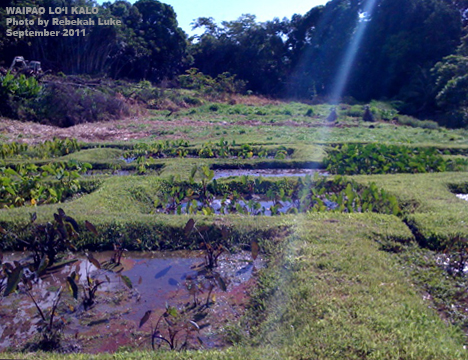
Loʻi kalo (taro gardens) in different growth stages. Notice more land being cleared in the distance. Lunch included a delicious stew made with foods grown at Waipao.

The band of green across the equator of the photo is the hau thicket from where we gathered the raw material.
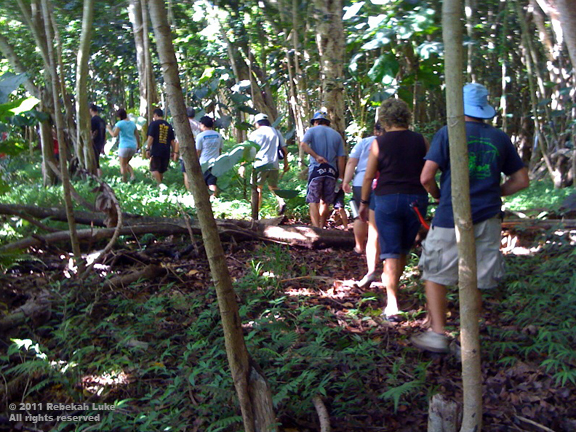
Into the forest we went to cut hau ʻili kea (young branches with light-colored bark).
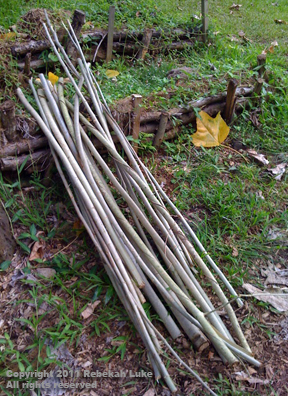
Freshly sawn hau branches waiting to be stripped of their bark
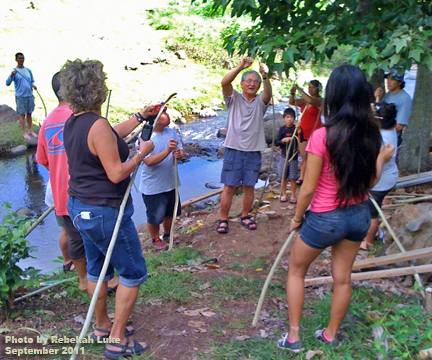
Our kumu Ken Ching demonstrates the right way and the less desirable way to pa‘e (strip) hau bark.
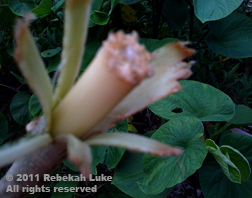
Peel away both the outer and inner bark by pulling down and "close to" the branch (as opposed to "away from") and from the top down, our kumu said. Discard the inner branch. (The leaves in the background are ʻawa (Piper methysticum), not hau.)
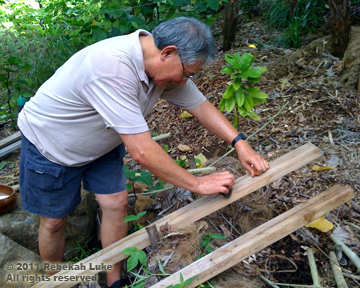
Kahi the wale (scrape the slimey goo away). Ken sets the bark on a 2 x 4 and scapes it using long strokes from top to bottom, pressing hard. Fresh water, such as from a stream or city faucet, will result in a brown fiber. To preserve the whiteness of the fiber, use salt water to soften and wash away the wale (looks like mucus).
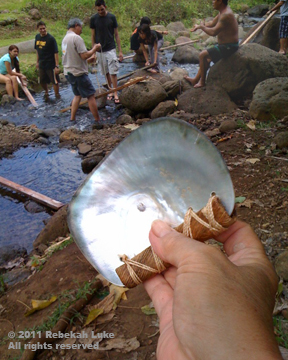
Shell scraper to comb out the wale (slime goo) of the bark.

L to R: Improperly stripped hau bark; mid-way stage of scraping; still slimy and not white enough, i.e., there are more brown areas left to scrape out.

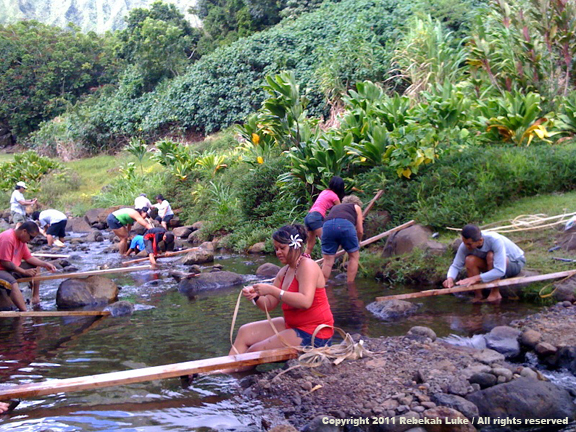
Back indoors and after some lunch Ken showed us how to grade the fiber and twist it into cordage.
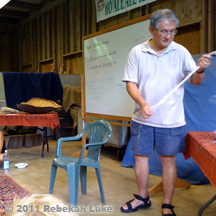
Ken Ching with a bundle cleaned hau fiber ready for twisting into cordage.
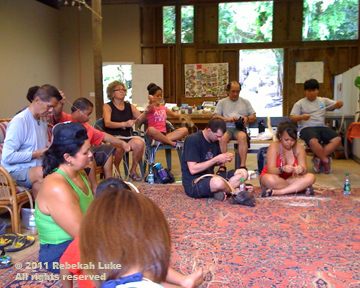
Separating the fiber and preparing to twist into cordage. Clue: You roll the fiber between your palm and your thigh with one hand, and twist with the other. It takes some practice.

Kaʻalua na kaʻakolu: Our kumu Ken made this beautiful hau cordage. He made more like it for the double-hulled sailing canoe Hawaiʻiki. It was an honor to learn from a master.
Copyright 2011 Rebekah Luke


This is Waipao (part 1)

24 09 2011

Hāʻikū Stream at Waipao

I went to Waipao today. So fulfilling. Waipao is an ‘ili (small land section) of  the ahupua‘a (land division extending from the uplands to the sea) of He‘eia on the island of O‘ahu. A Hawaiian cultural educational organization named Papahana Kuaola offered a workshop in how to make cordage from the bark of a hau tree (Hibiscus tiliaceus L.). An old friend, Ken Keola Ching, was the kumu (teacher). DH, my friend Piʻi and I had not seen Ken since our days together in Hale Kū‘ai Cooperative, so that was another reason to go.

The band of green across the middle of the photo is the hau thicket from where we gathered the raw material. Beyond are the Koʻolau Mountains.

Our kumu Ken Ching demonstrates the right way and the less desirable way to pa‘e (strip) hau bark.

In my next post I’ll show more photos of the ‘āina (land) where Papahana Kuaola is working on environmental restoration and sustainability while integrating traditional Hawaiian knowledge.

You’ll see the fun we had learning how to make hau kaula. It was a lot of work and gave us a greater appreciation of the culture and the days of old.

It was a first for me—turning hau plant fiber into cordage. Reflecting on the day’s activity, I can say, I made it myself!

Copyright 2011 Rebekah Luke


People came. It’s not the same.

26 08 2011

In a roundabout way, from champagne and sashimi at a dinner in Waikiki to a long ride back to the studio via Ala Moana, an anniversary night out made me think of my late dad Arthur.

DH and I reaffirmed our wedding vows yesterday (27 years to the same partner, thank you) and celebrated by going to the “old” Surf Room at the Royal Hawaiian Hotel for dinner. The restaurant is now Azure that specializes in seafood since the grand Pink Lady was renovated a few years ago.

We knew it wouldn’t be exactly the same (it wasn’t) as what used to be our favorite restaurant, but Diamond Head was still in view (kind of) and the service was just as attentive.

The fine-dining room is now set farther back from the beach and does not include the terrace next to the sand, and pillars and the fancy tents from a different restaurant block the million-dollar view that was the Surf Room’s.

Instead of real tablecloths and that cute and endearing pink candle fixture of the hotel, there were place mats the server kindly encouraged us to keep our dishes on.

That part of the critique aside, the chef’s preparation of the fish DH ordered was excellent (apparently, because I don’t recall that he offered me any to try ;-)), the sashimi melted down my throat, and I got a little tipsy on the champagne. No hangover this morning either.

And, oh, I almost forgot to tell you, our table was next to Senator Dan Inouye’s, and I’m pretty sure the secret service folks could pick up our conversation.

Going home we picked the wrong route. By the time we figured that out, it was too late, we were stuck. Long story short, only one traffic lane was open on Ala Moana boulevard leaving Waikiki for many blocks. One. Or, I should say, it looked like the Board of Water Supply had coned off all the others.

I began a Facebook thread about traffic/driving conditions and found it interesting that I would think it interesting to write about routes and directions. A few people have told me I should be a taxi driver because I know my way around pretty well.

When I was a kid, Dad drove a dump truck for a living. Went riding everywhere, and he would teach me.

When he decided working for the government would give him more financial security, he quit independent driving and applied to the Board of Water Supply, starting there as a pipe fitter’s helper. (My uncle, his brother, also drove truck, and he quit driving because of the bad traffic. He said it wasn’t fun anymore.)

Dad, a Chinese-Hawaiian who left school before finishing the 8th grade, eventually worked up to traffic inspector, a job he held until he retired. He was the person you went to see down at City Hall for a permit to bend the rules affecting traffic flow. He was smart and important (to borrow key words from The Help). He knew how to adjust traffic flow to make it safe and smooth for motorists. He was honest and earned the respect of contractors.

The test in the job application process involved identifying streets and neighborhoods on Oahu. For example, where are the streets named after men’s first names, in alphabetical order? Answer: St. Louis Heights. Name them. He did well from his experience of driving loads all over the island.

He missed the answer to a question about a little street in Wahiawa. He really got a kick out of the fact that it was one block from our house!

All this was in the 1950s and early and 60s while there were still pineapple fields and a scenic view, before Mililani and subsequent subdivisions and towns sprouted up on our ag land. This was prior to H-2.

During those days it took about 40-45 minutes to travel from Wahiawa to Honolulu along two-lane Kamehameha Highway, which we enjoyed every Thursday—me with my mom in a taxi on her day off to buy music books, and on the weekend to call on the relatives—the three of us, first in the dump truck and then in the car when we got a car. I think it might take that long or longer on the freeway today during rush hour.

In 1963 our family moved to Honolulu, a sacrifice on my parents’ part so I could walk to Punahou School.

Today the places south and west of Wahiawa and Pearl City are unfamiliar if not foreign to me. What happened? People came.

I can’t help thinking that Dad might have something to say about last night’s road set up. I can hear him now.

Copyright 2011 Rebekah Luke


Clouds lifting over Lanihuli

5 08 2011

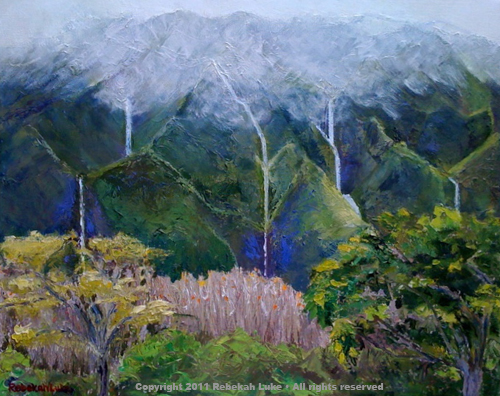
I wonder if it is true that in olden times the waterfalls of windward Oahu ran all the time. Olden times meaning before water was diverted to the Ewa plain for sugar cane and land development. At the present intersection of Kahekili and Likelike highways, while waiting at a red light, a rain storm typical of our wet season had just stopped and the clouds lifted to reveal a spectacular scene of the Koolau mountains. I was on my way to Hoomaluhia Botanical Garden at Luluku and made up my mind to hold the vision in my memory so I could paint it. For in just a few quarters of an hour the sun came out again and the waterfalls disappeared.

"Clouds Lifting Over Lanihuli" 16" x 20" Oil on Canvas (unfinished)

UPDATE, September 11, 2011: As you will see in my 9/11/2011 post, I have made some changes to this painting, and I think you may like the finished work better. Thanks for visiting Rebekah’s Studio.

Copyright 2011 Rebekah Luke


Oh my goodness, look at Lanikai beach

31 05 2011

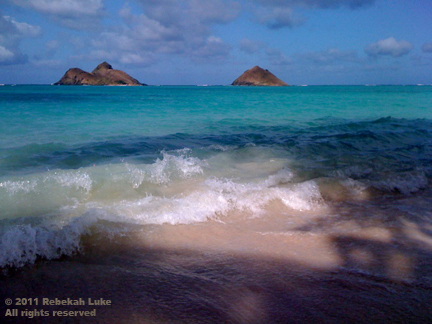
Classic Lanikai view

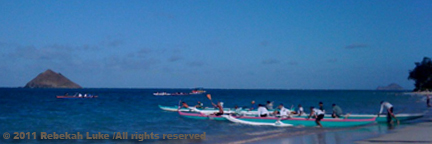
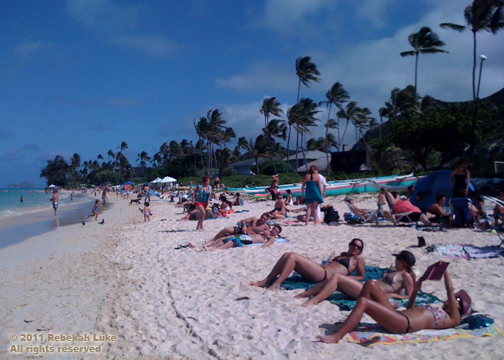
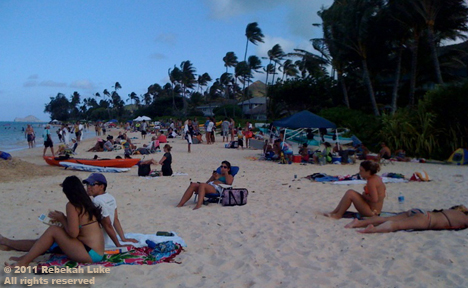
Aloha! This weekend our family spent some time at a beach house in Lanikai, Oahu. The idea of going there to relax this 3-day Memorial Day holiday was not an original one, as you can see. Never in my life have I seen this beach as crowded. On a normal day it is pretty secluded, tucked away around the corner from Kailua town, with outrigger canoes going out for practice in the early morning and late afternoon, a handful of sunbathers, and maybe a wedding shoot. But not yesterday. Take a look at all the activity!

Afternoon paddlers

Memorial Day 2011 at Lanikai

Escaping for some solitude on the sea

Beach sentinels

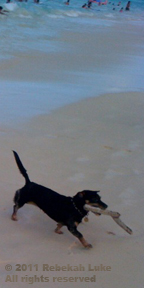
Please throw it again

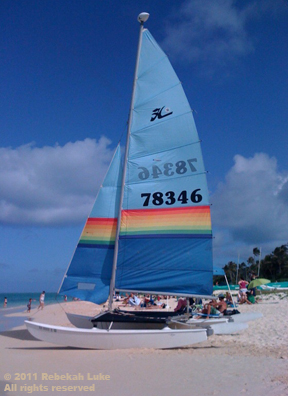
Colorful Hobie

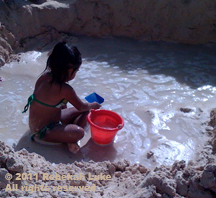
One of several "bathtubs"

One of several rafts

Para-something

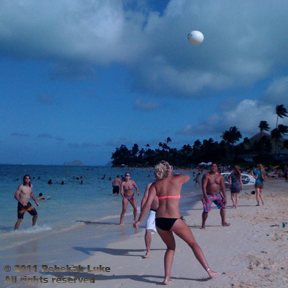
Volleyball

Looks like Waikiki beach

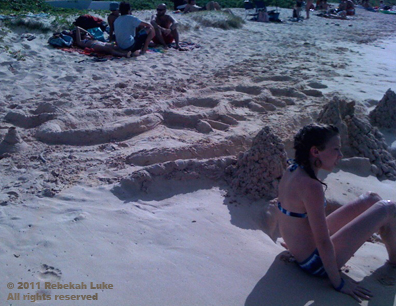
Sand caterpillar

Copyright 2011 Rebekah Luke


Lanikai diptych

11 04 2011

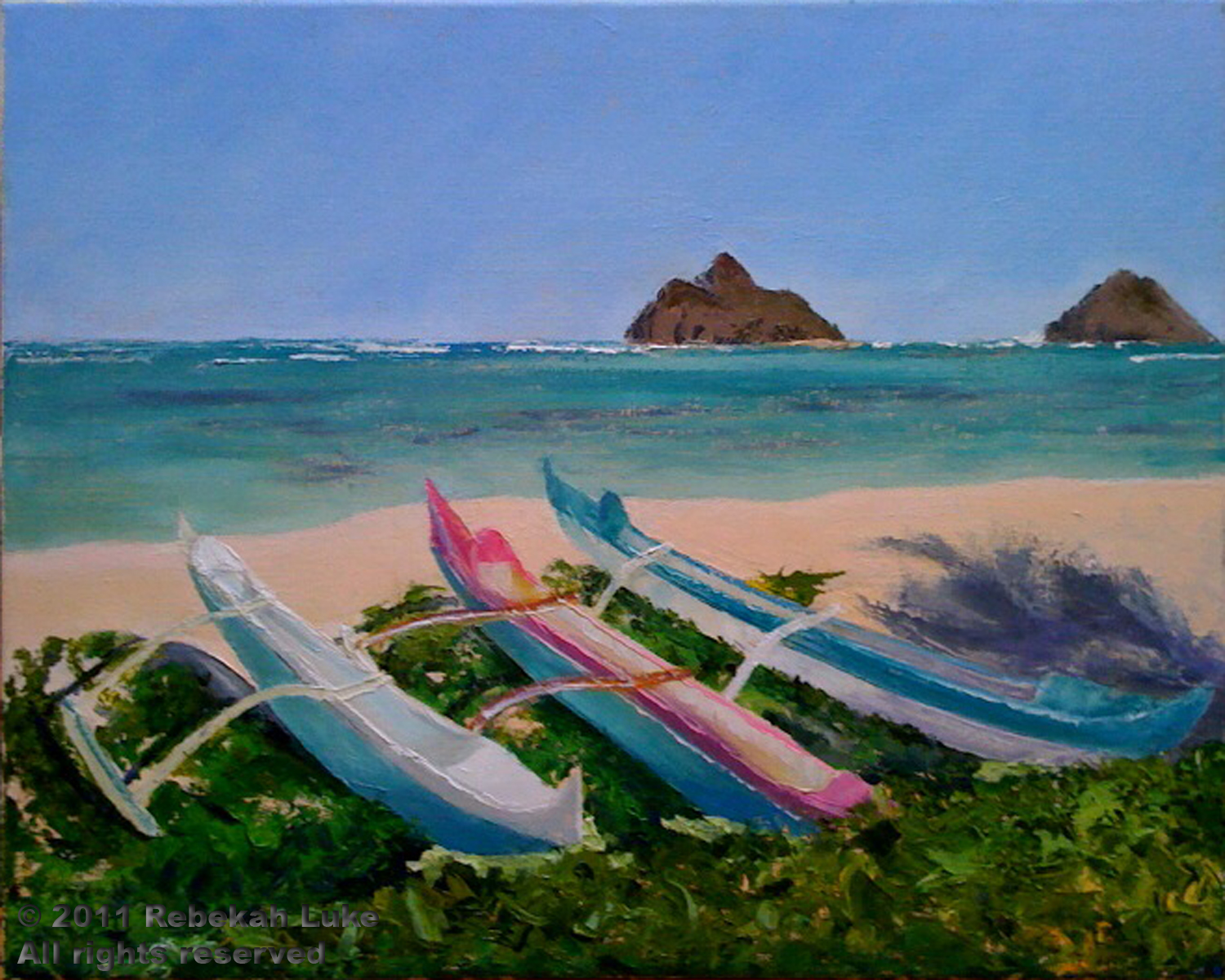
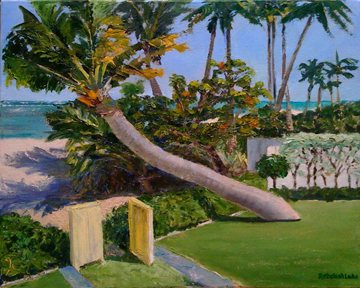
This is my finished painting of Lanikai Beach on Oahu. Oil on canvas. Each panel measures 20″ wide x 16″ high prior to framing. Beach goers are familiar with the iconic outrigger canoes, twin islands, and shady palms. This is the scene from Karl-and-Julie’s. I can’t wait for them to see it. © 2011 Rebekah Luke / All rights reserved

Wa'a Kolu, Moku Lua

Julie's Coconut Tree


Family time: Kaaawa Valley 5K Fun Run/Walk

9 04 2011

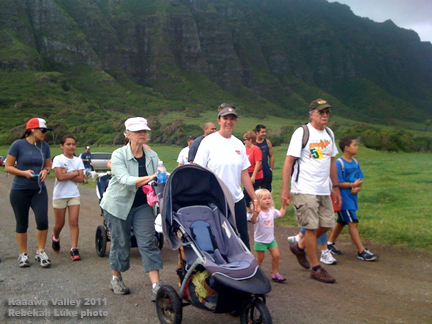
The 2nd Annual Ocean Warrior 5K Family Fun Run/Walk sponsored by Kaaawa Elementary School and hosted by Kualoa Ranch was held this morning in Kaaawa Valley.

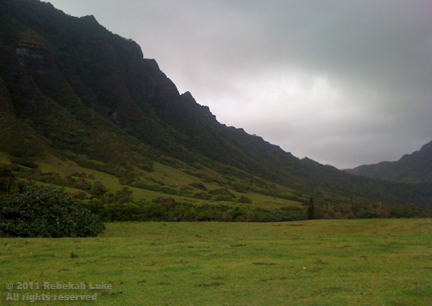
Kaaawa Valley slopes

The starting line

It's the second annual for Miss Marvelous, her Tutu, Mom and Papa

Turn marshals

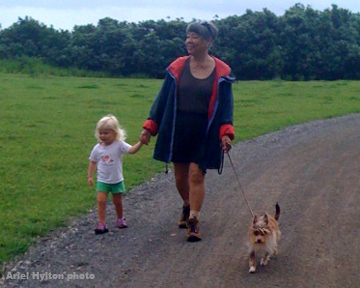
Miss Marvelous, me, and Alice Brown

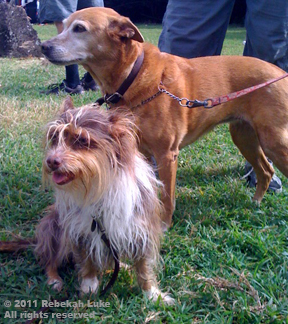
Alice Brown & Pua—the dogs enjoyed the walk, sights & smells

Copyright 2011 Rebekah Luke