Kids and me at the Filipino Fiesta

12 05 2013

Anxious to finish another painting, I headed out to Kapiolani Park yesterday only to find the Annual Filipino Fiesta staged there. It’s Saturday. Duh. I didn’t care. It takes me an hour to drive there from the studio, and DH gave up the use of our one car, so I felt I had to take advantage of the opportunity.

I circumnavigated the park twice after deciding to not park illegally and before squeezing into a spot on Leahi avenue that my friend Pi‘ikea would term “in the next county.”

Plein air oil painters lug their French easels, paints, and what-have-you all over the creation. We need to be there for the light. So I hoofed it.

I visualized my painting spot empty as I walked toward the iconic ironwood-lined path, and it was! Right in the middle of a pedestrian aisle lined with two rows of tent booths and across from the food booths and their aroma, each with a long line of customers.

The tinikling and other Filipino and pop tunes from the bandstand blared, and I welcomed another of day of painting to music. The one I did at the recent Bluegrass Hawaii festival was successful.

"Bluegrass Hawaii," 20"x16" oil on canvas

“Bluegrass Hawaii,” 20″x16″ oil on canvas

As you might imagine there were a lot of spectators, photographers, and videographers who stopped to watch me paint. I’m happy to stop and converse. What I like the best are the children. Here’s a sample of their comments and questions (some adults ask the same things):

Kid: What kind of paint is that?
Me: Oil paint.
 
Kid: Did you draw that?
Me: Uh huh.
 
Kid: How long did it take you to paint that?
Me: This is my fourth or fifth time out.
Kid: Are the people in the painting still there?
Me: Try look. Are they?
 
Kid: What are you going to call your painting?
Me: How about “Ironwood Path at Kapiolani Park”? “Diamond Head” is too ordinary, don’t you think?
Kid: (smiles widely and nods approval)
 
Kid (noticing the vista): Oh, look! She’s painting that!
 
Kid: Wow, you have a lot of colors.
Me: Do you like to draw?
Kid: Yes.
 
Kid: Are you going to be an artist when you grow up?
Older kid (punching the first kid in the arm): She IS an artist.
Me: Yup, when I grow up.
 
Me and Taxx, who I just met, with my painting in progress, i.e., it is not from completed (Photo by Taxx's photographer)

Me and Taxx, who I just met, with my painting in progress, i.e., it is not completed. I am revisiting some places I painted about 20 years ago and painting them again. This is one of them. I hope to mount an exhibit to compare the art works. Is there any growth? Have I grown up?  (Photo by Taxx’s photographer)

Copyright 2013 Rebekah Luke


Art and architecture where Hotel and Richards intersect in Honolulu

1 09 2012

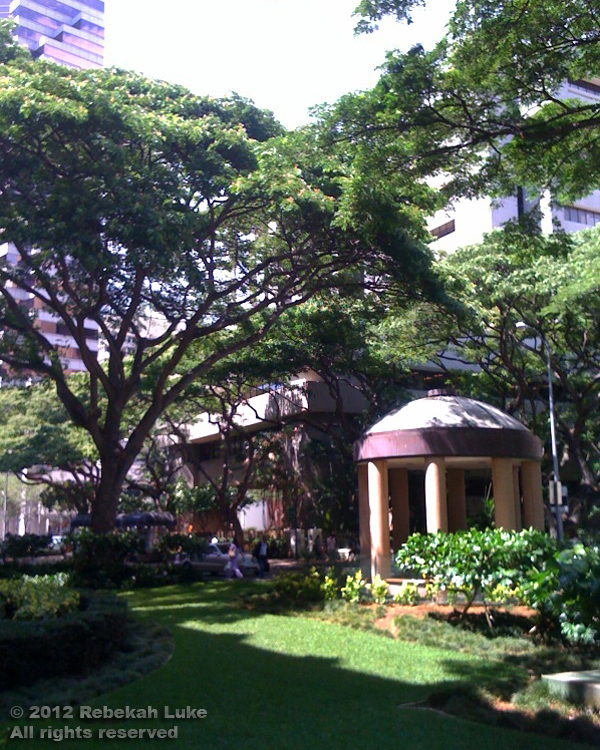
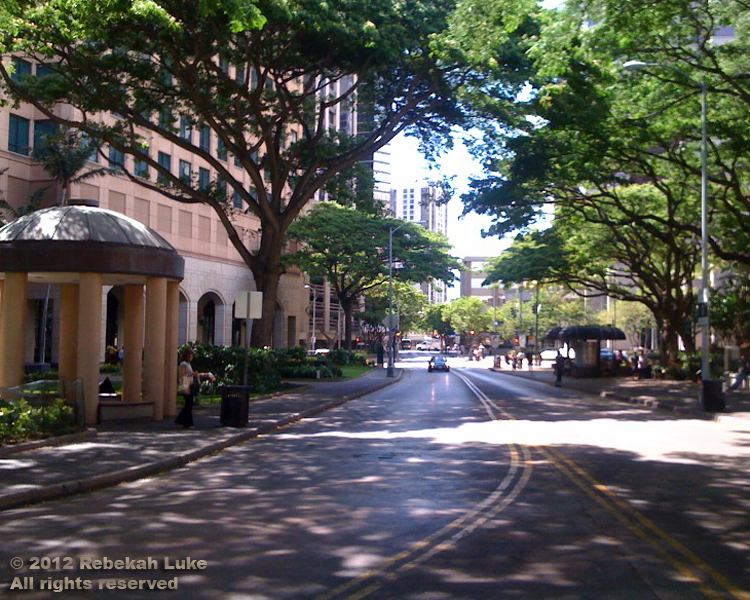
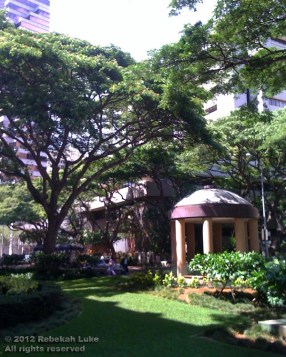
The charming gazebo at Hotel and Richards streets that caught my eye.

After lunch downtown last week with Becky at Café Julia, that got the vote for best downtown place for “breakfast and lunch only,” I strolled up the street, intending to visit the Hawai‘i State Art Museum (HiSAM). Becky suggested I take a look at what happened to the old Armed Services YMCA swimming pool.
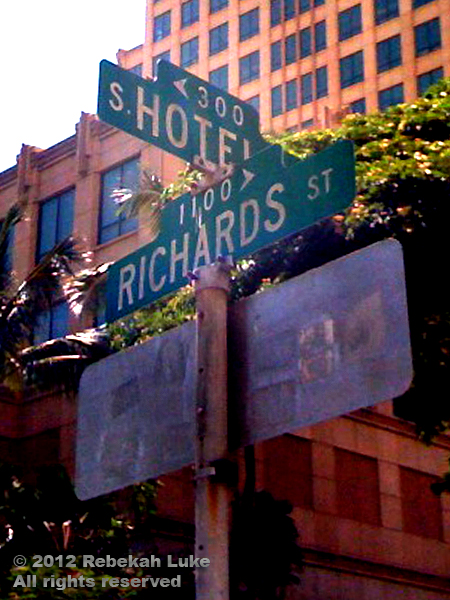
Approaching the intersection of Hotel and Richards, the loveliness of dappled sunlight through the monkeypod trees stopped me.  Pause for photos.

I saw four familiar buildings differently than before, and I reflected on their noteworthiness, all in proximity in this small area. Later, it occurred to me that on my little walking tour, I had focused on the historical architecture and fine art of these buildings, making for a very pleasant afternoon by myself . . . while Becky went back to her office to work.

Hawai‘i State Capitol

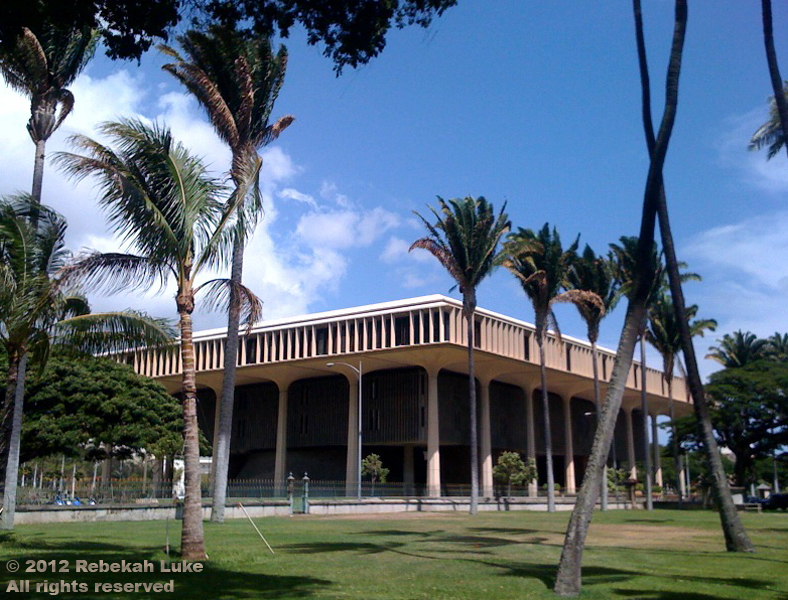
Kitty corner to the gazebo is the Hawai‘i State Capitol designed by Belt, Lemmon & Lo and John Carl Warnecke & Associates. Its columns represent coconut palm trees, and the two cone-shaped legislative chambers represent volcanoes emerging from the reflecting pools that depict the Pacific Ocean.

In the courtyard floor is a round artwork “Aquarius,” an Italian glass tile mosaic by Tadashi Sato. There are two noteworthy statues at the Capitol: one of Father Damien of Moloka‘i on Beretania street, and one of Lili‘uokalani, Hawai‘i’s last reigning monarch, on the opposite side facing ‘Iolani Palace.  Inside the chambers there are large tapestry weavings by Ruthadell Anderson.

Looking makai (toward the sea), notice ‘Iolani Barracks (1871) that housed the Royal Guard on the royal palace grounds. Hawaiian kings and queens lived in the ‘Iolani Palace (behind the Barracks in my photo) until 1893 when Lili‘uokalani was overthrown and imprisoned in her room. Today both buildings are museums worth touring.

‘Iolani Barracks, moved to this site in 1965 to make room for the new State Capitol.

When I was in my twenties, I came to the Armed Services YMCA once a week to rehearse with the Honolulu Chorale. In 1927-28 that building was erected to replace the second building of the original Royal Hawaiian Hotel (Hotel Street was named in 1850; the original hotel was demolished in 1882 and rebuilt). I thought it was grand as a functioning Y and imagined what it must have been like in its heyday. Today the building is renovated, housing State offices and the Hawai‘i State Art Museum on the second floor, my destination.
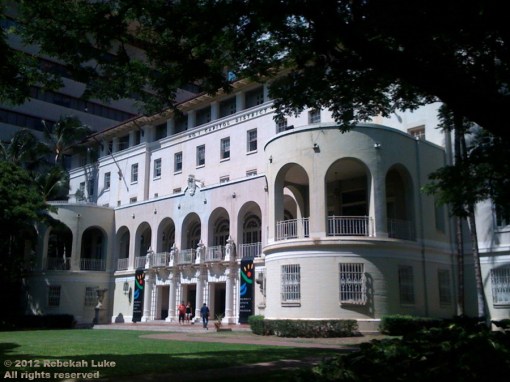
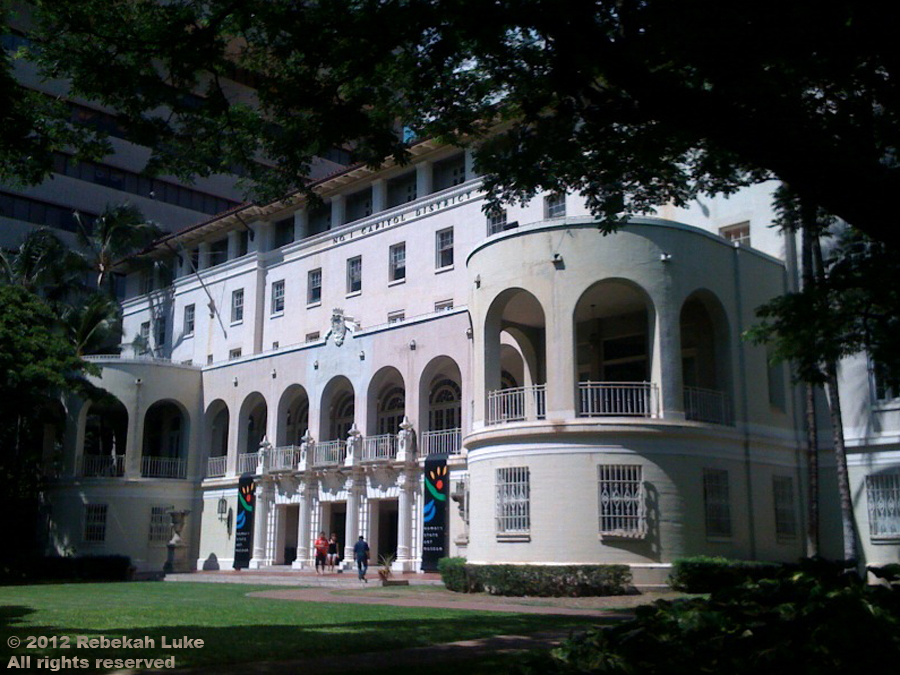
No. 1 Capitol District Building is the former Armed Services YMCA built in 1927-28. The former swimming pool and deck  in the middle of the U-shaped building is now a sculpture garden with a pretend swimming pool.

“Visions and Portraits of Hawai‘i” in the Ewa Gallery (toward Chinatown) contains representative work of Hawai‘i’s well-known artists, as defined by the State Foundation on Culture and the Arts. This display is eclectic, in that there is generally one work per artist. But Hawai‘i, since settled by non-natives, is eclectic!

Two stand-out works for me on this visit were the main piece as you enter the area — a painting of Waimea Canyon on Kaua‘i by D. H. Hitchcock (1861-1943) whose impressionistic works I admire greatly, and the painting of women, thickly painted by Madge Tennant.

The theme of the exhibit in the Diamond Head Gallery opposite is “Recent Acquisitions.” What I remember most is the nature photography of Wayne Levin. Three stunning images: an underwater shot of a diver chased by an ulua (I think), one aerial of Hawaiian monk seals at the tidal line (“Monk Seals and Surf, Derby’s Beach, Nihoa”), and one straight-on of birds and clouds (“Approaching Sooty Terns”). Classic clouds for my painting students to study!

Both galleries display impressively large wooden ‘umeke, or calabashes, turned by Robert W. Butts.

On the ground level, passing by the museum gift shop and through Downtown @ HiSAM restaurant, doors opened to the Sculpture Garden in the former swimming pool area. Artist Doug Young created a glass marvel in 2D with such visual depth that it seems as a 3D pool. I got dizzy staring down at it! Interesting. The restaurant staff began setting up for an outdoor garden party, and I moved on . . .

. . . Back to the Richards Street YWCA, half a block toward King street where Becky and I ate lunch. This attractive building was designed by architect Julia Morgan, who also designed Hearst Castle at San Simeon, California. Before I headed home, I revisited a Lau Chun painting hanging above the grand piano in the lobby. It was of the YWCA building as viewed from the palace grounds, and with the street and cars edited out.

His strokes of thick paint are of every color, you’ll see when you examine the painting closely. It’s as Miss Marvelous’s mother, when as a youngster she looked at my oil paintings, said: “I can’t figure out how, when you look at it close up, it’s just paint, but when you step back it’s a picture.” Lau Chun’s painting is an example that value (shades of light to dark) is more defining than hue (color) in a painting.

It can be useful and educational to look at other artists’ work. But more than that, I can pick out those things that are inspirational. Often, looking at other artists’ work usually frustrates me, and I’m only inspired to return to the studio to make my own creations. This time, I enjoyed the things I selected to see in a new light.
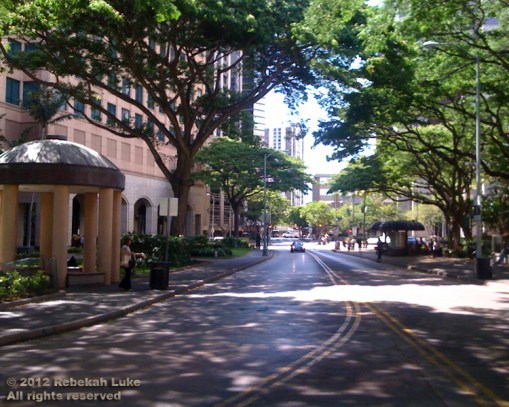
Looking north on Hotel street. Ali‘i i Place, primarily an office building, has a convenient municipal parking garage with cheap rates. The lobby and Alakea street pedestrian entry feature several fine, large paintings by John Wisnosky.

Copyright 2012 Rebekah Luke


Native artists at the Bishop Museum

22 05 2011

The enjoyment for today consisted of going to the Bishop Museum to show my oil paintings alongside other Native Hawaiian artists at the art mart that is part of the MAMo (Maoli Arts Month) Festival in Hawaii. It happens every May.

The Museum booked DH, who is a volunteer docent, to guide a group from a philosopher’s conference on a 1-1/2 hour tour of Hawaiian Hall, making it doubly worthwhile for the two of us.

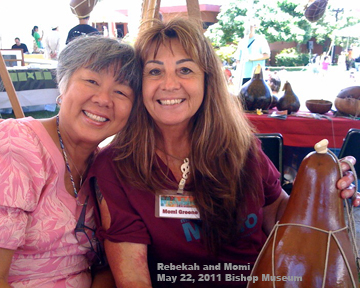
Ten minutes before show time, we arrived to find our spot next to my artist friend Momi Greene who came from Hawaii island with her decorated ipu (native gourd containers).

Me and my friend Momi Greene. Momi grows a native Hawaiian gourd and decorates them with carving and natural dyes she makes herself in the style that was done traditionally on the island of Niihau.

Years of art fence and craft fair experience paid off as we arrived ten minutes before show time, i.e. late. I saw some dark clouds as we drove over the mountain, and yes, we set up in the rain.

The paintings were fine; oil doesn’t like water. I just shake and blot them dry. DH staked the easels into the ground, and I attached extra ties, a good thing because gusty trade winds blew down from the valley throughout the day.

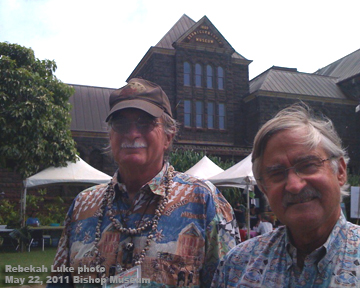
My brother-in-law Jon, in town from Oregon, came by to meet Momi in person because until today they had only been Facebook friends.

DH and Jon with the Bishop Museum's main building in the background

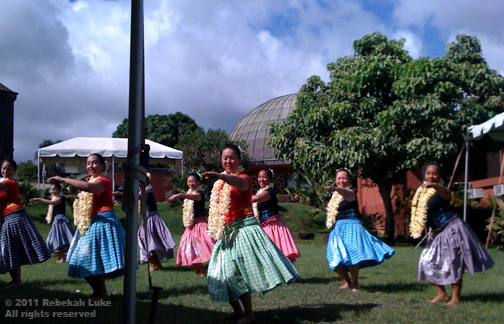
I loved the continuous live Hawaiian entertainment all day long.

Hula dancers wear long yellow plumeria lei

DH and I made some purchases:

I bought—with cash from trading my no-longer-wanted gold and silver items—some things from other artists, including a nifty re-designed T-shirt. I always try to buy from other artists where I am selling. The designer, using scissors, cuts away parts of the original garment, slits holes in the knit, weaves in contrasting colors or ties the fabric in creative ways to make a one-of-a-kind top that is truly styling and all the rage at the Native Hawaiian art mart. I plan to post a photo of me modeling it soon!

Yesterday in a gust of wind one of Momi’s ipu broke. It looked like it could be glued, but she said she’ll stitch it back together, making the stitching part of the design and giving the ipu new life and a story. When I relayed that to DH, he immediately told Momi of our plans to take a trip to her island and that he wanted to buy the ipu after she stitched it. That piece would be really special and would she kapu (reserve) it for him, we’d pick it up next month.

She said, “Okay, do you want to see it first?” DH can be impulsive at times, but he’s a good buyer and appreciates fine Native Hawaiian-made artwork.

What I realized and appreciated the most at the end of the day was how much the art by Native Hawaiians has improved, including the marketing of it. If you are in Honolulu next May, please plan on attending some of the activities of Maoli Arts Month.

Copyright 2011 Rebekah Luke


Punahou Carnival 2011

31 01 2011

This Friday and Saturday, Feb. 4 and 5. All the fun is bounded by Punahou Street and Wilder Avenue in Honolulu, from 11 a.m to 11 p.m., and I’ll be there. If you’re visiting, this is a great travel tip!

The big tent and the thrill rides are up, and they’re getting ready for the Punahou Carnival again. I’m here to plug my alma mater, with notes on my contribution and my favorites. It’s a humongous fundraiser put on by the junior class to raise scholarships. First-timers wonder how they do it. I’ll tell you how.

The school ropes in all the parents of the junior class and alumni to donate their time, labor, talent, and supply goods so that everything spent at the Carnival is profit for students.

The Carnival is such a bonding experience, you remember it for life and return every year to support it. There’s fun for all ages.

Banyan in the Park, an original oil on canvas by yours truly, for purchase at the Punahou Carnival Art Gallery. 16″ x 20″.

My contribution

For the past several years I’ve placed my paintings in the Art Gallery—50% of sales goes to the school, and put my time in at the Hawaiian Plate “booth.” I also help serve up the meal (5 to 8 p.m. Saturday).

Last year my graduating class was the second oldest still working the Carnival. We report to Dole Cafeteria and don aprons and hats to plate the meal of Hawaiian food. For anyone not of school age who isn’t interested in the midway carnival rides, it’s a nice place to relax because there is air-conditioning, there is continuous live music, and there are real bathrooms.

We used to prep and cook the food, and in years before that we worked the famous malasadas booth with Mr. Bowers until we were banned for making non-regulation sizes and shapes ;-). And frankly, I don’t remember what we did prior.

My favorites

Usually I carpool with DH and his daughter, also an alumna. We each arm ourselves with an empty shopping bag and an umbrella. We go to a secret parking place if the lots on campus are full. Tip: take the bus if you can or prepare to park and walk from neighboring streets.

These are some of our favorites:

  • Silent auction—Items vary from year to year, and sometimes we’re lucky. We scope this out first.
  • Art gallery—Always like to see what other island artists are doing; it just makes me want to paint more, though. A great collection.
  • Plant booth—I’ve donated bromeliads and small avocado trees. For my garden I’ve bought herbs, red and pink ginger, native Hawaiian species, water plants, and turf grass. They will hold your purchase for you to retrieve later, if you wish.
  • Malasadas—Of course, with a hot cup of coffee at night.
  • Jams and jellies—E.g., red pepper jelly and mango chutney. I think it sells out in the first hour on Friday 😦
  • Books—At the end you can fill up a bag and get it all for something really cheap.
  • White elephant—Quick survey. You never know what you might find.
  • Food—Whatever your heart’s desire, a separate booth for each. Gyros, corn on the cob, fruit smoothies, fried noodles, pizza, teriburgers, veggie stuff, Hawaiian food, chicken, Portuguese bean soup, ice cream, saimin and meat sticks … oh la la.
  • Produce—A crew goes to the Big Island to pick. I do my next week’s fruit and veggie shopping here.
  • Games—The kiddie games are a world apart. It’s fun to watch the little ones. I think it’s time to take Miss Marvelous there. There are games for older students and teens too. My Facebook friend Yo and her husband are parent chairs of the prizes this year.
  • Will call—You can check your loot here until time to go home.

So c’mon to the Punahou Carnival, alumni or not. Spend your money. It’s for a good cause!

Copyright 2011 Rebekah Luke


The gift of time

14 01 2011

My expansive morning — “expansiveness” is my word for 2011 — brought some surprises to what otherwise would have been ordinary. It started early when I recalled a pleasant dream of a stranger in a theater who knew my name.

It has been awhile since I’ve actively recalled my dreams. When I awoke I wondered if it was my teacher Alice Anne connecting with me energetically to prepare for her time travel meditation tonight.*

Fridays are my scheduled Reiki days, but with no appointments and a promising sunny sky I went to the Pohai Nani pool for aqua exercise at 8.

In 2006 (!) I bought a punch card of x number of classes that I stopped using when I took a full-time job. I love the deep water exercise class with the “Aqua Jogger” buoyancy belt and the cordial, caring staff. They heat the swimming pool to 86-89 degrees. If it is cooler than that on the morning of class, the instructor phones to say class cancelled.

Last November, I was surprised to learn that the card was still honored, but only until today. A new schedule of classes and fees for seniors starts on the 24th. Between now and then I have the gift of time to choose which class to sign up for.

On the way home I stopped at the bank to cash a check, presenting my bank ID card. The teller asked to see a picture ID as well, and when I showed it she asked for yet another picture ID. Why? My driver’s license expired on the 9th, my birthday! Thank you so much for pointing that out, I said. After confirming my signature with the superviser, she accepted the check.

I doubled back to Satellite City Hall in Kaneohe to renew my license, getting my face all prettied up for my photo. I was wearing a plain black t-shirt, and my hair—I just got out of the pool! A man stood puzzled outside the front door that had a Closed sign on it. He was reading the many messages taped to the window.

Is there anything that tells why the office is closed today? I asked. “Furlough Friday,” he mumbled, pointing to a calendar. The partial solution for overcoming Honolulu’s budget shortfall is to put government workers on furlough.

The two of us scrutinized the calendar and noticed that the office will be closed on Monday too: Martin Luther King Jr. Day. Guess I’m driving without a license until the 18th, then.

I stopped at nearby Foodland to pick up a few groceries. It’s not my usual place to shop, but I didn’t want to get in and out of the car anymore. The checker asked for my own reusable bag. It’s the first time a store asked me that. Luckily, I did have a bag at the bottom of my purse.

The checker explained, starting next year no longer will Foodland be providing plastic grocery bags. Customers will need to bring their own. (The islands of Maui and Kauai have done away with plastic bags already.) Next year: 2012? Yes, she said. Good, I thought. I have a year to figure out what to do with my dog’s poop.

* Tonight I’m attending a New Year’s guided group meditation led by my teacher Alice Anne Parker. Alice Anne, a professional psychic, takes her students on a journey into the future for a look at their lives to come. In general, it’s usually “It’s going to be okay.” People of all levels of awareness have attended in the past and reported their visions. Very interesting! Perhaps I’ll see you visiting me here at Rebekah’s Studio.

Copyright 2011 Rebekah Luke


Mauna ‘Ala, burial place of the ali‘i

18 11 2010

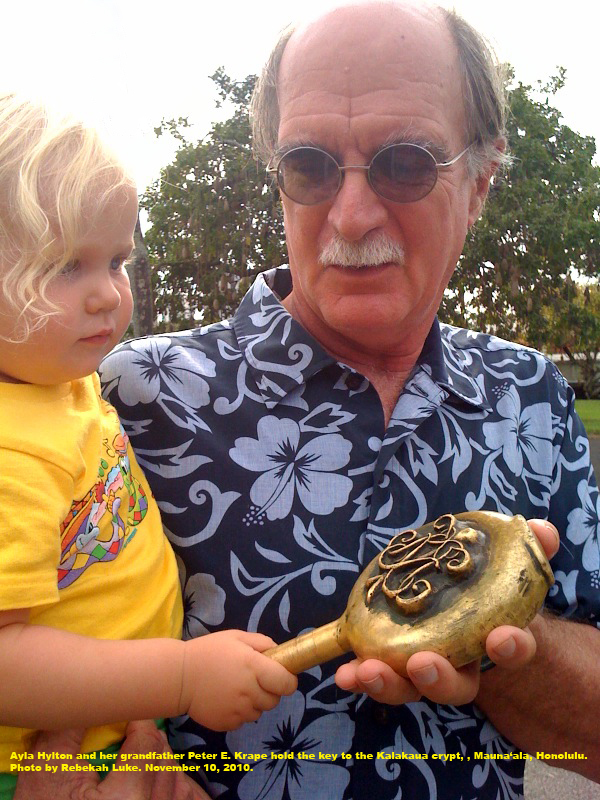
Miss Marvelous with her Papa entering the Kalakaua crypt

If they arrange ahead, Honolulu visitors to Mauna Ala, site of the Royal Mausoleum in Nuuanu, can have a guided tour by its curator William John Kaiheekai Maioho, the kahu of the iwi (bones) of the alii (royalty) and high chiefs—namely the Kamehamehas and the Kalakauas.

I and Miss Marvelous tagged along recently with DH and a group of volunteer docents from the Bishop Museum. Bill Maioho’s presentation—full of details and anecdotes, talk story style—included a chronology of the Hawaiian royals and others who are buried at Mauna Ala, information about the chapel building and how its use changed over the years, and a look inside the gates of the Kalakaua crypt.

Holding the key to the Kalakaua crypt

Bill Maioho descends from the Taylor family whose kuleana (responsibility and privilege) is to care for the iwi at Mauna Ala. You can find his story as an oral history article in Pacific Worlds, an excellent website with information about Polynesia. Please click on the link.

Mahalo to Uncle Bill.

Remembering Charles Reed Bishop

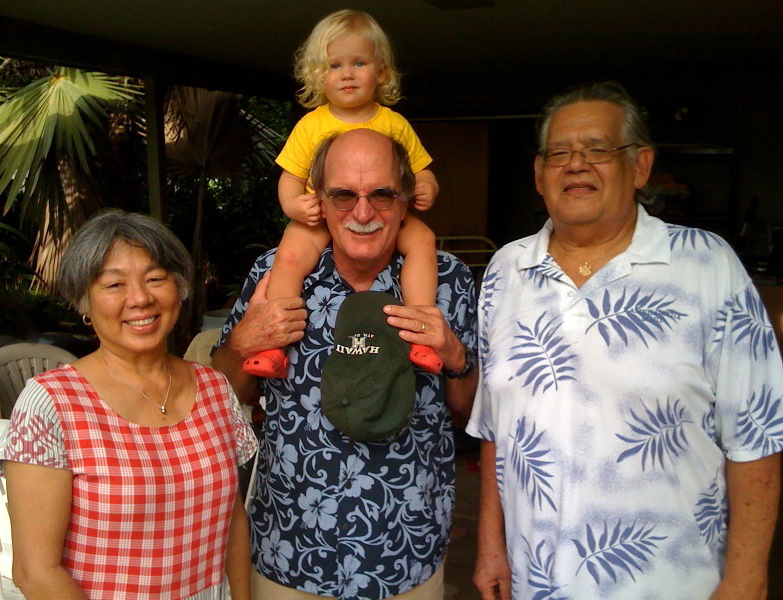
Me, Miss Marvelous, DH, and Bill Maioho

Copyright 2010 Rebekah Luke


Not sure how to sum up Thursday, but …

1 10 2010

… That was fun. A nice ending to a full day! The venue for my cousin Toy’s going away party was Terry’s Place in Honolulu Chinatown where another cousin, Sunway, and her band performed last night. I stopped by the bar after my glee club rehearsal and caught a couple sets with the relatives. Really good pop music. Good eats and fine wine.

Sunway giving it her all

The day started with driving four neighborhood aunties and the baby (Miss Marvelous) from our moku (district) on the windward side of Oahu to Honolulu.

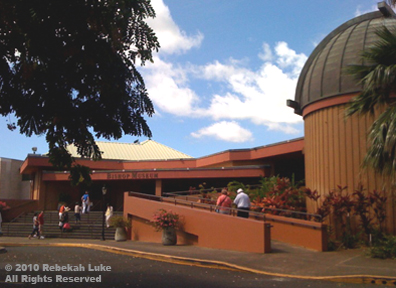
I skipped my usual morning of painting. Aunty Cornelia, Aunty Mercy, Aunty Ramona and Aunty Dot wanted to see the milestone exhibition of the three wooden images of the Hawaiian god Ku on display together at the Bishop Museum through October 4—just three more days.

One carved image resides at the Bishop Museum, one is on loan from the Peabody Essex Museum in Salem, and one is on loan from the British Museum in London. Museum literature states that two hundred years ago the Ku stood on heiau (temples) on the island of Hawaii.

Bishop Museum

DH (darling husband) who volunteers as a docent was delighted to give the aunties a tour, and we both were happy to provide the rides.

I used the time they were at the museum to grab some lunch, get my hair cut by Arlene and have photos taken for a new passport. I came back in time to catch Lokomaikai’s very enjoyable moolelo (story) about the hula before heading back over the Koolau mountains.

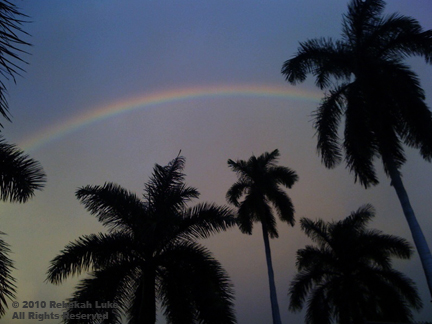
It rained some today, and as I drove down Palm Drive at Punahou on my way to glee club practice, I saw the rainbow over Manoa Valley.

Rainbow over Manoa

Copyright 2010 Rebekah Luke