Gathering kukui nuts and re-landscaping for a play space

18 09 2010

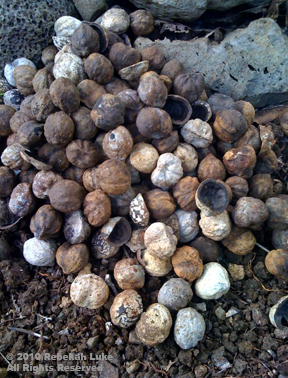
Aged kukui nuts prior to cleaning and polishing into Hawaiian jewelry

The studio and its surrounding garden of fruit trees and raised vegetable beds is not my choice for a toddler to play in, so I’ve cleared out the heliconia under the avocado tree to plant a soft thick green ground cover of clover with Miss Marvelous in mind. She likes to explore and play in the outdoors.
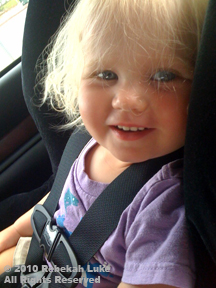
Those following the progress of Miss Marvelous may see what she looks like at 16 months this September. I snapped this image in the car on a shopping trip. She loves shopping!

The heliconia patch was there since purchasing our place. It has survived with not much care for more than 26 years. When the patch was full and thriving, gathering the fallen avocados in August was like hunting for Easter eggs in a forest.

Off and on since trimming the plants to the ground I’ve dug up roots, runners, sprouts, as well as rusty iron pieces from the old VW bug, now in its last disintegration phase.

Just by running my fingers through the coarse soil, I found lots of old, old kukui nuts, whole ones and halves of different colors—black, brown, white, multi—from the neighbor-in-the-back’s tree on the other side of the panax hedge. They were easy to find, a meditative search akin to shell seeking.  In all our years here I never gathered many.

Today I thought I’d rescue the nuts for my friend Kamakea who turns them into jewelry, and I saved them for her.

The kukui fruit with its outer skin covering or husk still intact. On the tree they are a gray-green color.

Next I looked for kukui nuts that were freshly fallen for another friend, Cathy, who makes inamona, a roasted nutmeat relish mashed with paakai (salt) and used in Hawaiian cuisine.

It is a long process to prepare inamona, about as long as it takes to make kukui nut jewelry. Cathy said, as long as the outer covering is still intact, it’s good for inamona. Kukui nuts are seasonal, and they are starting to fall now.

Sure enough, in and among the fallen dried leaves in the corner of the lot were these round fruit. So I scooped those up too. When I have a few more, I’ll deliver them to Cathy.

The kukui tree (Aleurites moluccana) is amazing. It has many uses. It is a canoe plant originally brought to the Hawaiian Islands by Polynesians who arrived here by canoe. You can spot the tree in the mountains by looking for light, mint-green-colored leaves.

In Hawaiian culture the kukui is one of the kinolau (forms taken by a supernatural) of the Hawaiian pig god Kamapuaa; the shape of the leaf resembles the head and ears of a puaa (pig). Freshly plucked leaves with stems on are arranged together by knotting the stems make beautiful lei (wreaths). In laau lapaau (Hawaiian medicine), the mashed kernel, as in inamona, is a laxative and prescribed for relieving constipation.

It is often called the candlenut tree. Kukui means light. Hawaiians skewered the oily kernels and burned them for light. The oil is the preferred oil for polishing wooden utensils for food, such as umeke (bowls) and platters. You can now find the oil on the commercial market as a cooking oil and in cosmetics.

The kukui tree also provides wonderful shade. Mahalo e ke Akua! Combined with the canopy of the avocado tree and a ground carpet of hardy clover, I envision a delightful play space for Miss Marvelous. She’ll just have to duck during the month when the fruit fall.
Copyright 2010 Rebekah Luke


Artist’s unforgettable memoir

15 04 2010

Once upon a time in 1994, not too long ago, I went to a Hawaiian place, a place of healing.

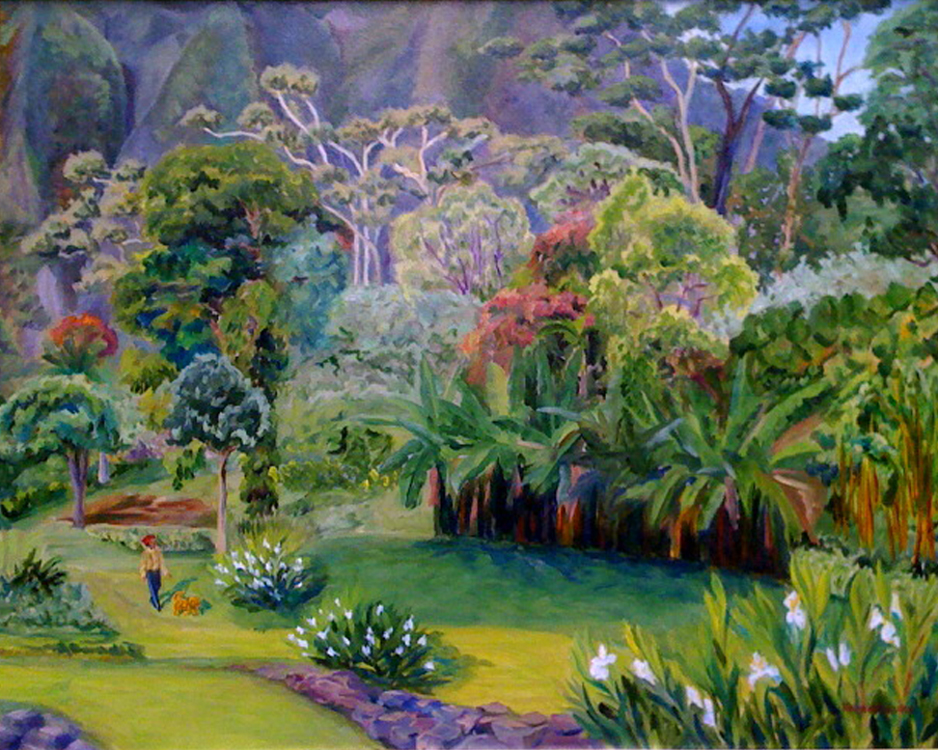
Through the treetops I could see glimpses of the Ko‘olau mountains. Patches of sunlight danced on colorful impatiens, and the sound of civilization gave way to the melodic symphony of the shama thrush. How enchanting, I thought. This feels like paradise. The trail skirted dense bamboo on one side and cultivated ti plants on the other. I could hear the stream running, and farther along, soft voices below. When the view finally opened up I saw up close the back of an amphitheater-headed valley, and, below me, a stretch of green terraces planted with kalo. To the left was a small house. This was unforgettable ‘Ioleka‘a, and Anita lived here.

Anita’s Place Kaiwikee Edge of the Forest

Anita was an inspiration to me. I met her through our work with Ka Lahui Hawaii. She took care of the land, and it took care of her. I met the family members who together with Anita own the private Native Hawaiian kuleana, and after a while they welcomed me in to paint the landscape.

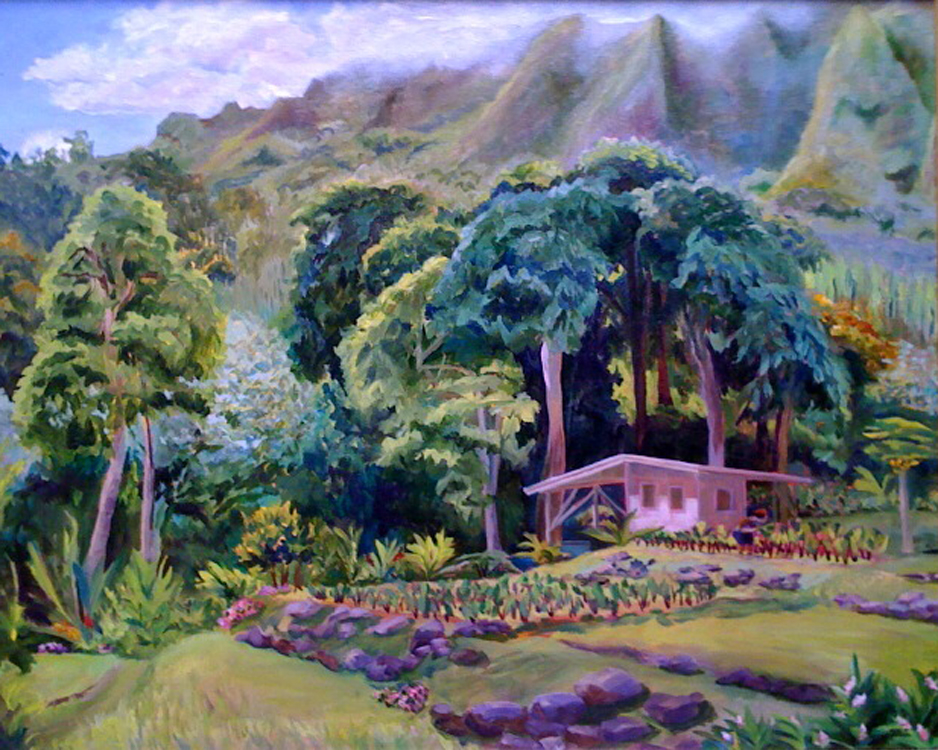
Over ten months, starting in February when the ‘awapuhi ke‘oke‘o (white ginger) bloomed — I still recall the sweet scent — and until a solo show exhibiting the work opened,  I hiked in and out many times and made more than a dozen oil paintings, starting with “Anita’s Place” that developed into the triptych above.

I attached pontoons to my easel to prevent the legs from sinking into the mud of this lo‘i land. I learned to smell and listen for the rain, just in time to cover my palette and don my rain gear. Sometimes Ei Nei the golden retriever would keep me company, but only until the mistress returned.

On November 5, 1994, a day after the show opened, I wrote:

I am so glad I made these paintings. Things are different at Ka ‘Ili ‘Ioleka‘a now. The goat’s gone. Got loose and took off. The papaya tree’s down. A couple more lo‘i are being prepped for planting. One of the mango trees on the trail fell. More people and the laws of nature bring constant, dynamic change.

Anita and I picked ho‘i‘o for the art show reception. One needs a good eye to spot those fern buds. Anita refused payment, even though I explained that was her income. A gift from the ‘aina, she said.

For a month the paintings are on exhibit at Leeward Community College. People like them. They really look at them. It is as though some folks have never seen a painting. It’s refreshing to see some of the green of the windward side of the island over here where it is drier. Sort of like a shot of menthol, a visitor said. When art evokes an emotional response, when it communicates, then it is successful. These images are.

These images stop people. They are scenes that people can relate to. They bring back memories and stimulate discussion. Instead of talking about budgets and college programs, they talk about their childhood experiences in the lo‘i, or on the ‘aina, on a neighbor island, when they went hiking, or … What more can one ask for in a response?

Gloria Foss, my teacher, attended the opening, and I asked her for a critique. She said there was almost no blue or violet as local color, but predominantly greens and reds, although I used blue and purple in the mixtures. In other words, it appeared that I’d used a limited palette. “Push the green as far as it will go, into blue,” she said. “Use cloud shadow to put more violet in the mountains. Use more cloud shadow everywhere to develop focal points. Focal points, yes. Work on developing those. That’s why the piece “Anita’s Place” works well. You’ve set up the little house as the focal point.”

The Leeward Community College Foyer Gallery was set up by Melvyn Sakaguchi when he was provost as a place where emerging artists could show their work and receive a little technical assistance from the college before heading out further on their own. Alan Leitner, the curator, thinks the campus galleries will become more important because they will be the places where the reviewers and critics go to see art.

Most of the ‘Ioleka‘a paintings went to buyers on opening night, and I donated some of the proceeds to Ka Lahui Hawaii. I still have the 90-inch-by-24-inch triptych and a couple of favorites in my collection.

Copyright 2010 Rebekah Luke


Flying moths over Kaneohe Bay

28 02 2010
Cool light northerly
winds meet odd-looking sailboats
Kaneohe Bay
Up on hydrofoils
small fast single-handed craft
skate on calm water
Iridescent wings
of high-tech mylar sailcloth
look and fly like moths

Stressed out? Take a few moments to view, hear, and feel what it’s like on Kaneohe Bay in the shadow of the Ko‘olau mountain range on a partly cloudy afternoon.

Taking time to relax and being mindful of the present is healing. Though some moments are anxious, as when awaiting a tsunami (yesterday) or faced with other disaster, it does a body good to rest and renew one’s spirit. Paint a canvas. Give and receive Reiki. Or go sailing! Last Saturday Ken and Georgia called with a kind invitation to see the moths on the bay, so we abandoned other plans and went!

We had fun making the movie. Turn up the speaker volume of your computer and enjoy!

Copyright 2010 Rebekah Luke


Declutter for the year of the tiger

10 02 2010

The Chinese Lunar New Year of the Tiger starts this February 14, presenting another chance for me to declutter the studio and garden. A few more days to get rid of the stale energy to make room for the new — key to continuing the healing.

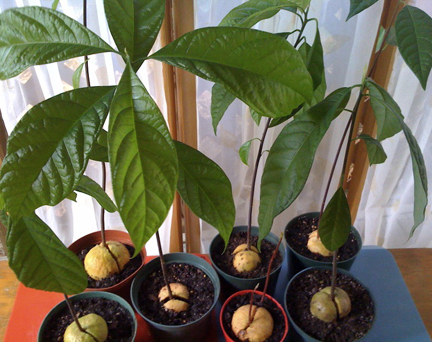
Last week I blessed the Punahou Carnival plant booth with several small avocado trees that I’d been nurturing for five months and about 175 strong bromeliad plants that had spread from where perhaps a dozen were first placed 20 years ago in the front yard.

Pulling out the broms uncovered quite a few vanda orchid plants. I call them lei vandas, but their correct name is Vanda Miss Joaquin. I haven’t seen them commercially for a long time. On Oahu, their popularity has been replaced by dendrobium orchids from Thailand. (Imagine!)

When I was a girl in Wahiawa, Uncle Harry and Aunty Edna who lived next door had a farm and a garden that included these vandas. On special occasions, when visitors would arrive from overseas, or when someone was going away, Aunty Edna would let me pick the flowers to make lei.

She sometimes separated the blossom and strung the bottom half maunaloa style into a lei of saturated color that resembled the look of a lei of flowers from the maunaloa vine. (Maunaloa is one of those plants that cannot be taken out of Hawaii.) She needed a lot of blossoms for this style of lei.

The color of a fresh maunaloa style vanda lei was as intense as the magenta akulikuli blossoms from the ice plant (Lampranthus multiradiatus) that grew on both sides of Uncle Harry and Aunty Edna’s walkway from the street to the front steps. Beautiful! Aunty Edna made akulikuli lei too! Now these are rarely seen.

These memories inspired me to clean and re-pot my lei vandas where they will have more air and sunlight among some native kupukupu fern that I relocated from the side of the garage. I mapped out some garden paths to make the place more interesting and inviting. I guess I’ve taken on the delightful pastime of re-landscaping the garden!

The vandas aren’t blooming at the moment, but I thought you might like to see what they could look like in their prime. Photographer Dominic Kite of Scotland has given me permission to link to his photo of Vanda Miss Joaquin. Thank you Dominic! If you want to see more of Dominic’s photos, you may go to his website dominickite.com. But for the moment, click on this link:

Vanda Miss Joaquin by Dominic Kite

Related articles from Sept. 2009 (see Earlier Posts in the sidebar):

“Sweet memories and coming home, part 1,” Sept. 7, 2009

“Gratitude for my abundant garden,” Sept. 8, 2009

Copyright 2010 Rebekah Luke


Noni for good measure

29 01 2010

Morinda citrifolia is the scientific name for noni. I’m interested in Hawaiian laau lapaau (healing medicine). I’m remembering this as I work/play at regaining my health.

A few years back when stocking Hale Kuai Cooperative, a store with Native Hawaiian products, we made sure we had a full line of Hawaiian herbal medicine on our shelves. We did this, knowing that the kahuna lapaau (master practitioners of Hawaiian healing) did not always agree on how to use certain plants.

Noni is one of those plants. I heard differing opinions on whether to use it externally and/or internally. I heard and read claims that noni will cure whatever ails you. That the large dark green leaves could heal broken bones. That one could rid head lice by smashing the ripe fruit on the scalp.

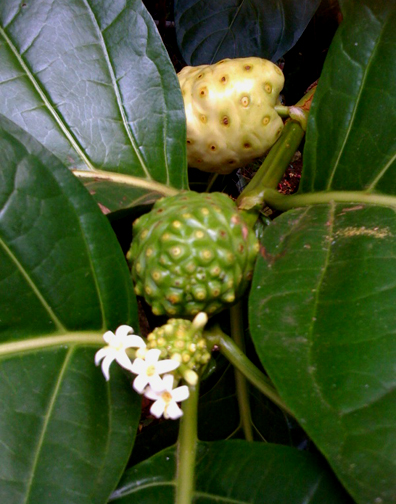
Noni (Morinda citrifolia) in three stages, bottom to top: flowering, green, almost ripe. Try the tiny white flowers for breakfast or as a garnish on salads.

There is very much to learn about noni. The literature is extensive, and the information is very interesting. I list some resources for lay readers at the end of this post. Today I just want to explain what I do with noni now, following a suggestion by the medical intuitive Camille Copeland who lives on Kauai.

For a time I gathered my own noni juice the traditional Hawaiian way by setting the ripe fruit in a clean and covered glass jar in the sun for a period of time until a dark liquid was extracted; then drank it as a morning tonic. This didn’t last long with me.

Listening to Camille on the radio one Sunday, she advised a caller to take noni fresh, not fermented, as a guard against inflammation. Did she have a tree? I thought, hey, I have a tree. I’ll give it a try.

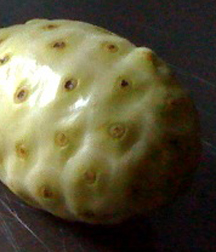
Every day I check my noni tree for a fruit that is opaque with white skin. If there is one that is nearly white, like pale yellow, that’s okay too, I can pick it. Like a tomato, it will continue to ripen after picked.

I pick noni when it looks like this on the tree

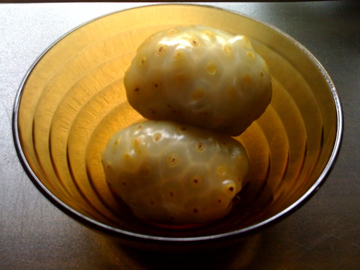
I put the noni in a glass bowl. After one or two days it turns translucent.

Translucent noni

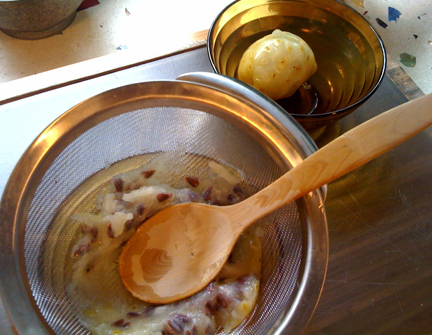
Then it’s time to press it through a sieve.

I use a wooden spoon to press the ripe noni through a metal sieve into a glass container, separating all of those seeds from the pulp

The fresh foamy noni pulp tastes slightly tangy. It doesn’t have an objectionable aroma to me. (The smell is likened to strong cheese.) I eat about a heaping tablespoon in the morning on an empty stomach, about 10-15 minutes before breakfast. I store any surplus in a tightly lidded jar, properly labeled, in the refrigerator.

I think this is working for me. I thank my noni tree each time it gifts me with its wondrous fruit.

Resources:

A good recent article about noni is found on this blog: http://drreese.wordpress.com/2010/01/29/the-pain-killer-plant/

Our Hawaiian co-op carried David Marcus’s Hawaiian Herbal Blessings of Maui. David has supplied noni products for many years, including to Hale Kuai Cooperative.

Noni: Aspirin of the Ancients by Diana Fairechild is a wonderful testimony about the wonders of this plant. Check amazon.com for the small paperback.

Copyright 2010 Rebekah Luke


A good day for going with the flow

22 01 2010

A good day, yesterday. Finished another painting. Caught up with Naomi at the park. Introduced baby and tried our luck at restaurant. Ate pasta with my friend Jan. Bought some starter veggie plants. Even put them into the ground. Every day, almost, my health improves. For now I’m simply going with the flow.

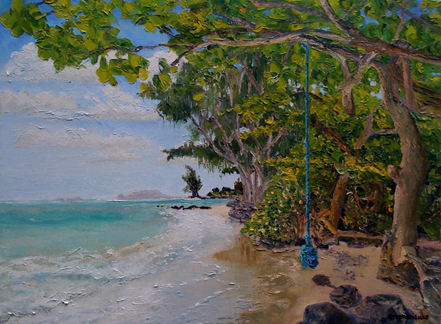
The Rope Swing

The Rope Swing. Painted at Kalaeokaoio Beach Park, Kaaawa. It’s historical. The swing is gone.

My friend Naomi. A painter and a sculptor. I hadn’t seen her since before Thanksgiving. February’s around the corner. Punahou Carnival time! and we compare art notes. She’ll have six of her whimsical ceramic sculptures at the carnival Art Gallery, and I’ll have two oils. As a featured artist, she gets to start with more than two pieces in the show. I think she’s a featured artist because her work always sells! Way to go!

Lunch with Jan. I had a lunch date. Until I’m driving again, DH is my chauffeur. I said, just bring baby along, I really want to see Jan. If it becomes unmanageable, then go on ahead, I’d take the bus home. You see, we were not sure how it would work out. The restaurant. At 8 months the baby is starting to express herself and crawl about. As the adults traded our latest stories over pasta, baby sat and ate so very nicely, checking out the other diners. She really is Miss Marvelous, already preferring shopping and going out with the girls!

The garden. To the 5 gallons of vermicast (worm poop) that I harvested and stirred into a section of the garden, I added okra, eggplant, celery, sage, lettuce, and mint. We still have beets, kale, basil, rosemary, garlic chives, salad greens, sweet potatoes, turmeric, and last season’s eggplant. I love it. To your health ~ Rebekah

Copyright 2010 Rebekah Luke


A plug for the Punahou Carnival

12 01 2010

Feeling better now. Your wishes and  prayers for my wellness are most appreciated. A spinal adjustment last Saturday has done wonders. I can stand up straight again, and my energy is flowing more like it should, except for a couple of spots of soreness that we’re still working on. Acupuncture, a little massage, hot showers and Reiki — now that I have back the range of motion to treat myself — all help.

I’m feeling well enough to nurture and pot the avocado plants for the Punahou Carnival this year.

This annual benefit of my alma mater to raise financial aid falls on Feb. 5 and 6 this year. The fund-raiser relies heavily on donations of all sorts to make it highly profitable for student scholarships. People donate supplies, ingredients (like sugar for jams and jellies), merchandise (books, white elephant), time (staffing booths), etc.

Punahou School taps its junior class, parents, and alumni to pitch in. It’s fun for the whole family, and I bet this year there will be many from the community who will want to check out where President Barack Obama went to school.

Besides supplying the young avo trees for the plant booth, I’m putting two of my original oil paintings into the art show: “Kamehameha Highway and Kaaawa Place” and “Looking Down Upon the Path.” (See my “Paintings” page.) I plan to join my class to help the Hawaiian plate dinner on Saturday, and if I can I’ll support the Punahou Alumni Glee Club either by singing Hawaiian music with the group or applauding from the serving line. See how much better I’m feeling? 😉

It’s an amazing two days of fun, booths, rides, shows, and games from 11 a.m. to 11 p.m. I think it’s the largest fair on Oahu. The school reports that last year it sold 146,000 malasada donuts, 12,400 ears of organic corn, and 33,000 cups of Portuguese bean soup. Our family spent our carnival script at the plant booth, books, silent auction, Hawaiian plate, a variety of other food booths, produce, art show, alumni store, and … of course … hot malasadas!

If you go: Go early. The main gate for pedestrians is at Punahou and Wilder avenues in Honolulu. If coming in your own vehicle, follow the signs to parking, or try your luck with street parking in the surrounding neighborhood and be prepared to walk to and from the carnival grounds. If you can take the bus or get dropped off, that’s even better. Spend your money freely; it’s for a good cause!

Copyright 2010 Rebekah Luke