This is Waipao (part 2)

25 09 2011

Hau cordage in the making. Hawaiians scrape to clean hau fiber by hand.

HAU KAULA (CORDAGE) WORKSHOP WITH KEN CHING

The foundation of native Hawaiian culture consists of the ability to fill three needs: containers to carry things like water and food, flaked stone for cutting, and cordage to fasten. These were necessary to build a Polynesian voyaging canoe that reached the Hawaiian Islands.

With that important bit of information, Ken Ching on Saturday showed a group of us the native Hawaiian way of making cordage from the bark of the hau tree (Hibiscus tiliaceus L.).

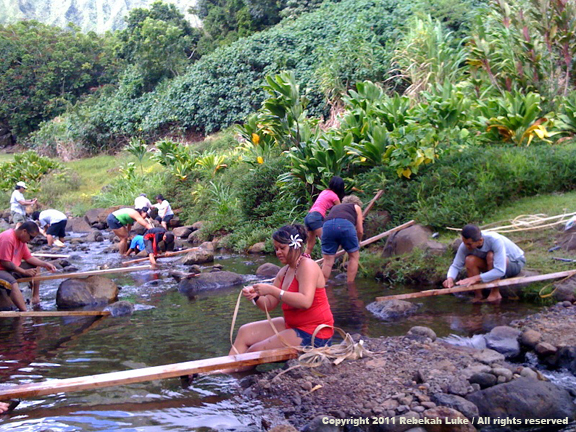
We gathered at Waipao, the site of Papahana Kuaola, on the banks of Haʻikū Stream on Oʻahu. The Papahana Kuaola organization is all about involving the community in environmental restoration and economic sustainability, while integrating native Hawaiian knowledge. Its activities center on cultural and natural history. It’s wonderful, pono (right), and maika‘i (good)!

Making cordage by hand is a way to learn about olden attitudes of living, said Ken. When one went for a walk, for example, it was to look for materials that were useful and could be appreciated.

Here is my photo record of the day. You can pretend you were there, or perhaps you would like to learn more about Papahana Kuaola from its website and visit there yourself.

I came away with a little feeling of what it was like to live in olden times. I thought, maybe this is how it used to be and can still be if we live with Hawaiian values, learn from our kūpuna, and be thankful and kind to each other. I was happy for the people who are restoring the ʻāina (land) of Waipao.

First are some images of this place, the ʻili (small land section) of Waipao in the ahupuaʻa (land division from the uplands to the sea) of Heʻeia, Oʻahu.

Hāʻikū Stream at Waipao

Terraces and pohaku (stones) near the stream
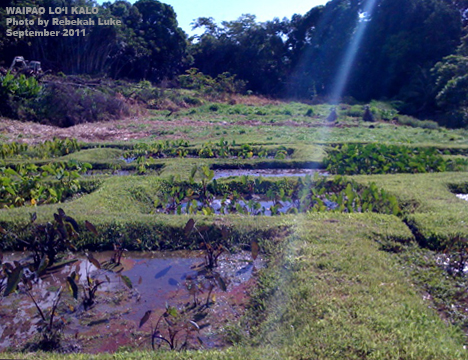
Loʻi kalo (taro gardens) in different growth stages. Notice more land being cleared in the distance. Lunch included a delicious stew made with foods grown at Waipao.

The band of green across the equator of the photo is the hau thicket from where we gathered the raw material.
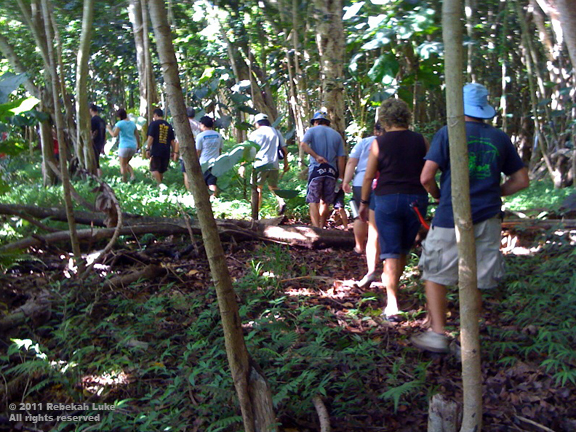
Into the forest we went to cut hau ʻili kea (young branches with light-colored bark).
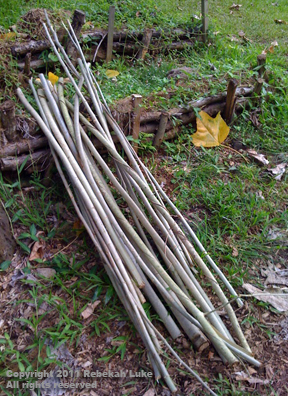
Freshly sawn hau branches waiting to be stripped of their bark
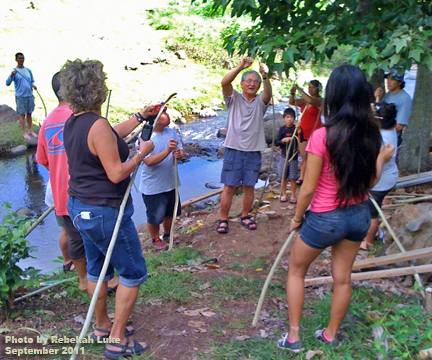
Our kumu Ken Ching demonstrates the right way and the less desirable way to pa‘e (strip) hau bark.
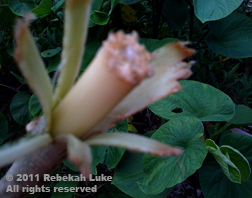
Peel away both the outer and inner bark by pulling down and "close to" the branch (as opposed to "away from") and from the top down, our kumu said. Discard the inner branch. (The leaves in the background are ʻawa (Piper methysticum), not hau.)
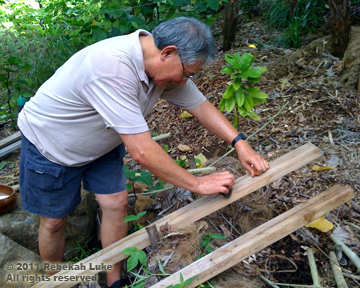
Kahi the wale (scrape the slimey goo away). Ken sets the bark on a 2 x 4 and scapes it using long strokes from top to bottom, pressing hard. Fresh water, such as from a stream or city faucet, will result in a brown fiber. To preserve the whiteness of the fiber, use salt water to soften and wash away the wale (looks like mucus).
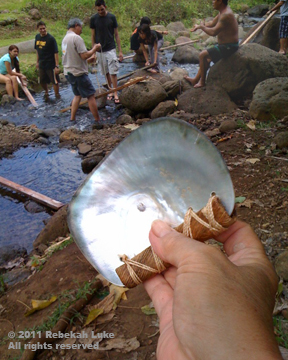
Shell scraper to comb out the wale (slime goo) of the bark.

L to R: Improperly stripped hau bark; mid-way stage of scraping; still slimy and not white enough, i.e., there are more brown areas left to scrape out.

Back indoors and after some lunch Ken showed us how to grade the fiber and twist it into cordage.
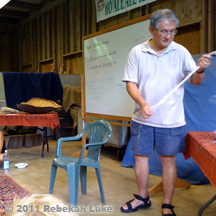
Ken Ching with a bundle cleaned hau fiber ready for twisting into cordage.
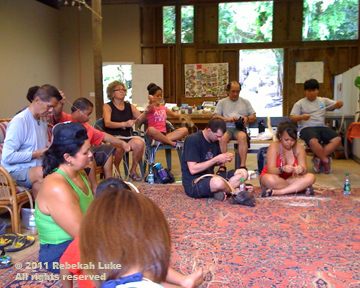
Separating the fiber and preparing to twist into cordage. Clue: You roll the fiber between your palm and your thigh with one hand, and twist with the other. It takes some practice.

Kaʻalua na kaʻakolu: Our kumu Ken made this beautiful hau cordage. He made more like it for the double-hulled sailing canoe Hawaiʻiki. It was an honor to learn from a master.
Copyright 2011 Rebekah Luke


Remaking an oil painting

11 09 2011

As an oil painter I’m often asked, “How long does it take to finish a painting?” In the same vein artists will remind each other, “You have to know when to stop.” We like to avoid overworking a piece.

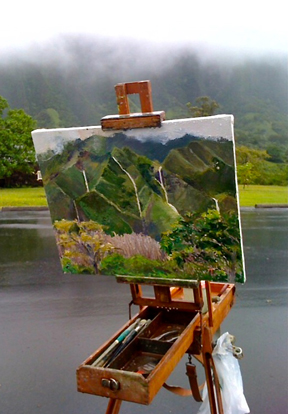
My “Clouds Lifting Over Lanihuli” demonstrates these points. First is a photo of the painting mid-way, in the field. On a clear day, there are no waterfalls in the scene, but just after a big rain when the clouds lift, there they are! To paint en plein air I headed to this place to study the scene when it was raining, time after time. I took this snapshot from the trunk of my hatchback where I’d taken shelter.

In the field, in the rain

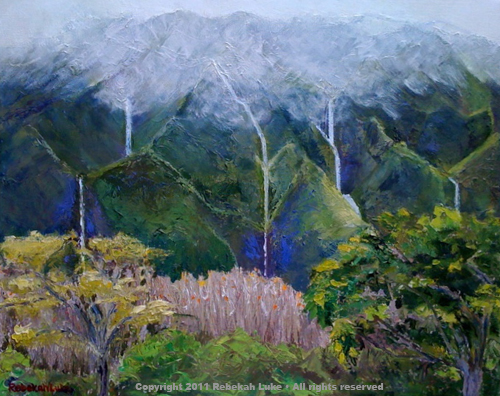
I wanted so much to finish the painting. Below is what I published, i.e., what I thought was ready for market, a few weeks ago. Oils take a long time to dry—up to six months before they can be varnished. In the meantime I can look at a painting every day. As I kept staring at this piece (it’s staged above the TV cabinet) something bothered me. It wasn’t finished.

Not quite finished

I decided to correct the areas of the painting that were “wrong.” In a representative piece, although it is impressionistic (I label my style as “impressionistic representationalism”) I want to paint a scene so that it looks logical.

To really finish and complete this painting, I did three things:

1) I added pigment to the center clouds area to hide the waterfall behind it.

2) I widened the same center waterfall at the bottom because it is closer to the viewer (and so should appear larger).

3) In addition, by very very carefully scraping with the long edge of a palette knife, I knocked down some objectionable relief areas I originally painted of the mountain ridges at the top and touched up the clouds to make them softer and smoother looking.

“Clouds Lifting Over Lanihuli” looks better now. I hope you agree!

Finished: "Clouds Lifting Over Lanihuli," 16" x 20" oil on canvas

Copyright 2011 Rebekah Luke


Native artists at the Bishop Museum

22 05 2011

The enjoyment for today consisted of going to the Bishop Museum to show my oil paintings alongside other Native Hawaiian artists at the art mart that is part of the MAMo (Maoli Arts Month) Festival in Hawaii. It happens every May.

The Museum booked DH, who is a volunteer docent, to guide a group from a philosopher’s conference on a 1-1/2 hour tour of Hawaiian Hall, making it doubly worthwhile for the two of us.

Ten minutes before show time, we arrived to find our spot next to my artist friend Momi Greene who came from Hawaii island with her decorated ipu (native gourd containers).

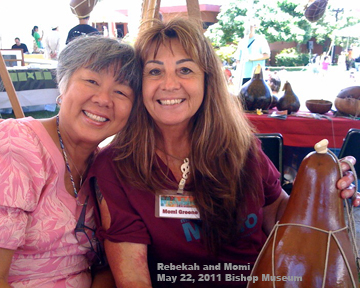
Me and my friend Momi Greene. Momi grows a native Hawaiian gourd and decorates them with carving and natural dyes she makes herself in the style that was done traditionally on the island of Niihau.

Years of art fence and craft fair experience paid off as we arrived ten minutes before show time, i.e. late. I saw some dark clouds as we drove over the mountain, and yes, we set up in the rain.

The paintings were fine; oil doesn’t like water. I just shake and blot them dry. DH staked the easels into the ground, and I attached extra ties, a good thing because gusty trade winds blew down from the valley throughout the day.

My brother-in-law Jon, in town from Oregon, came by to meet Momi in person because until today they had only been Facebook friends.

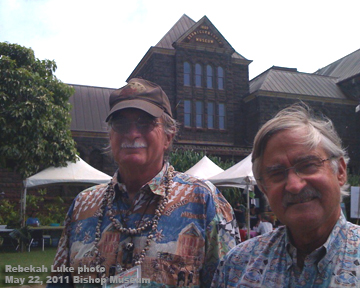
DH and Jon with the Bishop Museum's main building in the background

I loved the continuous live Hawaiian entertainment all day long.

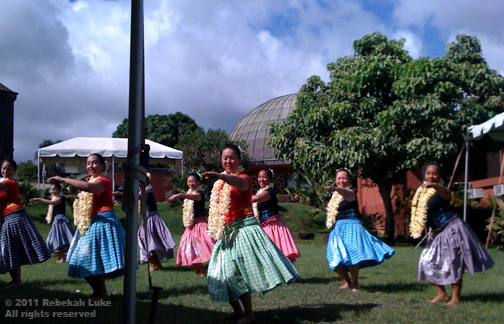
Hula dancers wear long yellow plumeria lei

DH and I made some purchases:

I bought—with cash from trading my no-longer-wanted gold and silver items—some things from other artists, including a nifty re-designed T-shirt. I always try to buy from other artists where I am selling. The designer, using scissors, cuts away parts of the original garment, slits holes in the knit, weaves in contrasting colors or ties the fabric in creative ways to make a one-of-a-kind top that is truly styling and all the rage at the Native Hawaiian art mart. I plan to post a photo of me modeling it soon!

Yesterday in a gust of wind one of Momi’s ipu broke. It looked like it could be glued, but she said she’ll stitch it back together, making the stitching part of the design and giving the ipu new life and a story. When I relayed that to DH, he immediately told Momi of our plans to take a trip to her island and that he wanted to buy the ipu after she stitched it. That piece would be really special and would she kapu (reserve) it for him, we’d pick it up next month.

She said, “Okay, do you want to see it first?” DH can be impulsive at times, but he’s a good buyer and appreciates fine Native Hawaiian-made artwork.

What I realized and appreciated the most at the end of the day was how much the art by Native Hawaiians has improved, including the marketing of it. If you are in Honolulu next May, please plan on attending some of the activities of Maoli Arts Month.

Copyright 2011 Rebekah Luke


New Year’s Eve 2010

31 12 2010

Home is the safest and most comfortable place for me on New Year’s Eve. I’m watching and listening to the New York Philharmonic play “The Nutcracker Suite” on PBS, Live from Lincoln Center.  Alice Brown is doped up and hiding under a blanket on DH’s lap. At least she is not trembling from the boom-booms,  pops, whistles and crackles of the fireworks that started on Christmas Eve and are building up to a crescendo tonight. Less than a couple more hours until 2011!

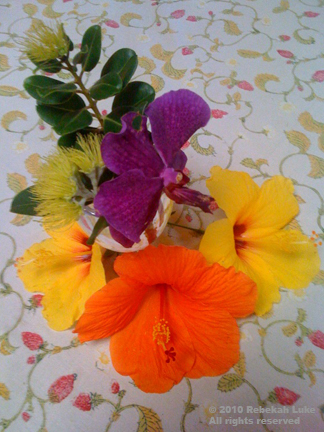
Kathryn's bouquet from her garden—yellow lehua, a vanda orchid, and hibiscus

I had a lovely day with three girlfriends who live here in Kaaawa. Dorothy, Kathryn, and I have birthdays around the same time, and Andrea has tried to get us all to celebrate together year after year. We live less than a mile from each other, one would think it would be easy. Not so with our busy lives.

I took a chance today and invited everyone over for lunch, conversation, and a round of board Scrabble. When our kids were young we used to play almost every Sunday at the beach. Well, they made time and came over! Dorothy brought champagne, Andrea brought pomegranate juice, and Kathryn brought her fried chicken, a lovely bouquet of flowers from her garden, and her Angel Cards.

I fixed a salad vinaigrette of Manoa lettuce, watercress, fennel, orange, and dried cranberries; turkey sandwiches, and my favorite lemon cheesecake. We played one game, drank up the champagne, then everybody left to do their New Year’s Eve thing.

Our thing was to spend a gift certificate for dinner at Haleiwa Joe’s with the rest of Miss Marvelous’s family (Mom, Dad, and Tutu) and my first college roommate Becky and her niece Katie, in town from New York. Becky gave me a box of Sparklers.

Alice Brown’s happiness at seeing DH and I arrive home must have temporarily overrode the benefits of the tranquilizer we gave her before we left, for she greeted us jumping up and wagging her tail as usual — so joyful!

I closed the windows, not wanting the smoke from the firecrackers to trigger my asthma. I opened a box of Island Princess Mele Macs and sat down to reflect on the end of the year and a decade. I’m so interested in seeing what we will all create in 2011! The Angel Card I pulled was “expansiveness.” I like that notion.

Well, I think I’ll take my Sparkler’s and champagne down the road and say Happy New Year to the neighbors. They were already burning the money as we drove back from dinner. (A ban on fireworks in the State of Hawaii takes effect on Jan. 2, so a lot of people are taking advantage of the last chance to burn them legally. Firecrackers will be regulated by permit.)

As the clock clicks toward midnight, I wish all of you every happiness, love, light, and gratitude! This is my last post for 2010. I hope you will continue to visit Rebekah’s Studio in the new year. All the same characters will be here, but we’ll have new experiences to share. I’d love to hear from you. ~ Rebekah

Copyright 2010 Rebekah Luke


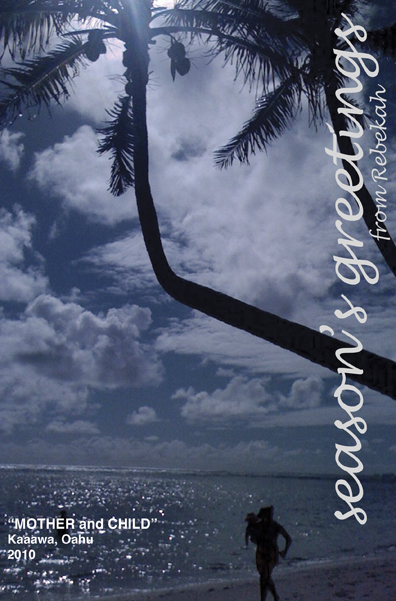
Season’s greetings from Rebekah

21 12 2010

The moment I made this photo of Miss Marvelous and her mom, I knew I had our Hawaiian greeting card for this year.

Everyone at Rebekah’s Studio—DH (Darling Husband), Alice Brown, Ula and I—wish you a Happy Winter Solstice!

I hope you don’t mind a re-post from 9-11-2009 that tells how we celebrate:

“With the winter holiday season upon us, most families are starting to get into the spirit. The signs include that real or imagined cold snap on Halloween night, slick merchandising catalogs overflowing from our mailboxes, store mark downs everywhere, and the lure of local craft fairs and festive events.

“Conversations now include, “What are you doing for (fill in the holiday)?” and newspaper features carry tips on how to remain stress free. We want to remember family and friends and hope no one is left alone. As families extend generationally, geographically, and by marriage, there can be many decisions to make.

“DH and I have a couple of philosophic ideas and old-fashioned traditions that give us a sense of peace. They link to our respective roots—Hawaiian Islands for me and Pennsylvania (Delaware County) for him.

“One is to acknowledge and be mindful of the Hawaiian Makahiki season, roughly from mid-November through January (exact dates depend on the moon). The planting season is over, work is pau (finished), and warring ceases. It is the time of the god Lono.

“The best of the harvest is dedicated to Lono in the form of ho‘okupu (offerings). The people give thanks, relax, socialize, play outdoor games, and generally enjoy themselves. No stress. It’s officially okay to play!

“The other is adopted from Winterthur, Delaware, not far from DH’s birthplace. As tourists we visited Winterthur, a museum and the former country estate of Henry Francis du Pont. During his life H. F. du Pont collected whole room interiors of various periods, not to mention whole street fronts, and installed them in his mansion.

“The museum decorates the rooms of this big house for Yuletide, and visitors can tour them around the same months of Makahiki in Hawaii. The holiday decor matches the period style of each different room. It’s educational and very festive.

“When we visited, our favorite room showed how du Pont’s own family celebrated in the first half of the 20th century. The story was told that Yuletide, the time around the Winter solstice, was a time to visit and entertain friends, to rest and to celebrate a successful harvest. Children were seen but not heard.

“Decorations consisted of a small table-top evergreen—adorned simply with cookies, candles and strands of popcorn and cranberries—that was set atop a pie crust table. Gifts were exchanged among immediate family members only and placed in a basket for each person. If the children behaved well, they could have the cookies!

“We liked the idea so well that we brought home a furniture piece similar to a pie crust table for ourselves, in a nod to the East Coast style and DH’s regional heritage. Each year we hang on a small tree the wooden ornaments crafted by DH’s parents for their first granddaughter on her first Christmas.”

Copyright 2010 Rebekah Luke


It’s rock-star snowing on Lanikai Beach

1 12 2010

I do believe it’s snowing here at Rebekah’s Studio! Just look at the snowflakes falling! And right after I posted this photo on my Facebook page with the caption “Thanksgiving weekend & no snow!” 🙂

Lanikai Beach - Thanksgiving weekend & no snow!

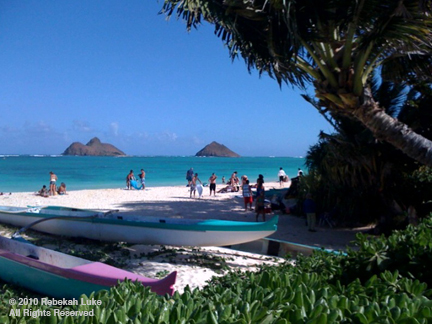
I’ve been staycationing with family all weekend down the coast of Oahu at my hanai brother’s and sister-in-law’s fancy beach house. I spent a few hours there on Tuesday and will likely go again tomorrow. I’m making a painting that’s a variation of this classic Hawaiian beach scene and the Mokulua (two islands). DH suggested I do some rock-star paintings. Is this rock-star enough for you?

And, thank you WordPress.com for a rock-star visual effect!

Copyright 2010 Rebekah Luke


Ula the photo assistant

11 11 2010

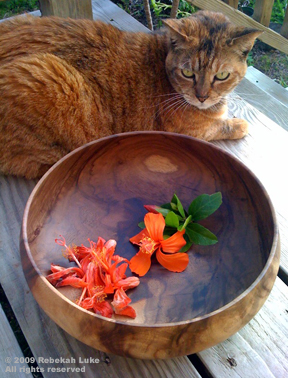
Alice Brown the 7-year-old puppy dog upstages Ula the cat all the time. Today I thought I’d share a photo of Ula the photo assistant.

I was making an artsy photo of Native Hawaiian plants—Hibiscus kokio ssp. saintjohnianus in an umeke (calabash) turned from kou by island artist and friend Scott Sullivan. The Lyon Arboretum displayed the final image.

Copyright 2010 Rebekah Luke