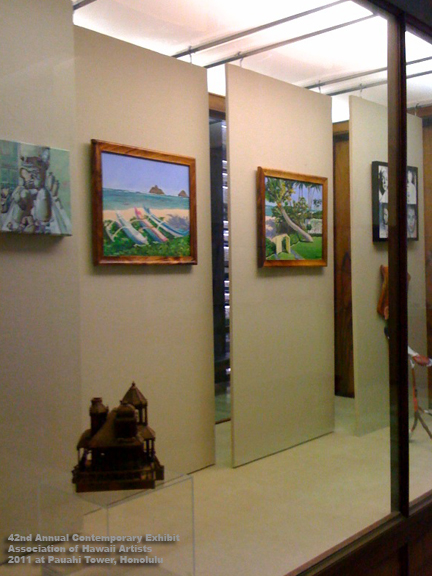
I've never had my art displayed in a glass case before. Love it!
I've never had my art displayed in a glass case before. Love it!
Much of what I learned about the business of art I learned from my time with the Arts of Paradise, a fine art gallery at the International Market Place in Waikiki, that kindly represented me for several years.
Artists Susan Rogers-Aregger, Susan Brooks, and Connie Hennings-Chilton were the co-owners who sought two- and three-dimensional work by local artists and priced them realistically for the buying public. I thank them so very much.
When I co-founded Hale Kuai Cooperative with Ka Lahui Hawaii and we opened a storefront, I applied many of the management skills they taught me to running our store that sold Native-Hawaiian-made products.
During the early Arts of Paradise days, we had frequent requests to donate our work. The gallery encouraged artists to share the explanation reprinted below with whoever asked for a donation.
While cleaning the studio today, I found it on Arts of Paradise letterhead, but I recall that it was originally shared by the artist Ramsay. The information makes sense to me, and it is useful even today.
CONTRIBUTIONS BY ARTISTS
The artist is often asked to donate art to worthy causes as a “tax-deductible contribution,” as a “form of advertising,” as a “goodwill gesture,” and as “the means to increased community exposure.”
However, many artists and most solicitors are unaware that the IRS views contributions made by artists differently than those made by any other contributor. Artists are not able to deduct the appraised or fair market value of their work. Artists must enter the cost of materials as a business expense rather than a charitable contribution.
At a benefit art sale or auction, payment for contributed merchandise is made in the name of the charity. The purchaser makes a tax-deductible contribution and receives a work of art; the organization gains needed operating funds; the artist has one less asset, an added business expense, no charitable deduction, no income from the sale, a devalued reputation because the work sold at less than market value and has “increased exposure” to a group of potential patrons now conditioned to acquire art through donation rather than direct purchase.
This situation is particularly difficult for artists living in an insular community like Hawaii, where patrons are few and the cost of living is high.
Organizations who wish continued support from artists should adopt the following guidelines:
Artists submitting work to charitable organizations should provide the suggested retail price and receive fifty percent of that price upon sale; unsold work should be returned to the artist.
The names of contributing artists should be listed in promotional material and printed programs.
Artists should receive thank-you letters with their checks specifying the amount of their contribution, the actual amount of the art brought at auction, and the name of the purchaser.
This arrangement will enable artists to provide work of importance to organizations and the community, while uplifting the image of art in Hawaii.
The enjoyment for today consisted of going to the Bishop Museum to show my oil paintings alongside other Native Hawaiian artists at the art mart that is part of the MAMo (Maoli Arts Month) Festival in Hawaii. It happens every May.
The Museum booked DH, who is a volunteer docent, to guide a group from a philosopher’s conference on a 1-1/2 hour tour of Hawaiian Hall, making it doubly worthwhile for the two of us.
Ten minutes before show time, we arrived to find our spot next to my artist friend Momi Greene who came from Hawaii island with her decorated ipu (native gourd containers).
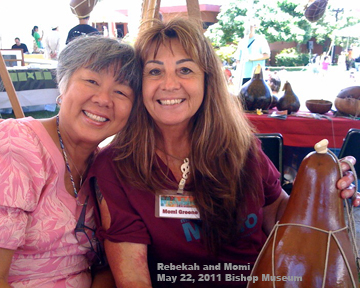
Me and my friend Momi Greene. Momi grows a native Hawaiian gourd and decorates them with carving and natural dyes she makes herself in the style that was done traditionally on the island of Niihau.
Years of art fence and craft fair experience paid off as we arrived ten minutes before show time, i.e. late. I saw some dark clouds as we drove over the mountain, and yes, we set up in the rain.
The paintings were fine; oil doesn’t like water. I just shake and blot them dry. DH staked the easels into the ground, and I attached extra ties, a good thing because gusty trade winds blew down from the valley throughout the day.
My brother-in-law Jon, in town from Oregon, came by to meet Momi in person because until today they had only been Facebook friends.
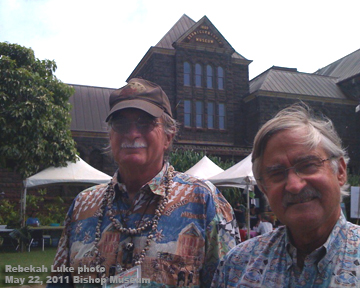
DH and Jon with the Bishop Museum's main building in the background
I loved the continuous live Hawaiian entertainment all day long.
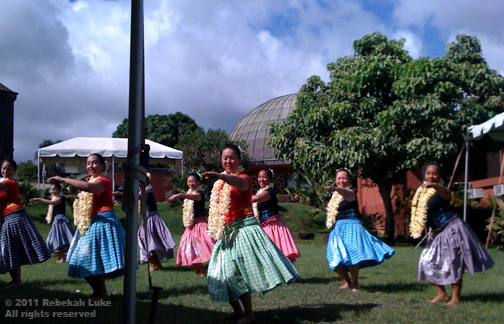
Hula dancers wear long yellow plumeria lei
DH and I made some purchases:
I bought—with cash from trading my no-longer-wanted gold and silver items—some things from other artists, including a nifty re-designed T-shirt. I always try to buy from other artists where I am selling. The designer, using scissors, cuts away parts of the original garment, slits holes in the knit, weaves in contrasting colors or ties the fabric in creative ways to make a one-of-a-kind top that is truly styling and all the rage at the Native Hawaiian art mart. I plan to post a photo of me modeling it soon!
Yesterday in a gust of wind one of Momi’s ipu broke. It looked like it could be glued, but she said she’ll stitch it back together, making the stitching part of the design and giving the ipu new life and a story. When I relayed that to DH, he immediately told Momi of our plans to take a trip to her island and that he wanted to buy the ipu after she stitched it. That piece would be really special and would she kapu (reserve) it for him, we’d pick it up next month.
She said, “Okay, do you want to see it first?” DH can be impulsive at times, but he’s a good buyer and appreciates fine Native Hawaiian-made artwork.
What I realized and appreciated the most at the end of the day was how much the art by Native Hawaiians has improved, including the marketing of it. If you are in Honolulu next May, please plan on attending some of the activities of Maoli Arts Month.
For special occasions, a fine meal may be in order. One of those times was last evening to celebrate my wedding anniversary with DH (darling husband). The fine meal was the kaiseki prix fixe menu at the Japanese restaurant Miyako in The New Otani Kaimana Beach Hotel at Sans Souci Beach at the foot of Diamond Head.
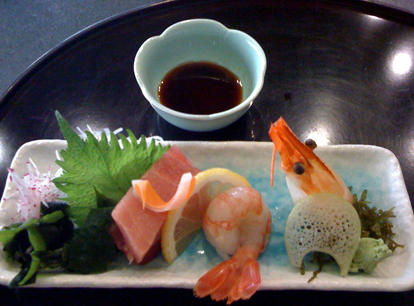
Sashimi. Everything on the plate in this beautiful presentation is edible.
The artistry in the presentation of all seven courses served one at a time over two hours was a treat—a reminder to incorporate good design in everything we do 😉 —as were the flavors from the food. It reminded us of TV’s Iron Chef. The difference was that we ate everything and sipped sake to softly played music while enjoying the view of Waikiki and the spectacular sunset.
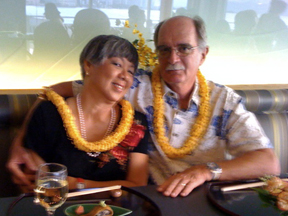
Anniversary couple
Our “If it’s Thursday, it must be Ho‘omaluhia!” public exhibit of paintings opens today at Ho‘omaluhia Botanical Garden visitor center and extends to August 30, 2010. The show displays the works of local artists Alex Weinstein, K.Y. Lum, Naomi Weinstein, Noreen Naughton, Richard Guy, Val Saban, and yours truly Rebekah Luke. The collection looks great!
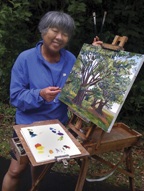
Photo of me by Noreen Naughton
Every Thursday for the past 10 years, more or less, our group has painted in the peaceful landscape that is Ho‘omaluhia, located at Luluku, at the base of the majestic Ko‘olau mountains in windward Oahu. We come from different backgrounds and for different reasons to enjoy the garden and each other’s friendship.
This the first exhibit of paintings for four of our group. All but one of the 42 works in oil and acrylic may be purchased, with prices ranging from $75 to $2,800. Most prices are reasonable and realistic for original art, so it’s a good opportunity to start or add to your collection. Interested buyers should contact the artists directly (lay away plan of installments considered), as no sales transactions are permitted on the city property.
How we met (excerpt from catalog)
In the 1990s, art professor Noreen Naughton frequented Europe with summer abroad courses. K.Y. Lum, a psychiatrist, and his wife took the “Drawing in Italy” tour, visiting Rome and Tuscany to take in Renaissance art in hill towns and obscure churches. When they went a second time to Italy, Naomi and Alex Weinstein joined Noreen’s group. Alex, an architect, is a good sketcher, and Naomi, a retired educator, was a ceramist.
They all went with Noreen again to paint in France, “Following the Path of the Impressionists” from Amsterdam to Paris.
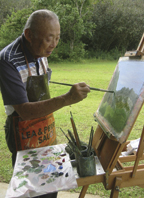
K. Y. Lum
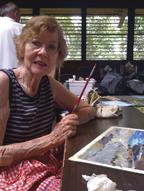
Naomi Weinstein
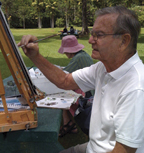
Alex Weinstein
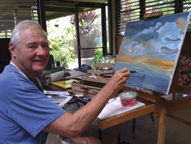
Richard Guy
When they returned to Hawai‘i they continued to paint with Noreen in the landscape. Ho‘omaluhia Botanical Garden became a favorite venue. K.Y. and the Weinsteins are the only ones from Noreen’s original group who continue to paint together on Thursdays.
The others: Val Saban, former international trader and industrialist, lives in the same building as K.Y., and the two swim together.
Rebekah Luke (that’s me) who studied painting with the late Gloria Foss, and K.Y. are first cousins. Richard Guy, retired chief justice of Washington state and a local arbitrator and mediator, joined the group after being introduced by Naomi who is in the same book club as his wife.
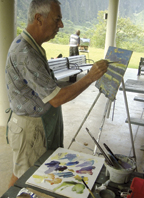
Val Saban
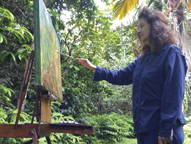
Noreen Naughton
If you go (and we hope you will)
The park entrance is located at the end of Luluku Road in Kaneohe, Oahu. The art will be on view every day from 9 a.m. to 4 p.m. through August 30, 2010. Exception: The park is closed on Aug. 6 and 27.
Thursday is the theme. You can meet the artists at a punch-and-cookies reception on Thursday, August 5, from noon to 2 p.m. Most of us will be there on the other Thursdays in August in the mornings only.
Allow time to enjoy the rest of Ho‘omaluhia Botanical Garden’s plants, trails, picnic areas, lake, camp sites, and overall Hawaiian tropical scenery.
Thanks for visiting!

View of the Ko‘olau Mountains from Ho‘omaluhia
My painting group and I are busy putting together an August exhibition of our artwork at Ho‘omaluhia Botanical Garden Visitor Center in Kaneohe, Oahu. It opens on August 3, with a punch-and-cookies reception on August 5 (Thursday) from noon to 2 p.m. If you are in the area, please come to see it! If time permits, see the garden too. You may click on the garden link above to read about the garden, and on the link below for details of the art show. – Rebekah
A shopper at last weekend’s Native Hawaiian Arts Market asked me if I considered myself a self-taught painter. “No is the short answer,” I replied quietly.
I believe in taking lessons, followed by lots of practice. I took lessons.
In the Hawaiian culture I learned everyone must have a teacher. Never mind you think you don’t need one, that you can do your own whatever. At least not in the beginning.
The first thing someone will ask is, “Who’s your kumu?” If you can say, “My kumu was ___ ,” respect for your work goes up a notch. If you can’t, the response might be, “Uh-huh,” and you hardly will be given the time of day and wonder why.
Perhaps after working at it for a while, an artist will perfect his/her line and system and turn out creations that are identifiably theirs, but most successful artists have gotten a background of the universal principles and basic techniques prior to discovering how to manipulate the medium into something original and all their own.
Having a teacher gives your work credibility. It applies to more than just painting.
For example, at the opening of Oceania Exhibit at the National Museum of Ethnology, a.k.a. Minpaku, in Osaka, Japan, for which the museum built a replica of the Hale Kuai Cooperative store in Hauula to represent the Hawaiian Islands, Kealii Gora attended officially as cultural consultant, and I attended in my role as the real co-op’s executive director.
Ka Lahui Hawaii and yours truly co-founded the cooperative to buy and sell products made by Native Hawaiians.
Hale Kuai Cooperative caught the attention of Minpaku anthropology professor Akitoshi Shimizu, who led the project team. He felt it depicted a movement in economic development among indigenous Hawaiians in 1999.
The opening ceremony was hauntingly beautiful and Kealii’s oli (chanting) rocked the entire hall. Afterward a VIP guest confronted him and wanted to know “by what authority” Mr. Gora performed the protocol, along with a Maori representative from Aotearoa.
Interestingly, but not surprisingly, Kealii did not reply that he was an officer of Ka Lahui Hawaii (a de facto Hawaiian nation). That he most certainly was. He replied, “My teacher was Kumu John Keola Lake.” There wasn’t anything the guest could say after that.
Similarly, certified Reiki masters will identify their credentials by stating the genealogy of their Reiki line. I am 10th generation from Dr. Mikao Usui through Mrs. Takata. That brings to mind Dr. Usui’s precepts:
Just for today, do not worry. Just for today, do not anger. Honor your parents, teachers, and elders. Earn your living honestly. Give thanks to every living thing.My mother, a piano teacher, taught me to remember and acknowledge my teachers. So I honor my teachers of art and Reiki by naming them here. Most of my teachers throughout my life were influential in some way, but these people made a loving impact.
Richard Nelson, Punahou School art history Duane Preble, University of Hawaii at Manoa art historyThank you for teaching me.


 Rebekah’s Studio
Recent comments