Singing the Queen’s music

31 08 2014

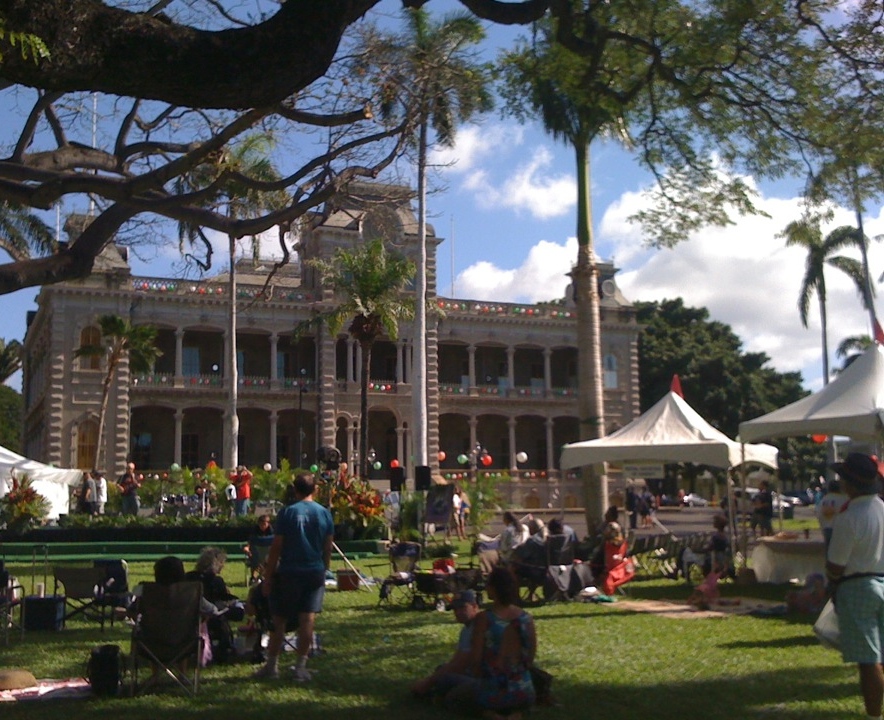
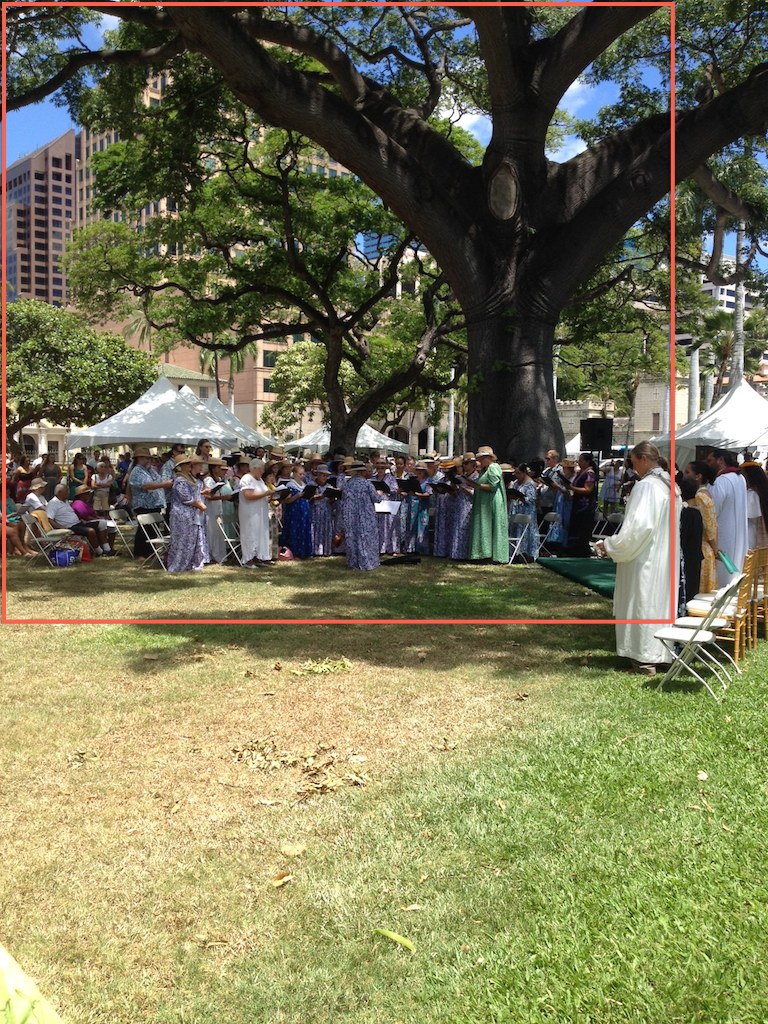
Today it was my honor and joy to take part in the interfaith prayer service with Nā Pua O Liliʻuokalani — the combined choirs from Kawaiahaʻo Church, University of Hawai‘i, Kawaiolaonāpūkanileo and Friends — on the beautiful grounds of ‘Iolani Palace, in celebration of Queen Lili’uokalani’s 176th birthday. Nola Nahulu was the musical director. (Peter Krape photo)


Music, music, music

24 08 2014

A musical summer. That’s what I’m having. A time to renew friendships, too. I’m back in the studio and excited to tell what’s been happening!

Since making the 12-foot-long lei for the Pacific Cup yachts—I went for the third time to sing and conduct with Prof. Rod Eichenberger in Cannon Beach, Oregon, a pilgrimage made by at least a hundred choir directors and music educators from all over the globe every summer. For me, and apparently many others, it is addicting to learn from the master, who has taught his tried-and-true method for 60 years. Each year he also shares what he learned the earlier 12 months. He teaches how to get a good sound out of a choir, how to save rehearsal time, and how to manage a choir.

Five days, almost 200 pieces of new music from publishers to sight-read, 20 “student” conductors—some already are extremely accomplished, wow! so very humbling—and a public concert on the fifth night. I am sort of misfit, neither an active choir director nor music educator, although I have done some of it. Love working on my skills. Of course, by way of introduction, folks ask, “What do you do?”  I’m a choral singer!

photo

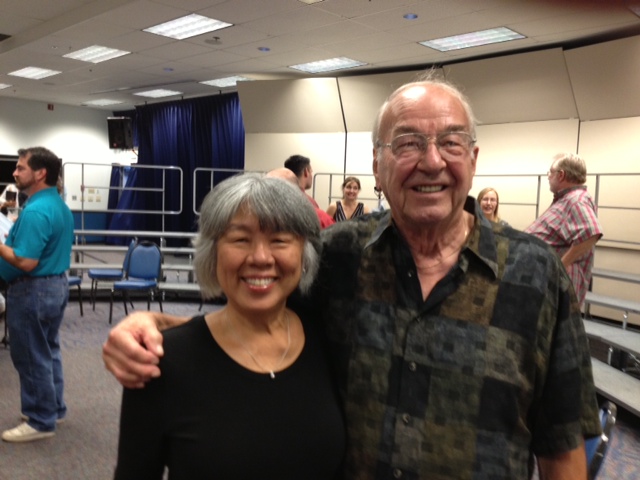
Me and Rod after the concert

It was fun to see familiar faces and to talk about the music culture. Everyone is so busy during the academic year. Summer is a great time to catch up. It’s like a retreat or music camp in a resort venue. Next year’s Choral Conductors Workshop is already scheduled for the last week of July 2015. Interested?

While in Oregon I visited with Jon and my hanai sister Margaret in Tualatin who graciously loaned me their van to drive to the beach, and who took care of me when I returned after the workshop with no speaking voice. I think it was a “bug” I picked up on the plane.

I love Facebook. A new friend, Kasey who lives nearby, posted a call for singers to join the noted 12-member Hawaiian choir Kawaiolaonāpūkanileo this season. The director calls it “project-based singing.” I asked to join and was accepted!

The first event is “Onipa‘a,” at 11 a.m., on Sunday, Aug. 31, at ‘Iolani Palace, Honolulu, celebrating Queen Lili‘uokalani’s birthday. We are singing her compositions as well as some songs written about/for her. These are in the Hawaiian language, and we are singing all the verses! So thankful I practiced with Rod last month.

‘Iolani Palace

‘Iolani Palace

The second project is “‘Emalani II,” a Hawaiian opera: two performances—3 p.m. and 6 p.m. on Saturday, Nov. 15, at St. Andrew’s Cathedral, Honolulu. Other choirs have roles, too.

Understandably, one has to commit to all the rehearsals. Luckily, there are none in September, so I can go with DH to Pennsylvania for his high school reunion, to visit his family there,  and to call on our friends in Massachusetts. Road trip!

My high school alumni glee club resumes rehearsing after the summer break, too. It will be great to sing and perform with the gang. I love music!

Copyright 2014 Rebekah Luke


Giant lei garlands for yachts say ‘Aloha!’

20 07 2014

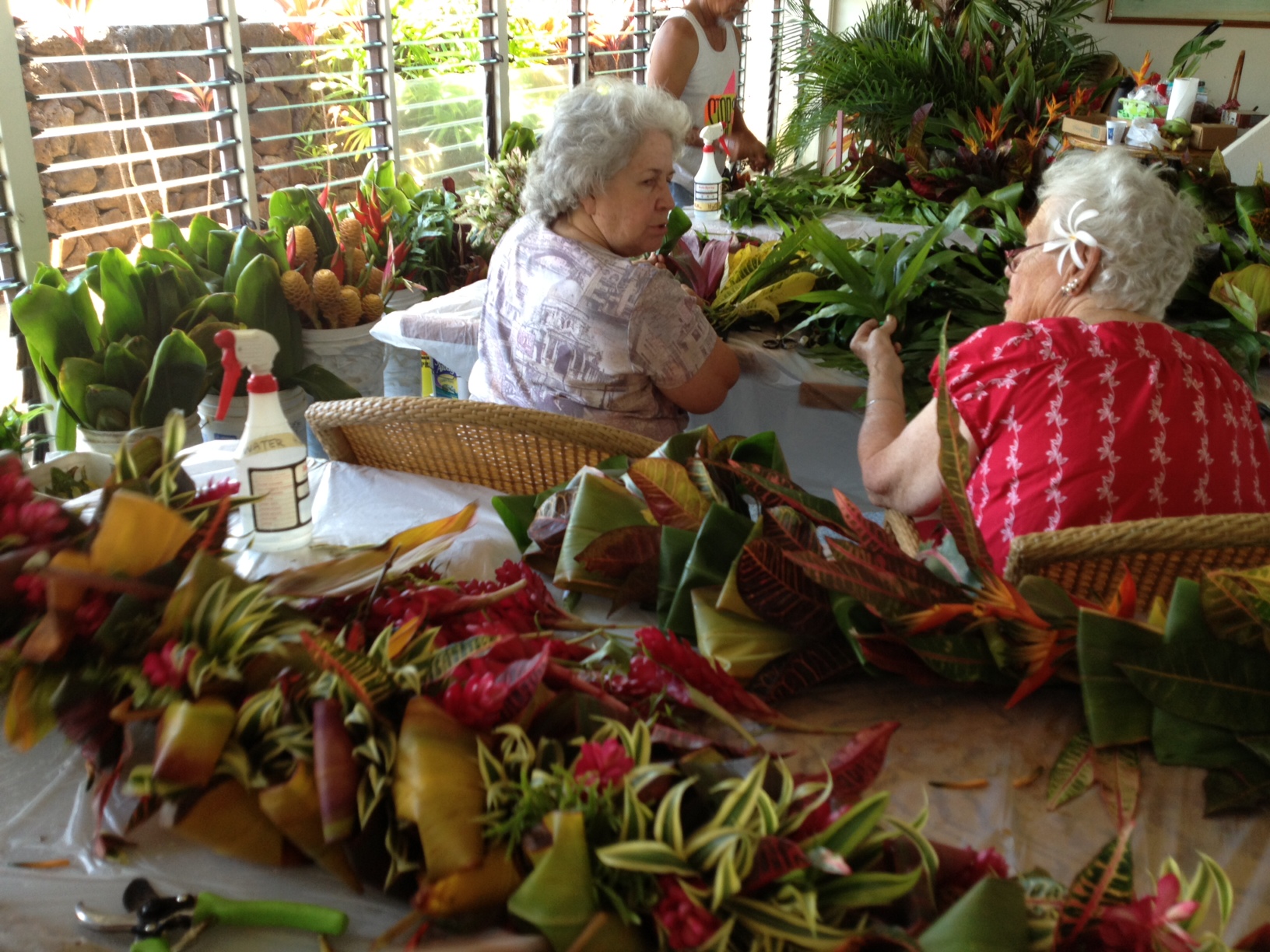
Good morning, studio fans! Until today we’ve been hanging out at Kaneohe Yacht Club where I and my team have been crafting lei for some of the arriving boats in the Pacific Cup Yacht Race from San Francisco.

I say “until today” because the thunder-lightning-rain storm that is ripping the Islands has closed roads, etc., and we are taking a rest this morning, enjoying the waterfalls, retrieving wet pets from outdoors, and surveying the flooding and mudslides. We can hardly imagine what it must have been for the small-boat racers at sea last night. What a light show!

Jennifer

Here’s Jennifer, Kaneohe Yacht Club member, thrilled with her first boat lei. She and Nancy, pictured below, discovered they went to the same high school in Minnesota. Now they meet on Oahu!

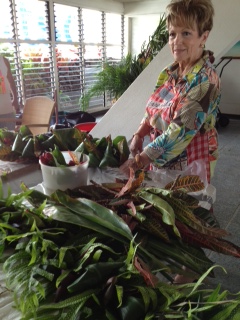
We are making 40 lei, wili style, each 12-feet long and uniquely beautiful. All the plant materials are gathered and donated voluntarily. Our lei makers range from first-timers to professionals. Our team is composed of folks from Kaneohe Yacht Club, Ko‘olauloa Hawaiian Civic Club that receives scholarship funds from the lei sales, and my friends. It is a fun, social activity that we do every even-numbered year.

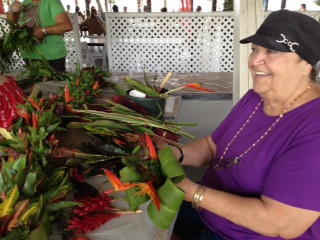
Michele Kamakea Kalili of Ko‘olauloa Hawaiian Civic Club is from a family of professional lei makers that go way back. Her father Gus Kalili made and sold lei out of his woodie along Lagoon Drive on the way to the old Honolulu International Airport back when.

Kamakea of Ko‘olauloa Hawaiian Civic Club is from a family of professional lei makers who go way back. Her father Gus Kalili made and sold lei out of his woody along Lagoon Drive on the way to the old Honolulu International Airport back when.

Kathleen

Kathleen Sattler, my glee club sister, welcomes the break from her otherwise stressful schedule this week.

Thanks to all the volunteers on all of the Pacific Cup committees.

Carol Silva

Carol, experienced in making lei for hats, crafts her first giant one for a boat.

Nancy and Pat

Friends Nancy and Pat enjoy helping with lei construction.


Mango season not pau

6 07 2014
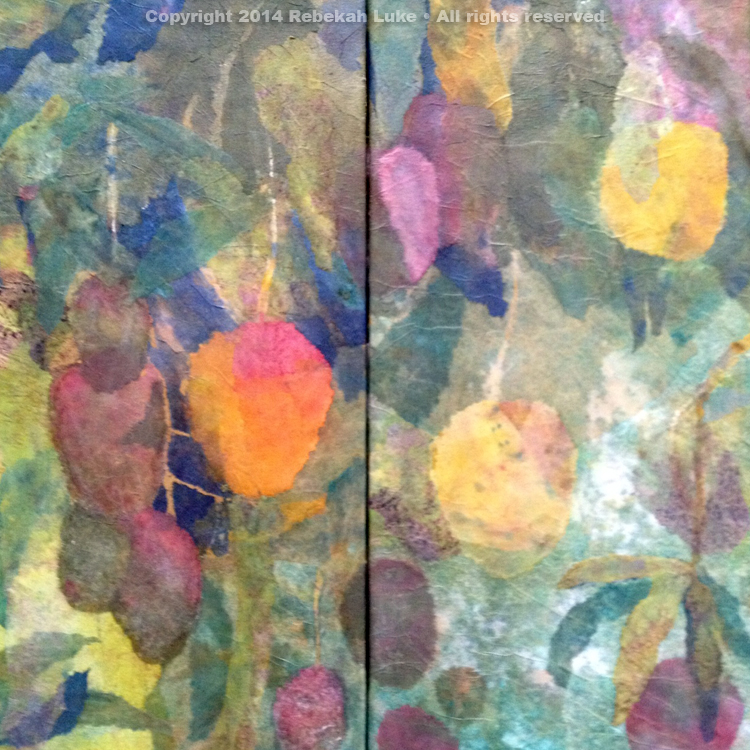
Mango Collage. 22.25" x 22.25" hand-dyed tissue paper on canvas

Mango Collage, 22.25″ x 22.25″ hand-dyed tissue paper on canvas

Mangos and more mangos! I am experimenting with a different art medium — collage with hand-dyed tissue papers. Here is my third piece finished yesterday, a diptych composed of two panels. I plan to put both into one frame for the square shape shown.

The big mango tree in the corner of the studio garden cooperated this year by bearing luscious fruit that we are enjoying. We are able to pick the mangos before the cherry headed conures get to them. That and the color palette of tissue papers that I had on hand inspired the work.

Managing the thin, flimsy papers with glue, water, and X-ACTO knife is tedious work and messy. At times it is carving paper, either wet or dry, being careful not to poke a hole in the canvas! In the end, I love the effect of layering and the jewel toned quality of the finished collage.

My colleague Susan Rogers-Aregger taught me how to create with this medium. She learned it from Gloria Foss, our late oil painting instructor and mentor. Together they wrote Paper Dyeing for Collage & Crafts (Honolulu: Belknap Publishing & Design, 2004; ISBN 0-9723420-3-6).

Susan has scheduled her next paper-dyeing and collage workshops for February 2015 in Kaneohe, Oahu.

Copyright 2014 Rebekah Luke


Mālama pono

2 07 2014

Conflicted, I wasn’t planning to submit a comment to the U. S. Department of Interior. But now I think I will. Based on something like this:

The most welcoming group of strangers I’ve met, the one that made me feel like I was coming home, were the card-carrying citizens of Ka Lāhui Hawai‘i, a name that translates to “the Hawaiian nation,” although for the time being this group is described as “a native initiative for sovereignty.”

I met them in January 1993, the 100th anniversary of the overthrow of Queen Liliʻuokalani and the Hawaiian monarchy, when my hanai father—RIP David A. Sinclair, MD, yes, the same who delivered Barack Obama—pointed out a small article in the Washington Post about a movement being led by Mililani Trask, then the kia‘āina (governor). “Isn’t this something you should be involved in?” Because I’m Hawaiian.

Some activity was taking place at ‘Iolani Palace for Martin Luther King Jr. Day, and I was drawn to a small tent identified with a banner reading “Ho‘omakaukau” — let’s get ready — on the lawn of the Library of Hawaii next door. Keali‘i Gora, a nokali (registrar) and the lukanela (lieutenant), enrolled me as a citizen of Ka Lāhui Hawai‘i. I took an oath. He and others gave out educational materials and information about the meeting, and it was the one organizing the peaceful march to the Palace.

That was the beginning of my involvement and the first of many meetings—district council meetings, island caucus meetings, legislative meetings, town hall meetings, constitutional conventions. I helped as a district officer and attended the legislative meetings, not as a delegate but out of interest and support.

I learned that Ka Lāhui Hawai‘i has a de facto government with a written constitution that was part of the educational materials for the people. Toward the end of Mililani Trask’s last term as kia‘āina (an elected position), at a church in Keaukaha, I witnessed her and Lilikalā Kameʻeleihiwa outline the Ka Lāhui Hawai‘i master plan document for sovereignty. It was a beautiful thing, entitled “Ho‘okupu a Ka Lāhui Hawaiʻi” (respectful offering to all).

My active involvement that was a big chunk out of my life included almost a decade as the executive director of Hale Kūʻai Cooperative that marketed Native Hawaiian made products—a small but significant economic development effort for Hawaiians.

Life happens and time passes, and Ka Lāhui Hawai‘i became inactive. Now other political forces have caused us to gather again, because of the Department of Interior meetings. The day before yesterday a parallel discussion began: whether to reconvene the Ka Lāhui Hawai‘i mokuna (legislature). It is an opportunity for an initiative that had at one time a reportedly 22,000 citizens living in the Hawaiian Islands and elsewhere on its rolls. To those expressing “No” to the Department of Interior’s questions, what next? Ka Lāhui Hawai‘i is an option.

For now, Ka Lāhui Hawai‘i citizens are attaching their names at the bottom of comments to the questions currently being asked by the Department of Interior as posed in the Federal Register. They say “No,” but more importantly, Ka Lāhui Hawaiʻi citizens are reminding the Department and all of us that it already has a Constitution, a Master Plan, and a platform on the Four Arenas of Sovereignty that further describes and defines four political arenas: native to native, native to nation/state, the international arena, and nation to nation.

I believe those documents will be attached and filed with the Department of Interior. They are very comprehensive and worth another read. The answer to “What do Hawaiians want?” is not as simple as the question, but the prior work of Ka Lāhui Hawai‘i ought not to be discounted, for there one can read some thoughtful answers.

When I first associated with Ka Lāhui Hawai‘i, I was embarrassed because I hadn’t learn much Hawaiian language (and still haven’t and I’m still embarrassed). I admitted, once as we were leaving an evening meeting, “I need to look the words up in the dictionary.” Two friendly young women said, “That’s okay!”

I asked, “How do you say goodbye? What is it that you are saying?”

They slowly pronounced every syllable for me. “A hui hou. Mālama pono!” Meaning, “See you again. Do the right thing.”

I personally want to do the right thing, but I don’t know what that is. I’ll at least point Ka Lāhui Hawai‘i citizens, honorary citizens, and would-be citizens to “Ho‘okupu a Ka Lāhui Hawai‘i” where we left off.

Copyright 2014 Rebekah Luke


What a good momma!

25 06 2014

The front garden, overgrown, seemed ideal for a hen to nest. I found a nest with four eggs a while ago. I collected three for breakfast–all were good to eat–and left one. Since we discovered the nest, DH intended to mark the one so we would know which eggs were newer when the hen laid again. We had heard that hens lay one egg a day. But DH said he didn’t have the heart to poke the hen off her nest. This morning I met her on the path, and out from under her appeared a teeny tiny white chick. I went to the nest and found just one empty shell! All these days she had been sitting on just one egg. What a good momma!

20140625-093217.jpg

20140625-093235.jpg
Copyright 2014 Rebekah Luke


Where I am in Hawaii today

24 06 2014

Every now and then we’re thrown a curve ball and need to perk up. So I left the studio and headed over to Ka Lahui Hawaii, a Native initiative for sovereignty, http://kalahuihawaii.wordpress.com, to offer some information to the Hawaiian community.

Representatives of U.S. Department of Interior were on island to listen to comments about whether and/or how there should be a government-to-government relationship between the U.S. and Native Hawaiian community.

I went to yesterday’s three-hour public meeting at the Hawaii State Capitol because I wanted to get up to speed about the Hawaiian sovereignty movement. I had the feeling the panel would be in for a surprise. The testimonies were emotional, for the most part saying the D.O.I.’s presence was inappropriate and unwelcome (I’m being kind here).

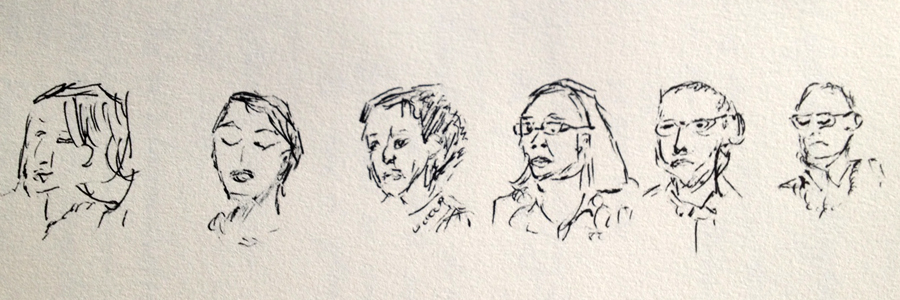
DOI panel 062314

The panel looked tired and sad after a while. Twenty such meetings are scheduled throughout the Islands and America. Two of my Hawaiian neighbors have asked me for a ride to Wednesday’s meeting in Kaneohe, closest to our homes. 

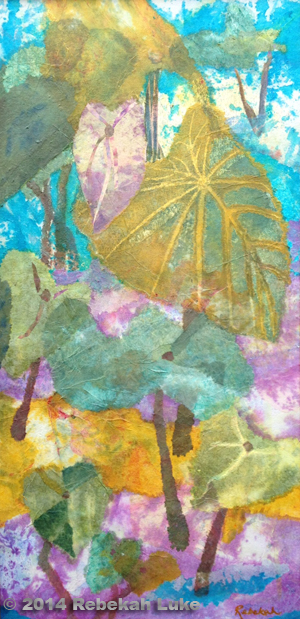
This morning I’m headed to Ho‘omaluhia Botanical Garden to create some cheerful collage art with hand-dyed tissue paper. The public is invited to watch the artists and see our exhibit in the Visitor Lecture Room showing daily, now until the end of June. The entrance is at the end of Luluku Road in Kaneohe.  This is my “Kalo.” Today I’m working on “Mango.”

"Kalo Collage," 15" x 30" hand-dyed paper on canvas. $385.

“Kalo Collage,” 15″ x 30″ hand-dyed paper on canvas.

 Copyright 2014 Rebekah Luke