Punahou Carnival 2011

31 01 2011

This Friday and Saturday, Feb. 4 and 5. All the fun is bounded by Punahou Street and Wilder Avenue in Honolulu, from 11 a.m to 11 p.m., and I’ll be there. If you’re visiting, this is a great travel tip!

The big tent and the thrill rides are up, and they’re getting ready for the Punahou Carnival again. I’m here to plug my alma mater, with notes on my contribution and my favorites. It’s a humongous fundraiser put on by the junior class to raise scholarships. First-timers wonder how they do it. I’ll tell you how.

The school ropes in all the parents of the junior class and alumni to donate their time, labor, talent, and supply goods so that everything spent at the Carnival is profit for students.

The Carnival is such a bonding experience, you remember it for life and return every year to support it. There’s fun for all ages.

Banyan in the Park, an original oil on canvas by yours truly, for purchase at the Punahou Carnival Art Gallery. 16″ x 20″.

My contribution

For the past several years I’ve placed my paintings in the Art Gallery—50% of sales goes to the school, and put my time in at the Hawaiian Plate “booth.” I also help serve up the meal (5 to 8 p.m. Saturday).

Last year my graduating class was the second oldest still working the Carnival. We report to Dole Cafeteria and don aprons and hats to plate the meal of Hawaiian food. For anyone not of school age who isn’t interested in the midway carnival rides, it’s a nice place to relax because there is air-conditioning, there is continuous live music, and there are real bathrooms.

We used to prep and cook the food, and in years before that we worked the famous malasadas booth with Mr. Bowers until we were banned for making non-regulation sizes and shapes ;-). And frankly, I don’t remember what we did prior.

My favorites

Usually I carpool with DH and his daughter, also an alumna. We each arm ourselves with an empty shopping bag and an umbrella. We go to a secret parking place if the lots on campus are full. Tip: take the bus if you can or prepare to park and walk from neighboring streets.

These are some of our favorites:

  • Silent auction—Items vary from year to year, and sometimes we’re lucky. We scope this out first.
  • Art gallery—Always like to see what other island artists are doing; it just makes me want to paint more, though. A great collection.
  • Plant booth—I’ve donated bromeliads and small avocado trees. For my garden I’ve bought herbs, red and pink ginger, native Hawaiian species, water plants, and turf grass. They will hold your purchase for you to retrieve later, if you wish.
  • Malasadas—Of course, with a hot cup of coffee at night.
  • Jams and jellies—E.g., red pepper jelly and mango chutney. I think it sells out in the first hour on Friday 😦
  • Books—At the end you can fill up a bag and get it all for something really cheap.
  • White elephant—Quick survey. You never know what you might find.
  • Food—Whatever your heart’s desire, a separate booth for each. Gyros, corn on the cob, fruit smoothies, fried noodles, pizza, teriburgers, veggie stuff, Hawaiian food, chicken, Portuguese bean soup, ice cream, saimin and meat sticks … oh la la.
  • Produce—A crew goes to the Big Island to pick. I do my next week’s fruit and veggie shopping here.
  • Games—The kiddie games are a world apart. It’s fun to watch the little ones. I think it’s time to take Miss Marvelous there. There are games for older students and teens too. My Facebook friend Yo and her husband are parent chairs of the prizes this year.
  • Will call—You can check your loot here until time to go home.

So c’mon to the Punahou Carnival, alumni or not. Spend your money. It’s for a good cause!
Copyright 2011 Rebekah Luke


Working on a diptych

28 01 2011

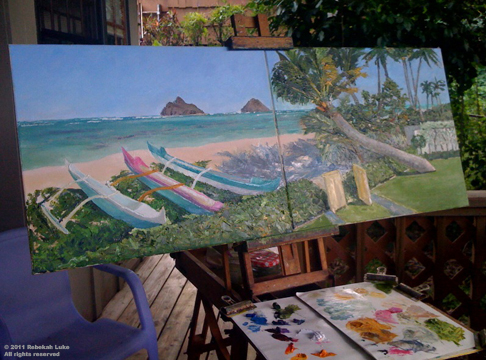
Off and on since Thanksgiving I’ve been working on finishing a diptych—an image on two panels, each of which can stand alone. I paint with oil on canvas. After I finish the painting, I’ll wait a long time—several months—for it to dry, apply a coat of varnish, and put the panels in two frames, most likely of koa.

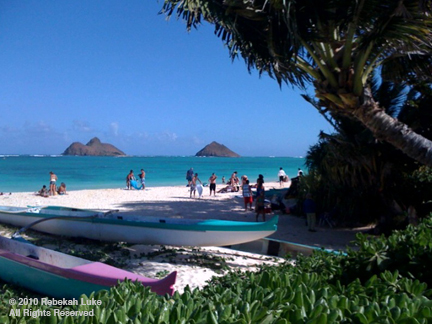
This style is “impressionistic representationalism.” The viewer is able to recognize the scene, in this case, classic Lanikai Beach on Oahu with the Mokulua islets offshore. The paint edges are soft and approximate rather than hard and exact.

I like to paint images of where you might have been and want to remember, or of places where you’d rather be. This diptych began en plein air on location. Thanks to my hanai relatives Karl and Julie for their hospitality on site.

METHOD.  I started by loosely applying very thinned-out oil paint wash, using two or three tints, to the canvases with a 1.5″ brush, in a random pattern, leaving no white showing. I’m trying to leave  about 5 to 8% of this under painting showing to give the finished work a jeweled look.

While waiting for the wash to dry, I did an ink sketch of the scene, including the shadows, in my small notebook.  I made more than one sketch, experimenting with different compositions. Hand drawing a sketch reinforces the scene in my memory with similar results as taking written notes at a lecture.

I also set up my palette, generally arranging the colors following the color wheel order. Then I was ready to block in the scene on the canvas, using a brush and paint and referring to my ink drawing. I was careful to sight the objects to make sure my proportions were correct.  Yes, I actually stretched out my arm and measured with my thumb or a brush handle!

I mixed the “local” colors (middle tones) on my palette, as well as a dark and a light of the color. I painted analogously. That means, to darken a color I mixed in the next neighboring (on the color wheel) cool color for a shade. To lighten a color, I added a little of the next neighboring (on the color wheel)  warm color before adding white.

As a general example, take the local color red. For a dark red that one would see in the form shadow of, say, a tomato, I would mix in alizarin crimson. For a light red, I would add a little orange to the red before adding a little white. In teaching this technique, my teacher the late Gloria Foss called it the “Tomato Theory.”

Gloria taught that painting analogously was prettier than simply adding black or white, or the complement color to darken.

I love the idea of being able to call on your neighbors to help out instead of going  across the island!

When I finally got paint on canvas, I first put in the local colors that had the lightest values—usually a tint of white, and the darkest values. These were the off-white outrigger canoes and the dark coconut palm fronds. I put the lightest and darkest values in first that let me know all the values in between were relative to those two extremes.

As I painted I held up some paint on my palette knife against the object, like the sky and the ocean, to check that I had the hue and value (lightness or darkness) correct. I learned these last two tips from the late painter Peter Hayward.

I painted all over the canvas at once, by hue, considering both panels at the same time, so that the painting would become a tapestry of color. There are color repeats throughout.

In the end, much of the artwork is about the light. What direction is the light coming from in the painting? In plein air landscape painting, the sun moves constantly. What is the logic of light? That is, what does the light do when it hits a certain form? When it reflects?

Copyright 2011 Rebekah Luke

Related post: https://rebekahstudio.wordpress.com/2010/12/01/its-rock-star-snowing-on-lanikai-beach/


The gift of time

14 01 2011

My expansive morning — “expansiveness” is my word for 2011 — brought some surprises to what otherwise would have been ordinary. It started early when I recalled a pleasant dream of a stranger in a theater who knew my name.

It has been awhile since I’ve actively recalled my dreams. When I awoke I wondered if it was my teacher Alice Anne connecting with me energetically to prepare for her time travel meditation tonight.*

Fridays are my scheduled Reiki days, but with no appointments and a promising sunny sky I went to the Pohai Nani pool for aqua exercise at 8.

In 2006 (!) I bought a punch card of x number of classes that I stopped using when I took a full-time job. I love the deep water exercise class with the “Aqua Jogger” buoyancy belt and the cordial, caring staff. They heat the swimming pool to 86-89 degrees. If it is cooler than that on the morning of class, the instructor phones to say class cancelled.

Last November, I was surprised to learn that the card was still honored, but only until today. A new schedule of classes and fees for seniors starts on the 24th. Between now and then I have the gift of time to choose which class to sign up for.

On the way home I stopped at the bank to cash a check, presenting my bank ID card. The teller asked to see a picture ID as well, and when I showed it she asked for yet another picture ID. Why? My driver’s license expired on the 9th, my birthday! Thank you so much for pointing that out, I said. After confirming my signature with the superviser, she accepted the check.

I doubled back to Satellite City Hall in Kaneohe to renew my license, getting my face all prettied up for my photo. I was wearing a plain black t-shirt, and my hair—I just got out of the pool! A man stood puzzled outside the front door that had a Closed sign on it. He was reading the many messages taped to the window.

Is there anything that tells why the office is closed today? I asked. “Furlough Friday,” he mumbled, pointing to a calendar. The partial solution for overcoming Honolulu’s budget shortfall is to put government workers on furlough.

The two of us scrutinized the calendar and noticed that the office will be closed on Monday too: Martin Luther King Jr. Day. Guess I’m driving without a license until the 18th, then.

I stopped at nearby Foodland to pick up a few groceries. It’s not my usual place to shop, but I didn’t want to get in and out of the car anymore. The checker asked for my own reusable bag. It’s the first time a store asked me that. Luckily, I did have a bag at the bottom of my purse.

The checker explained, starting next year no longer will Foodland be providing plastic grocery bags. Customers will need to bring their own. (The islands of Maui and Kauai have done away with plastic bags already.) Next year: 2012? Yes, she said. Good, I thought. I have a year to figure out what to do with my dog’s poop.

* Tonight I’m attending a New Year’s guided group meditation led by my teacher Alice Anne Parker. Alice Anne, a professional psychic, takes her students on a journey into the future for a look at their lives to come. In general, it’s usually “It’s going to be okay.” People of all levels of awareness have attended in the past and reported their visions. Very interesting! Perhaps I’ll see you visiting me here at Rebekah’s Studio.

Copyright 2011 Rebekah Luke


It’s rock-star snowing on Lanikai Beach

1 12 2010

I do believe it’s snowing here at Rebekah’s Studio! Just look at the snowflakes falling! And right after I posted this photo on my Facebook page with the caption “Thanksgiving weekend & no snow!” 🙂

Lanikai Beach - Thanksgiving weekend & no snow!

I’ve been staycationing with family all weekend down the coast of Oahu at my hanai brother’s and sister-in-law’s fancy beach house. I spent a few hours there on Tuesday and will likely go again tomorrow. I’m making a painting that’s a variation of this classic Hawaiian beach scene and the Mokulua (two islands). DH suggested I do some rock-star paintings. Is this rock-star enough for you?

And, thank you WordPress.com for a rock-star visual effect!

Copyright 2010 Rebekah Luke


Mauna ‘Ala, burial place of the ali‘i

18 11 2010

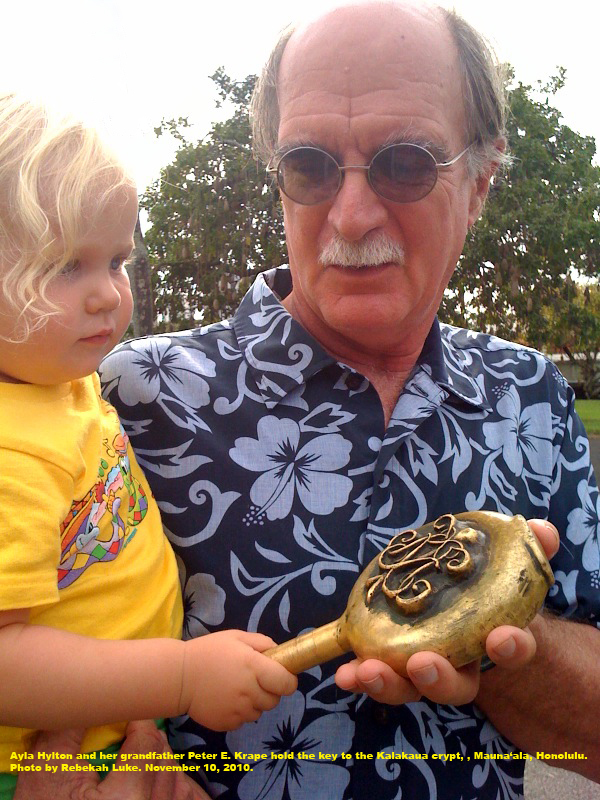
Miss Marvelous with her Papa entering the Kalakaua crypt

If they arrange ahead, Honolulu visitors to Mauna Ala, site of the Royal Mausoleum in Nuuanu, can have a guided tour by its curator William John Kaiheekai Maioho, the kahu of the iwi (bones) of the alii (royalty) and high chiefs—namely the Kamehamehas and the Kalakauas.

I and Miss Marvelous tagged along recently with DH and a group of volunteer docents from the Bishop Museum. Bill Maioho’s presentation—full of details and anecdotes, talk story style—included a chronology of the Hawaiian royals and others who are buried at Mauna Ala, information about the chapel building and how its use changed over the years, and a look inside the gates of the Kalakaua crypt.

Holding the key to the Kalakaua crypt

Bill Maioho descends from the Taylor family whose kuleana (responsibility and privilege) is to care for the iwi at Mauna Ala. You can find his story as an oral history article in Pacific Worlds, an excellent website with information about Polynesia. Please click on the link.

Mahalo to Uncle Bill.

Remembering Charles Reed Bishop

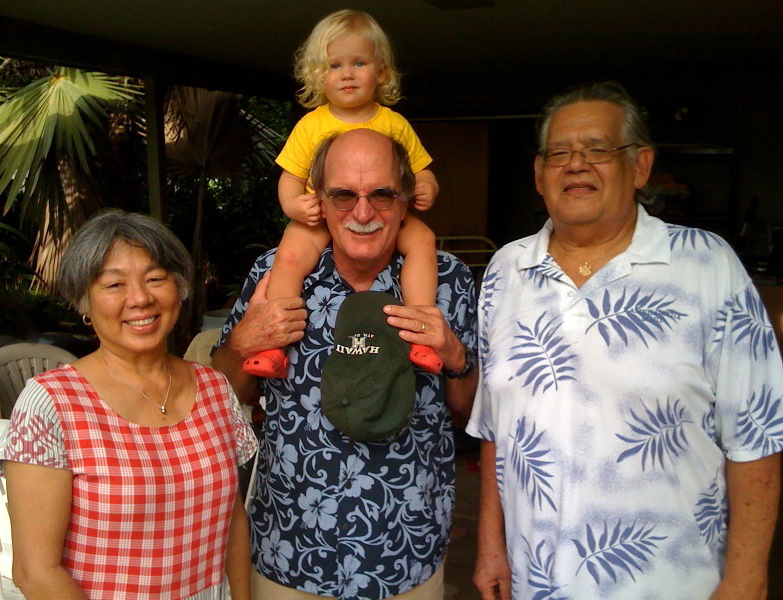
Me, Miss Marvelous, DH, and Bill Maioho

Copyright 2010 Rebekah Luke


Rare op to view inside the Mormon temple

6 11 2010

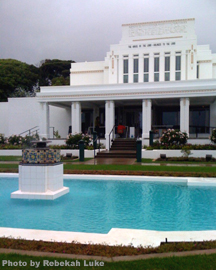
A look at the interior of Laie Hawaii Temple with two special visitors to the studio.

My glee club sisters Nani and Rae came to see my paintings yesterday! In planning the day, Nani invited me to join them for a visit to the Mormon temple in Laie afterward. It is newly renovated, and it is open for public tours through November 13 (closed Sunday). An open house!

Temple of The Church of Jesus Christ of Latter-day Saints, Laie, Oahu

Note: After the temple is re-dedicated on November 21, it will be closed to the public, so yesterday’s viewing was a rare opportunity for us. You can make a reservation to see it by phoning 1-866-537-8457.

None of us three are Mormon, but we were curious to see the temple interior and interested in hearing why the Church of Jesus Christ of Latter-day Saints builds temples and what the LDS beliefs were.

Clear signs from Kamehameha Highway in Laie directed us to the parking lot. There, ushers greeted us with white umbrellas for the rain and escorted us to a series of white tents for an orientation video, that gave a brief history of the Mormon religion, and for some remarks on what to expect on the 25-minute walking tour through the temple.

At the last minute I saw two familiar faces. My former project assistant Kura, ever cheery :-), and her husband  joined our group. Kura and David were married in the temple before the current renovation, and this was their first time to see the new look.

Before entering the front door, volunteers gave us booties to cover our shoes.

Once inside, a husband-and-wife team (we have now been greeted by seven church members) guided us through the halls and different rooms. There was an usher at every turn and doorway. Near the end of the tour I asked how many people staffed the milestone open house event. The number varies with the day and time of day or night, but all LDS members on the island of Oahu are involved, I was told.

For the uninitiated, an informative brochure explains that LDS members have churches, chapels, and other meeting facilities for their Sunday worship services and weekday activities. The temple, however, is considered to be the most sacred place on earth. It is reserved for LDS members who are worthy in the eyes of the church. Then, the more one visits the temple to study, the closer one can become to God.

On entering, I am immediately impressed with the superb wall-sized paintings, art glass windows, and bas-relief panels in the waiting area.  It is like being in an art museum. (Think Elgin marbles of the British Museum in London.) More large and fine paintings line the hallways and lovely murals line some of the rooms.

All of the interior space is very beautifully decorated, welcoming, serene, peaceful. Actually, it is divine, and designed to feel ethereal. (Think HGTV’s “Divine Design” with Candice Olson). I had a similar lightness of feeling touring Catherine Palace just outside of St. Petersburg, Russia. Tastefully grand. The temple, however, is much smaller, more intimate, and not ornate like the palace. Perhaps the way the art is treated reminds me of Catherine Palace.

What happens in the temple? LDS members believe in the Book of Revelations, eternal life, and are interested in their ancestors and their progeny, i.e., one’s family’s past, present, and future; hence, their dedication to genealogy research. In the temple one may perform baptisms for one’s ancestors who have died. A couple may seal their marriage and can have their children sealed to them forever. As one advances in the teachings given in the rooms for instruction on the commandments, one may grow spiritually closer to God.

Furnishings of hardwood, soft green upholstery and drapes, crystal chandeliers, gold leaf inlay, sculpted carpeting, white calla lilies, excellent craftsmanship — these decorated a waiting room, the men’s changing room (one must change into white clothes while in the temple), a bride’s dressing room, a baptismal font, instruction rooms, a sealing room, and the white celestial room at the top.

After the open house tour we were escorted to the refreshment tent for cookies, and Kura and David cordially chatted with us and answered our questions. Thanks, Nani, for inviting me. And thanks to the LDS church members for a pleasant and educational afternoon.

Copyright 2010 Rebekah Luke

Rev. Rebekah Luke is ordained by the Universal Life Church that has two tenets: “freedom of religion” and “do the right thing.”


Not sure how to sum up Thursday, but …

1 10 2010

… That was fun. A nice ending to a full day! The venue for my cousin Toy’s going away party was Terry’s Place in Honolulu Chinatown where another cousin, Sunway, and her band performed last night. I stopped by the bar after my glee club rehearsal and caught a couple sets with the relatives. Really good pop music. Good eats and fine wine.

Sunway giving it her all

The day started with driving four neighborhood aunties and the baby (Miss Marvelous) from our moku (district) on the windward side of Oahu to Honolulu.

I skipped my usual morning of painting. Aunty Cornelia, Aunty Mercy, Aunty Ramona and Aunty Dot wanted to see the milestone exhibition of the three wooden images of the Hawaiian god Ku on display together at the Bishop Museum through October 4—just three more days.

One carved image resides at the Bishop Museum, one is on loan from the Peabody Essex Museum in Salem, and one is on loan from the British Museum in London. Museum literature states that two hundred years ago the Ku stood on heiau (temples) on the island of Hawaii.

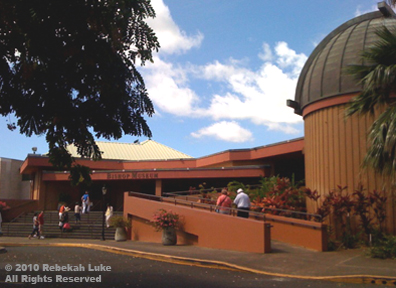
Bishop Museum

DH (darling husband) who volunteers as a docent was delighted to give the aunties a tour, and we both were happy to provide the rides.

I used the time they were at the museum to grab some lunch, get my hair cut by Arlene and have photos taken for a new passport. I came back in time to catch Lokomaikai’s very enjoyable moolelo (story) about the hula before heading back over the Koolau mountains.

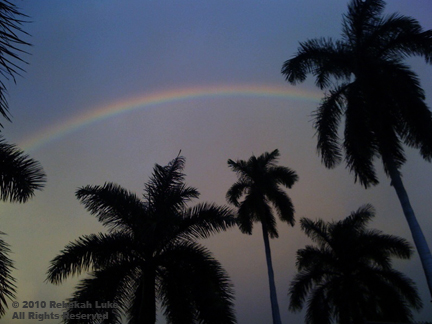
It rained some today, and as I drove down Palm Drive at Punahou on my way to glee club practice, I saw the rainbow over Manoa Valley.

Rainbow over Manoa

Copyright 2010 Rebekah Luke