View of the art market—what will tomorrow bring?

22 05 2010

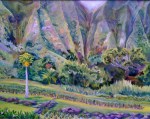
Shall we pick this one . . .

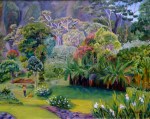
... or that one up there?

No one bought much art today at the Native Hawaiian Arts Market, but there were plenty of art appreciators.  I am happy to show my work and talk about it with others. I met some very nice people, and some friends stopped by.

The artists are expecting a Sunday crowd tomorrow, the 23rd, at the Bishop Museum, on the last event day of Maoli Arts Month. (Please see two posts earlier for info.)

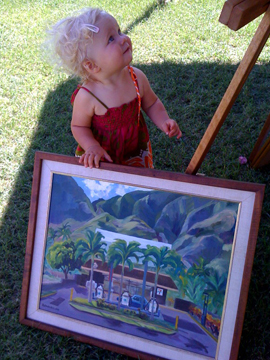
Miss Marvelous liked “Gas Pumps in Paradise,” an earlier work painted in 1993 of the 7-Eleven and gas station in Kaaawa the day Bula Logan led a sovereignty march along Kamehameha Highway.

The painting was part of my “Painting the Town” collection of all the public structures in Kaaawa: the post office, the fire station, the school, the bath house, the library (bookmobile), and two bridges.

I remember organizing with Pat, the then director of Swanzy Beach Park, an art show reception to open the new covered lanai for the park facility. I showed the paintings with environmental portrait photography of the people who worked in the buildings. The only advertising was a hand-painted roadside sign by the summer fun kids that read, “Everybody come.” And everybody did!  Times have changed.

Rather than keep “Gas Pumps in Paradise” as a leaner becoming shop worn in the studio, I’ve marked it down to $200.00, solid koa frame included. The amount is half the original price.

Miss Marvelous enjoys the art show with her mom

Copyright 2010 Rebekah Luke


Perpetuate the Hawaiian national anthem

25 04 2010

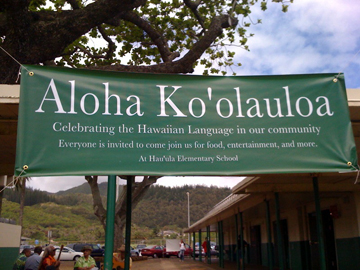
Yesterday’s long menu of activities all around the island was a feast for anybody interested in going and doing. Pick any venue, and one was sure to be entertained. I committed to a hoolaulea (country style backyard fair) at Hauula Elementary School, helping out at the Hawaiian civic club booth. Live Hawaiian music and hula, craft booths, local Hawaiian-style food, community exhibits, free parking.  The event drew attention to the Hawaiian language immersion schools on our coast.

The singing of “Hawaii Ponoi” by the children impressed me the most. “Hawaii Ponoi” is our national anthem, and we stand when it is played or sung. When I was a kid, we learned the words to the first verse and the chorus, and we sang the chorus two times. Yesterday, I was blown away when, after the chorus, the children of Aha Punana Leo and Ke Kula Kaiapuni sang the other verses. Wow, that’s so maikai (good)! A proud, chicken-skin moment!

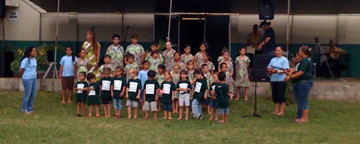
Haumana (students) and kumu (teachers) of Ke Kula Kaiapuni o Hauula, Ke Kula Kaiapuni o Kahuku, and Aha Punana Leo o Koolauloa

Here are the “Hawaii Ponoi” lyrics written by King Kalakaua to music composed by Henry Berger. They were first sung in 1874 at Kawaiahao Church.

(1st verse)
Hawaii ponoi
Nana i kou moi
Ka lani alii
Ke alii
============
(Chorus)
Makua lani e
Kamehameha e
Na kaua e pale
Me ka ihe
============
(2nd verse)
Hawaii ponoi
Nana i na alii
Na pua muli kou
Na pokii
============
(3rd verse)
Hawaii ponoi
E ka lahui e
O kau hana nui
E ui e
Copyright 2010 Rebekah Luke


Artist’s unforgettable memoir

15 04 2010

Once upon a time in 1994, not too long ago, I went to a Hawaiian place, a place of healing.

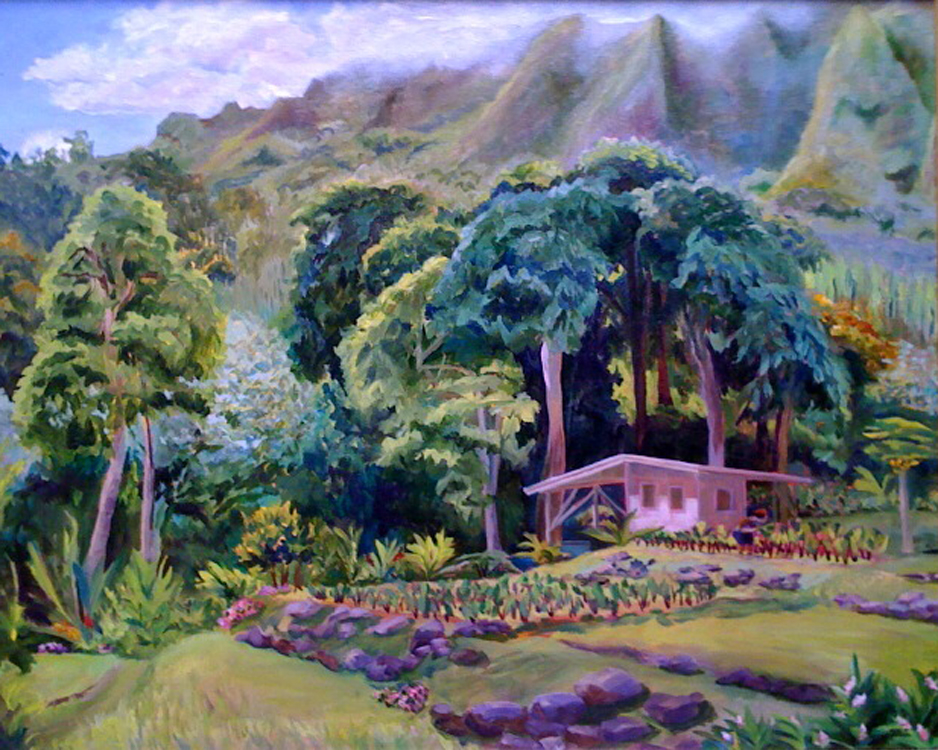
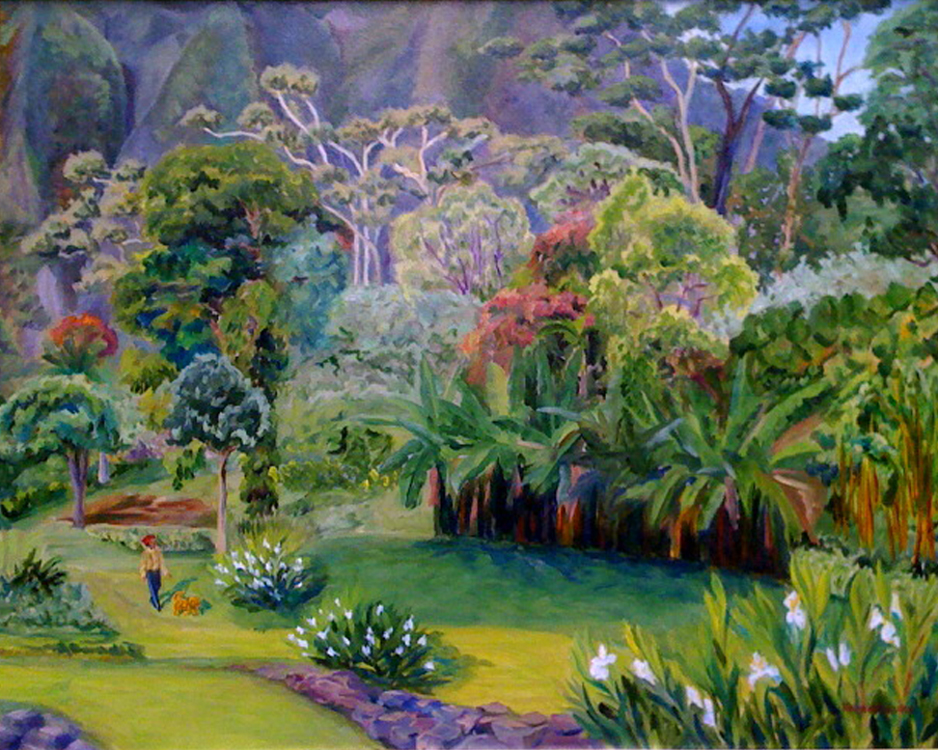
Through the treetops I could see glimpses of the Ko‘olau mountains. Patches of sunlight danced on colorful impatiens, and the sound of civilization gave way to the melodic symphony of the shama thrush. How enchanting, I thought. This feels like paradise. The trail skirted dense bamboo on one side and cultivated ti plants on the other. I could hear the stream running, and farther along, soft voices below. When the view finally opened up I saw up close the back of an amphitheater-headed valley, and, below me, a stretch of green terraces planted with kalo. To the left was a small house. This was unforgettable ‘Ioleka‘a, and Anita lived here.
Anita’s Place Kaiwikee Edge of the Forest

Anita was an inspiration to me. I met her through our work with Ka Lahui Hawaii. She took care of the land, and it took care of her. I met the family members who together with Anita own the private Native Hawaiian kuleana, and after a while they welcomed me in to paint the landscape.

Over ten months, starting in February when the ‘awapuhi ke‘oke‘o (white ginger) bloomed — I still recall the sweet scent — and until a solo show exhibiting the work opened,  I hiked in and out many times and made more than a dozen oil paintings, starting with “Anita’s Place” that developed into the triptych above.

I attached pontoons to my easel to prevent the legs from sinking into the mud of this lo‘i land. I learned to smell and listen for the rain, just in time to cover my palette and don my rain gear. Sometimes Ei Nei the golden retriever would keep me company, but only until the mistress returned.

On November 5, 1994, a day after the show opened, I wrote:

I am so glad I made these paintings. Things are different at Ka ‘Ili ‘Ioleka‘a now. The goat’s gone. Got loose and took off. The papaya tree’s down. A couple more lo‘i are being prepped for planting. One of the mango trees on the trail fell. More people and the laws of nature bring constant, dynamic change.

Anita and I picked ho‘i‘o for the art show reception. One needs a good eye to spot those fern buds. Anita refused payment, even though I explained that was her income. A gift from the ‘aina, she said.

For a month the paintings are on exhibit at Leeward Community College. People like them. They really look at them. It is as though some folks have never seen a painting. It’s refreshing to see some of the green of the windward side of the island over here where it is drier. Sort of like a shot of menthol, a visitor said. When art evokes an emotional response, when it communicates, then it is successful. These images are.

These images stop people. They are scenes that people can relate to. They bring back memories and stimulate discussion. Instead of talking about budgets and college programs, they talk about their childhood experiences in the lo‘i, or on the ‘aina, on a neighbor island, when they went hiking, or … What more can one ask for in a response?

Gloria Foss, my teacher, attended the opening, and I asked her for a critique. She said there was almost no blue or violet as local color, but predominantly greens and reds, although I used blue and purple in the mixtures. In other words, it appeared that I’d used a limited palette. “Push the green as far as it will go, into blue,” she said. “Use cloud shadow to put more violet in the mountains. Use more cloud shadow everywhere to develop focal points. Focal points, yes. Work on developing those. That’s why the piece “Anita’s Place” works well. You’ve set up the little house as the focal point.”

The Leeward Community College Foyer Gallery was set up by Melvyn Sakaguchi when he was provost as a place where emerging artists could show their work and receive a little technical assistance from the college before heading out further on their own. Alan Leitner, the curator, thinks the campus galleries will become more important because they will be the places where the reviewers and critics go to see art.

Most of the ‘Ioleka‘a paintings went to buyers on opening night, and I donated some of the proceeds to Ka Lahui Hawaii. I still have the 90-inch-by-24-inch triptych and a couple of favorites in my collection.

Copyright 2010 Rebekah Luke


Stories as legacy

27 03 2010

Stories can be legacies. I was reminded of this when my cousin Galien sent me the Hawaii island press photos and story of Kalahikiola church with a note, “It shows you how Kohala takes care of its own, rarely waiting for the government or others to do their needs.”

The photos show the congregation seated in pews of a renovated interior. The news article reports that on February 27, 2010, while most of Hawaii waited for a potentially damaging tsunami from an earthquake in Chile, the people of North Kohala were in church to dedicate their newly rebuilt Kalahikiola church building, a casualty of an earlier natural disaster: The earthquake on October 15, 2006, off the coast of the Big Island of Hawaii caused the stone walls of the church, located at Kapaau, to crumble.  A dramatic photo showed the damage to the world.

Among the relatives of my mother’s side of the family, what we noticed in the 2006 photo was that the bell tower was intact. (Click on “dramatic photo” in the above paragraph.) Growing up, we were told the story of how our grandfather — who managed the grounds of Dr. Benjamin D. Bond’s estate that included the church — repaired the bell tower in the early 1900s, replacing rotted timbers one by one.

Yet, actually, someone read and quoted the anecdote in Father Bond of Kohala: A Chronicle of Pioneer Life in Hawai‘i by Ethel M. Damon (Honolulu: The Friend, 1927) about “Ah Nee, the faithful Chinese workman,” the only carpenter who dared to undertake the repair. (He was called Ah Nee, which means Two for the second son, but his correct name was Chong How Kong.) And that quote is re-cited in our cousin J. H. Kim On Chong-Gossard’s The Chong Family History (Kaaawa: Chong Hee Books, 1992).

Our grandfather died in 1930, but when we saw the 2006 photo of the church with the untouched bell tower, we patted him on the back anyway. We cherish this connection to Kohala. It’s the story we pass down, even though there are so many more stories, given that my mother and her 14 siblings were born and began their lives there. But that’s the story we know about our grandfather.

Accuracy is part of my training and experience. My 6th grade teacher taught how to use a dictionary, how to outline, and drilled us on “speed and accuracy.” When writing the daily news, it’s customary to check facts with more than one source; two to concur, but three are better. In the Sunset test kitchen we made a recipe a minimum of three times before publication.

Recently I became involved for five years in designing and managing the publication of bi-lingual children’s story books in Hawaiian and English for a non-profit educational organization in our area. The stories were to ring true to the Hawaiian culture, places, customs, heritage, etc.

The storybook project was by the indigenous community and involved many partners, writers, reviewers, elders, editors, photographers, designers, and translators. While allowing an author’s voice, I lobbied my darndest to avoid what I felt were inaccuracies, but sometimes I wasn’t successful.  In the end I relaxed and said okay to some things that I’d now regard as modern myth.

This past week the publisher, Na Kamalei – K.E.E.P., released its Hawaiian-culture-based early childhood education curriculum for families. It’s wonderful, and it integrates 20 of the story books into the lesson plans. It is for use by family and child interaction learning programs.

I still feel accuracy is important, so as not to perpetuate something that’s not so, thereby creating a myth.

What stories do you remember? What stories will you write or tell? What legacy will you leave?

Copyright 2010 Rebekah Luke


Declutter for the year of the tiger

10 02 2010

The Chinese Lunar New Year of the Tiger starts this February 14, presenting another chance for me to declutter the studio and garden. A few more days to get rid of the stale energy to make room for the new — key to continuing the healing.

Last week I blessed the Punahou Carnival plant booth with several small avocado trees that I’d been nurturing for five months and about 175 strong bromeliad plants that had spread from where perhaps a dozen were first placed 20 years ago in the front yard.

Pulling out the broms uncovered quite a few vanda orchid plants. I call them lei vandas, but their correct name is Vanda Miss Joaquin. I haven’t seen them commercially for a long time. On Oahu, their popularity has been replaced by dendrobium orchids from Thailand. (Imagine!)

When I was a girl in Wahiawa, Uncle Harry and Aunty Edna who lived next door had a farm and a garden that included these vandas. On special occasions, when visitors would arrive from overseas, or when someone was going away, Aunty Edna would let me pick the flowers to make lei.

She sometimes separated the blossom and strung the bottom half maunaloa style into a lei of saturated color that resembled the look of a lei of flowers from the maunaloa vine. (Maunaloa is one of those plants that cannot be taken out of Hawaii.) She needed a lot of blossoms for this style of lei.

The color of a fresh maunaloa style vanda lei was as intense as the magenta akulikuli blossoms from the ice plant (Lampranthus multiradiatus) that grew on both sides of Uncle Harry and Aunty Edna’s walkway from the street to the front steps. Beautiful! Aunty Edna made akulikuli lei too! Now these are rarely seen.

These memories inspired me to clean and re-pot my lei vandas where they will have more air and sunlight among some native kupukupu fern that I relocated from the side of the garage. I mapped out some garden paths to make the place more interesting and inviting. I guess I’ve taken on the delightful pastime of re-landscaping the garden!

The vandas aren’t blooming at the moment, but I thought you might like to see what they could look like in their prime. Photographer Dominic Kite of Scotland has given me permission to link to his photo of Vanda Miss Joaquin. Thank you Dominic! If you want to see more of Dominic’s photos, you may go to his website dominickite.com. But for the moment, click on this link:

Vanda Miss Joaquin by Dominic Kite

Related articles from Sept. 2009 (see Earlier Posts in the sidebar):

“Sweet memories and coming home, part 1,” Sept. 7, 2009

“Gratitude for my abundant garden,” Sept. 8, 2009

Copyright 2010 Rebekah Luke


Let it snow!

2 12 2009

Where does a Hawaiian island girl go on vacation? To places where it is cold and snowy. To places where I can wear clothes! In a few days I’ll be on my way to central Europe to visit the Christmas markets where I know it will be very cold.  I am wishing for snow.

Somewhere along the river cruise route from Germany to Austria, Slovakia, and Hungary there might be some of that falling white fluffy stuff. Maybe in Salzburg, Vienna, Bratislava, or Budapest? I’ve got my snow boots packed! In the meantime, our WordPress host is accommodating by snowing on Rebekah’s Studio. Cool, huh? (pun intended)

Here’s a picture of a picture of my very first snowman the year I declared, as an adult, that I wanted a winter vacation. It was the first time I deliberately traveled to a cold place. My visit to Anchorage, Alaska, coincided with the Fur Rendezvous festival in Anchorage.

Heather and Sean showed me how to build a snowman in Alaska

A couple of seasons before that, it snowed in the mountains on the San Francisco peninsula in California during the coldest winter since such-and-such year. I was working for Sunset magazine at the time. That winter I remember the first snowball thrown at me at Yosemite National Park where the waterfalls were frozen and the scenery was gorgeous-crisp and quiet.

Throughout our 25 years of marriage, DH and I often visited his parents, brother’s and sister’s families in Pennsylvania during the winter holiday, so often that my friends would ask if I ever went anywhere else besides Pennsylvania.

The last December we went to the East Coast, before this one, was to see his parents at their funerals within two weeks of each other. We huddled under the falling snow and placed orchid lei on the ground in the church’s memorial garden where we buried their ashes.

One weekend we took the train from Philadelphia to Washington, D.C. We stayed at the Pen Arts building that is the headquarters for the National League of American Pen Women, the members’ clubhouse. The staff went home for the weekend, and the mansion was ours. To trek around in the snow the next morning, though, we first had to get out of the front door. Thank goodness DH remembered how to shovel the steps and to say, “Yes, thank you!” when a man came by to ask if he should salt the sidewalk.

If you have to live in wintry weather all the time, I’m sure it could be more tiresome than romantic. But if you are born and reared in Hawaii as I was, it’s a novelty.

When I was in Osaka, Japan, one February for the opening of the Oceania exhibit at Minpaku (the National Museum of Ethnology) at Senri Park, Professor Shimizu regretted to tell me, when I asked, that it probably would not snow. A few minutes into lunch, he was really surprised to see the white flakes falling outside the dining room window. But I wasn’t.

Here is the link to Minpaku. The photo you see is an exact replica of Hale Kuai Cooperative store with authentic Native Hawaiian made products in Hauula, Oahu, that I co-founded with Ka Lahui Hawaii. How it got there as the Hawaiian part of the permanent Oceania exhibit at the museum is an amazing story, a real memoir that I’ll share with you someday.

I say it’s fitting that WordPress bless this blog with snow. Please enjoy it warmly in front of your computer! I’m planning to send holiday posts while abroad.

Copyright 2009 Rebekah Luke


Guardians of tradition

21 10 2009

“Guardians of Tradition” are we, I was reminded last evening. The event: a gathering of Punahou School alumni to hear a lecture by kumu Hattie Eldredge Phillips at Kauihelani, the Hawaiian resources center of the Case Middle School.

Hattie is of the well-known Eldredge family that has touched the students, faculty, staff,  parents, and alumni of Punahou for generations—as student leaders, teachers and coaches.

In front of last night’s audience, she introduced her brother Pal, who teaches first graders, her very good friend and colleague Malia Ane, who teaches grade 3, and Malia’s mother Marilyn Ane, retired kindergarten teacher. The Ane family is equally dedicated to Punahou. Each would take the microphone to share stories and mele (songs) about Punahou traditions and how they came to be, reliving the journey we alumni were all so fortunate to be a part of. None of what she does is done alone, Hattie said. The others on stage with her and ke Akua were her allies.

It was a bittersweet moment when Hattie prefaced that the empty rocking chair draped with lei was to be for her brother David who passed over the day before. Dave Eldredge retired from Punahou after 40 years as an athletic coach and teacher. He established the Hawaiian studies program at Punahou and designed the school’s fabulous Holoku Pageant.

The Holoku Pageant was how I first met Dave—Mr. Eldredge—who was the adviser to the Hawaiian Club when I was a student, and his sister Hattie, who was one class ahead of me and taught all the hula. Part of the philosophy of teaching hula and mele to students was/is that the students will in turn teach the dance and music to others, thereby helping to perpetuate Hawaiian culture. And this has been happening for all the time Mr. Eldredge, and now Hattie, Pal, and Malia have spent at Punahou. Mr. Eldredge would be proud of Hattie’s program that was dedicated to him last night.

Some highlights:

The entire Eldredge family, though grieving, was present at Kauihelani, a thoroughly modern Hawaiian resource center facility that is Hattie’s domain. Seventh graders have a huge and great place to  learn Hawaiian values, history, tradition, activities, and culture. There they can connect with real events happening in the community.

Pal Eldredge, who has researched the history of Punahou School, showed us some interesting, old photos of campus, gave us the correct lyrics for the alma mater “Oahu-a” and played guitar.

Marilyn Ane (Class of ’48) told how she started the “Flaming P” tradition to generate school spirit.

Malia Ane, also known as “Queen of Mele,” led the gang in a group duet of  “Pupu Hinuhinu” and “Maile Lei.” It was Malia who started the tradition of teaching Hawaiian songs to the elementary grades.

Leilehua Phillips, Hattie’s daughter and past queen of the Holoku Pageant, performed a hula. Hattie inherited the directorship of the pageant from Dave few years ago.

We all sang a medley of Punahou fight songs. The women—Hattie, Malia, and Marilyn—were football song- and cheerleaders, no surprise!

And the special request from the audience that brought the house down: that Marilyn Ane  lead the alumni audience in the cheer “Geeve ’em the hash, the hash, the hash” as the video camera rolled. It was hilarious! I know, it’s something you had to be there for, and I’m sure Dave was. “E Aunty, you still got it!”

We are shown the way by those who came and went before us. We have only to listen for their guidance, follow in their footsteps and teach our children. That was Hattie’s message, and it came through loud and clear.

Mahalo!

Copyright 2009 Rebekah Luke