Artist’s unforgettable memoir

15 04 2010

Once upon a time in 1994, not too long ago, I went to a Hawaiian place, a place of healing.

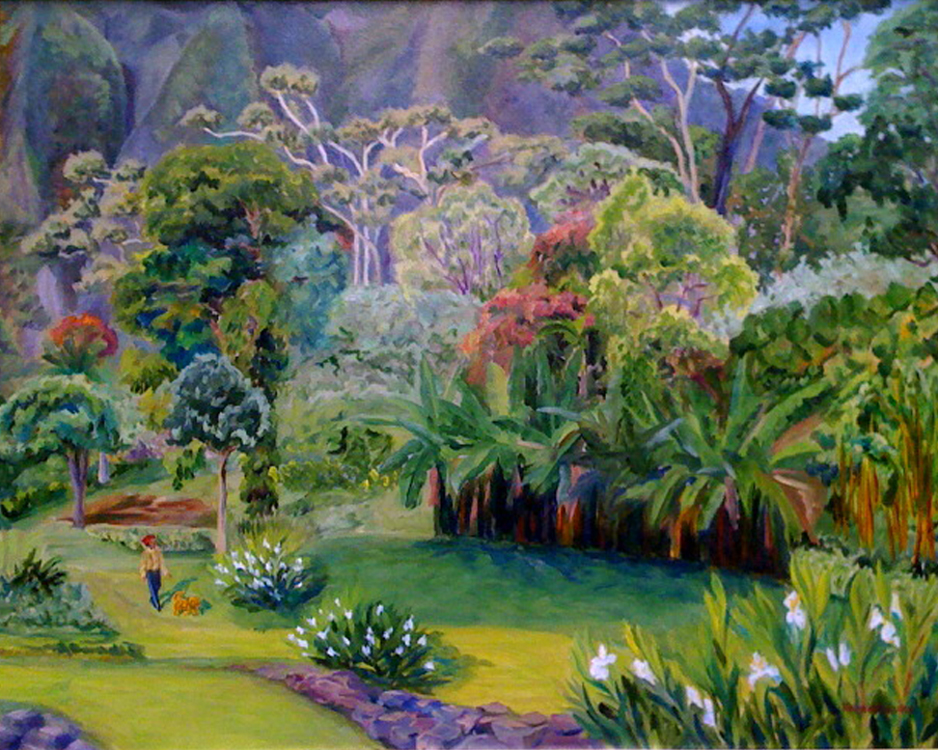
Through the treetops I could see glimpses of the Ko‘olau mountains. Patches of sunlight danced on colorful impatiens, and the sound of civilization gave way to the melodic symphony of the shama thrush. How enchanting, I thought. This feels like paradise. The trail skirted dense bamboo on one side and cultivated ti plants on the other. I could hear the stream running, and farther along, soft voices below. When the view finally opened up I saw up close the back of an amphitheater-headed valley, and, below me, a stretch of green terraces planted with kalo. To the left was a small house. This was unforgettable ‘Ioleka‘a, and Anita lived here.
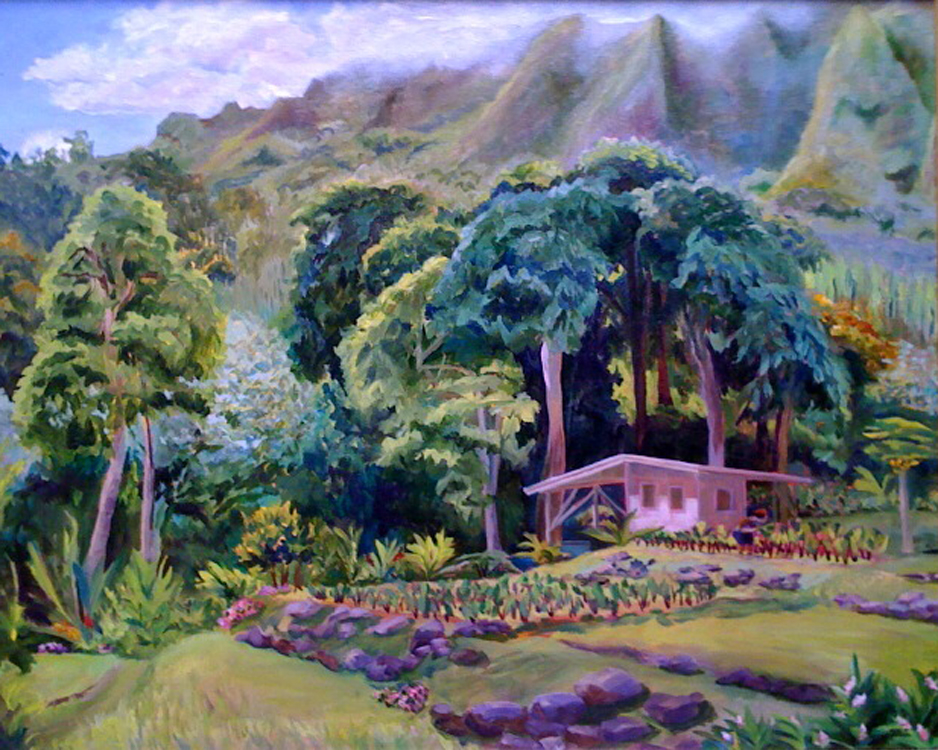
Anita’s Place Kaiwikee Edge of the Forest

Anita was an inspiration to me. I met her through our work with Ka Lahui Hawaii. She took care of the land, and it took care of her. I met the family members who together with Anita own the private Native Hawaiian kuleana, and after a while they welcomed me in to paint the landscape.

Over ten months, starting in February when the ‘awapuhi ke‘oke‘o (white ginger) bloomed — I still recall the sweet scent — and until a solo show exhibiting the work opened,  I hiked in and out many times and made more than a dozen oil paintings, starting with “Anita’s Place” that developed into the triptych above.

I attached pontoons to my easel to prevent the legs from sinking into the mud of this lo‘i land. I learned to smell and listen for the rain, just in time to cover my palette and don my rain gear. Sometimes Ei Nei the golden retriever would keep me company, but only until the mistress returned.

On November 5, 1994, a day after the show opened, I wrote:

I am so glad I made these paintings. Things are different at Ka ‘Ili ‘Ioleka‘a now. The goat’s gone. Got loose and took off. The papaya tree’s down. A couple more lo‘i are being prepped for planting. One of the mango trees on the trail fell. More people and the laws of nature bring constant, dynamic change.

Anita and I picked ho‘i‘o for the art show reception. One needs a good eye to spot those fern buds. Anita refused payment, even though I explained that was her income. A gift from the ‘aina, she said.

For a month the paintings are on exhibit at Leeward Community College. People like them. They really look at them. It is as though some folks have never seen a painting. It’s refreshing to see some of the green of the windward side of the island over here where it is drier. Sort of like a shot of menthol, a visitor said. When art evokes an emotional response, when it communicates, then it is successful. These images are.

These images stop people. They are scenes that people can relate to. They bring back memories and stimulate discussion. Instead of talking about budgets and college programs, they talk about their childhood experiences in the lo‘i, or on the ‘aina, on a neighbor island, when they went hiking, or … What more can one ask for in a response?

Gloria Foss, my teacher, attended the opening, and I asked her for a critique. She said there was almost no blue or violet as local color, but predominantly greens and reds, although I used blue and purple in the mixtures. In other words, it appeared that I’d used a limited palette. “Push the green as far as it will go, into blue,” she said. “Use cloud shadow to put more violet in the mountains. Use more cloud shadow everywhere to develop focal points. Focal points, yes. Work on developing those. That’s why the piece “Anita’s Place” works well. You’ve set up the little house as the focal point.”

The Leeward Community College Foyer Gallery was set up by Melvyn Sakaguchi when he was provost as a place where emerging artists could show their work and receive a little technical assistance from the college before heading out further on their own. Alan Leitner, the curator, thinks the campus galleries will become more important because they will be the places where the reviewers and critics go to see art.

Most of the ‘Ioleka‘a paintings went to buyers on opening night, and I donated some of the proceeds to Ka Lahui Hawaii. I still have the 90-inch-by-24-inch triptych and a couple of favorites in my collection.
Copyright 2010 Rebekah Luke


Beach swings

5 04 2010

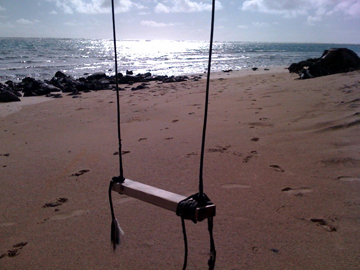
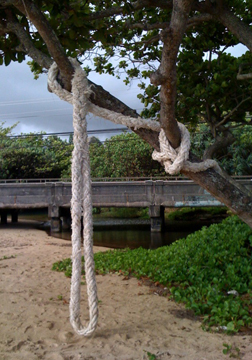
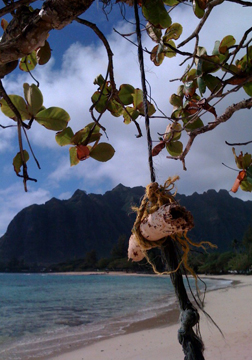
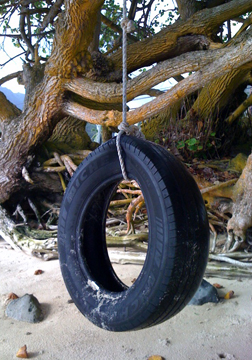
No sooner than I reported the rope swing gone (see my painting “The Rope Swing”), several new ones appeared! We ran into them on a morning walk along Kaaawa beach this week with our almost-seven-year-old puppy Alice Brown. The large white rope must have drifted ashore.

Driftwood Swing

Tire Swing

Board Swing

White Rope Swing


Stories as legacy

27 03 2010

Stories can be legacies. I was reminded of this when my cousin Galien sent me the Hawaii island press photos and story of Kalahikiola church with a note, “It shows you how Kohala takes care of its own, rarely waiting for the government or others to do their needs.”

The photos show the congregation seated in pews of a renovated interior. The news article reports that on February 27, 2010, while most of Hawaii waited for a potentially damaging tsunami from an earthquake in Chile, the people of North Kohala were in church to dedicate their newly rebuilt Kalahikiola church building, a casualty of an earlier natural disaster: The earthquake on October 15, 2006, off the coast of the Big Island of Hawaii caused the stone walls of the church, located at Kapaau, to crumble.  A dramatic photo showed the damage to the world.

Among the relatives of my mother’s side of the family, what we noticed in the 2006 photo was that the bell tower was intact. (Click on “dramatic photo” in the above paragraph.) Growing up, we were told the story of how our grandfather — who managed the grounds of Dr. Benjamin D. Bond’s estate that included the church — repaired the bell tower in the early 1900s, replacing rotted timbers one by one.

Yet, actually, someone read and quoted the anecdote in Father Bond of Kohala: A Chronicle of Pioneer Life in Hawai‘i by Ethel M. Damon (Honolulu: The Friend, 1927) about “Ah Nee, the faithful Chinese workman,” the only carpenter who dared to undertake the repair. (He was called Ah Nee, which means Two for the second son, but his correct name was Chong How Kong.) And that quote is re-cited in our cousin J. H. Kim On Chong-Gossard’s The Chong Family History (Kaaawa: Chong Hee Books, 1992).

Our grandfather died in 1930, but when we saw the 2006 photo of the church with the untouched bell tower, we patted him on the back anyway. We cherish this connection to Kohala. It’s the story we pass down, even though there are so many more stories, given that my mother and her 14 siblings were born and began their lives there. But that’s the story we know about our grandfather.

Accuracy is part of my training and experience. My 6th grade teacher taught how to use a dictionary, how to outline, and drilled us on “speed and accuracy.” When writing the daily news, it’s customary to check facts with more than one source; two to concur, but three are better. In the Sunset test kitchen we made a recipe a minimum of three times before publication.

Recently I became involved for five years in designing and managing the publication of bi-lingual children’s story books in Hawaiian and English for a non-profit educational organization in our area. The stories were to ring true to the Hawaiian culture, places, customs, heritage, etc.

The storybook project was by the indigenous community and involved many partners, writers, reviewers, elders, editors, photographers, designers, and translators. While allowing an author’s voice, I lobbied my darndest to avoid what I felt were inaccuracies, but sometimes I wasn’t successful.  In the end I relaxed and said okay to some things that I’d now regard as modern myth.

This past week the publisher, Na Kamalei – K.E.E.P., released its Hawaiian-culture-based early childhood education curriculum for families. It’s wonderful, and it integrates 20 of the story books into the lesson plans. It is for use by family and child interaction learning programs.

I still feel accuracy is important, so as not to perpetuate something that’s not so, thereby creating a myth.

What stories do you remember? What stories will you write or tell? What legacy will you leave?

Copyright 2010 Rebekah Luke


Ready for buyers

18 03 2010

Aloha! Today I picked up two paintings from the framer. You’ve seen them before in previous posts, but now the canvases are dry and the frames finish them off nicely. I chose a classic linen liner and koa for “The Rope Swing” and a simple antique silver-colored frame for “View of the Koolau Mountains.” If you wish to invest in any of my paintings—these are originals—I can work out a payment schedule with you. Please click on PAINTINGS tab in the menu bar. I would love for you to see them in person. Just contact me for an appointment. Thank you for visiting my gallery and studio! Rebekah


Peace begins with me

14 03 2010

Already the middle of March and approaching the equinox! Good fortune has indeed gathered at the front door since the lunar year began.

My fortunes include a potential gallery venue to show my paintings this year, freelance copy editing and proofreading income, and an extra green trash can from a neighbor for our garden trimmings, just when I wished for them!

I checked in with Oprah and enjoyed a couple of her interviews with Thich Nhat Hanh that you might like too. Here are the links:

oprah.com/spirit/Oprah-Talks-To-Thich-Nhat-Hanh

oprah.com/spirit/A-Conversation-with-Thich-Nhat-Hanh-About-Savor

What else is new in this light?

I am reading Jamling Tenzing Norgay’s book Touching My Father’s Soul, on loan from another good neighbor who has trekked in Nepal. He promises I’ll like it — the book (agreed) and the trekking (if only . . . now that’s what I call a goal!). You may click on the title to read some reviews.

Our granddaughter, who comes to the studio several times a week now when her parents are away at work, turned 10 months, and she’s so tickled to walk on her own. Look out, world! I find myself reflecting on my toddlerhood — yes, I can remember all they way back to then — and appreciate all the more the extended family, uncle, aunt, and neighbors, who took care of me.

Which brings to mind a new meditation I’m doing. It’s called “Installing Inner Game” by Devon White. You may check it out at this website: www.gogratitude.org/devon. It requires T-O-T, time on task. So far I have listened to the 70-minute audio message and read the manual one time each. Although I’ve just started this program, my guess is that it helps take you all the way back to who you were in the beginning, as well as all the way forward in terms of becoming and being at your best to fulfill your life’s purpose. How cool is that?! We all need healing every day.

So not only good fortune, but peace at the front door as well. Thank you!

Tropical Hawaiian Ti Plants

Here’s a painting of tropical Hawaiian ti plants I finished on location this week, just as a sudden downpour drenched everything and left me in a puddle.

Copyright 2010 Rebekah Luke


Flying moths over Kaneohe Bay

28 02 2010
Cool light northerly
winds meet odd-looking sailboats
Kaneohe Bay
Up on hydrofoils
small fast single-handed craft
skate on calm water
Iridescent wings
of high-tech mylar sailcloth
look and fly like moths

Stressed out? Take a few moments to view, hear, and feel what it’s like on Kaneohe Bay in the shadow of the Ko‘olau mountain range on a partly cloudy afternoon.

Taking time to relax and being mindful of the present is healing. Though some moments are anxious, as when awaiting a tsunami (yesterday) or faced with other disaster, it does a body good to rest and renew one’s spirit. Paint a canvas. Give and receive Reiki. Or go sailing! Last Saturday Ken and Georgia called with a kind invitation to see the moths on the bay, so we abandoned other plans and went!

We had fun making the movie. Turn up the speaker volume of your computer and enjoy!

Copyright 2010 Rebekah Luke


Declutter for the year of the tiger

10 02 2010

The Chinese Lunar New Year of the Tiger starts this February 14, presenting another chance for me to declutter the studio and garden. A few more days to get rid of the stale energy to make room for the new — key to continuing the healing.

Last week I blessed the Punahou Carnival plant booth with several small avocado trees that I’d been nurturing for five months and about 175 strong bromeliad plants that had spread from where perhaps a dozen were first placed 20 years ago in the front yard.

Pulling out the broms uncovered quite a few vanda orchid plants. I call them lei vandas, but their correct name is Vanda Miss Joaquin. I haven’t seen them commercially for a long time. On Oahu, their popularity has been replaced by dendrobium orchids from Thailand. (Imagine!)

When I was a girl in Wahiawa, Uncle Harry and Aunty Edna who lived next door had a farm and a garden that included these vandas. On special occasions, when visitors would arrive from overseas, or when someone was going away, Aunty Edna would let me pick the flowers to make lei.

She sometimes separated the blossom and strung the bottom half maunaloa style into a lei of saturated color that resembled the look of a lei of flowers from the maunaloa vine. (Maunaloa is one of those plants that cannot be taken out of Hawaii.) She needed a lot of blossoms for this style of lei.

The color of a fresh maunaloa style vanda lei was as intense as the magenta akulikuli blossoms from the ice plant (Lampranthus multiradiatus) that grew on both sides of Uncle Harry and Aunty Edna’s walkway from the street to the front steps. Beautiful! Aunty Edna made akulikuli lei too! Now these are rarely seen.

These memories inspired me to clean and re-pot my lei vandas where they will have more air and sunlight among some native kupukupu fern that I relocated from the side of the garage. I mapped out some garden paths to make the place more interesting and inviting. I guess I’ve taken on the delightful pastime of re-landscaping the garden!

The vandas aren’t blooming at the moment, but I thought you might like to see what they could look like in their prime. Photographer Dominic Kite of Scotland has given me permission to link to his photo of Vanda Miss Joaquin. Thank you Dominic! If you want to see more of Dominic’s photos, you may go to his website dominickite.com. But for the moment, click on this link:

Vanda Miss Joaquin by Dominic Kite

Related articles from Sept. 2009 (see Earlier Posts in the sidebar):

“Sweet memories and coming home, part 1,” Sept. 7, 2009

“Gratitude for my abundant garden,” Sept. 8, 2009

Copyright 2010 Rebekah Luke