Valentine preview
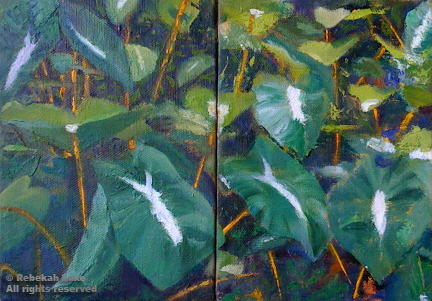
Kalo diptych / 10" x 7" / oil on canvas
Kalo diptych / 10" x 7" / oil on canvas
Season’s greetings to you! Joyfully, I can report that I survived transcribing my first Hawaiian newspaper page from the 1800s. I’ve put it in my pau (finished) folder and started another one.
On Nov. 28 I answered a call for volunteers to type, in simple text manuscript form, pages from old Hawaiian language newspapers so that the content can be searchable with a computer. The project, called the “ʻIke Kūʻōkoʻa Initiative,” is seeking 200,000 volunteer hours. More than 100 Hawaiian language newspapers were published between 1834 and 1948.
Here I share my experience and tips for you if you want to try. If you have heard about this project and are anxious to help, please visit www.awaiaulu.org and hear the welcoming invitation from Kaui Sai-Dudoit and Puakea Nogelmeier. If you sign on and decide later it’s not for you, you can always cancel.
Although it’s true that one doesn’t need to speak Hawaiian to type it, it is an advantage. In addition, good eyesight, squinting, accurate typing copyreading skills, and time = Success.
I do not speak Hawaiian. I am not fluent in the language. I haven’t learned all the little words and parts of speech that one of my early teachers said were so important. Although I might not know what the words mean, I know what written Hawaiian looks like. I can pronounce and hear it in my head. With my Pukui-Elbert Hawaiian dictionary in hand I can figure out the gist of a paragraph.
(My Hawaiian dictionary and Place Names of Hawaii, both from University of Hawaii Press, are my standard editing tools.)
Hawaiian words are not foreign to me, as they are all around me. Hawaiian music lyrics, Hawaiian language class in the 8th grade at Kamehameha Schools, several attempts at formal language classes as an adult, my citizenship in Ka Lāhui Hawaiʻi, and membership in the Ko‘olauloa Hawaiian Civic Club are how I’ve become familiar with Hawaiian.
My most recent exposure was with Nā Kamalei-Koʻolauloa Early Education Project. I was hired to design and later direct the creation of 20 bilingual children’s books in Hawaiian and English. I worked with translators Kama Hopkins and Lono ‘Ikuwā — both excellent teachers besides . . . Mahalo! — and painstakingly copy-read every single character, ʻokina and kahakō (what typesetters refer to as a “single open quote” and a “macron.”) Long linguistic discussions with authors and Native Hawaiians of the community were enlightening.
I cut my teeth as a newswoman on hot type (before the advent of the desktop computer) in the late Sixties and early Seventies at Ka Leo o Hawaii and the Honolulu Advertiser, then read galley proofs from Hawaii Hochi during many years with the Office of University Relations at UH Mānoa. That gave me an understanding and appreciation for setting lead type by hand, upside down and backwards! I recall that a professional typesetter (not me!) commanded $50 an hour in those days for speed and accuracy.
These are additional reasons why I am excited to contribute some of my time for the current Hawaiian newspaper project.
In the end, I took 12 or so hours over three weeks that included two extensions to finish my first page. Originally the planners hoped a typist would take only 1 week to complete a page. (Another volunteer’s strategy was to transcribe one of 6 columns per day, then proofread on the seventh day.)
On one side of my computer screen is the scanned graphic of a page reserved for me. I enlarge this. On the other side is a blank text document to type into — exactly what I see. No need to correct errors or type accent marks because, except for the apostrophe, they were not used. If I cannot decipher a character, or if it is obscured for a reason, typing “@” alerts whoever reads the transcription next.
When I examine the typeface enough to tell the difference between a “u” and an “n”, or a “1” and an “l”, or a “3” and a “5”, it’s smooth sailing. But only for one hour at a time. After that I can’t “see” it any more.
Sometimes, if I’m not sure of the spelling of a word because I can’t make it out completely, I will check my dictionary; if it’s there and makes sense, I’ll put it in. Sometimes that word I can’t make out appears later in the columns, and I verify in that way.
Then I go back to check my work, and sure enough I find some typos. After the first couple of weeks, it looks like the project understood the need to grant extensions. So, if your experience is like mine, don’t fret!
To be more encouraging, let me say it is a very interesting activity to see what people were reading in those days. My first page contained a poem “The Beautiful Snow” (English title) followed by Hawaiian verse, a lyrical and sensual description of snow in seven verses (2/3 column); a Sunday school lesson; price lists for bibles.
My second page reports who bought and sold or rented how many acres of what land on what island for what amount. You can learn Hawaiian vocabulary and see what words had fallen into disuse and are being resurrected with this project.
I’m grateful for the opportunity to assist and learn, and I hope I’m doing a good enough job for the project. I want my comments to be encouraging and to give interested transcribers a “heads up” about what to expect. I hope anyone who has an interest will volunteer for this worthwhile effort.
In Hawaii we are fortunate to grow gardens with flowers and foliage to decorate our homes and adorn ourselves the year ’round. I’ve started to show others how to craft holiday garlands, such as Christmas wreaths, table centerpieces, hostess gifts, and swags.
Today some of us gathered at the yacht club in Kaneohe to put the decorations together. It’s a fairly easy method adapted from the Hawaiian wili style of lei making. We substituted wire for natural fiber used to whip the plant material together, and we omitted a separate backing that is unnecessary because the stiff stems of ti leaves are sufficient foundation.
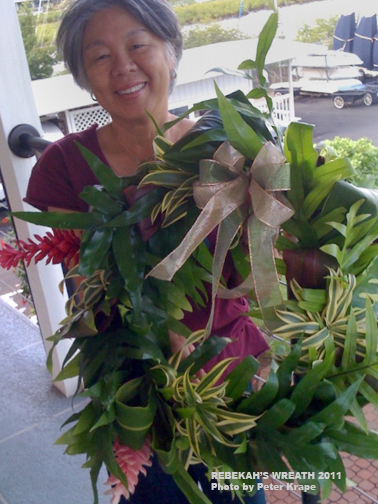
This fresh wreath is made of green ti, red ti, laua‘e, and song-of-India leaves. Red and pink ginger blossoms offer pops of complementary colors. A big bow completes my creation.

Just in time for the holidays: handcrafted decorations from our gardens
Images from last night’s HHSAA Division I State Football Championship game at Aloha Stadium. I’m a Buff ‘n’ Blue alumna. I live in Red Raider country. Where to sit? What color to wear? Arrggg! 😕 What a great game! Hail to the champs!

Early in the big game. Unfortunately, No. 90 Punahou was injured in the first quarter.

Playing with color. My neighbors of Ko'olauloa are cheering in the red section. After Kahuku won, they honked their car horns, yelled and screamed past the studio, all the way to the North Shore. Kaaawa brought out the aerial fireworks.
Good morning! It’s Day 4 at the Hawaiian Civic Club convention at the Turtle Bay Resort on the North Shore of Oahu, where I’m showing some of my paintings. It’s a hard sell against Aunty May’s banana bread, Kamakea’s colorful baubles, kulolo from Kauai, Makaweli poi, maile plants from Hawaii island, faux flower hair ornaments, yarn lei, and Aunty Phyllis’s Hawaiian print pillows — none of which are three figures like my oils!
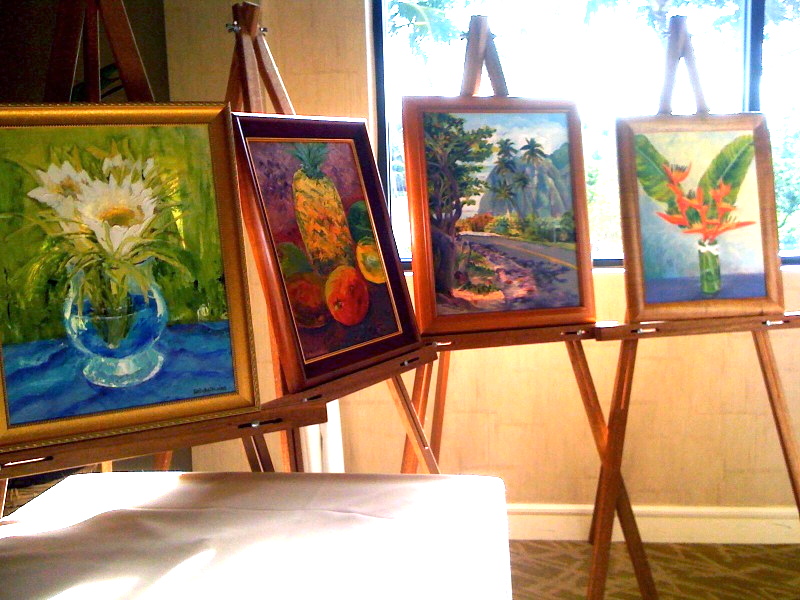
My paintings
On Day 1 I spent the time making a wili lei for a friend’s father’s memorial in the Midwest, and delivered it to the airport in time. Day 2 and 3 offered a bit of down time when the convention was in session.
To make it more interesting I’ve decided to paint on location today with my French easel and oils, making use of time and place. Because this is the view from the window. Yeah!

North Shore view of inspiration

Miss Marvelous and I experience the new "Hawaiʻi Loa Kū Like Kākou" mural created this month by Native Hawaiian artists at the Hawaii Convention Center. This photo shows only a small section of the painting with the tip of an 'auamo (stick used on one's shoulders to carry things) that represents the concept of balance for the world. The entire ʻauamo image including the opposite end extends the width of the mural. The artwork will be officially presented to the public today, October 19, 5:30 - 7 p.m., street-level entrance. For a related article, please see my October 8 post. — Photo by Peter Krape
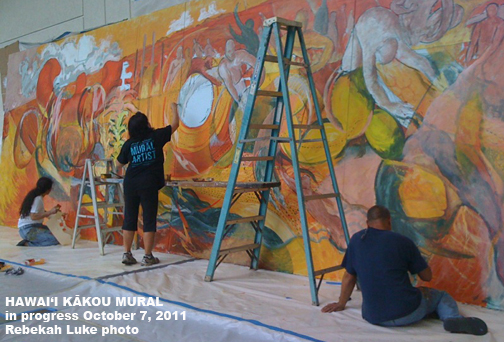
Native Hawaiian fine artists Harinani Orme, Meleanna Meyer, and Kahi Ching work on the "Hawaiʻi Loa Kū Like Kākou" mural at the Hawaii Convention Center.
A mural painting in progress at the Hawaii Convention Center in Honolulu is something for the whole community to see and appreciate. Hurry on down.
I watched the artists at work yesterday, intrigued with the program, the content, and the painting technique.
The mural is being created in response to the upcoming APEC (Asia-Pacific Economic Cooperation) summit conference here Nov. 7-10. The title “Hawaiʻi Loa Kū Like Kākou” means “All Hawaiʻi Stands Together.”
At this time five Native Hawaiian artists and kumu (teachers) — Kahi Ching, Solomon Enos, Al Lagunero, Meleanna Meyer, and Harinani Orme — and four alaka‘i (apprentice leaders) are working collectively on it following the ideas and insight from 22 haumana (students) of public, private, charter, and Hawaiian immersion schools and others. Many hands and hearts are touching this work. The mural consists of many layers of inspiration, thought, and paint.
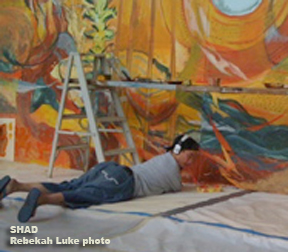
Shad Kaluhiwa, who has a disability, holds his paintbrush with this teeth.
As the artists added the warm colors yesterday, and as I sat and continued to look at the painting, I kept seeing different things. The form of an ʻauamo (pole used to carry and balance burdens across the shoulders) was being visually turned. I noticed it curved, like the curvature of Earth, for then I saw the profile of continents and islands.
From there, Earth images, sky images, plant images, people images, spheres, fish, line and dot. Intertwined and intriguing. Beguiling in a charming way.
I mused, “I see.”
WHEN YOU GO: The mural painting is on the ground level underneath the escalators and next to the waterfall, through Oct. 11. It will be installed (I don’t know the exact location) Oct. 17-19, according to a printed fact sheet. Parking at the convention center costs $5 flat rate.


 Rebekah’s Studio
Recent comments