Season’s greetings from Rebekah

21 12 2010

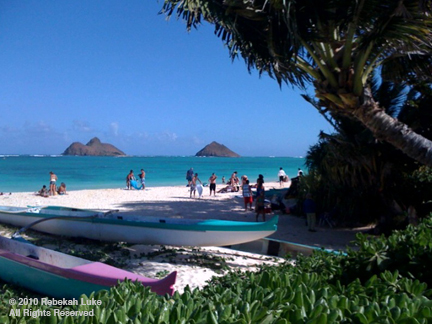
The moment I made this photo of Miss Marvelous and her mom, I knew I had our Hawaiian greeting card for this year.
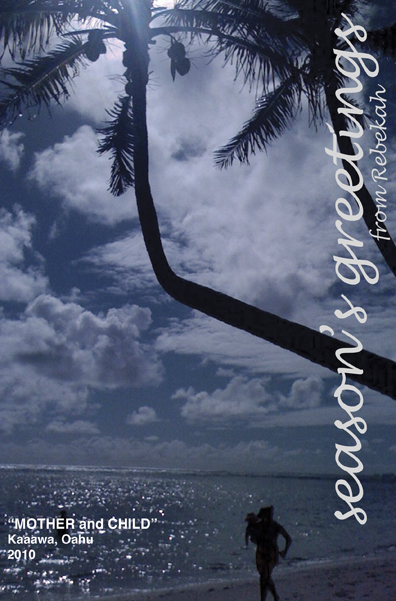
Everyone at Rebekah’s Studio—DH (Darling Husband), Alice Brown, Ula and I—wish you a Happy Winter Solstice!

I hope you don’t mind a re-post from 9-11-2009 that tells how we celebrate:

“With the winter holiday season upon us, most families are starting to get into the spirit. The signs include that real or imagined cold snap on Halloween night, slick merchandising catalogs overflowing from our mailboxes, store mark downs everywhere, and the lure of local craft fairs and festive events.

“Conversations now include, “What are you doing for (fill in the holiday)?” and newspaper features carry tips on how to remain stress free. We want to remember family and friends and hope no one is left alone. As families extend generationally, geographically, and by marriage, there can be many decisions to make.

“DH and I have a couple of philosophic ideas and old-fashioned traditions that give us a sense of peace. They link to our respective roots—Hawaiian Islands for me and Pennsylvania (Delaware County) for him.

“One is to acknowledge and be mindful of the Hawaiian Makahiki season, roughly from mid-November through January (exact dates depend on the moon). The planting season is over, work is pau (finished), and warring ceases. It is the time of the god Lono.

“The best of the harvest is dedicated to Lono in the form of ho‘okupu (offerings). The people give thanks, relax, socialize, play outdoor games, and generally enjoy themselves. No stress. It’s officially okay to play!

“The other is adopted from Winterthur, Delaware, not far from DH’s birthplace. As tourists we visited Winterthur, a museum and the former country estate of Henry Francis du Pont. During his life H. F. du Pont collected whole room interiors of various periods, not to mention whole street fronts, and installed them in his mansion.

“The museum decorates the rooms of this big house for Yuletide, and visitors can tour them around the same months of Makahiki in Hawaii. The holiday decor matches the period style of each different room. It’s educational and very festive.

“When we visited, our favorite room showed how du Pont’s own family celebrated in the first half of the 20th century. The story was told that Yuletide, the time around the Winter solstice, was a time to visit and entertain friends, to rest and to celebrate a successful harvest. Children were seen but not heard.

“Decorations consisted of a small table-top evergreen—adorned simply with cookies, candles and strands of popcorn and cranberries—that was set atop a pie crust table. Gifts were exchanged among immediate family members only and placed in a basket for each person. If the children behaved well, they could have the cookies!

“We liked the idea so well that we brought home a furniture piece similar to a pie crust table for ourselves, in a nod to the East Coast style and DH’s regional heritage. Each year we hang on a small tree the wooden ornaments crafted by DH’s parents for their first granddaughter on her first Christmas.”

Copyright 2010 Rebekah Luke


Special Chinese food: joong

14 12 2010

Nani showed me how to make joong at her house today. Last month I was with her when she bought a whole bunch of eggs in flats. She said they were to make hahm dahn, or salted eggs, for joong. I began salivating.

“You know how to make joong?!” I asked. Coincidentally, my cousin Tim had just issued a joong cook-off challenge to his cousins via Facebook, but most had no idea what he was talking about!

Nani said she has made joong every year for 60 years starting from the time her mother taught her. At choir practice last week I asked how the hahm dahn were coming along, hinting that I wanted to see the production.

Joong is a Chinese festival food—a pouch of soft, sticky, sweet rice hiding savory morsels pork, peanuts, and a salted egg yolk. At least the way Nani makes them.

I recall my mother treating joong as special food. Nani said Chinese people eat joong for Boat Day in the spring although she makes it more often, and that joong represented an anchor—something heavy that stuck to the bottom of your stomach. Could be, I thought, but joong is also delicious.

Today Nani and her three sisters Corinne, Barbara, and Rae and her cousin Eva were already gathered around the modern kitchen island when I arrived. Each had her own set up. Each had started soaking chicken eggs in brine 30 days ago. What they made today they took home to boil for 6 hours. After cooling in the cooking water overnight they will be ready to eat or freeze for later enjoyment.

As with most Chinese recipes, much goes into preparation before cooking. Last night Nani softened the bamboo leaves that she bought in Chinatown by heating them in boiling water. She soaked the peanuts and the glutinous rice. She marinated cubes of belly pork with Hawaiian salt and Chinese five spices. Just prior to assembling the joong, she cracked the salted eggs into a bowl.

There are similar rice pouch type foods – of Chinese and other ethnic origins – of other shapes, using other kinds of outer leaves, using other fillings, but according to my joong mentor, those are not joong.

I can hardly wait to taste our efforts. Thank you, Nani, for sharing your family joong-making day with me!

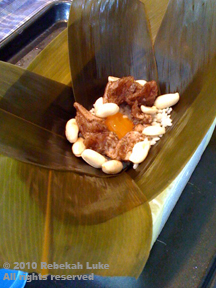
This metal form makes it easy to assemble the joong. You build an upside-down pyramid starting with 3 bamboo leaves inserted a certain way.

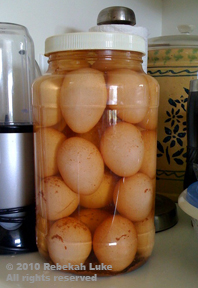
The process starts with soaking eggs in brine at least 30 days in advance. These are chicken eggs. You may also use duck eggs that would be more of a delicacy. These eggs are tan because Nani added tea to the solution. (Aha! Chef’s secret?!)

Once the bamboo leaves are in place, top sides touching the food, add a serving spoon of rice, the hahm dahn yolk (discard the whites), two pieces of marinated pork, and a few peanuts. Top with two serving spoons of the rice to cover the filling you see here. Then fold both long sides of the leaves over as if gift wrapping a box, followed by the short sides. Secure with string.

More finished bundles will go into this pot. Add water to cover and set to boil and simmer for 6 hours.

P.S. Nani said the following book most closely describes their family’s way to make joong. In it, the recipe is entitled “Savory Jeng.”

Every Grain of Rice by Ellen Blonder and Annabel Low. Clarkson N. Potter Inc./Random House, 1998. ISBN 0-609-60102-4

Copyright 2010 Rebekah Luke


It’s rock-star snowing on Lanikai Beach

1 12 2010

I do believe it’s snowing here at Rebekah’s Studio! Just look at the snowflakes falling! And right after I posted this photo on my Facebook page with the caption “Thanksgiving weekend & no snow!” 🙂

Lanikai Beach - Thanksgiving weekend & no snow!

I’ve been staycationing with family all weekend down the coast of Oahu at my hanai brother’s and sister-in-law’s fancy beach house. I spent a few hours there on Tuesday and will likely go again tomorrow. I’m making a painting that’s a variation of this classic Hawaiian beach scene and the Mokulua (two islands). DH suggested I do some rock-star paintings. Is this rock-star enough for you?

And, thank you WordPress.com for a rock-star visual effect!

Copyright 2010 Rebekah Luke


Thanksgiving 2010

25 11 2010

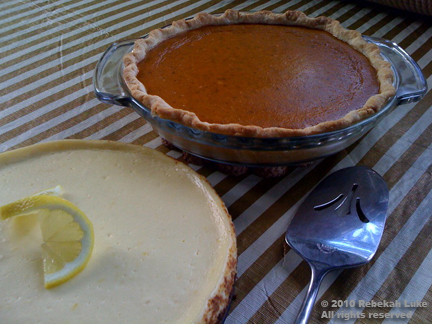
Warm and sweet Thanksgiving Day wishes to all. Tonight's feast ends with lemon cheesecake and traditional pumpkin pie. Yup, I baked 'em!


Ula the photo assistant

11 11 2010

Alice Brown the 7-year-old puppy dog upstages Ula the cat all the time. Today I thought I’d share a photo of Ula the photo assistant.

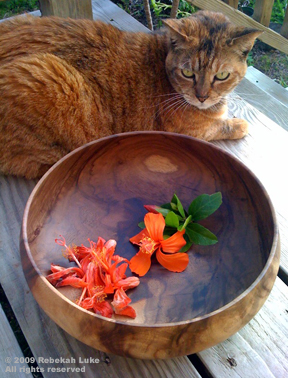
I was making an artsy photo of Native Hawaiian plants—Hibiscus kokio ssp. saintjohnianus in an umeke (calabash) turned from kou by island artist and friend Scott Sullivan. The Lyon Arboretum displayed the final image.

Copyright 2010 Rebekah Luke


Rare op to view inside the Mormon temple

6 11 2010

A look at the interior of Laie Hawaii Temple with two special visitors to the studio.

My glee club sisters Nani and Rae came to see my paintings yesterday! In planning the day, Nani invited me to join them for a visit to the Mormon temple in Laie afterward. It is newly renovated, and it is open for public tours through November 13 (closed Sunday). An open house!

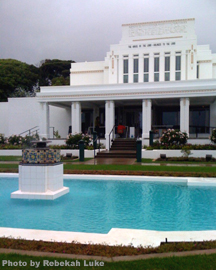
Temple of The Church of Jesus Christ of Latter-day Saints, Laie, Oahu

Note: After the temple is re-dedicated on November 21, it will be closed to the public, so yesterday’s viewing was a rare opportunity for us. You can make a reservation to see it by phoning 1-866-537-8457.

None of us three are Mormon, but we were curious to see the temple interior and interested in hearing why the Church of Jesus Christ of Latter-day Saints builds temples and what the LDS beliefs were.

Clear signs from Kamehameha Highway in Laie directed us to the parking lot. There, ushers greeted us with white umbrellas for the rain and escorted us to a series of white tents for an orientation video, that gave a brief history of the Mormon religion, and for some remarks on what to expect on the 25-minute walking tour through the temple.

At the last minute I saw two familiar faces. My former project assistant Kura, ever cheery :-), and her husband  joined our group. Kura and David were married in the temple before the current renovation, and this was their first time to see the new look.

Before entering the front door, volunteers gave us booties to cover our shoes.

Once inside, a husband-and-wife team (we have now been greeted by seven church members) guided us through the halls and different rooms. There was an usher at every turn and doorway. Near the end of the tour I asked how many people staffed the milestone open house event. The number varies with the day and time of day or night, but all LDS members on the island of Oahu are involved, I was told.

For the uninitiated, an informative brochure explains that LDS members have churches, chapels, and other meeting facilities for their Sunday worship services and weekday activities. The temple, however, is considered to be the most sacred place on earth. It is reserved for LDS members who are worthy in the eyes of the church. Then, the more one visits the temple to study, the closer one can become to God.

On entering, I am immediately impressed with the superb wall-sized paintings, art glass windows, and bas-relief panels in the waiting area.  It is like being in an art museum. (Think Elgin marbles of the British Museum in London.) More large and fine paintings line the hallways and lovely murals line some of the rooms.

All of the interior space is very beautifully decorated, welcoming, serene, peaceful. Actually, it is divine, and designed to feel ethereal. (Think HGTV’s “Divine Design” with Candice Olson). I had a similar lightness of feeling touring Catherine Palace just outside of St. Petersburg, Russia. Tastefully grand. The temple, however, is much smaller, more intimate, and not ornate like the palace. Perhaps the way the art is treated reminds me of Catherine Palace.

What happens in the temple? LDS members believe in the Book of Revelations, eternal life, and are interested in their ancestors and their progeny, i.e., one’s family’s past, present, and future; hence, their dedication to genealogy research. In the temple one may perform baptisms for one’s ancestors who have died. A couple may seal their marriage and can have their children sealed to them forever. As one advances in the teachings given in the rooms for instruction on the commandments, one may grow spiritually closer to God.

Furnishings of hardwood, soft green upholstery and drapes, crystal chandeliers, gold leaf inlay, sculpted carpeting, white calla lilies, excellent craftsmanship — these decorated a waiting room, the men’s changing room (one must change into white clothes while in the temple), a bride’s dressing room, a baptismal font, instruction rooms, a sealing room, and the white celestial room at the top.

After the open house tour we were escorted to the refreshment tent for cookies, and Kura and David cordially chatted with us and answered our questions. Thanks, Nani, for inviting me. And thanks to the LDS church members for a pleasant and educational afternoon.

Copyright 2010 Rebekah Luke

Rev. Rebekah Luke is ordained by the Universal Life Church that has two tenets: “freedom of religion” and “do the right thing.”


’Bye ’bye Norfolk Island pine

12 10 2010

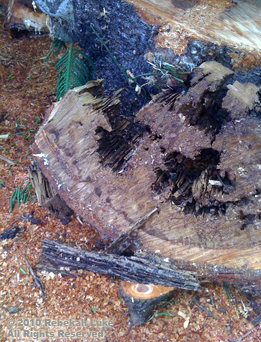
The old Norfolk Island pine tree is no longer at the Manoa Valley homestead where my hanai (adopted) mom lives. Mom decided to have the tall evergreen sentinel, damaged by termites and dry rot, cut down this past weekend before it fell down. With the wet and windy season approaching, I think Mom did the right thing.

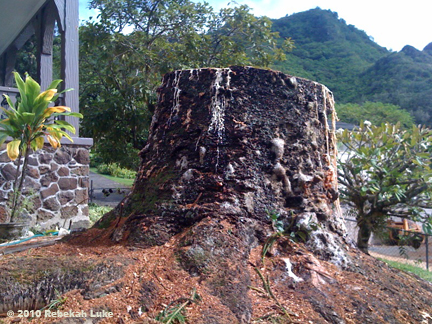
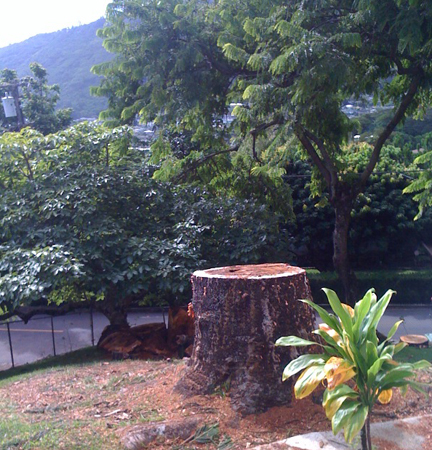
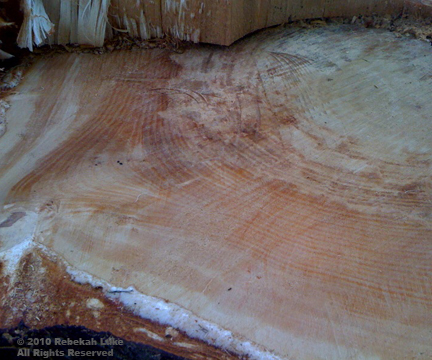
This tree was big. The existing stump measures about 40 inches in diameter. I counted the rings and estimated the tree was about 80 years old. Termites used to live in the lower part of the trunk. Sections from further up, however, are still good and useful to woodturners.

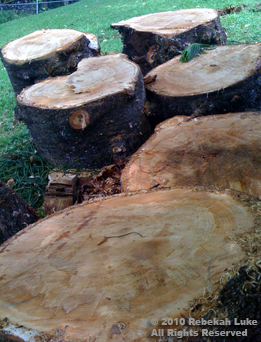
By the time I arrived at Mom’s yesterday to make these photographs, she had given away some of the choicer sections to the tree cutters. There’s still plenty more wood.

I eyeball the diameter of the Norfolk Island pine to be about 40 inches. Tree sap still oozes from the cut

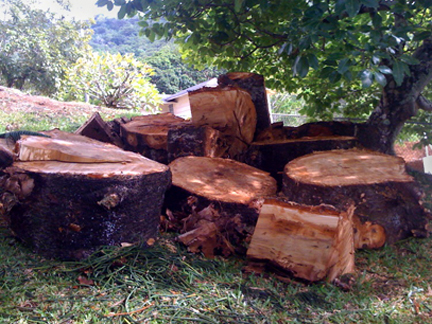
Sections of the trunk

Termites used to live here

More trunk sections, still good for making art

The dark and blond two-toned shades are characteristic of Norfolk Island pine wood

New view from the front porch

I counted the rings. Each represents one year of life, right?

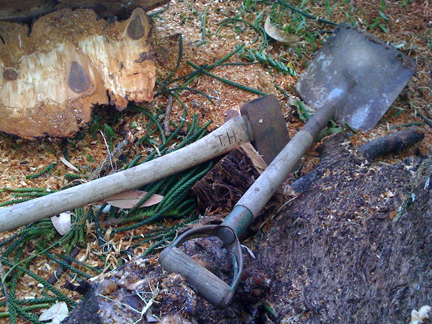
Workers left their tools behind; they're not pau (finished) yet

Copyright 2010 Rebekah Luke