Rebekah’s Kaʻaʻawa Mountain Apple Pie

3 07 2011

My mountain apple pies

Okay, okay, here’s the recipe. Jeez. I must say, it’s too good to not share. When there was a mountain apple tree outside the studio — Hawaiians call the fruit ʻōhiʻa ʻai (Eugenia malaccensis) — I made these pies every summer, one after another, so many that I froze them to eat later.

One year I was too late, and I could only watch the bulbul birds eat the entire crop in 20 minutes. “Hey fellas, come on over: breakfast!” Another year afterwards, the fruit was just not edible anymore. I think the tree was just old, so we cut it down.

This past Friday, I went to Candy’s house to catch a ride to our art show reception at 1132 Bishop Street in Honolulu. But first she pressed me into service to help pick the mountain apples from her tree for the refreshment table.

Oh, my gosh, I have never seen more beautiful mountain apples!  Candy and her husband had found from a garden shop a solution that repelled the pesky fruit flies that love to sting the fruit (causing the fruit to become wormy. Yecch!)

Clearly, Candy and Ken have a harvest they cannot possibly eat by themselves alone, and I was overjoyed when they offered me the surplus. Thinking about our family potluck gathering the next day, I thought, I’ll make pie!

This recipe has already been published in Everyone, Eat Slowly: The Chong Family Food Book (Kaaawa: Chong Hee Books, 1999). I adapted it from a formula a chef at the Kahala Hilton gave me many years ago when I worked for Sunset. For my recipe, the Betty Crocker brand mix is a must. Yesterday I used 15 very large mountain apples for one 9″ pie. I substituted 3 tablespoons fresh calamansi juice for the lemon juice, and I brushed the top with half-and-half cream for a golden brown finish.
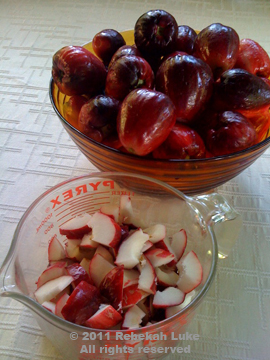
Gorgeous mountain apples, freshly picked and washed. The foreground shows the apples pitted, trimmed, and cut into chunks with a paring knife.

REBEKAH’S KAʻAʻAWA MOUNTAIN APPLE PIE

In Kaʻaʻawa the season for ʻōhiʻa-ʻai (mountain apples) is in June, usually, and it last for about two weeks. The challenge is to harvest them before the birds do. And then, what do you do with them? There are only so many fresh mountain apples one can eat. Now you can try them in a pie! The flavor is a cross between apple and rhubarb.

Betty Crocker Pie Crust Mix
5 cups sliced fresh mountain apples
1/2 teaspoon salt
1 teaspoon cinnamon
3/4 cup sugar
3 tablespoons butter, cut up in pieces
Juice of 1 lemon, or equivalent in lime juice
3 tablespoons tapioca OR 1/4 cup flour

Prepare Betty Crocker Pie Crust Mix for a double-crusted pie.

Combine the mountain apples, salt, cinnamon, sugar, butter, and lemon juice. Cook until the mountain apples are half done, about 10 minutes in the microwave on full power. Remove from heat.

Gradually stir in tapioca or flour. Cool mixture. (Place the mixture in its container in the freezer to cool down fast; be careful not to freeze). Pour into unbaked pie shell. Cut a vent in the top crust and place over pie. Seal the top crust to the bottom crust.

Bake at 375 degrees Fahrenheit for 45 minutes. Remove from oven and cool before slicing. The filling sets as it cools.

Rebekah Luke
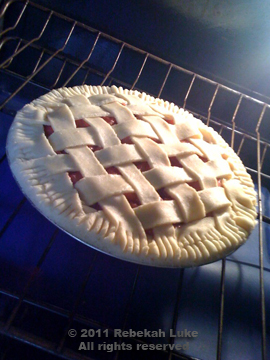
Ready to bake. I decided to make a pretty lattice top like the picture on the box of the Betty Crocker Pie Crust Mix.
Copyright 2011 Rebekah Luke


Foods my ancestors ate

20 05 2011

Hakka menu

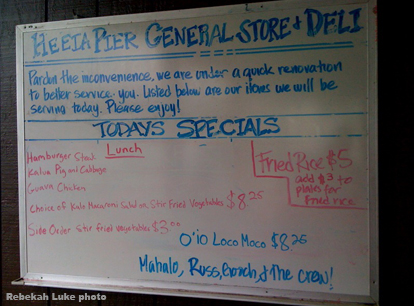
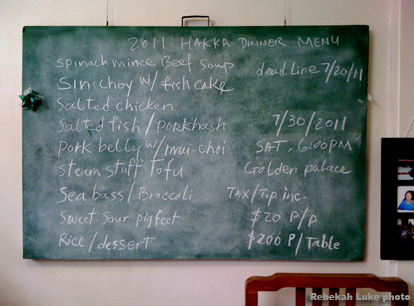
The theory of eating the foods my ancestors ate for good health came to mind when I saw two board menus recently: a Hakka dinner menu planned by the Tsung Tsin Association in Honolulu, and the day’s local specials at the Heeia Pier General Store and Deli on Oahu.

They reminded me of a model for sustainability presented at the “Chefs & Farmers Facing Future” forum I attended last month: create tighter communities and make friends with your neighbors.

At lunch with Cousin Millie (see my 5/15/2011 post) she asked if we would be interested in joining the Tsung Tsin Association, an international club that practices and preserves the (Chinese) Hakka culture.

We have Hakka genes. Hakka people descend from the Han people and migrated at various times for various reasons from northern China to the south and beyond. Hakka people are still migrating. They are nomadic.

Cousin Audrey Helen and I decided we would go to the Sunday meeting in Chinatown (Millie couldn’t make it) to check it out—for Millie—and report back. What do they do? I asked. Millie said she was told they eat and learn about Hakka culture (in that order). I chuckled.

Everyone the world around agrees eating has priority. There it was on Sunday—a Hakka Dinner Menu posted in the clubhouse. There are no Hakka restaurants on Oahu, but the association found a restaurant in Chinatown that would cook the special menu for them. I thought of my friend Linda.

I met Linda in the Sunset magazine food test kitchens in the Seventies. I left the magazine after a couple of years, and she enjoyed a long career as food editor. When she retired in 2005 Linda planned a trip to China to research Hakka cuisine. It was an eating tour with all the arrangements made, right down to the chef of most meals, by Linda. She needed two more travelers to make up her party of 10 for a group rate, so DH and I did not have to think twice to accept the invitation. All we had to do was pay and show up in Beijing on the appointed day.

There are some basics to Hakka cuisine, but we also found that food took on added flavors from whichever region Hakka people lived.

Both Linda and I will have food books out in 2012—hers the product of her Hakka cuisine research, and mine a reprint of Everyone, Eat Slowly that has recipes and anecdotes of my family. The Tsung Tsin Association members might want copies, I’m guessing.

So that’s the Chinese side.

The other side is part Native Hawaiian. What’s native on the menu below is the “kalua pig,” “guava,” “kalo” and  “o‘io.” And it wasn’t lost on me! These foods are not the traditional plate lunch fare. How refreshing to see what the new chefs like Mark Noguchi are coming up with.

Looks good to me

The eatery that served up local-style food at the end of He‘eia pier, has reopened under new ownership/management, much to my delight. It had been closed for months since the previous owners retired. It is one of the very few ocean-front restaurants on the long coast between Kailua and Haleiwa. DH and I used to bicycle there from the studio for breakfast and watch the fishing boats come and go, or stop there on the drive back from town. Its scenic value is popular with artists.

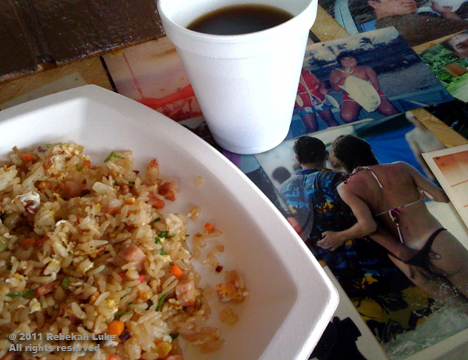
From this menu, though the other diners recommended the guava chicken, I tried the fried rice. It’s a sautéed mixture of onion, green onion, carrot, egg, bacon, Spam—all diced finely—rice, and (I think) a little oyster sauce.

Island fried-rice breakfast at the counter decorated with snapshots. Wow!

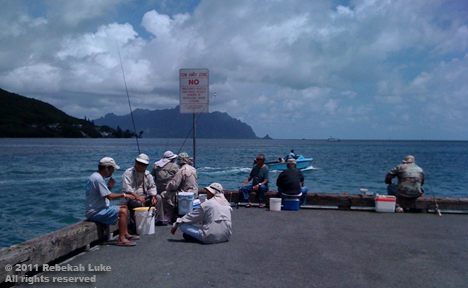
You can sit at the picnic tables or the small counter and listen to the folks talk story, or meander down the dock and watch the people fish for their own food. A man offered me some dried aku he made to go with my fried rice.

He‘eia pier

All this seems to fit in nicely with the message received from the “Chefs & Farmers Facing Future” food forum, organized by shegrowsfood.com and Leeward Community College, whose food service students wanted to give back to the industry that gives so much to them. The event brought together farmers, fishers, aquaculturists, ranchers, chefs, and media reps to explore promoting and using locally produced food for sustainability in our island communities.

The meeting started with the sobering fact that there is only about a 10-days’ supply of food here with most of it arriving by ship or plane.

What I took away from the meeting was the notion that to sustain we should form tighter communities and make new friends with our neighbors within them.

As the Hakka association that takes care of its clan. (My grandmother took care of her own family of 15 and neighbor bachelors by growing vegetables in her victory garden.)

Or the young creative chefs serving dishes with local ingredients, or the man who gave his fish to me, or my own developing garden that sometimes produces enough to share with the neighbors. It’s a great life.

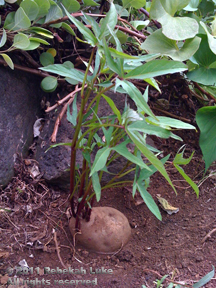
Sweet potato in my garden

Copyright 2011 Rebekah Luke


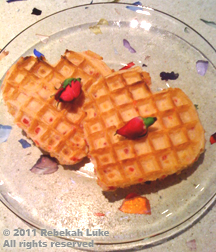
Be mine

14 02 2011

All my love. Happy Valentine's Day! xoxoxo


Calamansi marmalade

8 02 2011

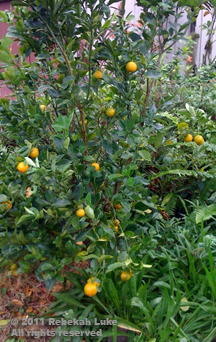
Calamansi tree with ripe fruit

Calamansi tree
flowering and bearing both.
Let’s make marmalade!

My father’s former caregivers grow a calamansi tree outside their back porch in Kahuku, Oahu, and they use the juice of this fruit in their Filipino cooking to season meats, fish, and noodles.

I was so happy to learn about it, I planted a tree of our own several years ago in the garden where it gets full sun and good drainage. Growing food is so satisfying!

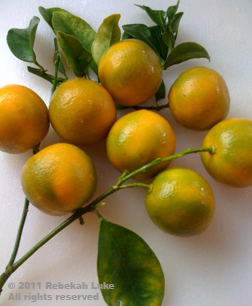
The botanical name is Citrofortunella microcarpa, sort of a cross between a kumquat and a mandarin orange, and it is native to the Philippines, according to my reading. The average diameter is slightly bigger than a quarter dollar. The flesh is tart, and the skin is sweet and thin.

Calamansi is believed to be a hybrid of a kumquat and a mandarin orange.

You can use it in cocktails in place of lime or lemon, and as the acid in a vinaigrette dressing. Yet, there are only so many cocktails one can drink and only so many salads one can dress.

When our tree starts bearing and the fruit begins to ripen, I make calamansi marmalade in the microwave, one small batch at a time.

I like marmalade with a lot of bitter peel, and I can’t always find it in the market. Calamansi preserves has the right amount of that flavor for me. It’s wonderful on toasted English muffins or on pancakes.

Here is my easy recipe, basically one part fruit to one part sugar. How sad that sugar is bad for our health. Calamansi marmalade is so delicious!

1 cup sugar + 1 cup calamansi

CALAMANSI MARMALADE

Have ready a clean glass jelly jar and lid. Either run them through the dishwasher or under hottest tap water and allow to drip dry. Wash and scrub 1 cup of whole ripe calamansi fruit with orange skin. Cut each fruit into fourths and remove seeds with the tip of the knife. Combine with 1 cup granulated sugar in a 4-quart glass measuring cup or similar microwave-safe container. Cover loosely with plastic wrap to catch splatters, leaving a vent so it won’t boil over into a mess. Place container in a larger dish to collect any syrup that does boil over. Cook in the microwave on full power for 7 to 10 minutes, stirring half way through to blend, until the calamansi appears cooked and shriveled, and until the mixture thickens but is still liquid. The mixture will be very hot. Using hot pads, carefully pour into the jelly jar. Put on the lid securely and refrigerate. As the marmalade cools, it will further thicken and gel into jelly and cause the lid to seal tightly. Keep stored in the refrigerator. Makes 1 cup.

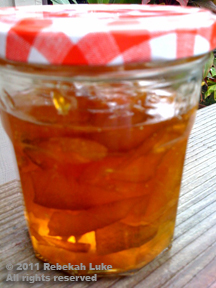
Beautiful homemade marmalade!

Copyright 2011 Rebekah Luke