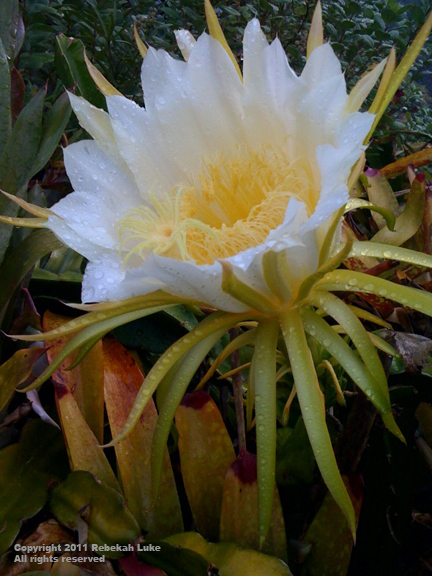
A treat for us this morning at the studio! Two cereus! Night blooming cereus, that is. You can probably expect to see me post images of these cactus flowers every season. They’re so dramatic, blooming only at night for one night only and closing at sun up. I sometimes paint them. Here they’re mixed in with some bromeliads.
Two cereus!
6 09 2011Comments : Leave a Comment »
Tags: cactus flower, night blooming cereus
Categories : Fine Art
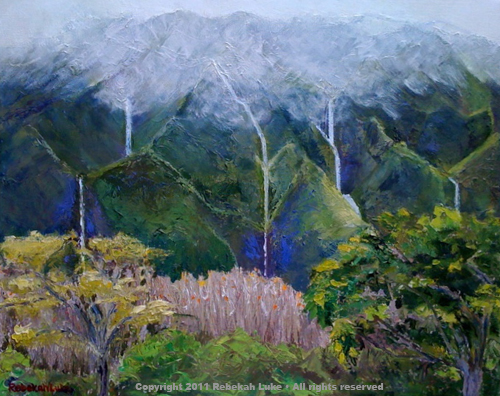
Clouds lifting over Lanihuli
5 08 2011I wonder if it is true that in olden times the waterfalls of windward Oahu ran all the time. Olden times meaning before water was diverted to the Ewa plain for sugar cane and land development. At the present intersection of Kahekili and Likelike highways, while waiting at a red light, a rain storm typical of our wet season had just stopped and the clouds lifted to reveal a spectacular scene of the Koolau mountains. I was on my way to Hoomaluhia Botanical Garden at Luluku and made up my mind to hold the vision in my memory so I could paint it. For in just a few quarters of an hour the sun came out again and the waterfalls disappeared.
UPDATE, September 11, 2011: As you will see in my 9/11/2011 post, I have made some changes to this painting, and I think you may like the finished work better. Thanks for visiting Rebekah’s Studio.
Copyright 2011 Rebekah Luke
Comments : Leave a Comment »
Tags: Hawaii, Hoomaluhia Botanical Garden, Koolau, Koolau Mountains, Lanihuli, Oahu, oil painting, waterfall
Categories : Fine Art, Hawaiian, Travel
Seven Polynesian voyaging canoes
25 06 2011In this lifetime I’ve witnessed the revival of the Polynesian voyaging canoe.
One time, a man I was married to—a newspaper reporter and a sail-boater (before DH)—was excited about meeting the artist Herb Kawainui Kane whom he had just interviewed.
He saw Herb Kane’s beautiful paintings of double-hulled canoes under sail. He learned of Herb’s dream to build such a canoe in Hawaii that would make a voyage across the Pacific to the land of his ancestors in the way that the Polynesians first came to the Hawaiian Islands. He had an idea of what the boats looked like, and he was in the process of figuring out how exactly how to build them.
The reporter had crewed for Rudy Choy, a naval architect, from California to Hawaii on the Aikane II, a modern 65-foot catamaran built for his sunset dinner cruise fleet, on its shakedown voyage. He introduced the painter and the naval architect to each other, and that was about the start of the Polynesian Voyaging Society that celebrated the now-famous Hokulea’s 1976 voyage from Hawaii to Tahiti.
I was young and just a “fly on the wall” at the time, but that tidbit is true and a treasured memory of mine.
You can find out about Polynesian voyaging on this Polynesian Voyaging Society website. For more than a generation the organization has educated our island youngsters and the public with the ancient knowledge of traveling across the ocean without modern navigation instruments. PVS has played a major role in showing Native Hawaiians their ocean heritage.

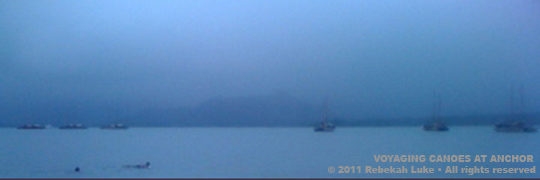
Six of the seven voyaging canoes at anchor in Kaneohe Bay at Hakipuu this afternoon. The blue-toned scene is from a rain squall.
Fast forward 35 years to yesterday afternoon when seven Polynesian voyaging canoes called at “Hokulea Beach,” within Kualoa Park on Oahu where Hokulea was launched originally. These seven canoes began their voyage from New Zealand and are on their way to North America. They sailed from Nukuhiva in the Marquesas on June 2 and called at other Hawaiian islands to the east before reaching Oahu.
It was a wonderful sight to watch them enter Kaneohe Bay. The canoes represent Tahiti, Samoa, Fiji, Tonga, New Aotearoa, New Guinea, Vanuatu, Kiribati, and the Solomon Islands and are sailing together in a voyage titled “Te Mana O Te Moana.”
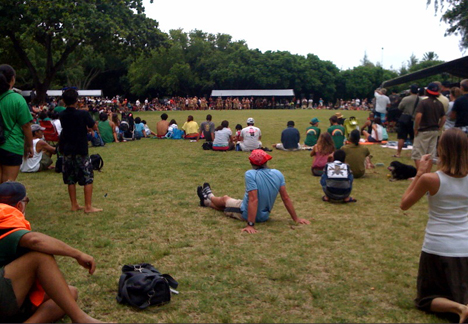
With sails furled and anchors down, the celebration continued on land today, with ceremonies, exchanges of greeting, singing, dancing, and eating.
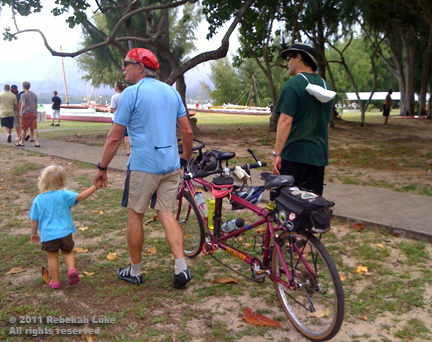
DH and I rode our tandem bicycle from the studio to take it all in.

Our tandem rig. Miss Marvelous and her dad, far right, are anxious to show her Papa (DH) the canoes.
Copyright 2011 Rebekah Luke
Comments : 1 Comment »
Tags: canoe, double hulled canoe, Herb Kawainui Kane, Hokulea, Polynesian Voyaging Society, Rudy Choy, Te Mana O Te Moana, voyaging canoe
Categories : About me, Fine Art, Hawaiian, Memoir
All pau & ready for market
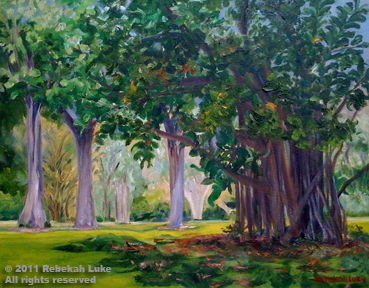
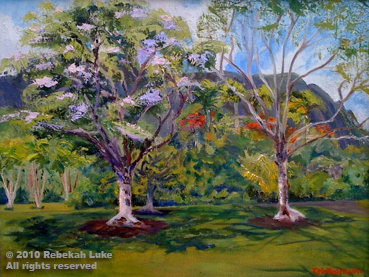
8 06 2011Pau means finished. I finished two more of my landscape paintings. More trees. Patrons tell me they like the way I paint them. “Banyan Shade” needs a final varnishing as soon as it’s bone dry. “Welcome Spring” is framed, wired, and ready to leave the studio.
Please click on the PAINTINGS menu tab for other available art work. Thanks for visiting!
Copyright 2011 Rebekah Luke
Comments : Leave a Comment »
Tags: banyan, garden, Hawaii, oil painting, tree
Categories : Fine Art, Hawaiian
Contributions by artists
8 06 2011Much of what I learned about the business of art I learned from my time with the Arts of Paradise, a fine art gallery at the International Market Place in Waikiki, that kindly represented me for several years.
Artists Susan Rogers-Aregger, Susan Brooks, and Connie Hennings-Chilton were the co-owners who sought two- and three-dimensional work by local artists and priced them realistically for the buying public. I thank them so very much.
When I co-founded Hale Kuai Cooperative with Ka Lahui Hawaii and we opened a storefront, I applied many of the management skills they taught me to running our store that sold Native-Hawaiian-made products.
During the early Arts of Paradise days, we had frequent requests to donate our work. The gallery encouraged artists to share the explanation reprinted below with whoever asked for a donation.
While cleaning the studio today, I found it on Arts of Paradise letterhead, but I recall that it was originally shared by the artist Ramsay. The information makes sense to me, and it is useful even today.
CONTRIBUTIONS BY ARTISTS
The artist is often asked to donate art to worthy causes as a “tax-deductible contribution,” as a “form of advertising,” as a “goodwill gesture,” and as “the means to increased community exposure.”
However, many artists and most solicitors are unaware that the IRS views contributions made by artists differently than those made by any other contributor. Artists are not able to deduct the appraised or fair market value of their work. Artists must enter the cost of materials as a business expense rather than a charitable contribution.
At a benefit art sale or auction, payment for contributed merchandise is made in the name of the charity. The purchaser makes a tax-deductible contribution and receives a work of art; the organization gains needed operating funds; the artist has one less asset, an added business expense, no charitable deduction, no income from the sale, a devalued reputation because the work sold at less than market value and has “increased exposure” to a group of potential patrons now conditioned to acquire art through donation rather than direct purchase.
This situation is particularly difficult for artists living in an insular community like Hawaii, where patrons are few and the cost of living is high.
Organizations who wish continued support from artists should adopt the following guidelines:
Artists submitting work to charitable organizations should provide the suggested retail price and receive fifty percent of that price upon sale; unsold work should be returned to the artist.
The names of contributing artists should be listed in promotional material and printed programs.
Artists should receive thank-you letters with their checks specifying the amount of their contribution, the actual amount of the art brought at auction, and the name of the purchaser.
This arrangement will enable artists to provide work of importance to organizations and the community, while uplifting the image of art in Hawaii.
Copyright 2011 Rebekah Luke
Comments : Leave a Comment »
Tags: art, artists, Arts of Paradise, business of art, contributions, donations
Categories : Fine Art
Native artists at the Bishop Museum
22 05 2011The enjoyment for today consisted of going to the Bishop Museum to show my oil paintings alongside other Native Hawaiian artists at the art mart that is part of the MAMo (Maoli Arts Month) Festival in Hawaii. It happens every May.
The Museum booked DH, who is a volunteer docent, to guide a group from a philosopher’s conference on a 1-1/2 hour tour of Hawaiian Hall, making it doubly worthwhile for the two of us.
Ten minutes before show time, we arrived to find our spot next to my artist friend Momi Greene who came from Hawaii island with her decorated ipu (native gourd containers).
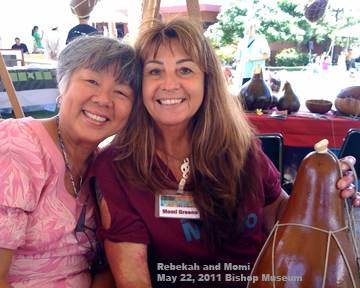
Me and my friend Momi Greene. Momi grows a native Hawaiian gourd and decorates them with carving and natural dyes she makes herself in the style that was done traditionally on the island of Niihau.
Years of art fence and craft fair experience paid off as we arrived ten minutes before show time, i.e. late. I saw some dark clouds as we drove over the mountain, and yes, we set up in the rain.
The paintings were fine; oil doesn’t like water. I just shake and blot them dry. DH staked the easels into the ground, and I attached extra ties, a good thing because gusty trade winds blew down from the valley throughout the day.
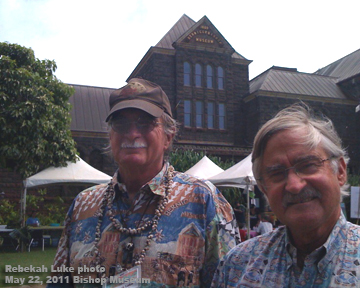
My brother-in-law Jon, in town from Oregon, came by to meet Momi in person because until today they had only been Facebook friends.
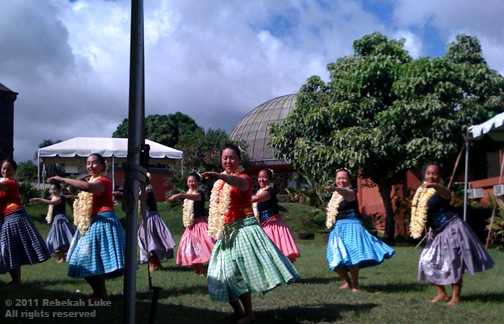
I loved the continuous live Hawaiian entertainment all day long.
DH and I made some purchases:
I bought—with cash from trading my no-longer-wanted gold and silver items—some things from other artists, including a nifty re-designed T-shirt. I always try to buy from other artists where I am selling. The designer, using scissors, cuts away parts of the original garment, slits holes in the knit, weaves in contrasting colors or ties the fabric in creative ways to make a one-of-a-kind top that is truly styling and all the rage at the Native Hawaiian art mart. I plan to post a photo of me modeling it soon!
Yesterday in a gust of wind one of Momi’s ipu broke. It looked like it could be glued, but she said she’ll stitch it back together, making the stitching part of the design and giving the ipu new life and a story. When I relayed that to DH, he immediately told Momi of our plans to take a trip to her island and that he wanted to buy the ipu after she stitched it. That piece would be really special and would she kapu (reserve) it for him, we’d pick it up next month.
She said, “Okay, do you want to see it first?” DH can be impulsive at times, but he’s a good buyer and appreciates fine Native Hawaiian-made artwork.
What I realized and appreciated the most at the end of the day was how much the art by Native Hawaiians has improved, including the marketing of it. If you are in Honolulu next May, please plan on attending some of the activities of Maoli Arts Month.
Copyright 2011 Rebekah Luke
Comments : 1 Comment »
Tags: art, Bishop Museum, Hawaiian, Honolulu, MAMo, Maoli Arts month, museum
Categories : Fine Art, Hawaiian, Travel, Uncategorized
Lanikai diptych
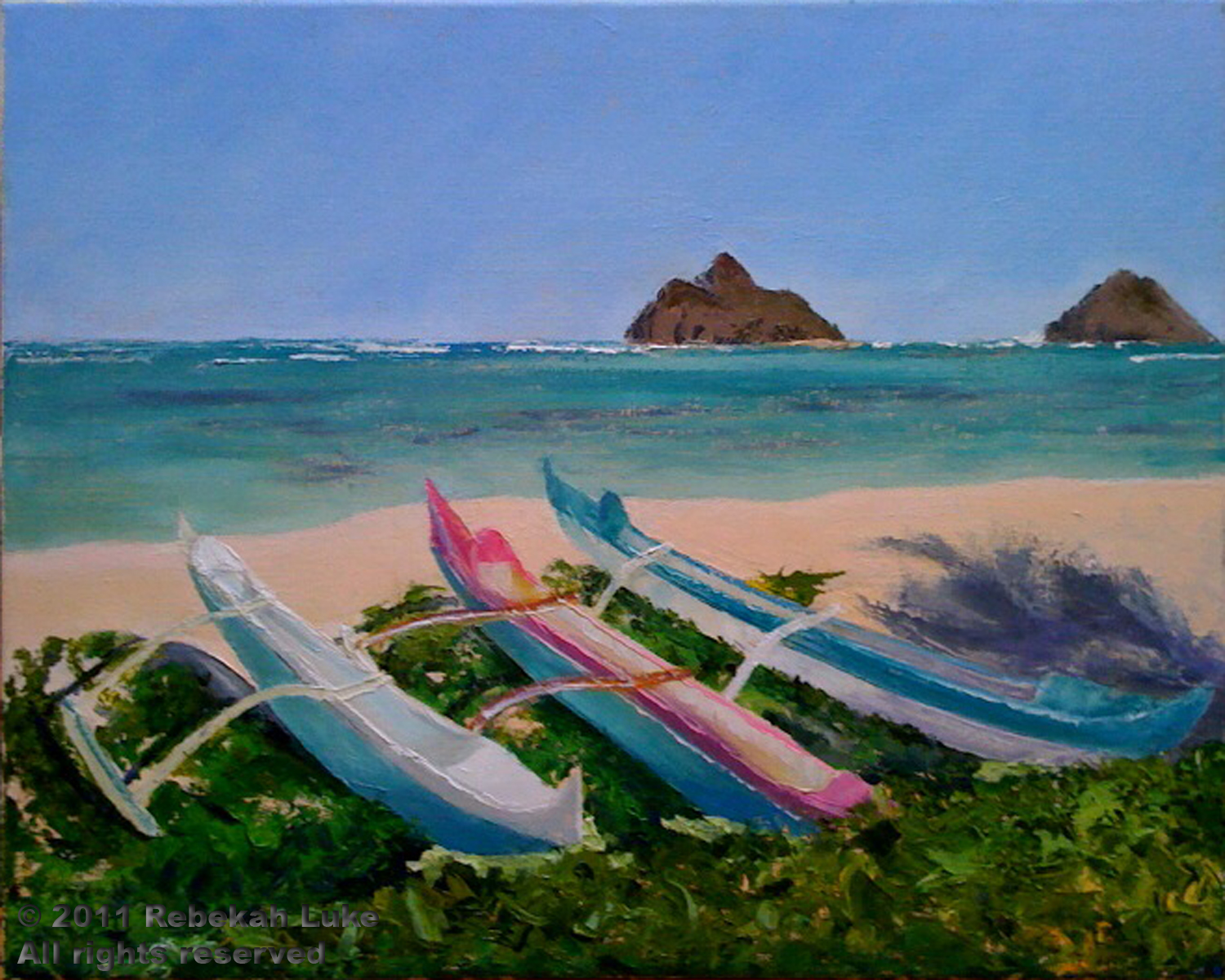
11 04 2011This is my finished painting of Lanikai Beach on Oahu. Oil on canvas. Each panel measures 20″ wide x 16″ high prior to framing. Beach goers are familiar with the iconic outrigger canoes, twin islands, and shady palms. This is the scene from Karl-and-Julie’s. I can’t wait for them to see it. © 2011 Rebekah Luke / All rights reserved
Comments : Leave a Comment »
Tags: beach, diptych, Hawaii, Lanikai, Moku Lua, Mokulua, Oahu, oil painting
Categories : Fine Art, Hawaiian, Travel


Recent comments