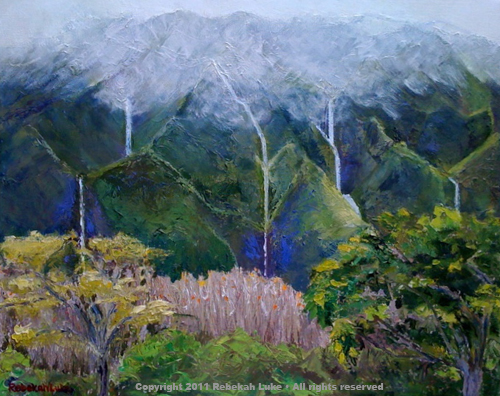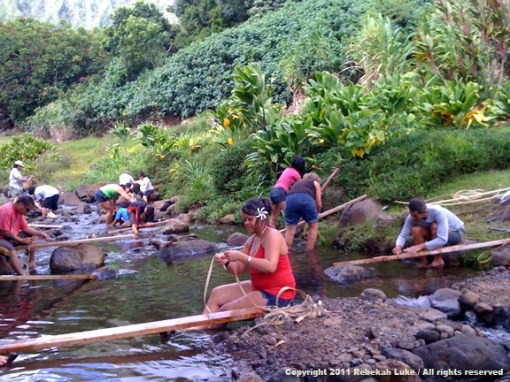
My oil paintings year by year

4 10 2011

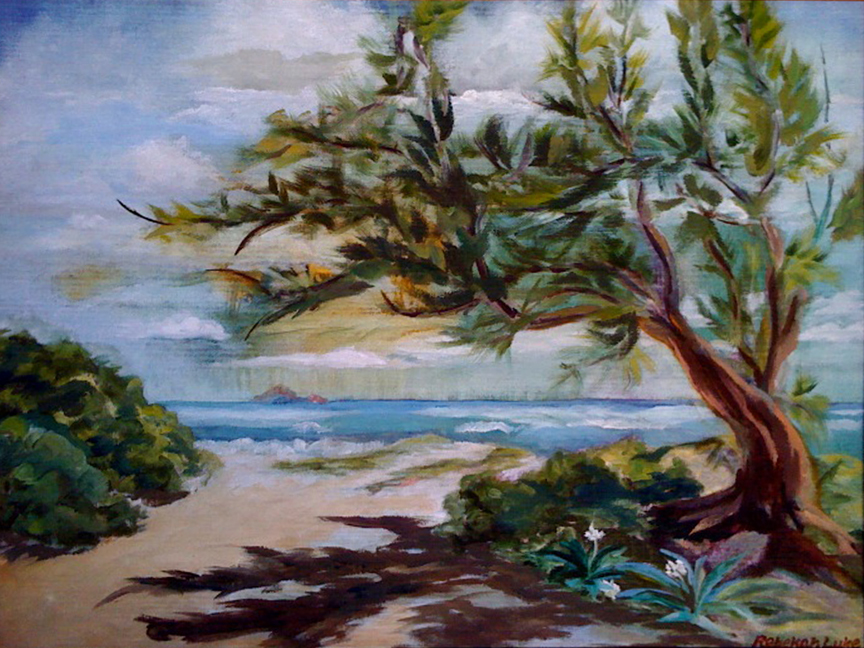
In my second year of oil painting, I did "Kalama Beach" on a canvas panel. 18" x 24". Ariel Krape Hylton Collection. © 1990 Rebekah Luke

Just a few more electronic images to gather, and my Retrospective Collection of paintings will be complete — for the time being. Most of it is installed at Rebekah’s Studio.

I presented “Kalama Beach” to my step-daughter about 20 years ago. When I went back to photograph the work for this collection, I saw I had attached an “artist at work” snapshot of her watching me paint at this very spot. (Sigh.) Time and place. Perhaps Miss Marvelous will inherit the piece one day.

To view more of the collection, just click on https://rebekahstudio.wordpress.com/retrospective-collection. It’s another look back! Thank you for visiting!

Copyright 2011 Rebekah Luke


This is Waipao (part 2)

25 09 2011

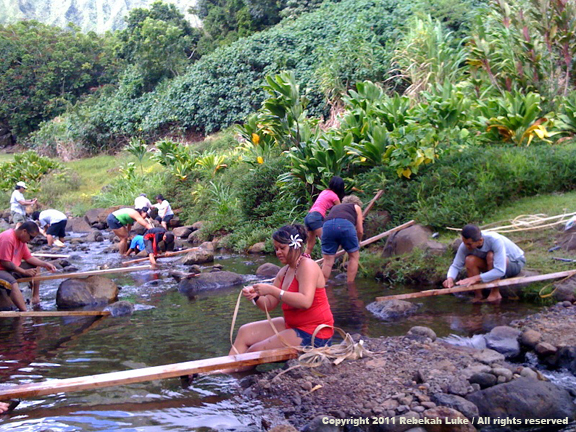
Hau cordage in the making. Hawaiians scrape to clean hau fiber by hand.

HAU KAULA (CORDAGE) WORKSHOP WITH KEN CHING

The foundation of native Hawaiian culture consists of the ability to fill three needs: containers to carry things like water and food, flaked stone for cutting, and cordage to fasten. These were necessary to build a Polynesian voyaging canoe that reached the Hawaiian Islands.

With that important bit of information, Ken Ching on Saturday showed a group of us the native Hawaiian way of making cordage from the bark of the hau tree (Hibiscus tiliaceus L.).

We gathered at Waipao, the site of Papahana Kuaola, on the banks of Haʻikū Stream on Oʻahu. The Papahana Kuaola organization is all about involving the community in environmental restoration and economic sustainability, while integrating native Hawaiian knowledge. Its activities center on cultural and natural history. It’s wonderful, pono (right), and maika‘i (good)!

Making cordage by hand is a way to learn about olden attitudes of living, said Ken. When one went for a walk, for example, it was to look for materials that were useful and could be appreciated.

Here is my photo record of the day. You can pretend you were there, or perhaps you would like to learn more about Papahana Kuaola from its website and visit there yourself.

I came away with a little feeling of what it was like to live in olden times. I thought, maybe this is how it used to be and can still be if we live with Hawaiian values, learn from our kūpuna, and be thankful and kind to each other. I was happy for the people who are restoring the ʻāina (land) of Waipao.

First are some images of this place, the ʻili (small land section) of Waipao in the ahupuaʻa (land division from the uplands to the sea) of Heʻeia, Oʻahu.

Hāʻikū Stream at Waipao
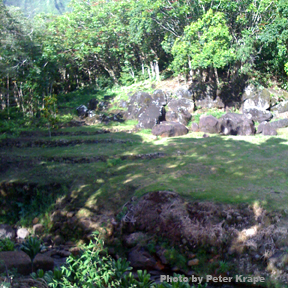
Terraces and pohaku (stones) near the stream
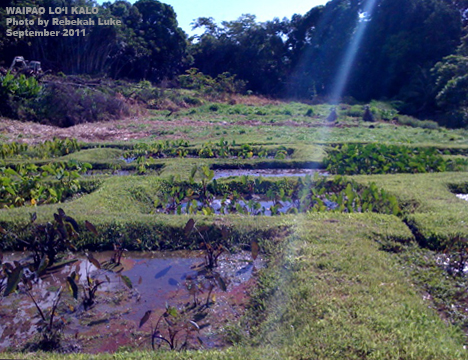
Loʻi kalo (taro gardens) in different growth stages. Notice more land being cleared in the distance. Lunch included a delicious stew made with foods grown at Waipao.
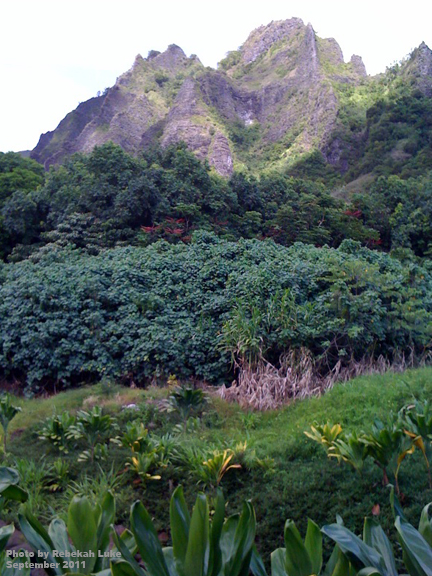
The band of green across the equator of the photo is the hau thicket from where we gathered the raw material.

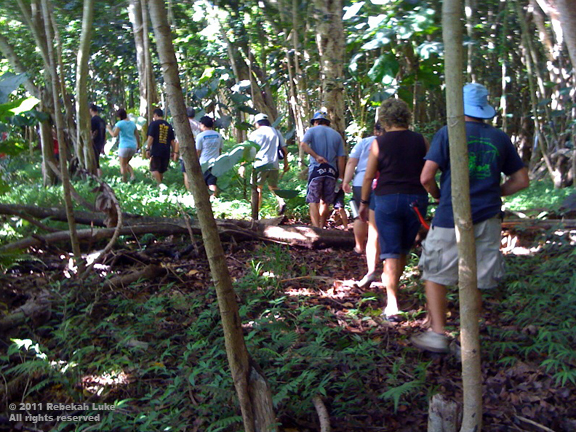
Into the forest we went to cut hau ʻili kea (young branches with light-colored bark).
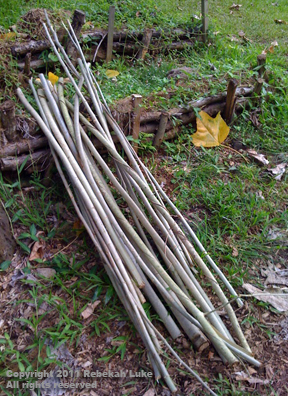
Freshly sawn hau branches waiting to be stripped of their bark
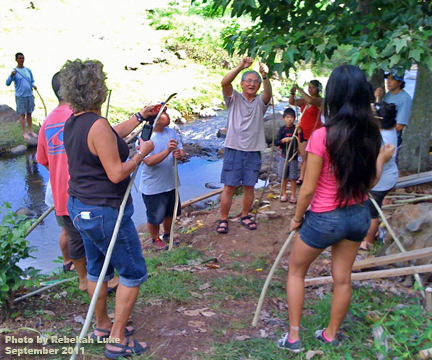
Our kumu Ken Ching demonstrates the right way and the less desirable way to pa‘e (strip) hau bark.
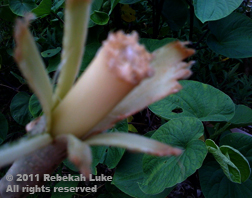
Peel away both the outer and inner bark by pulling down and "close to" the branch (as opposed to "away from") and from the top down, our kumu said. Discard the inner branch. (The leaves in the background are ʻawa (Piper methysticum), not hau.)
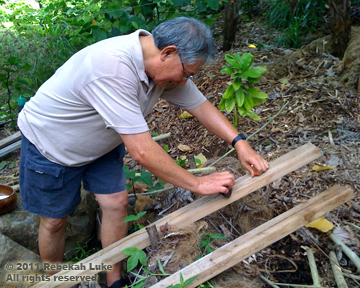
Kahi the wale (scrape the slimey goo away). Ken sets the bark on a 2 x 4 and scapes it using long strokes from top to bottom, pressing hard. Fresh water, such as from a stream or city faucet, will result in a brown fiber. To preserve the whiteness of the fiber, use salt water to soften and wash away the wale (looks like mucus).
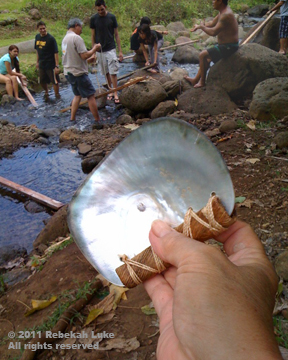
Shell scraper to comb out the wale (slime goo) of the bark.
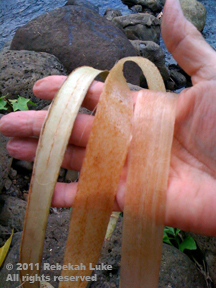
L to R: Improperly stripped hau bark; mid-way stage of scraping; still slimy and not white enough, i.e., there are more brown areas left to scrape out.

Back indoors and after some lunch Ken showed us how to grade the fiber and twist it into cordage.
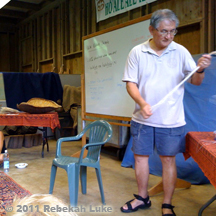
Ken Ching with a bundle cleaned hau fiber ready for twisting into cordage.
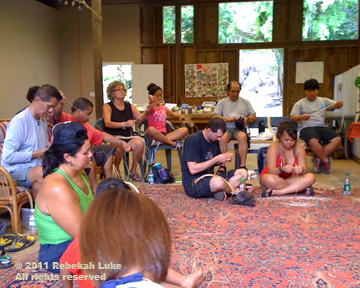
Separating the fiber and preparing to twist into cordage. Clue: You roll the fiber between your palm and your thigh with one hand, and twist with the other. It takes some practice.

Kaʻalua na kaʻakolu: Our kumu Ken made this beautiful hau cordage. He made more like it for the double-hulled sailing canoe Hawaiʻiki. It was an honor to learn from a master.

Copyright 2011 Rebekah Luke


This is Waipao (part 1)

24 09 2011

Hāʻikū Stream at Waipao

I went to Waipao today. So fulfilling. Waipao is an ‘ili (small land section) of  the ahupua‘a (land division extending from the uplands to the sea) of He‘eia on the island of O‘ahu. A Hawaiian cultural educational organization named Papahana Kuaola offered a workshop in how to make cordage from the bark of a hau tree (Hibiscus tiliaceus L.). An old friend, Ken Keola Ching, was the kumu (teacher). DH, my friend Piʻi and I had not seen Ken since our days together in Hale Kū‘ai Cooperative, so that was another reason to go.

The band of green across the middle of the photo is the hau thicket from where we gathered the raw material. Beyond are the Koʻolau Mountains.

Our kumu Ken Ching demonstrates the right way and the less desirable way to pa‘e (strip) hau bark.

In my next post I’ll show more photos of the ‘āina (land) where Papahana Kuaola is working on environmental restoration and sustainability while integrating traditional Hawaiian knowledge.

You’ll see the fun we had learning how to make hau kaula. It was a lot of work and gave us a greater appreciation of the culture and the days of old.

It was a first for me—turning hau plant fiber into cordage. Reflecting on the day’s activity, I can say, I made it myself!

Copyright 2011 Rebekah Luke


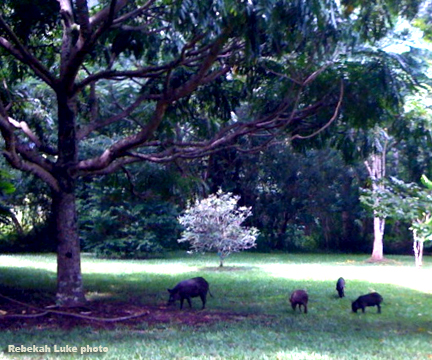
Four wild pigs

22 09 2011

Never know what’s in store for me when I go into the landscape to make a painting. This morning these wild pigs enjoyed the area at Luluku as much as I did.

Copyright 2011 Rebekah Luke


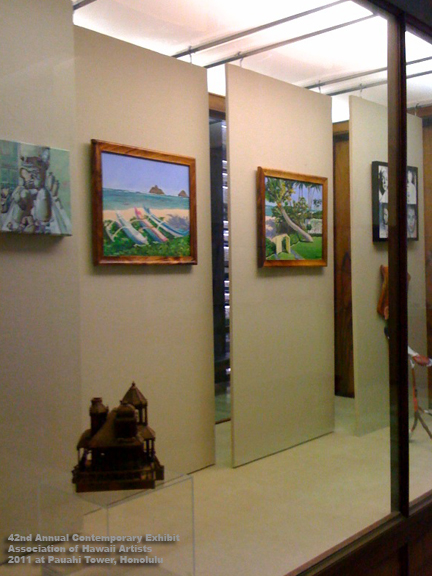
Lanikai on display at Pauahi Tower

20 09 2011

I've never had my art displayed in a glass case before. Love it!


Latest artworks on view in Honolulu

17 09 2011

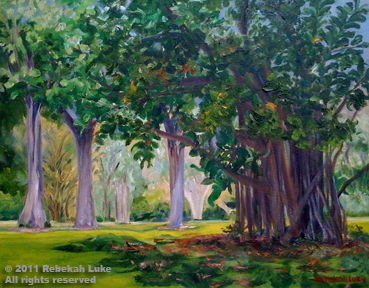
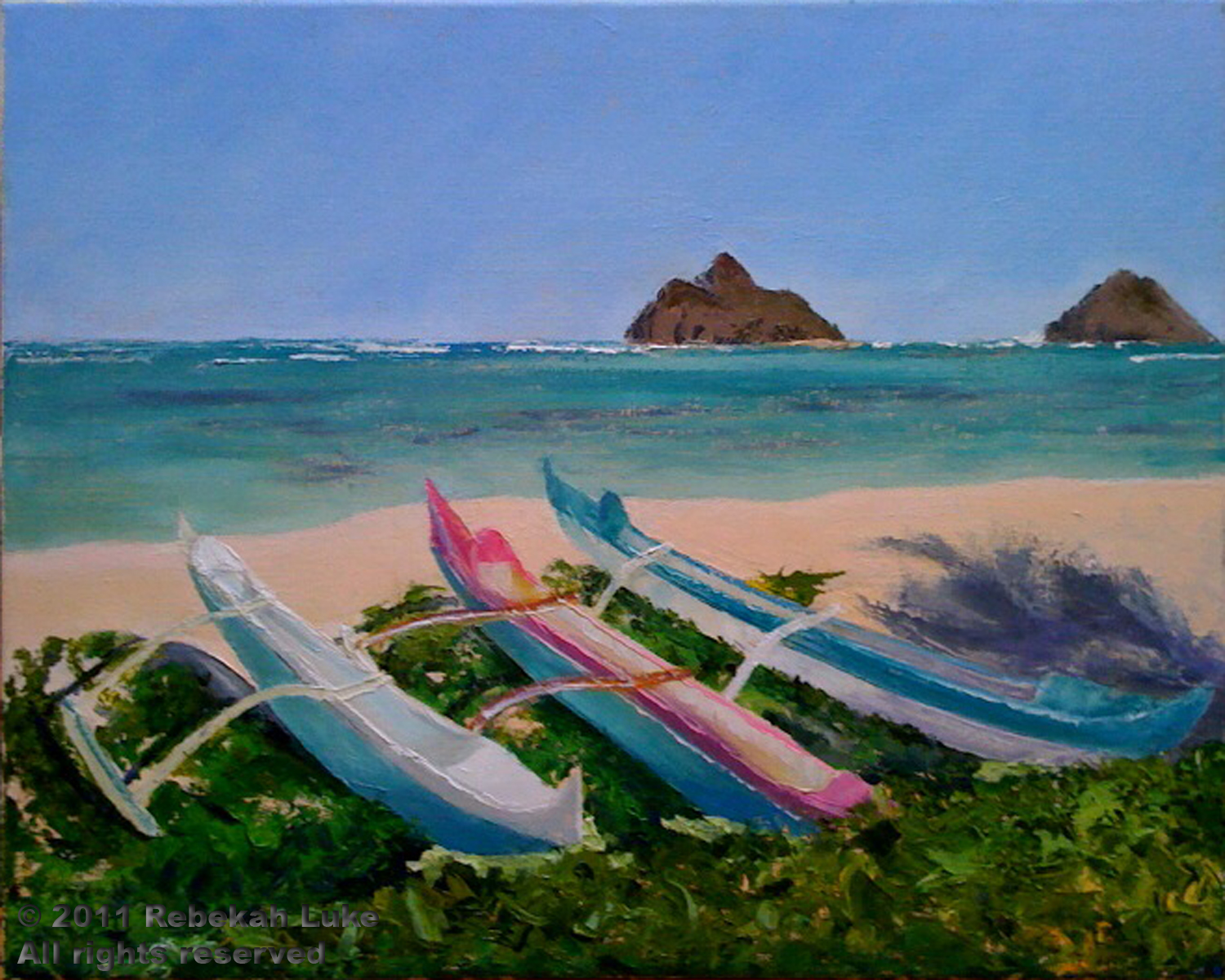
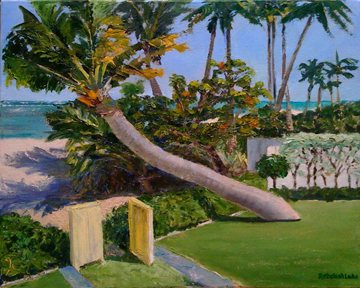
Hello Art Lovers! “Banyan Shade” and “Lanikai Diptych” made it into the juried show of the Association of Hawaii Artists this morning. Ta dah! These are my most recently framed original oil paintings made this year.

Banyan Shade, 16" x 20" Oil on Canvas, $600.00

Having my work selected for a public exhibition encourages me to keep going, and I’m thankful a large audience will see it.

I installed “Banyan Shade” in a dark wood frame. I framed the two panels of “Lanikai Diptych” in a beautiful solid curly koa. (And when is curly koa not beautiful?! ;-))

Come take a look. The art is for sale and will be on display through October 14, 2011. Here’s the rest of the 411:

Event—The 42nd Annual Contemporary Exhibit of the Association of Hawaii Artists; Antoinette Martin, juror.

Dates—Sept. 19-Oct. 14; M-F 8 a.m. to 6 p.m., Sat. 8 a.m. to 2 p.m. (Sunday closed)

Place—Pauahi Tower, 1001 Bishop St., lobby level, downtown Honolulu.

Reception—4:30-6:30 p.m., Sept. 27. You’re invited! Recommended parking is at Alii Place (cheaper rates).

Please let me know if you wish to purchase my original art for your private collection, and I will work with you on a payment plan.

"Wa'a Kolu, Moku Lua," 16" x 20" Oil on Canvas, left panel of "Lanikai Diptych," $1,400.00 for 2 panels

"Julie's Coconut Tree," 16" x 20" Oil on Canvas, right panel of "Lanikai Diptych," $1,400.00 for 2 panels

Copyright 2011 Rebekah Luke


Remaking an oil painting

11 09 2011

As an oil painter I’m often asked, “How long does it take to finish a painting?” In the same vein artists will remind each other, “You have to know when to stop.” We like to avoid overworking a piece.

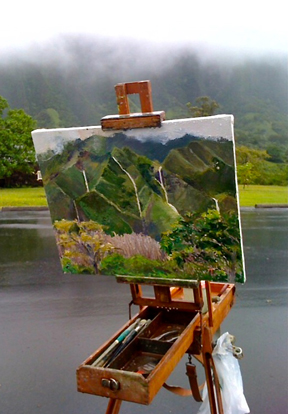
My “Clouds Lifting Over Lanihuli” demonstrates these points. First is a photo of the painting mid-way, in the field. On a clear day, there are no waterfalls in the scene, but just after a big rain when the clouds lift, there they are! To paint en plein air I headed to this place to study the scene when it was raining, time after time. I took this snapshot from the trunk of my hatchback where I’d taken shelter.

In the field, in the rain

I wanted so much to finish the painting. Below is what I published, i.e., what I thought was ready for market, a few weeks ago. Oils take a long time to dry—up to six months before they can be varnished. In the meantime I can look at a painting every day. As I kept staring at this piece (it’s staged above the TV cabinet) something bothered me. It wasn’t finished.

Not quite finished

I decided to correct the areas of the painting that were “wrong.” In a representative piece, although it is impressionistic (I label my style as “impressionistic representationalism”) I want to paint a scene so that it looks logical.

To really finish and complete this painting, I did three things:

1) I added pigment to the center clouds area to hide the waterfall behind it.

2) I widened the same center waterfall at the bottom because it is closer to the viewer (and so should appear larger).

3) In addition, by very very carefully scraping with the long edge of a palette knife, I knocked down some objectionable relief areas I originally painted of the mountain ridges at the top and touched up the clouds to make them softer and smoother looking.

“Clouds Lifting Over Lanihuli” looks better now. I hope you agree!

Finished: "Clouds Lifting Over Lanihuli," 16" x 20" oil on canvas

Copyright 2011 Rebekah Luke