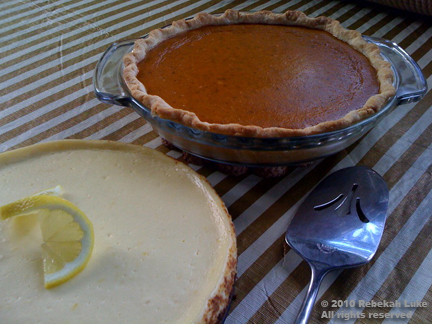
Warm and sweet Thanksgiving Day wishes to all. Tonight's feast ends with lemon cheesecake and traditional pumpkin pie. Yup, I baked 'em!

Warm and sweet Thanksgiving Day wishes to all. Tonight's feast ends with lemon cheesecake and traditional pumpkin pie. Yup, I baked 'em!
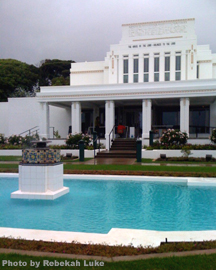
A look at the interior of Laie Hawaii Temple with two special visitors to the studio.
My glee club sisters Nani and Rae came to see my paintings yesterday! In planning the day, Nani invited me to join them for a visit to the Mormon temple in Laie afterward. It is newly renovated, and it is open for public tours through November 13 (closed Sunday). An open house!
Note: After the temple is re-dedicated on November 21, it will be closed to the public, so yesterday’s viewing was a rare opportunity for us. You can make a reservation to see it by phoning 1-866-537-8457.
None of us three are Mormon, but we were curious to see the temple interior and interested in hearing why the Church of Jesus Christ of Latter-day Saints builds temples and what the LDS beliefs were.
Clear signs from Kamehameha Highway in Laie directed us to the parking lot. There, ushers greeted us with white umbrellas for the rain and escorted us to a series of white tents for an orientation video, that gave a brief history of the Mormon religion, and for some remarks on what to expect on the 25-minute walking tour through the temple.
At the last minute I saw two familiar faces. My former project assistant Kura, ever cheery :-), and her husband joined our group. Kura and David were married in the temple before the current renovation, and this was their first time to see the new look.
Before entering the front door, volunteers gave us booties to cover our shoes.
Once inside, a husband-and-wife team (we have now been greeted by seven church members) guided us through the halls and different rooms. There was an usher at every turn and doorway. Near the end of the tour I asked how many people staffed the milestone open house event. The number varies with the day and time of day or night, but all LDS members on the island of Oahu are involved, I was told.
For the uninitiated, an informative brochure explains that LDS members have churches, chapels, and other meeting facilities for their Sunday worship services and weekday activities. The temple, however, is considered to be the most sacred place on earth. It is reserved for LDS members who are worthy in the eyes of the church. Then, the more one visits the temple to study, the closer one can become to God.
On entering, I am immediately impressed with the superb wall-sized paintings, art glass windows, and bas-relief panels in the waiting area. It is like being in an art museum. (Think Elgin marbles of the British Museum in London.) More large and fine paintings line the hallways and lovely murals line some of the rooms.
All of the interior space is very beautifully decorated, welcoming, serene, peaceful. Actually, it is divine, and designed to feel ethereal. (Think HGTV’s “Divine Design” with Candice Olson). I had a similar lightness of feeling touring Catherine Palace just outside of St. Petersburg, Russia. Tastefully grand. The temple, however, is much smaller, more intimate, and not ornate like the palace. Perhaps the way the art is treated reminds me of Catherine Palace.
What happens in the temple? LDS members believe in the Book of Revelations, eternal life, and are interested in their ancestors and their progeny, i.e., one’s family’s past, present, and future; hence, their dedication to genealogy research. In the temple one may perform baptisms for one’s ancestors who have died. A couple may seal their marriage and can have their children sealed to them forever. As one advances in the teachings given in the rooms for instruction on the commandments, one may grow spiritually closer to God.
Furnishings of hardwood, soft green upholstery and drapes, crystal chandeliers, gold leaf inlay, sculpted carpeting, white calla lilies, excellent craftsmanship — these decorated a waiting room, the men’s changing room (one must change into white clothes while in the temple), a bride’s dressing room, a baptismal font, instruction rooms, a sealing room, and the white celestial room at the top.
After the open house tour we were escorted to the refreshment tent for cookies, and Kura and David cordially chatted with us and answered our questions. Thanks, Nani, for inviting me. And thanks to the LDS church members for a pleasant and educational afternoon.
Rev. Rebekah Luke is ordained by the Universal Life Church that has two tenets: “freedom of religion” and “do the right thing.”
The studio and its surrounding garden of fruit trees and raised vegetable beds is not my choice for a toddler to play in, so I’ve cleared out the heliconia under the avocado tree to plant a soft thick green ground cover of clover with Miss Marvelous in mind. She likes to explore and play in the outdoors.

Those following the progress of Miss Marvelous may see what she looks like at 16 months this September. I snapped this image in the car on a shopping trip. She loves shopping!
The heliconia patch was there since purchasing our place. It has survived with not much care for more than 26 years. When the patch was full and thriving, gathering the fallen avocados in August was like hunting for Easter eggs in a forest.
Off and on since trimming the plants to the ground I’ve dug up roots, runners, sprouts, as well as rusty iron pieces from the old VW bug, now in its last disintegration phase.
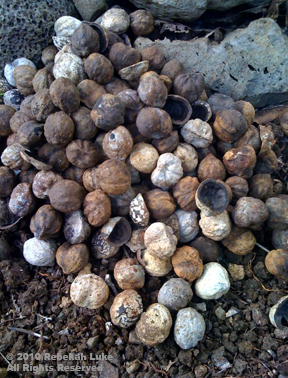
Just by running my fingers through the coarse soil, I found lots of old, old kukui nuts, whole ones and halves of different colors—black, brown, white, multi—from the neighbor-in-the-back’s tree on the other side of the panax hedge. They were easy to find, a meditative search akin to shell seeking. In all our years here I never gathered many.
Today I thought I’d rescue the nuts for my friend Kamakea who turns them into jewelry, and I saved them for her.

The kukui fruit with its outer skin covering or husk still intact. On the tree they are a gray-green color.
Next I looked for kukui nuts that were freshly fallen for another friend, Cathy, who makes inamona, a roasted nutmeat relish mashed with paakai (salt) and used in Hawaiian cuisine.
It is a long process to prepare inamona, about as long as it takes to make kukui nut jewelry. Cathy said, as long as the outer covering is still intact, it’s good for inamona. Kukui nuts are seasonal, and they are starting to fall now.
Sure enough, in and among the fallen dried leaves in the corner of the lot were these round fruit. So I scooped those up too. When I have a few more, I’ll deliver them to Cathy.
The kukui tree (Aleurites moluccana) is amazing. It has many uses. It is a canoe plant originally brought to the Hawaiian Islands by Polynesians who arrived here by canoe. You can spot the tree in the mountains by looking for light, mint-green-colored leaves.
In Hawaiian culture the kukui is one of the kinolau (forms taken by a supernatural) of the Hawaiian pig god Kamapuaa; the shape of the leaf resembles the head and ears of a puaa (pig). Freshly plucked leaves with stems on are arranged together by knotting the stems make beautiful lei (wreaths). In laau lapaau (Hawaiian medicine), the mashed kernel, as in inamona, is a laxative and prescribed for relieving constipation.
It is often called the candlenut tree. Kukui means light. Hawaiians skewered the oily kernels and burned them for light. The oil is the preferred oil for polishing wooden utensils for food, such as umeke (bowls) and platters. You can now find the oil on the commercial market as a cooking oil and in cosmetics.
The kukui tree also provides wonderful shade. Mahalo e ke Akua! Combined with the canopy of the avocado tree and a ground carpet of hardy clover, I envision a delightful play space for Miss Marvelous. She’ll just have to duck during the month when the fruit fall.
Hello Family (Mom’s side),
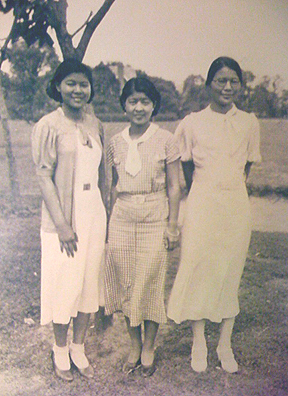
While reorganizing and recycling things from the studio, I came across this photo. The handwritten caption reads, “The 3 sisters — who is the tallest? My pumps didn’t help to make me the tallest. Ha! Ha! June 9, 1935.”
Beloved Aunty Yun is at the far right, Aunty Inez is in the middle, and at first glance I identified the sister on the left as my mother, age 18. But looking again, is it she? Maybe, maybe not.
In the 1930s after my grandfather Chong How Kong died, my grandmother Siu Chin and many of her 14 children and their young families went to China from Hawaii, mostly as tourists. Some taught at the university level or worked. With my Uncle Fan’s and Aunty Yun’s tuition and room & board support, my mother went to the University of Shanghai to study music, English, and education.
They were all there until World War II broke out in China, and they made their way back to the Islands. Otherwise they may have stayed in China, and probably I would not be here. Mom continued her college education at the American Conservatory of Music in Chicago, returning to Honolulu to teach and direct music when she finished.
My mother was a member of the Mid-Pacific Institute Class of ’34. According to J. H. Kim On Chong-Gossard’s writing, our family genealogist, she traveled alone to Shanghai in September 1935. If she is in the photo, then one of the dates is wrong.
I emailed the photo to Cousin Millie, asking what she thought: Fo-Tsin (my mother) or Lois (Millie’s mother)? For Lois was in Shanghai too. Of course neither I nor Millie was born yet. I just haven’t seen a picture of my mom that full of face, but perhaps at 18 she was heavier than I’m used to seeing her in other photos. I usually recognize her high angular cheek bones. Photographers loved using her as a model.
While waiting for Millie’s opinion, I went through mom’s letters, photos, and other papers I still can’t throw away, even though I have no real heirs to save them for. I guess I’ve saved them for me, for a day like today.
I found one of her report cards from the University of Shanghai dated February 19, 1935. Another records that she entered the U. of Shanghai in Spring 1935.
I also found a letter she wrote to Aunty Nyuk in California, dated January 12, 1934, from Peiping [now Beijing]. Aunty Nyuk kept all of the correspondence, and after she died, the letters found their way to me. With all of my 14 aunties and uncles and their spouses now passed, it’s like piecing together a puzzle to get a fuller picture.
Some things are nice to keep. Unless Cousin Millie thinks that’s Lois on the left, I’ll gladly say, that’s my mom and my aunties!
Epilogue: Millie says not her mom.
. . . AND SOME HAWAIIAN PLACE NAMES
Not only am I lucky to live in Hawaii, I’m lucky to live in Hawaii to go sailing!
This past Labor Day DH and I spent most of the day on Kaneohe Bay off Oahu with our good friends Ken and Georgia aboard their 38′ sloop Mariah.
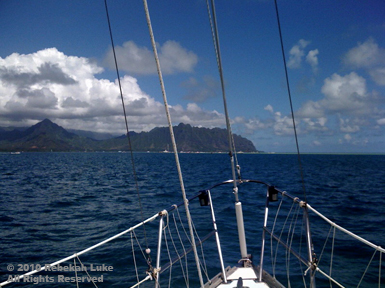
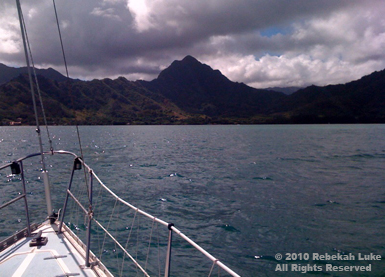
We sailed with main alone, and not having a headsail up meant wider unobstructed views of the shore. This is the view from the bow after leaving the yacht club mooring and passing Moku o Loe (aka Coconut Island). Puu Ohulehule is the triangular peak on the left, and the peak and ridge named Kanehoalani is about 10 degrees to port (left) of the bow.
We’re headed toward Ahu o Laka, a 3.1 acre islet off Kahaluu popularly known as “the sandbar” that is awash at high tide. It’s a popular destination for boats and various water craft on weekends and holidays, and last Monday it was a “zoo!” We opted to sail on by to a quieter spot farther north to anchor for lunch and some kayaking before continuing on to Hakipuu and Kualoa.

Passing the sandbar, from left, Georgia, DH, and skipper Ken. The hill beyond the sandbar in the distance on the left is Puu Hawaiiloa.
Kaneohe Bay is full of reef and shallow areas. In addition to spotting the white reef stakes, the red and green channel markers, and noticing landmarks, local knowledge is a must for piloting one’s way to where we were going. No worries, skipper Ken knows the way!
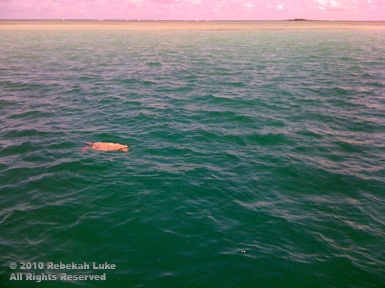
We sailed among a herd of honu (turtles), big ones. Every few minutes we passed another one. Fresh breeze, calm sea. What a lazy afternoon!
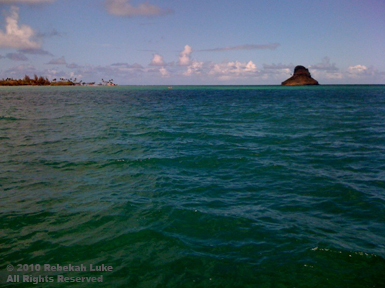
Soon we could make out Mokolii . . .
. . . and some activity at Hakipuu and Kualoa.

The tallest peak and the ridge extending diagonally left to right from the peak down to the flat land are Kanehoalani. The ridge points to Puu Hawaiiloa across the bay. Hakipuu is on the left of the ridge, and Kualoa is on the right.

Sailing in to Hakipuu beneath majestic Puu Ohulehule. Local knowledge required. We're careful to not run aground!
Ken tells us this little piece of paradise in Kaneohe Bay is just like Tahiti. You wouldn’t have known it was Labor Day weekend.
Hi Everybody,
Our 2010 avocado season is one of the better. These luscious gems are overhanging the healing space near the studio right now.
It’s an awesome sight to me. I can just reach up and pluck them to eat, in about 7-10 days. They will be so yummy. This year there are twice as many than years past.
Who knows why, but I’m not complaining. Is the big old rusting anchor next to the tree finally providing enough iron? Or ditto the VW bug left there by DH 20 odd years ago? Did my cleaning out the heliconia patch allow it to breathe more? Or did the March winds blow off fewer flowers? Perhaps the tree liked the fertilizer left by the chickens and the peacocks.
My neighbors have beaucoup limes on their tree, so likely we will trade and make guacamole. But most of the time I prefer eating avocados with a spoon plain, in their own natural bowl, all the way to skin, with just a little salt and pepper.
Click below for related posts, then click on your back button to return to this page
Avos and cocos October 11, 2009
Gratitude for my abundant garden September 8, 2009
Recent comments