Hana hou: ukulele and family history

23 10 2011

Excited and inspired this morning!

What with a fun day yesterday at the Waikiki Shell with DH and my friends. We went there to join hundreds of others in an attempt to break the Guinness world record for the most number of ukulele players playing the same song together in the same venue. With none other than ukulele artist extraordinaire Jake Shimabukuro leading.

And connecting with my first cousin once removed J.H. Kim On Chong-Gossard to collaborate on a sequel to The Chong Family History.

Nope, we didn’t break the record. 😦 There were a little more than 1,050 ukulele players, and Hawaii needed a little more than 1,500. The Waikiki Shell has seats for 1,958.  The current record? It’s held by Sweden! Even though we failed at the Guinness thing, the effort raised a lot of money for charity. I guess we’ll have to hana hou (do it again). http://www.gofordarecord.org informs all about the effort and the event.
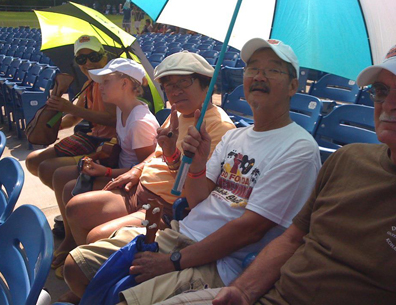
We're waiting for the attempt to begin AND for people to fill up the seats behind us. These are my friends Colleen, Skyler, Pi‘ikea, cousin Nathan, and DH. It was in the heat of the day, and we waited until the last minute to take out our ukulele so the instruments wouldn't be damaged (so advised Nathan who is a luthier). Bottom line: we had fun!

Of course we were surprised that more people didn’t turn up for this, especially with the social media capability that we have now. I guess one can’t just post something on the internet. You have to tell people that you posted and how to find the information. And remember that not everyone “does” the internet.

Which brings me to my cousin. I call him Jim. Around the studio, behind his back but within earshot, we call him Teddy Bear Jim in honor of his vast collection of the stuffed toys. He calls himself K.O. for Kim On, that was his grandfather’s name, that he asked for and took legally. Jim is our family genealogist.

He’s on vacation from the University of Melbourne where he teaches, to crank out a book in time for our family reunion in August 2012, or at least do the research in a couple three of weeks time.

The first time he did this was 20 years ago, and The Chong Family History told about five generations, starting with my maternal grandparents who met at an orphanage in China. Jim would come here from America as a student on his spring and winter school breaks and interview our large family. My Chong Hee Books publishing company was born, and we held our first family reunion.
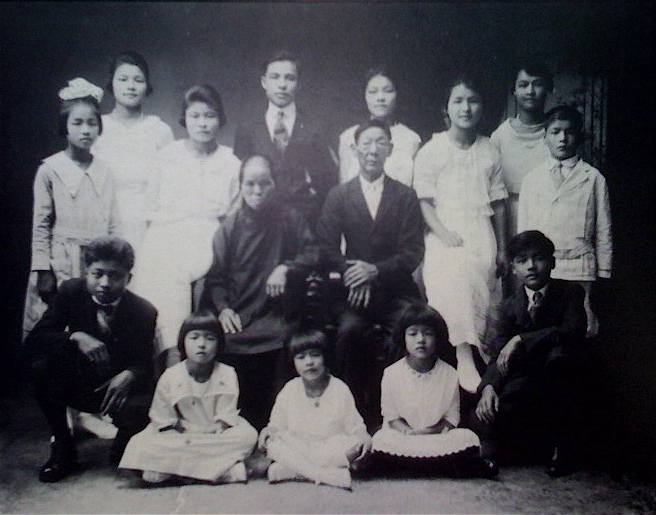
My maternal grandparents and 13 of their 15 children in Kohala. My mother, seated front row and center, was the baby of the family. Jim's grandfather is standing, far right. All of these ancestors have now passed. They comprised the first and second generations. Today, generation number six has shown up. We'll have a big reunion in 2012.

Publishing was not as computerized as it is today, so I am excited at the prospect of how more creative we can be with the sequel update, and perhaps even making it available as an ebook.

I can’t wait to see Jim in person on Tuesday. Meanwhile we are tossing ideas back and forth wirelessly. I am so proud of him. He got a new cell phone and joined Facebook—finally!

Copyright 2011 Rebekah Luke


Something old, something new

14 10 2011

New addition to my collection — hand-carved wooden sculpture, approx. 3.75″W x 3.5″H x 3.5″D

This small, dark wooden sculpture of a seated man bent over with his hands covering his face caught my eye at a silent auction earlier this month. I picked up the piece — smooth, curved, with interesting hand-carved detail all around, about the size of a large softball. The man appeared to be created from a single piece of pretty-grained hardwood.

He felt comforting to hold in my hands. Really interesting. I showed it to a friend looking over my shoulder who mentioned it was a Buddha. But I’d not seen a Buddha like this before. He wore a loin cloth, and his legs were crossed, but not in a lotus position. I couldn’t see his eyes. In any case, I thought he would complement my Kwan Yin statue.

I dared to place my bid. Nothing to lose unless I won. DH muttered, “Too low.” At the end of the day, nothing. “Oh well,” I thought. A full week later, the Daughters of Hawaii who had presented “A Day at Queen Emma Summer Palace” and ran the auction phoned. I’d won!

When I asked, the museum had no information about the item to give me, and I was still unfamiliar with this figure. My friends at dinner — I’d rushed to claim the prize on my way to meet Susan and Becky in Waikīkī — had not seen him either as I pulled out my treasure from the bottom of my handbag, but they agreed he felt good to hold.

Later that evening I Googled “man bent over with hands in face statue”. It turns out he is “The Weeping Buddha” who “takes away the grief and troubles of the world. In return, he bestows peace and provides strength to all those who rub his back.” Did you know about The Weeping Buddha? http://www.buddhagroove.net/television/ My cousin Paul who’s a frequent visitor to Japan said smaller versions are very popular as netsuke.

I’ll be rubbing my Weeping Buddha’s back every day. 😉

P.S. As I get ready to publish this post, I notice as of this moment there have been 20,035 visits to Rebekah’s Studio. Thanks, everybody, for stopping by! ~ RL

Copyright 2011 Rebekah Luke


A cherished family photo

2 10 2011

1949

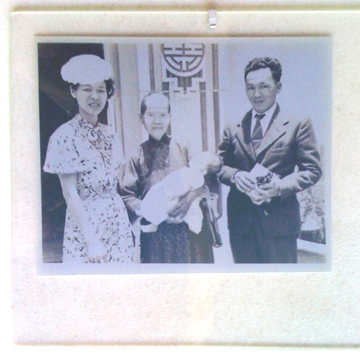
Just traveling down the layers of memory lane this morning. Nah, just kidding. I don’t think I really remember the occasion of my birth, though I might try. I’m looking for a photo for the Timeline on my Facebook profile page. How about this one? It shows my Chinese mother Fo-Tsin, my maternal grandmother Siu-Chin carrying the infant me, and my Hawaiian-Chinese father Arthur. 

The new Timeline starts with the display type “Born.” (I’ve been playing with the preview version, so there’s a chance when it’s released tomorrow — allegedly — it may be different.) “Born” looks a little lonely all by itself. While remembering that Facebook can only manage my information if I provide it, I think it will be fine to share this image, even though I’m now revealing my age.

The Timeline feature will likely have Facebook fans in a tizzy about privacy. I think the new tools are fun. People who work it right can essentially write their obituary using the Timeline. Then family members and friends won’t have to research their lives when the time comes. At least that’s how I see it!

Or you can stretch your creativity and tell a different story. Facebook’s idea is that the more we share with each other, the more “social” we are, the more we will become One.

Copyright 2011 Rebekah Luke


Pampered by a fried egg sandwich

27 09 2011

It’s easy for me to feel pampered down at the fishing pier.

10:30, after my workout in Kāneoʻhe, in the mood for a late breakfast, I stop at He‘eia Pier once again. I’m monitoring my food intake for several reasons, but today, after reading the menu, I feel I can have an egg: Fried Egg Sandwich $4.

But like I said, I’m pampered.

In a few moments Chef Mark calls out: Rebekah, would you like anything else on it? Some cheese?

Me: Um, no, do you have any lettuce?

Chef: Tomato would be good.

Me: Okay!

Chef: A little mayonnaise?

Me: No thanks, and please hold the cheese.

Now why, you might ask, don’t I just fix my own egg sandwich at home?

On a beautiful day in Hawaii like today, I can sit at the outdoor picnic table on the waterfront and be mesmerized by the Ko‘olau Mountains I love to paint and the sound of the sea lapping the shore. I can eavesdrop on the old-time regulars and watch the boats come and go to drop off and pick up polite Japanese tourists. It’s peaceful.

When my order comes out, I see beautiful food art neatly cut in two triangles. I don’t have to step up to the pick-up window for my plate. Chef delivers it personally to the table.

Bread toasted perfectly, just how I like it. Egg fried perfectly, but not greasy, with just the tiniest bit of runny yolk. Tomato slice and sprigs of . . . purslane!

I would have shown two thumbs up when Mark checked back—it seems he always makes it a point to acknowledge the customers—but one hand was putting the sandwich in my mouth. And I’m sorry, I ate everything before I thought of taking a picture.

WHEN YOU GO

• Be willing to park on the far side of the boat ramp and walk if there are no spaces closer. The Deli is open for breakfast and lunch, closed on Monday.

• Have no expectations except to expect to wait for your order. Allow yourself to be surprised. He‘eia Pier Deli is not a fast food joint. It’s the most welcome addition to local cuisine kicked up a couple notches where the chef and crew take care of windward Oahu residents.

• Feel good that you are supporting the local Hawaiian economy.

Copyright 2011 Rebekah Luke


This is Waipao (part 2)

25 09 2011

Hau cordage in the making. Hawaiians scrape to clean hau fiber by hand.

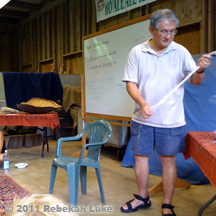
HAU KAULA (CORDAGE) WORKSHOP WITH KEN CHING

The foundation of native Hawaiian culture consists of the ability to fill three needs: containers to carry things like water and food, flaked stone for cutting, and cordage to fasten. These were necessary to build a Polynesian voyaging canoe that reached the Hawaiian Islands.

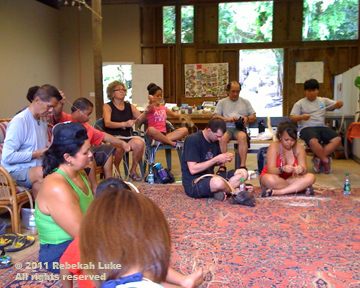
With that important bit of information, Ken Ching on Saturday showed a group of us the native Hawaiian way of making cordage from the bark of the hau tree (Hibiscus tiliaceus L.).

We gathered at Waipao, the site of Papahana Kuaola, on the banks of Haʻikū Stream on Oʻahu. The Papahana Kuaola organization is all about involving the community in environmental restoration and economic sustainability, while integrating native Hawaiian knowledge. Its activities center on cultural and natural history. It’s wonderful, pono (right), and maika‘i (good)!

Making cordage by hand is a way to learn about olden attitudes of living, said Ken. When one went for a walk, for example, it was to look for materials that were useful and could be appreciated.

Here is my photo record of the day. You can pretend you were there, or perhaps you would like to learn more about Papahana Kuaola from its website and visit there yourself.

I came away with a little feeling of what it was like to live in olden times. I thought, maybe this is how it used to be and can still be if we live with Hawaiian values, learn from our kūpuna, and be thankful and kind to each other. I was happy for the people who are restoring the ʻāina (land) of Waipao.

First are some images of this place, the ʻili (small land section) of Waipao in the ahupuaʻa (land division from the uplands to the sea) of Heʻeia, Oʻahu.

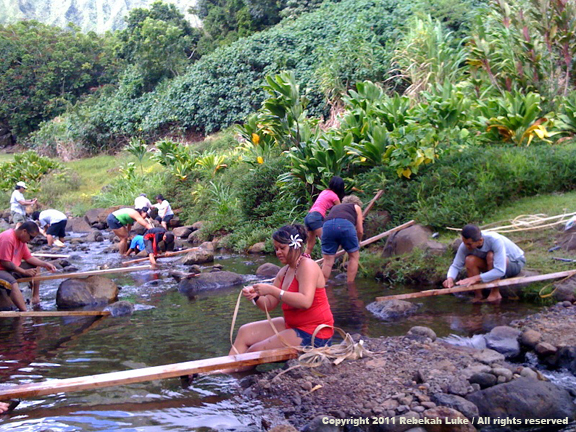
Hāʻikū Stream at Waipao

Terraces and pohaku (stones) near the stream

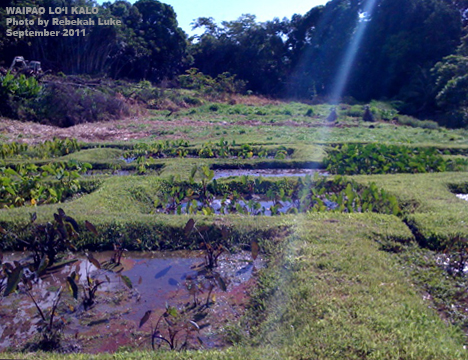
Loʻi kalo (taro gardens) in different growth stages. Notice more land being cleared in the distance. Lunch included a delicious stew made with foods grown at Waipao.

The band of green across the equator of the photo is the hau thicket from where we gathered the raw material.

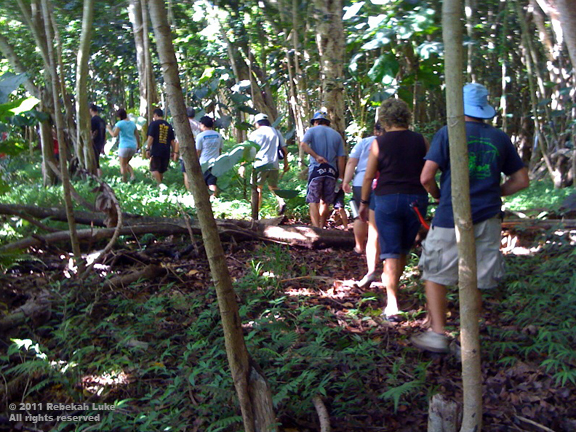
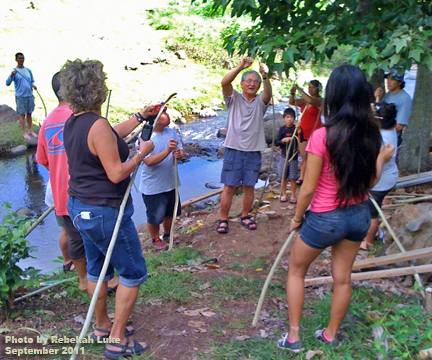
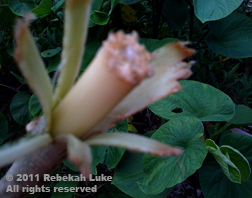
Into the forest we went to cut hau ʻili kea (young branches with light-colored bark).

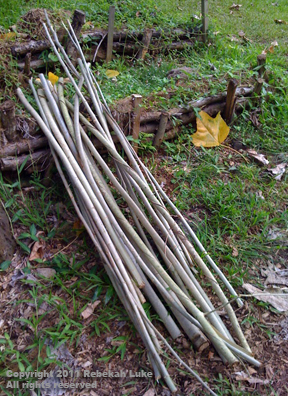
Freshly sawn hau branches waiting to be stripped of their bark

Our kumu Ken Ching demonstrates the right way and the less desirable way to pa‘e (strip) hau bark.

Peel away both the outer and inner bark by pulling down and "close to" the branch (as opposed to "away from") and from the top down, our kumu said. Discard the inner branch. (The leaves in the background are ʻawa (Piper methysticum), not hau.)

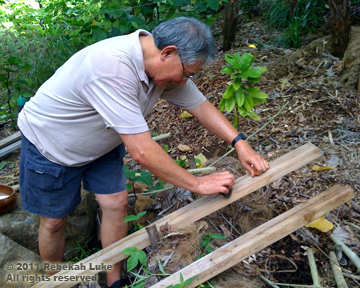
Kahi the wale (scrape the slimey goo away). Ken sets the bark on a 2 x 4 and scapes it using long strokes from top to bottom, pressing hard. Fresh water, such as from a stream or city faucet, will result in a brown fiber. To preserve the whiteness of the fiber, use salt water to soften and wash away the wale (looks like mucus).

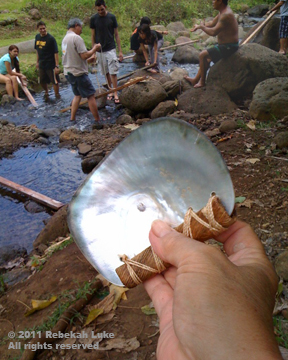
Shell scraper to comb out the wale (slime goo) of the bark.

L to R: Improperly stripped hau bark; mid-way stage of scraping; still slimy and not white enough, i.e., there are more brown areas left to scrape out.

Back indoors and after some lunch Ken showed us how to grade the fiber and twist it into cordage.

Ken Ching with a bundle cleaned hau fiber ready for twisting into cordage.

Separating the fiber and preparing to twist into cordage. Clue: You roll the fiber between your palm and your thigh with one hand, and twist with the other. It takes some practice.

Kaʻalua na kaʻakolu: Our kumu Ken made this beautiful hau cordage. He made more like it for the double-hulled sailing canoe Hawaiʻiki. It was an honor to learn from a master.

Copyright 2011 Rebekah Luke


This is Waipao (part 1)

24 09 2011

Hāʻikū Stream at Waipao

I went to Waipao today. So fulfilling. Waipao is an ‘ili (small land section) of  the ahupua‘a (land division extending from the uplands to the sea) of He‘eia on the island of O‘ahu. A Hawaiian cultural educational organization named Papahana Kuaola offered a workshop in how to make cordage from the bark of a hau tree (Hibiscus tiliaceus L.). An old friend, Ken Keola Ching, was the kumu (teacher). DH, my friend Piʻi and I had not seen Ken since our days together in Hale Kū‘ai Cooperative, so that was another reason to go.

The band of green across the middle of the photo is the hau thicket from where we gathered the raw material. Beyond are the Koʻolau Mountains.

Our kumu Ken Ching demonstrates the right way and the less desirable way to pa‘e (strip) hau bark.

In my next post I’ll show more photos of the ‘āina (land) where Papahana Kuaola is working on environmental restoration and sustainability while integrating traditional Hawaiian knowledge.

You’ll see the fun we had learning how to make hau kaula. It was a lot of work and gave us a greater appreciation of the culture and the days of old.

It was a first for me—turning hau plant fiber into cordage. Reflecting on the day’s activity, I can say, I made it myself!

Copyright 2011 Rebekah Luke


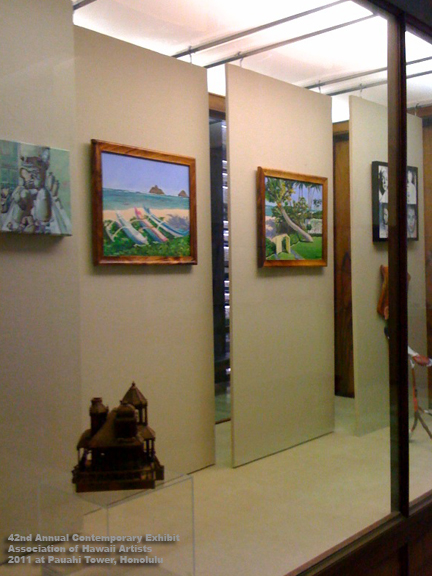
Lanikai on display at Pauahi Tower

20 09 2011

I've never had my art displayed in a glass case before. Love it!