Taiji for health

18 11 2009

The WCC Taiji Class had a lovely visit from its master Alex Dong this week. He is a fourth generation Taiji master who was born in China, moved to Hawaii as a boy and attended school here. From Hawaii he moved to New York City and opened schools in many parts of the world. He travels from school to school.

I’ve been attending the class at Windward Community College in Kaneohe on the island of Oahu for only about three years. Class is twice a week and tuition is $40 a month. Once or twice annually, Master Dong returns to teach weekend workshops from which we learn the finer points of the Taiji form, that is “Dong Style Orthodox Taiji” evolved from the Yang and Hao styles.

When he’s not in town, his senior students or appointed teachers lead the class. Students may advance their study during the various workshops taught by Master Dong wherever in the world he gives them. Many combine the workshops with vacation travel abroad—New York, Greece, Italy, Croatia, Czech Republic, Brazil, Great Britain, China, Hawaii, for example.

To become more acquainted with Taiji, I’ll refer you to the website alexdongtaiji.com. There I read that Alex Dong comes from a family of Taijiquan masters. His great-grandfather, Grand Master Tung Ying Jie was the national champion of China for many years, and he was a leading disciple of Yang Cheng-Fu, the main proponent of the modern Yang Long Form. Tung Ying Jie also studied with Li Xiang Yuan who was a disciple of Hao Wei Jing founder of the Hao style Taiji. Alex Dong’s grandfather, Grand Master Dong Hu Ling, spread the art in Southeast Asia and the United States, and his father, Grand Master Dong Zeng Chen, is world famous for his skills, especially in Taiji push hands.

Taiji had been recommended to me for exercise, and I do think my health has improved since I began. Balance, concentration and memory, strength, breathing (I am asthmatic, but less so now), energy, grounding, flexibility, posture—these are just some of the aspects of mind, body, and spirit that Taiji addresses.

To give you an idea of how whole Taiji is, I asked the master sifu (teacher) what he did to cross train. He replied, “Nothing. Only Taiji.”

So far I practice all three sections of the slow set and the sabre (knife) set; I practice between classes, read articles and books, and watch the videos of the master performing. My first Taiji teacher Lois explained that learning Taiji is like peeling away the layers of an onion. That is so true! A warm “Thank you!” to all of my teachers.

At this stage of my practice, I have a personal interest in relating the energy work of Taiji to Qigong to Reiki and healing.

For related posts, please see my 9/3/09 entry “Learning about energy healing.”  From the menu bar, Reiki Healing by Oelen, tells about my Reiki practice.

Copyright 2009 Rebekah Luke


Artist sketches in oil

30 09 2009
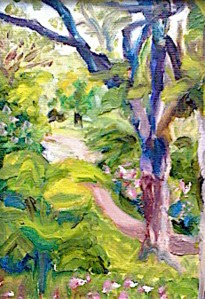
Looking Down Upon the Path - 5"x7" oil on canvas

Looking Down Upon the Path - 5"x7" oil on canvas

Usually I sketch a scene before blocking it out on a larger canvas. This drawing is like a dry run. Sometimes I sketch in oil. Sometimes I like the sketches better than the larger paintings. “Blue Koolau Mountains” and “Looking Down Upon the Path” are two examples made from the Hoomaluhia Botanical Garden Visitor Center on Oahu in the area called Luluku. This is a lovely place to visit, walk, and camp if you want to up your green quotient. I’m going out there again tomorrow. On Friday 10/2, I will be at the Pohai Nani health fair from 9 to 1 with my Reiki table. Come for a demo with Oe-Len. There’s a fabulous view of the mountains.  ~ RebekahBlue Koolau Mountains by Rebekah Luke

Blue Koolau Mountains - 5"x7" Oil on Canvas

Copyright 2009 Rebekah Luke


Alii Sunday at Kawaiahao

31 08 2009

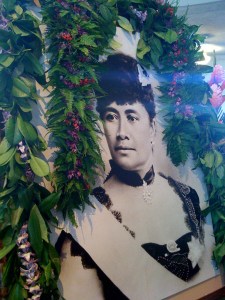
Liliu's portrait

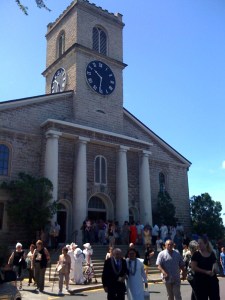
Yesterday was Alii Sunday at Kawaiahao Church in Honolulu, honoring Queen Liliuokalani (b. 1838-d. 1917), sister of King David Kalakaua. She reigned as the last monarch of Hawaii from 1891 to 1893 when she was overthrown. Her birthday is September 2.

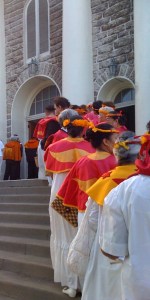
Each Alii Sunday, the Hawaiian Royal Societies and other ahahui (Hawaiian clubs) walk in the  processional, and the front pews are reserved for them.

Yesterday I attended as a member of the Koolauloa Hawaiian Civic Club with Kamakea, our vice president. We rode in to Honolulu with her son Kaimana, who is a member of the Royal Order of Kamehameha I.

This post shares the highlights for me. You may wish to go sometime. Visitors are welcome to Sunday worship service. Portions are in the Hawaiian language. Kawaiahao is part of the United Church of Christ.

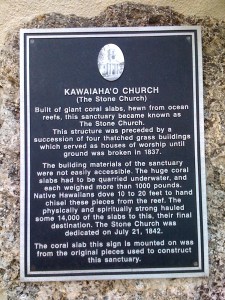
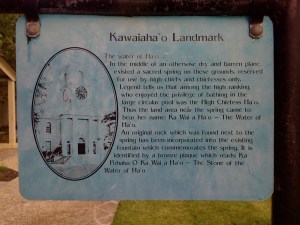
Kawaiahao Church is on the corner of King and Punchbowl streets. A plaque describes its construction

Kawaiahao Church is on the corner of King and Punchbowl streets. A plaque describes its construction.

Kawaiahao plaque

The Hawaiian Royal Societies, or Aha Hipuu, are a special sight. They include:

Royal Order of Kamehameha I who wear red and yellow capes over black suits. The different patterns and lengths of the capes indicate rank.

• Hale O Na Alii O Hawaii, whose members wear white with red and yellow capes. Hale O Na Alii O Hawaii at Kawaiahao

Ahahui Kaahumanu, whose formal attire consists of black muumuus, black hats and deep-yellow lei resembling feathers.

Ahahui Mamakakaua—Daughters and Sons of the Hawaiian Warriors wear black with red, black, and yellow capes (some capes have green).

Other groups who were represented on Alii Sunday were the Daughters of Hawaii in their pure white hats and muumuus (they operate the Queen Emma Summer Palace), the children of Queen Liliuokalani Children’s Center (QLCC is supported by Liliu’s estate, and its beneficiaries are the orphan and destitute children in Hawaii with preference to those of Hawaiian ancestry), and the Association of Hawaiian Civic Clubs that strung crown flowers into 52 strands of lei to drape on the statue of Queen Liliuokalani at the Hawaii State Capitol following the service.

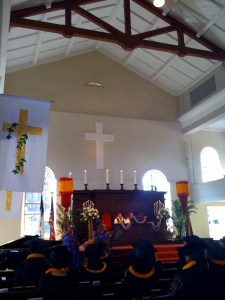
Crown flower was Queen’s favorite. The lavender blossom drapes the left side of her portrait, at the top of this post, and the altar in the next photo.

Kawaiahao interior


At left are the Ahahui Kaahumanu ladies in their formal black in the foreground. Aunty Ilima and Aunty Millie in purple muumuu sing Liliuokalani’s compositions, “Tutu” and “Paoakalani.” [See comment below.]

The church service itself was more lively and less formal than the congregational ones I attended in high school, about the last time I went. Admittedly, that was a few decades ago!

Kalowena gave a tribute to Queen Liliuokalani, and in her remarks she wondered, if Liliu’s time and our time coincided, would Google have given her an edge in maintaining Hawaii’s place in the world? Would her compositions be on iTunes, and would she be blogging and twittering?

This Sunday there was frequent applause, lots of “Amens” by the whole congregation, a testimony by a recent member for the sermon, and a hip-hop dance performance of the Black Eyed Peas’s “Where is the Love” by the youth ensemble. Apart from the pipe organist and choir in the back balcony, there was an ohana (family) choir of anyone else who wanted to sing from the front of the church.

Until she became Queen, Liliuokalani led the Kawaiahao Church choir. She composed more than 150 songs. Some were lyrics only, some were melodies without lyrics, and the rest were full arrangements. At Sunday’s service we sang “The Queen’s Prayer.” A fitting recessional was her “Aloha Oe” now famous around the world. I felt so sad.  ~ Rebekah

[See comment at the bottom.]

If you go …

Do view the 20 original portraits in oil painted by Susan S. Hoffstot entitled “Alii of Hawaii — The Hoffstot Collection” that are displayed on the walls of the right and left balconies. These were a gift from the artist and her husband William H. Hoffstot, Jr., “… to the glory of God, the honor of the Hawaiian people and the enrichment of the State of Hawaii” and dedicated on September 2, 1973.

[UPDATE: The portraits were painted by Patric Bauernschmidt, not Susan S. Hoffstot. Please read the comment by Patric’s granddaughter André below.]

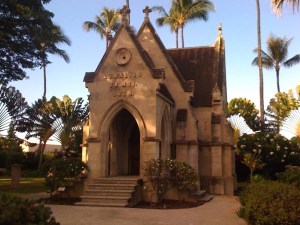
In addition to the church building are other historical structures. One is the tomb of King Lunalilo. Read the plaque explaining why Lunalilo is not buried at the Royal Mausoleum with the other monarchs.

Lunalilo's tomb

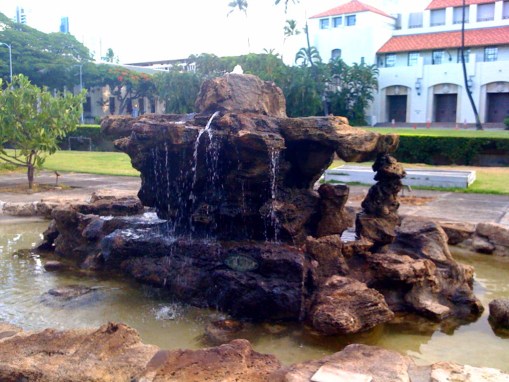
Another is a fountain on the King street side of the church. That’s the Library of Hawaii and Honolulu Hale city hall in the background.

Kawaiahao fountain

Kawaiahao fountain sign

The motto translates, "The life of the land is perpetuated in righteousness."

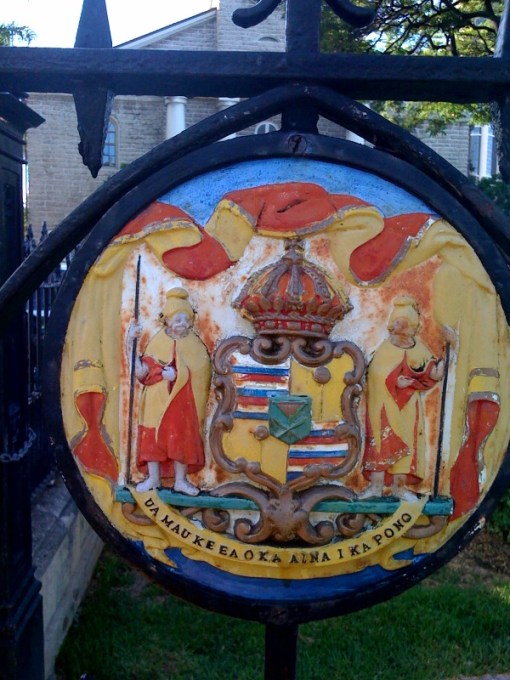
And a third is the seal on the gate to Lunalilo's tomb. "Ua mau ke ea o ka aina i ka pono." This motto became the Hawaii state motto, and it means, "The life of the land is perpetuated in righteousness."

Copyright 2009 Rebekah Luke

Rev. Rebekah Luke has a healing ministry and is ordained by the Universal Life Church. The only two tenets of the ULC are “Freedom of religion” and “Do the right thing.” For more information, click on REIKI HEALING BY OELEN on the menu bar.

Suggested reading:

Liliuokalani. Hawaii’s Story by Hawaii’s Queen. Mutual Publishing, 1991. ISBN 978-0935180855 Paperbound.

Liliuokalani, Her Majesty Queen. The Queen’s Songbook. Honolulu: Hui Hanai, 1999. Edited by Dorothy Kahananui Gillett and Barbara Barnard Smith. ISBN 0-9616738-7-7 Clothbound Edition and ISBN 0-9616738-8-5 Paperbound Edition.


Flowing like water

28 08 2009

I visited the People’s Republic of China twice, once in 1978 with my father on a special cultural tour from Honolulu, and again in 2005 with my Sunset foodie friend on, what else?, a custom eating tour! Like all first-time visitors to China, we were impressed by the modes of transportation, the humongous population, and the bad traffic in the cities.

In 1978 the people traveled by one-speed bicycle, I recall. Valerie of our group arranged to meet relatives of friends outside the Friendship Store where only tourists were allowed to shop, and where the goods were of export quality. They gave her some money, she went inside, and in a few minutes she emerged wheeling a brand new bicycle. The family was overjoyed and so grateful. It was like getting a new car, I guess, or, perhaps greater, getting one’s first car. At that time, even if I knew how to ride a bike, I don’t think I would have, for fear of getting smooshed or yelled at in Chinese in the peloton. Except unlike a peloton, the Chinese didn’t seem quite as orderly, so how would I merge into the traffic in the first place? Let’s just say all those bicycles were awe inspiring.

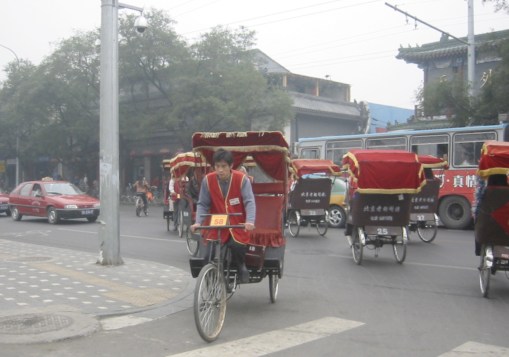
In 2005, things had changed, of course. Capitalism and automobiles had arrived. Not as many bicycles—although still enough for darling husband’s jaw to drop. Like describing the ocean surf, I informed, “You should have been here when”— and where were all the people? Answer: In their cars! We were chauffeured by bus with a good view of the traffic below, and all we could think of was, yikes! so many first-time drivers! Some of our travel mates/side-seat drivers actually closed their eyes. In China, it seemed, there was no regard for lines or arrows on the street. No one really stopped or reduced speed. My heart skipped a beat when the tourist bicycle rickshaw we were in crossed in front of a bus.

China traffic

All types of transportation are mixed up together: cars, trucks, bicycles, taxis, carts, motorbikes, three-wheel minis, rickshaws, pedestrians, you-name-it. The amazing thing is, we never witnessed a crack-up. Traffic there is like water. It just flows. How do they do it?

A better question is, why? I think it has to do with the practice of qigong. Masters of the art taught just a few others in ancient China, passing it down from generation to generation, but back then qigong was somewhat of a mystery.  Since the mid 1950s qigong and tai chi forms have been practiced widely by the Chinese. The Communist government endorsed it for health and healing. In 1978 I watched young and old alike in parks of the places we visited as they engaged in the slow moves of this exercise. Their hands, arms, legs, feet, and entire bodies moved gracefully and at a steady tempo, one movement flowing into the next as they replenished stale energy with fresh energy.

I started practicing tai chi and qigong (“chi” or “qi” are the same words meaning life force energy) with the WCC Tai Chi Class only a few years ago. It’s the same energy as the “ki” in Reiki that I do for others and myself. My understanding expanded when I read about qigong in a book my cousin gifted me. There is a way to heal, harmonize, and balance one’s mind, body, spirit, and emotions. There is a way to remove blockages and have your energy flow like water for your highest good. The technique is available to anyone. Anyone can learn to do it, provided they have an open mind and are willing to receive. As a Reiki Master and practitioner, I can show you how. ~ Rebekah

Copyright 2009 Rebekah Luke

For more on Reiki, click on Reiki Healing by Oelen on the menu bar. From now through November, we are open for Reiki Fridays.

Suggested reading: Orr, Katherine. Beautiful Heart, Beautiful Spirit Shing-Ling-Mei Wudang Qigong. Kaneohe: DragonGate Publishing, 2005. ISBN 978-0-9765178-0-1