Vog: an art lesson

29 10 2009

It’s voggy in the landscape today. I saw it when I drove from Kaaawa to Kaneohe.
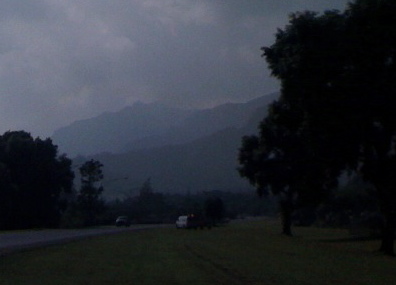
Koolaus in vog © Rebekah Luke

The Koolau Mountains in vog, about 10:15 a.m. today. Notice the ridges appear in three tints of gray.

What’s vog? Vog is the less-than-clear air that we have when the kona winds from the southeast blow the emissions from the volcano up the island chain toward the northwest. It’s like the words fog and smog. It hangs around until the regular trade winds return.

Vog is worst on Hawaii island, a.k.a the Big Island, home of the eruption. The falling ash deteriorates homes and crops, and the smokey air makes it hard to breathe. It reminds me of when I arrived at art school in Pasadena (Los Angeles) one August and was told as I gazed out the floor-to-ceiling windows, “The mountains are right there in our backyard, and they’re beautiful, but it’s so smoggy, we can’t see them.”

One good thing about the atmosphere as today’s vog, though, is that it serves to explain how to paint distance. Generally, objects in the foreground have the darkest value, and as objects recede into the middle-ground and background, they become lighter in value. As one’s eye moves back into space, the values become lighter.

On an ordinary sunny day, the kind that prompts us to say, “It’s just another beautiful day in Hawaii!” the Koolau Mountains are clear and colorful enough to see the individual trees on them. To represent such a scene with paint and for it to “read” properly, we consider the logic of light and either lighten and/or mute the colors in the background, even though we don’t see them that way with our eyes. But on a day like today, you absolutely can see it.

If you have ever seen the Blue Ridge Mountains in Appalachia, or photos of them, it’s the same thing.
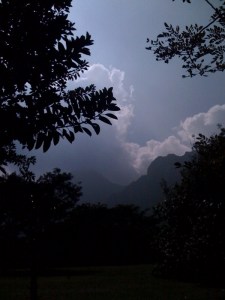
Nuuanu Pali pass © Rebekah Luke

Nuuanu Pali Lookout (center of photo) viewed from Luluku, about 10:30 a.m. today

This morning my destination was Hoomaluhia Botanical Garden at Luluku at the foot of the mountains where I go to paint.  Here is a photo of the Nuuanu Pali  pass viewed from Luluku. Ordinarily the cars on the highway and the people at the lookout are visible.

Notice that both photos appear blue, or blue-gray. My own eyes did not see the scene this way because I am used to seeing the scene in full color (the whole spectrum), and my brain translated it into full color. But, as the saying goes, the camera doesn’t lie. Blue is the color of atmosphere.

Now, knowing about values (shades of gray) as they relate to distance, and knowing about the color of atmosphere, you can represent distance in a painting by muting and lightening the colors of objects as they recede.

If you forget to do this initially in an oil painting, there is a glazing technique you can use, but only after the paint is dry. Take a dollop of painting medium with your palette knife and mix it with a tint of blue pigment (e.g., white + ultramarine + cobalt). Have a clean, soft cloth handy. Brush the glaze over the part of the painting that you want to lighten. Then, working quickly (because glaze dries fast), wipe off with the cloth little by little, if you wish, to get the effect you want. Ta-dah!

The values underneath that you painted originally will stay the same, that is, the relationships among the values will remain. You are simply putting in the atmosphere with your tinted glaze.

Don’t worry if the glaze gets beyond the area you want. Just go back and paint over it. (We call that “destroy and recover.”)

Copyright 2009 Rebekah Luke

Thanks to Gloria Foss who taught me how to do this. To see my oils, click on PAINTINGS in the menu bar.

Why write? why paint? why heal?

15 10 2009

Rebekah’s Studio features old-fashioned letters, paintings and healing. Why write? Why paint? Why heal?

In the current 42-day world gratitude experiment shepherded by Stacey Robyn, the meditation for Day 27 is “Writes of Passage.” The suggestion is to ponder, “Who am I grateful for?” and write a letter to thank this person without the pressure that it needs to be delivered (because it doesn’t).

Stacey Robyn notes that psychology professor Peterson of the University of Michigan gives students a homework assignment now and then of writing such a gratitude letter, a belated thank you note, if you will. The letter writing “provides long-lasting mood boosts to the writers.” The professor says his students feel happier one hundred percent of the time.

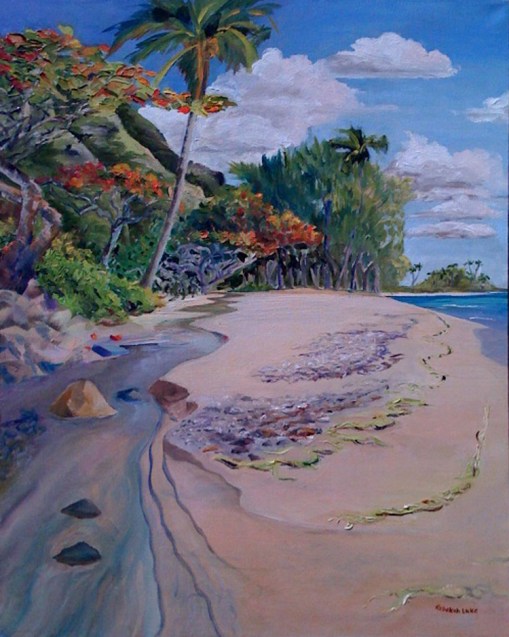
Lately I have been trying to locate a certain Alan who was a fan of my oil paintings when I first started exhibiting my work. He would see the announcements in the paper and show up at the openings. Passing by one day he saw me painting on location at Kaaawa Stream and pulled up along the side of the highway. He cheerfully called out the window, “Let me know when you’re finished with that one, I’d like to see it.”

The painting he admired

The painting he admired

As it turns out, this was quite some years ago, and after a long pause in painting I pulled out the canvas just this spring and completed it. I remembered Alan and set out to contact him. It’s a wonder to me how I remembered his name—his first name, and then after a couple of days, his last name. No luck in the printed phone directory, and initially nothing familiar in various searches on the internet.

My research brought me to a blurb and photo from Hawaii Fishing News, reporting and depicting a fisherman with the same last name and looks who had caught a 100-plus-pound ulua fish in the summer of 1999 and who thanked Alan for his help. Being tenacious in my research, I contacted HFN who kindly gave me the fisherman’s phone number. I left call back messages twice, but no one rang back.

Still wanting to reach Alan, I took to searching the internet again. Last night I came across an esoteric article by T. Castanha, Aia Na Ha’ina I Loko o Kakou (The Answers Lie Within Us),” concerning the “Boricua Migration to Hawai‘i and Meaning of Caribbean Indigenous Resistance, Survival and Presence on  the Island of Boriken (Puerto Rico).”

The article is interesting to me for its insight on the situation of the indigenous peoples of Boriken and the Hawaiian Islands both. The paper was presented in Hilo at the 1999 World Indigenous Peoples’ Conference on Education.

More intriguing to me was that the author dedicated his presentation to his friend, brother and roommate, who recently passed on, the article stated, his friend who had the same name of the Alan I was looking for.

There, then, was the answer for me.

And here, now, is my gratitude letter to a faithful fan: Mahalo, Alan, for encouraging my art. Perhaps our paths will cross again.

Copyright 2009 Rebekah Luke

In a Reiki healing session, we thank our Reiki masters in spirit from the heart. Like writing a gratitude letter, Reiki can help one feel happier. For more information, click on Reiki Healing by Oelen in the menu bar.


FAQs about my art: an interview with self

25 09 2009

Rebekah, what is your medium? Oil.

What kind of painter are you? Mostly plein air (French, literally, open air). I go on location outdoors, into the field, and study the light.

How would you describe your style? Impressionistic representationalism. Sometimes abstract.

What is your subject matter? Hawaiian places; landscapes; Hawaii nei. More recently, I’ve added still life, and I am doing some seascapes. I paint subjects I think people would like to hang on their walls.

Do you paint from photographs? Rarely. I always felt if I painted from a photograph, the painting would look like a photograph. Sometimes I’ll make a black-and-white photo to see the values (range of darks to lights). I prefer painting en plein air or from life.

How long does it take to finish a painting? It depends on a lot of things, but on average about four or five times out on location. Some may take five hours, others five years.

Is your work in galleries? It used to be, but not at the present time. I am seeking a good venue and good representation.

Where can I see your work? Right here on Rebekah’s Studio! Come and visit my virtual gallery. Click on Paintings on the menu bar. To see the actual original painting, please contact me and we can make an appointment to see it. I’d love to show you!

How did you learn to paint? I took lessons, primarily from Gloria Foss. Before that I took the required art history classes in high school and college. I also studied art as part of the photography program at Art Center College of Design in Pasadena.

When and where did you start showing your work? In earnest at the Honolulu Zoo Fence on Monsarrat avenue and at Arts of Paradise gallery at the International Market Place, both in Waikiki in the later 1980s, and at invitational and juried shows. You might like to read my August 26, 2009, post “I wasn’t always a painter.”

What are your prices, what does a painting cost? An example would be U.S. $600.00 for an original 16″ x 20″ landscape in oil, frame included. Smaller ones are priced less, larger ones more.

How do you price your work? Besides the general guide in the above Q and A, I look at the overall piece, the thing. I imagine a price and I imagine selling the piece for that price. If I experience an awful feeling in my stomach, then the price is too low. I also go to galleries and shows and look at other artists’ works and prices for comparison. I think my prices are realistic.

Does the price include shipping? No. The customer pays for shipping and delivery. I take care of the packing and packaging.

Why is art so expensive to buy? The materials don’t cost that much. Artists are like actors. We don’t work every day. (Actually, we do, but we don’t sell every day; you get the idea.) This is how we earn our living—you know, food, shelter, gas, not so much clothing.

I love your work, but I don’t think I can afford to buy it. Can I? Sometimes for things we really want, we need to sacrifice. I have a layaway plan, normally three monthly payments each of 1/3, 1/3, 1/3. It’s possible to stretch payments out longer. The customer does not get the painting until it is paid in full. The installment payments are not refundable. That’s the deal. Several collectors of my paintings purchase on layaway, and they are able to enjoy enduring original art that way. If your finances can’t handle the layaway plan, then you probably can’t afford the painting.

Do you make reproductions? I’m wondering if I should manufacture some more. I have a giclée entitled “Mele’s Beach” that’s almost sold out.

Do you accept credit cards? Yes, through PayPal.

Who buys your paintings? Anyone. I have customers, patrons, and angels. 😉

Do you teach painting? Not formally. I’m happy to have people watch me paint and answer their questions, give a demo and talk about my art. My best audiences/pupils are kids. I might offer some tips on this blog.

Do you ever donate your artwork to a benefit auction event of a non-profit organization? Only if I can have part of the income. The reasons are: The non-profit receives merchandise and a donation for the painting if it is sold. The winning bidder gets a painting and a charitable tax deduction. The artist receives no income and can deduct only the cost of materials (i.e., canvas, paint, frame, wire). The public gets the erroneous idea that artists don’t mind donating their work. When I participate, I suggest this arrangement: Set an upset price of an amount I would like. The organization may keep the difference between the upset price and the winning bid. If the painting doesn’t sell, then I get the painting back.

Why aren’t there any new paintings in your virtual gallery? I keep checking back and see the same images. I would love to install new ones as fast as I can. And I’m glad you’re checking back. The thing is, oil paint takes a long time to dry, especially in a humid climate like Hawaii. Only when the painting is bone dry does it get a finishing varnish coat. Then that has to dry, then I photograph it, and then the painting gets a frame. It could take up to six months from the time I finish a painting to when it’s put on display. So, please stay tuned! I value your interest.

Thanks, Rebekah. And thank you! If you have other questions, you may Leave a Comment below or contact me by email. RL

Copyright 2009 Rebekah Luke


On being there

15 09 2009

Ayla learned how to kick off her blanket this morning as a result of my playing peekaboo with the receiving blanket and her legs. Still in the car seat from the ride to our house, she kicked off the cloth on cue repeatedly, smiling widely, then cooing each time I covered her tiny little feet with it, liking the great game with Popo (Chinese grandmother, me). So much fun, she started giggling!

Was that her first giggle? I thought how blessed darling husband is to be the caregiver for this child. He’s there during the daytime when the baby’s cheerfully awake. While Ayla’s parents are away at work, he’s treated to many of baby’s firsts. I began reflecting on how the sweetest and most rewarding moments of life have to do with being there.

In my professional work, being there has made all the difference.

As a general assignment reporter who wrote the daily news, I had to be at events as they were happening, or there would be no story.

As a photographer, I could not notice a gorgeous scene and decide to come back later to make the picture because later the light will have changed and be different. I would have missed the shot.

As a children’s book designer who worked with models, locations, and photography, I had to go there to the photo; it wasn’t going to come to me.

As a plein air landscape painter, I have to be on location the same time each day until the painting is finished to capture the light I saw the first time.

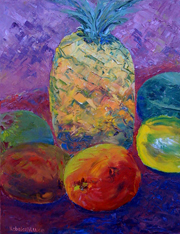
Nowadays back at the studio, I’m experimenting with painting still life and changing my technique. My intention is to paint looser, to use a different color palette than my landscape greens, to apply definite strokes of thick oil paint with a palette knife, and to paint fast. This requires being in the mood, being in the present, and being able to concentrate in order to get it right the first time.

Mango papaya pineapple

Mango papaya pineapple

I’m painting subject matter that’s appeared previously in this blog. Wanting to capture magnificence before it fades away, I had to be there to witness the mangos turn from green to shades of red and red-orange to bright yummy yellow. I had to be there to see the night blooming cereus open for one night only until next year.

Something funny happened, too, because I wasn’t there. As the green, almost-ripe avocado pear sat on the table of my set, waiting for me to preserve its three pounds of glory in a painting, its color turned to the alizarin-brown of ripeness. Before I got around to putting pigment on canvas, I had to eat it!

As a Reiki practitioner, I know that our Reiki Master in Spirit is there for us all the time. We just have to relax, be open to receive, smile, and maybe giggle to witness the healing.

Copyright 2009 Rebekah Luke

To see more images, click on PAINTINGS in the menu bar.


Miss Marvelous discovers her toes

1 09 2009
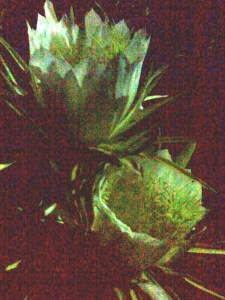
In my garden for one night only, 12 night blooming cereus flowers like these

In my garden for one night only, 12 night blooming cereus flowers like these

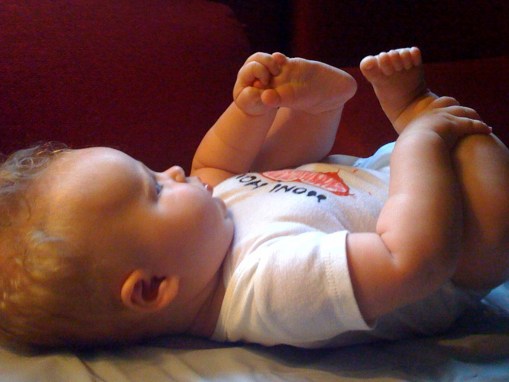
I made two paintings with light today. One is of our granddaughter Ayla, and the other of night blooming cereus. Both were taken with my iPhone, hand held with existing light. The only adjustment I made was to the contrast on the cereus, as I shot it just a few moments ago, and it’s dark outside! The real artist, though, and I’m sure you’ll agree, is our Creator. Mahalo e ke Akua. ~ Rebekah

She's marvelous!

She's marvelous!

Copyright 2009 Rebekah Luke

To see my paintings in oil, click on PAINTINGS in the menu bar. RL