Avos and cocos

11 10 2009
Morning light bathes tree
of avos sunny yellow
against blue-gray sky.
Like miniature
candied eggs hanging from tree
our avocados.
Through second-story
window kukui and avo
part for coco trees.
Fuzzy lollipops
wave in the gusty trade winds
two coconut palms.
As long as the tree
avocado grows and grows
birds will have a home.
Avocado Pear

Avocado Pear

I offer a haiku and a painting to honor and thank the avocado tree.

This year it produced 15-20 fruit, judging by the number of sprouting seeds on the kitchen counter. That’s a bumper crop. Usually we  gather just six, but each weighs three pounds. They’re super good, and I try to reserve a couple for the previous homeowner, Linda, who was a good steward of the aina (land) and planted the tree.

The season is over, and we’re enjoying the last of the fresh guacamole.

If you would like a little avocado tree from ours to plant in your garden, and you live in Hawaii, let me know.

Copyright 2009 Rebekah Luke

“Avos and Cocos” is from my book From My Window Seat: Views and Song. —RL


Artist sketches in oil

30 09 2009
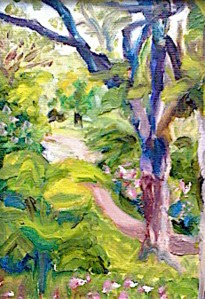
Looking Down Upon the Path - 5"x7" oil on canvas

Looking Down Upon the Path - 5"x7" oil on canvas

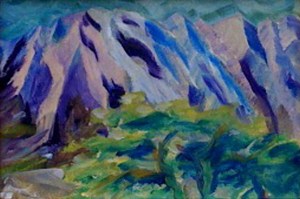
Usually I sketch a scene before blocking it out on a larger canvas. This drawing is like a dry run. Sometimes I sketch in oil. Sometimes I like the sketches better than the larger paintings. “Blue Koolau Mountains” and “Looking Down Upon the Path” are two examples made from the Hoomaluhia Botanical Garden Visitor Center on Oahu in the area called Luluku. This is a lovely place to visit, walk, and camp if you want to up your green quotient. I’m going out there again tomorrow. On Friday 10/2, I will be at the Pohai Nani health fair from 9 to 1 with my Reiki table. Come for a demo with Oe-Len. There’s a fabulous view of the mountains.  ~ RebekahBlue Koolau Mountains by Rebekah Luke

Blue Koolau Mountains - 5"x7" Oil on Canvas

Copyright 2009 Rebekah Luke


FAQs about my art: an interview with self

25 09 2009

Rebekah, what is your medium? Oil.

What kind of painter are you? Mostly plein air (French, literally, open air). I go on location outdoors, into the field, and study the light.

How would you describe your style? Impressionistic representationalism. Sometimes abstract.

What is your subject matter? Hawaiian places; landscapes; Hawaii nei. More recently, I’ve added still life, and I am doing some seascapes. I paint subjects I think people would like to hang on their walls.

Do you paint from photographs? Rarely. I always felt if I painted from a photograph, the painting would look like a photograph. Sometimes I’ll make a black-and-white photo to see the values (range of darks to lights). I prefer painting en plein air or from life.

How long does it take to finish a painting? It depends on a lot of things, but on average about four or five times out on location. Some may take five hours, others five years.

Is your work in galleries? It used to be, but not at the present time. I am seeking a good venue and good representation.

Where can I see your work? Right here on Rebekah’s Studio! Come and visit my virtual gallery. Click on Paintings on the menu bar. To see the actual original painting, please contact me and we can make an appointment to see it. I’d love to show you!

How did you learn to paint? I took lessons, primarily from Gloria Foss. Before that I took the required art history classes in high school and college. I also studied art as part of the photography program at Art Center College of Design in Pasadena.

When and where did you start showing your work? In earnest at the Honolulu Zoo Fence on Monsarrat avenue and at Arts of Paradise gallery at the International Market Place, both in Waikiki in the later 1980s, and at invitational and juried shows. You might like to read my August 26, 2009, post “I wasn’t always a painter.”

What are your prices, what does a painting cost? An example would be U.S. $600.00 for an original 16″ x 20″ landscape in oil, frame included. Smaller ones are priced less, larger ones more.

How do you price your work? Besides the general guide in the above Q and A, I look at the overall piece, the thing. I imagine a price and I imagine selling the piece for that price. If I experience an awful feeling in my stomach, then the price is too low. I also go to galleries and shows and look at other artists’ works and prices for comparison. I think my prices are realistic.

Does the price include shipping? No. The customer pays for shipping and delivery. I take care of the packing and packaging.

Why is art so expensive to buy? The materials don’t cost that much. Artists are like actors. We don’t work every day. (Actually, we do, but we don’t sell every day; you get the idea.) This is how we earn our living—you know, food, shelter, gas, not so much clothing.

I love your work, but I don’t think I can afford to buy it. Can I? Sometimes for things we really want, we need to sacrifice. I have a layaway plan, normally three monthly payments each of 1/3, 1/3, 1/3. It’s possible to stretch payments out longer. The customer does not get the painting until it is paid in full. The installment payments are not refundable. That’s the deal. Several collectors of my paintings purchase on layaway, and they are able to enjoy enduring original art that way. If your finances can’t handle the layaway plan, then you probably can’t afford the painting.

Do you make reproductions? I’m wondering if I should manufacture some more. I have a giclée entitled “Mele’s Beach” that’s almost sold out.

Do you accept credit cards? Yes, through PayPal.

Who buys your paintings? Anyone. I have customers, patrons, and angels. 😉

Do you teach painting? Not formally. I’m happy to have people watch me paint and answer their questions, give a demo and talk about my art. My best audiences/pupils are kids. I might offer some tips on this blog.

Do you ever donate your artwork to a benefit auction event of a non-profit organization? Only if I can have part of the income. The reasons are: The non-profit receives merchandise and a donation for the painting if it is sold. The winning bidder gets a painting and a charitable tax deduction. The artist receives no income and can deduct only the cost of materials (i.e., canvas, paint, frame, wire). The public gets the erroneous idea that artists don’t mind donating their work. When I participate, I suggest this arrangement: Set an upset price of an amount I would like. The organization may keep the difference between the upset price and the winning bid. If the painting doesn’t sell, then I get the painting back.

Why aren’t there any new paintings in your virtual gallery? I keep checking back and see the same images. I would love to install new ones as fast as I can. And I’m glad you’re checking back. The thing is, oil paint takes a long time to dry, especially in a humid climate like Hawaii. Only when the painting is bone dry does it get a finishing varnish coat. Then that has to dry, then I photograph it, and then the painting gets a frame. It could take up to six months from the time I finish a painting to when it’s put on display. So, please stay tuned! I value your interest.

Thanks, Rebekah. And thank you! If you have other questions, you may Leave a Comment below or contact me by email. RL

Copyright 2009 Rebekah Luke


On being there

15 09 2009

Ayla learned how to kick off her blanket this morning as a result of my playing peekaboo with the receiving blanket and her legs. Still in the car seat from the ride to our house, she kicked off the cloth on cue repeatedly, smiling widely, then cooing each time I covered her tiny little feet with it, liking the great game with Popo (Chinese grandmother, me). So much fun, she started giggling!

Was that her first giggle? I thought how blessed darling husband is to be the caregiver for this child. He’s there during the daytime when the baby’s cheerfully awake. While Ayla’s parents are away at work, he’s treated to many of baby’s firsts. I began reflecting on how the sweetest and most rewarding moments of life have to do with being there.

In my professional work, being there has made all the difference.

As a general assignment reporter who wrote the daily news, I had to be at events as they were happening, or there would be no story.

As a photographer, I could not notice a gorgeous scene and decide to come back later to make the picture because later the light will have changed and be different. I would have missed the shot.

As a children’s book designer who worked with models, locations, and photography, I had to go there to the photo; it wasn’t going to come to me.

As a plein air landscape painter, I have to be on location the same time each day until the painting is finished to capture the light I saw the first time.

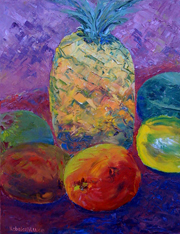
Nowadays back at the studio, I’m experimenting with painting still life and changing my technique. My intention is to paint looser, to use a different color palette than my landscape greens, to apply definite strokes of thick oil paint with a palette knife, and to paint fast. This requires being in the mood, being in the present, and being able to concentrate in order to get it right the first time.

Mango papaya pineapple

Mango papaya pineapple

I’m painting subject matter that’s appeared previously in this blog. Wanting to capture magnificence before it fades away, I had to be there to witness the mangos turn from green to shades of red and red-orange to bright yummy yellow. I had to be there to see the night blooming cereus open for one night only until next year.

Something funny happened, too, because I wasn’t there. As the green, almost-ripe avocado pear sat on the table of my set, waiting for me to preserve its three pounds of glory in a painting, its color turned to the alizarin-brown of ripeness. Before I got around to putting pigment on canvas, I had to eat it!

As a Reiki practitioner, I know that our Reiki Master in Spirit is there for us all the time. We just have to relax, be open to receive, smile, and maybe giggle to witness the healing.

Copyright 2009 Rebekah Luke

To see more images, click on PAINTINGS in the menu bar.


I wasn’t always a painter

26 08 2009

First I threw up. Every week on the way home from class. I had to stop the car. Was it the paint thinner, not eating properly, or my nerves? Who knows?

I was enrolled in the Gloria Foss Color Course and was taking one vacation day per week from my university relations job because the class ran from 9 to 3 at Vicky Kula’s. Since coming home homesick from the rigorous Art Center College of Design photography program the second time I went to college (the first time was for journalism and music at UH), I vowed to keep my eye trained with continuing studio courses.

For starters, I picked Gloria’s. Gloria and I were both members of the National League of American Pen Women, Honolulu Branch. When I first met her, I was about 25 and working as a reporter. Her hair was already silver, and she was studying for her Master in Fine Arts degree so she could teach. She said she studied with a lot of art teachers and that if they had taught certain basic things in the beginning, it would have been a lot easier. So she designed her own course. I remembered  that.

These were lessons in oil painting. Enrolling was a commitment. A luxury. Something I’d wished for. In elementary school and high school, back in the day, a choice had to be made between art and music. I always picked music. My mother was a piano teacher and my father was a truck driver. Art lessons weren’t cheap, and neither were art supplies.

Vicky Kula taught the basics in the studio, like values (the shades of gray from light to dark), how to turn the form based on the logic of light (light, middle tone, dark, reflective light) starting with the ball, cube, cylinder and cone while slowly introducing color. After awhile all of it will come together, she promised. Then Gloria took students into the landscape. Her mantra was: “Warm it in the light. Cool it in the shade.” I learned about “Tomato Theory” and “Umbrella Theory” and how to apply the “Grapes and Drapes” lesson in the studio to painting the forest and the Koolau Mountains.

One day Gloria announced she was cutting us loose. Peggy Chun in her crazy fearless way organized an exhibit and opening reception for us classmates at The Croissanterie on Merchant Street. And that was the first time I put it all out there.

Then came showing on the Honolulu Zoo Fence, and invitations from galleries to exhibit. Encouraged by customers liking my work enough to buy it, I kept at it. It’s the process of making art that’s important. You do have to keep at it, and every once in a while something wonderful happens. The trick is to remember the feeling to be able to do it again.

One morning I went over to Kaaawa Valley to paint Puu Ohulehule, a mountain so sacred that Hawaiians in ancient times did not say her name out loud. I did everything I was taught: “Paint what you see; paint what you know; paint what you feel.” After the last stroke, I was sure it was the last, I put my brush down and looked at my watch. It was only 8:15 a.m.

And I wasn’t throwing up any more.

Optical illusion painting

Copyright 2009 Rebekah Luke

I’m fond of painting scenes of Kaaawa. To see more, click on PAINTINGS in the menu bar.

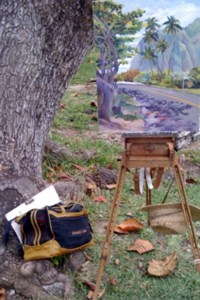
This photo juxtaposes the canvas “Kamehameha Highway and Kaaawa Place” on my easel with the actual landscape.

~ Rebekah

Thanks to my teachers Gloria and Vicky, to Peggy, and to my “Easel.”