Gathering kukui nuts and re-landscaping for a play space

18 09 2010

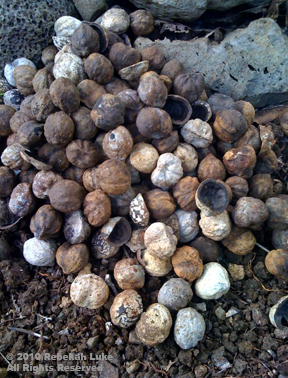
Aged kukui nuts prior to cleaning and polishing into Hawaiian jewelry

The studio and its surrounding garden of fruit trees and raised vegetable beds is not my choice for a toddler to play in, so I’ve cleared out the heliconia under the avocado tree to plant a soft thick green ground cover of clover with Miss Marvelous in mind. She likes to explore and play in the outdoors.

Those following the progress of Miss Marvelous may see what she looks like at 16 months this September. I snapped this image in the car on a shopping trip. She loves shopping!

The heliconia patch was there since purchasing our place. It has survived with not much care for more than 26 years. When the patch was full and thriving, gathering the fallen avocados in August was like hunting for Easter eggs in a forest.

Off and on since trimming the plants to the ground I’ve dug up roots, runners, sprouts, as well as rusty iron pieces from the old VW bug, now in its last disintegration phase.

Just by running my fingers through the coarse soil, I found lots of old, old kukui nuts, whole ones and halves of different colors—black, brown, white, multi—from the neighbor-in-the-back’s tree on the other side of the panax hedge. They were easy to find, a meditative search akin to shell seeking.  In all our years here I never gathered many.

Today I thought I’d rescue the nuts for my friend Kamakea who turns them into jewelry, and I saved them for her.

The kukui fruit with its outer skin covering or husk still intact. On the tree they are a gray-green color.

Next I looked for kukui nuts that were freshly fallen for another friend, Cathy, who makes inamona, a roasted nutmeat relish mashed with paakai (salt) and used in Hawaiian cuisine.

It is a long process to prepare inamona, about as long as it takes to make kukui nut jewelry. Cathy said, as long as the outer covering is still intact, it’s good for inamona. Kukui nuts are seasonal, and they are starting to fall now.

Sure enough, in and among the fallen dried leaves in the corner of the lot were these round fruit. So I scooped those up too. When I have a few more, I’ll deliver them to Cathy.

The kukui tree (Aleurites moluccana) is amazing. It has many uses. It is a canoe plant originally brought to the Hawaiian Islands by Polynesians who arrived here by canoe. You can spot the tree in the mountains by looking for light, mint-green-colored leaves.

In Hawaiian culture the kukui is one of the kinolau (forms taken by a supernatural) of the Hawaiian pig god Kamapuaa; the shape of the leaf resembles the head and ears of a puaa (pig). Freshly plucked leaves with stems on are arranged together by knotting the stems make beautiful lei (wreaths). In laau lapaau (Hawaiian medicine), the mashed kernel, as in inamona, is a laxative and prescribed for relieving constipation.

It is often called the candlenut tree. Kukui means light. Hawaiians skewered the oily kernels and burned them for light. The oil is the preferred oil for polishing wooden utensils for food, such as umeke (bowls) and platters. You can now find the oil on the commercial market as a cooking oil and in cosmetics.

The kukui tree also provides wonderful shade. Mahalo e ke Akua! Combined with the canopy of the avocado tree and a ground carpet of hardy clover, I envision a delightful play space for Miss Marvelous. She’ll just have to duck during the month when the fruit fall.

Copyright 2010 Rebekah Luke


Lifelong learning about my art process

10 08 2010

Kaaawa Valley Morning

Some things take a long time. Waiting for an oil painting to dry is one of them. Here is “Kaaawa Valley Morning.” I painted it in May and varnished it this week. It’s already sold to a happy family waiting patiently to hang it in their home!

Oil paint takes at least three months to dry. A painted canvas should be bone dry before adding a protective varnish coat, for best results. So when commissioning an original painting, allow at least six months for delivery. That would be the technical aspect. As for the practical aspect, each artist has his/her own process that varies from artist to artist. Perhaps plan on a little longer.

Last Thursday I was happy to see Kit Kowalke, among other lovely friends, at our art reception at Ho‘omaluhia Botanical Garden. I first met Kit, an artist and art educator, when she was teaching at Honolulu Community College and I was in university relations. She was always cheerful, always a pleasure to be around, always sharing and helpful, always fun! And she still is.

She asked what medium, I said oil, she asked how do I paint, I said one at a time. That is, I like to finish one painting before starting another. And that my paintings take a long time to dry. Oil painters often switch to acrylic because the medium dries quickly, and they can get their work out on the market faster. Personally, I’ve been partial to oil because of the way the colors mix and look.

What I didn’t say was that I don’t like the state of unfinished-ness, or that unfinished projects are stressful to me.

“Oh!” Kit told me, “no need to paint one at a time, you can paint more than one at a time. Like two or three.”

“I can?!” 😕

“Yes!” she said. “Sometimes you might want to let an oil dry before painting on it some more. While you wait, start another one. Go back and forth.”

Well, that’s a perspective I’ll consider. And, I think that will ease my stress over things like unfinished home and garden remodeling projects. I can think of them as works in progress!

She asked more questions and gave me more tips, even volunteered which classes and workshops I could attend nearby. Which is what my intention was when I first left art school—to regularly keep my eye in training by always taking part in a studio class.

It is the advice given also by my tai chi sifu Alex Dong, who advocates not waiting until you have mastered a set before learning a new one because there are aspects of each set that help in understanding other sets. Or, (my interpretation) you will always be improving on the basics. Clicking on the above link to his website takes you to his journal article about the subject.

Somewhat similarly, when I was taking beginning kumidaiko (Japanese ensemble drumming) lessons and had an interest in composing, I asked the master Kenny Endo at what level one could start composing. How long must I study taiko before I would have enough knowledge to write drum music? He replied he believed one could start composing at any level.

Some things to think about. In my case, they still may take time because that’s my process. So far.

Copyright 2010 Rebekah Luke

Quite a few images are ready to leave the studio; these paintings are dry!  See my PAINTINGS page. If you are on Oahu, visit the art show at Ho‘omaluhia Botanical Garden during August 2010. Please see my previous post about seven artists.


The story of the boat lei

21 07 2010

Every two years in July about 50 sailing yachts compete from San Francisco Bay to Kaneohe Bay for the Pacific Cup, “the fun race to Hawaii.” It’s organized and hosted by Pacific Cup Yacht Club in Northern California and Kaneohe Yacht Club in Hawaii. The boats have handicap starts and sail under the Golden Gate Bridge and across the sea to arrive around the same time, hopefully, and in time for the parties ashore on Oahu.
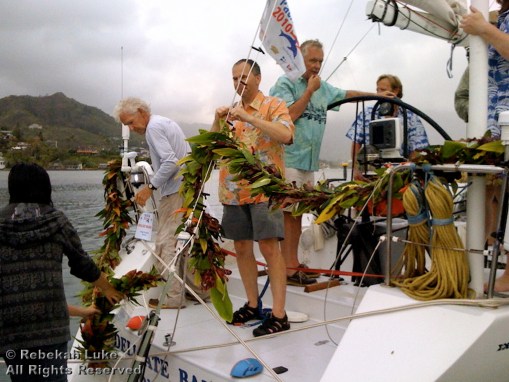
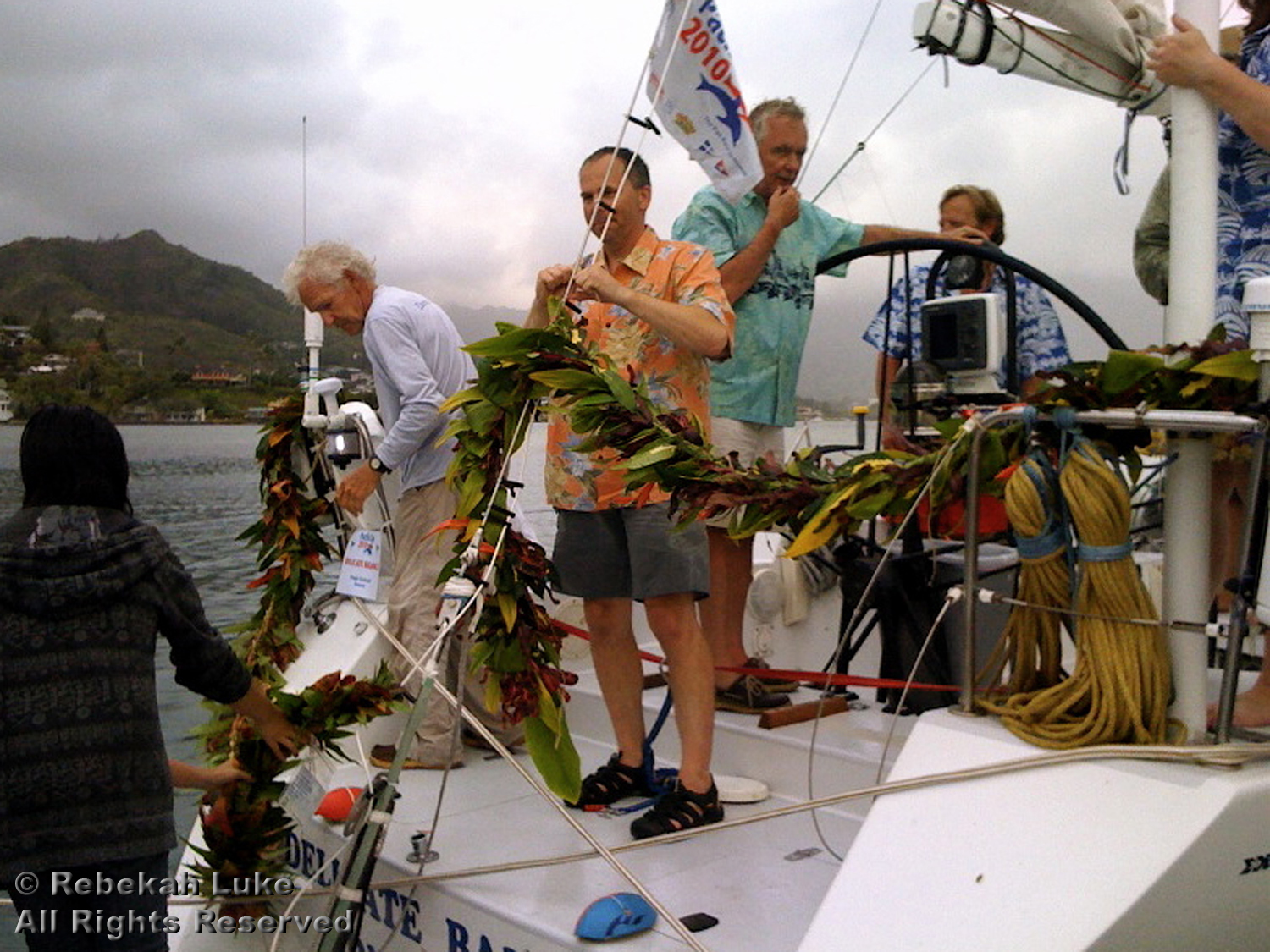
Delicate Balance arrives at Kaneohe on a cloudy afternoon. Two boat lei welcome her.

Many years ago I became the volunteer chair of the Boat Lei committee for KYC. I’m affectionately known as the Boat Lei Lady! A boat lei is a giant 12-foot garland of fresh, tropical foliage to greet and honor the vessel that carried her skipper and crew safely across the ocean.

Some call it a bow lei because it is attractive draped over the front end of the boat. Because most of the Pacific Cup yachts tie up stern to, we renamed it boat lei. It may be fastened anywhere as a decoration. The custom of presenting the lei has become a Pacific Cup tradition.

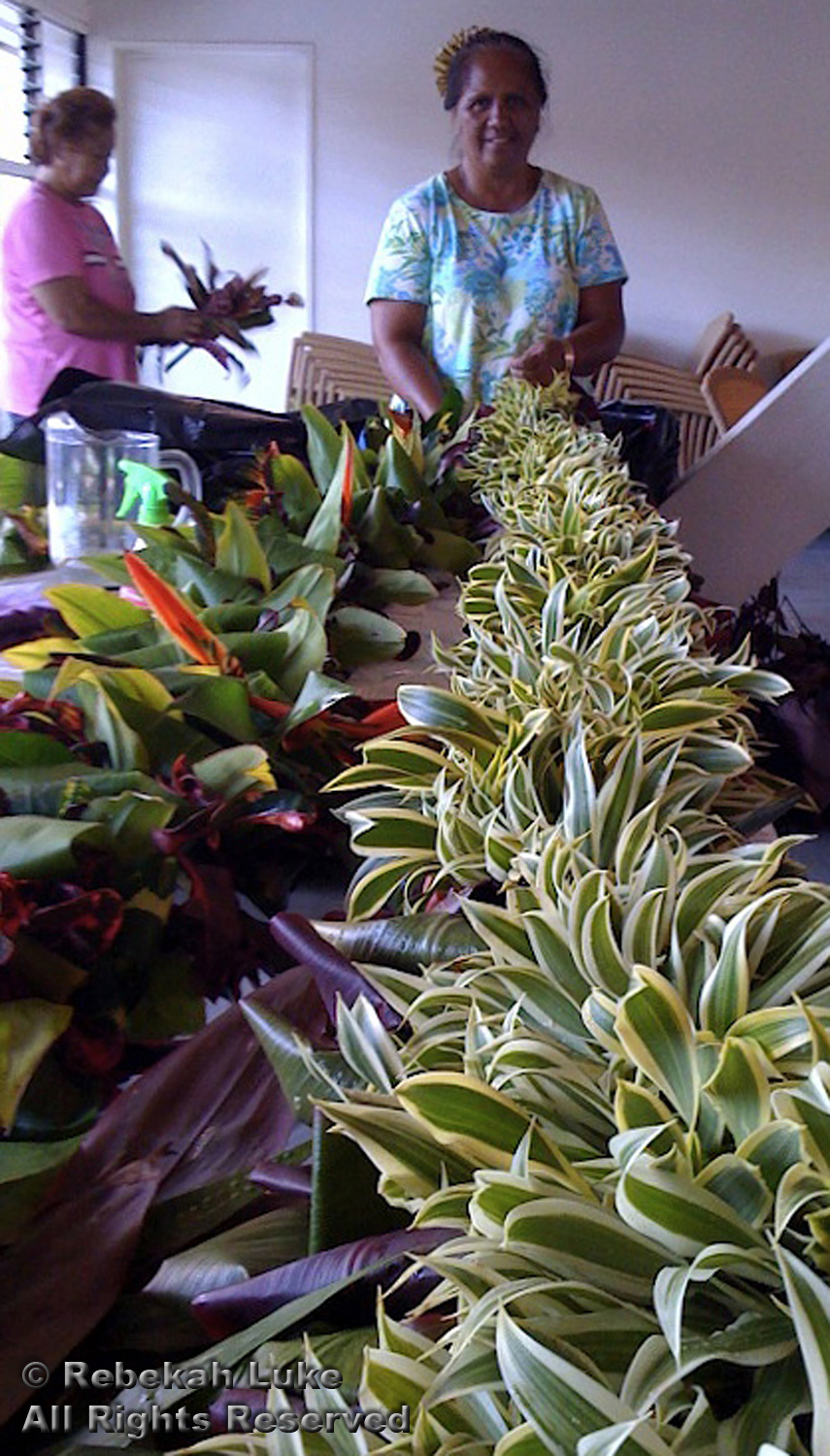
It takes many hands to make the boat lei for this event. The finished products are beautiful works of art and much admired. Event organizers inform the racers, family and friends they may pre-order the lei so it’s ready for their favorite boat when it arrives.

Last Friday, Saturday, and Sunday my crew made 45 boat lei! Many thanks to Michael and Bobbi for the promotion in California and for handling the sales from the e-store. That was a big help. Thanks to Kaneohe Yacht Club for lending the workspace. And, of course, mahalo (thanks) to all the lei artists for their remarkable team effort. Some KYC members also pitched in, and we are grateful for their contribution.
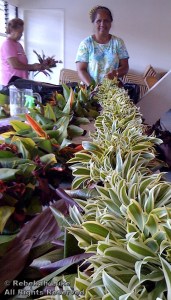
Haleaha finishes her 12-foot lei made with variegated Song of India clusters and red ti leaves

How do we make the lei? And how are we able to make so many? I’ve been asked. I will tell you! But first a little history and a funny story.

LITTLE HISTORY. In the early years I worked with  members of Hale Kuai Cooperative, a Native Hawaiian organization, to design the basic lei. We wanted cut foliage that would hold up in the sun, rain, trade winds, and salt air and look pretty for at least a couple of days in the elements.

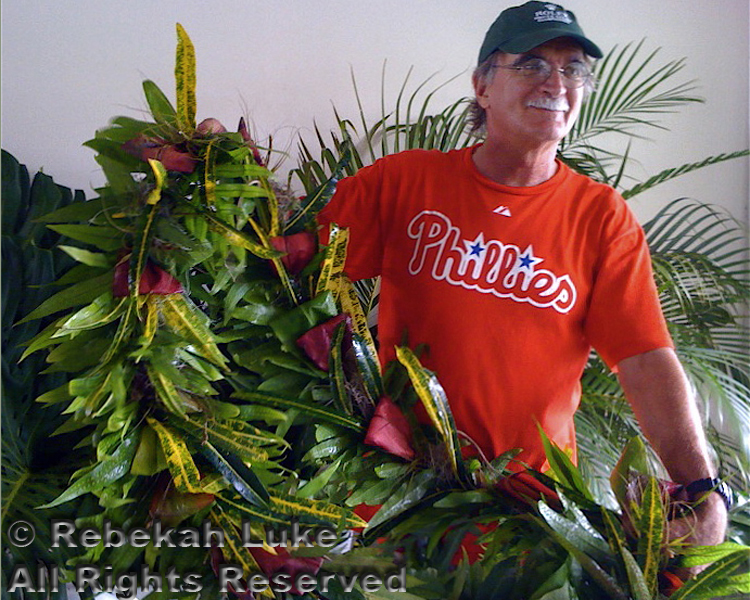
We settled on lai (say LAH-EEE, leaves from the ti plant), lauae (say LUH-AU-AY , a fragrant yet sturdy fern … Phymatosorus scolopendria, syn. Microsorium scolopendria), and multi-colored croton leaves. Our friend Kapa showed us how to use floral wire to bind the foliage; she learned the use of wire from her kumu hula. And Aunty Havana, who is a master at making hat lei, showed how to combine everything into lovely creations, once she figured out how to translate small to big. The lei became a product of the Co-op.
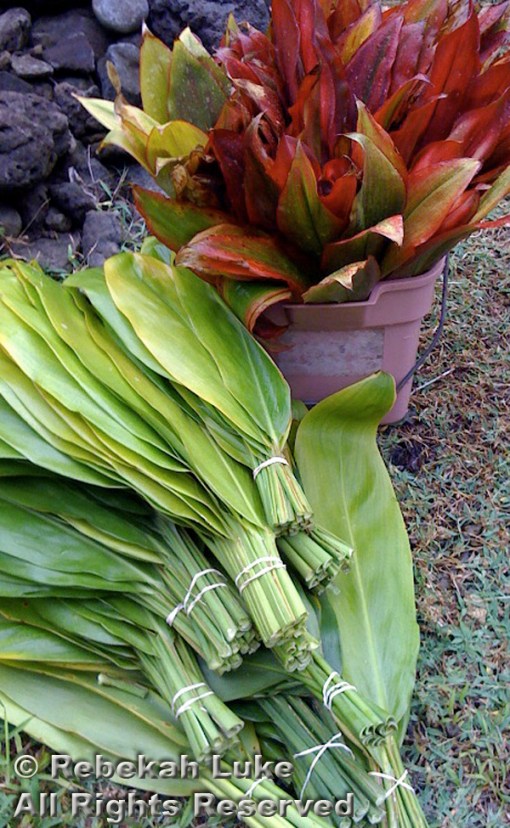
Green and red ti leaves. When picked from the stalk, they are called la‘i.

In more recent years, I have partnered with Koolauloa Hawaiian Civic Club to supply the boat lei. Volunteer members and friends gather the plant material from their gardens and from the mountains, donating the material and their time to the project. Other members and friends, who are artistic and enjoy lei making, work professionally as floral designers for a few days and assemble the lei.  The net proceeds from the sale of the lei provide scholarships for Native Hawaiian club members and/or their children.
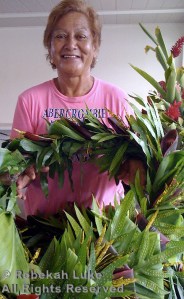
Clover's lei

FUNNY STORY. The very first year of my boat lei experience, we made the lei fine, but I had not given any thought to delivering the lei. I was so involved in providing a product that it did not occur to me that the boats would arrive at any time of day or night, 24/7. OMG! It was too late to organize any shift work.
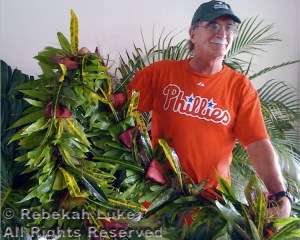
Pekelo's lei. Yellow-and-green croton and red ti provide accent color among the other greenery.

DH (Darling Husband) has a sailboat moored at the yacht club. He and I monitored the ETAs, and for an evening arrival, we would catnap on his little Mugquomp and wake up as the radio crackled to announce a boat had crossed the finish line. As we climbed out of our bunk and put on our jackets, for it was cool and a little rainy, we were fascinated and impressed by the radio conversation between Iwalani of the Escort committee and each arriving yacht. In her very calm, reassuring, professional, and gracious way, Iwalani gave the information and instructions on how to enter and come down the channel (with coral reef on both sides) to the dock at night. We had enough time on foot to greet the boat with a big lei.

DH and I were very short on sleep that year. Someone later suggested that we arrange for the Leis and Trays committee to deliver the lei. Brilliant! That committee is much larger and greets the boats with Hawaiian music, lei and mai tais for the captain and crew. Why not the lei for the boat too?

HOW TO MAKE A BOAT LEI

The style of the lei is known as wili (say WEE-LEE), meaning to wind. We wind by hand—one must have strong hands to tug—using wire instead of a natural twine or raffia traditionally used to make a hat or neck lei. Wire allows us to put the work down and makes it easier on our hands. Our lei are 12 feet long, but shorter lengths make lovely bouquets, wreaths, and table decorations. Allow enough time to gather & prep the materials and make the lei. It takes about two hours to make, excluding time to gather.

Each artist has his/her “line,” so do not worry that your lei does not look like someone else’s. It won’t. The variables are selection and placement of the plant material as well as the available supply of the greenery and flowers. Here is the basic way to construct the lei.
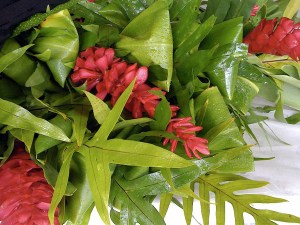
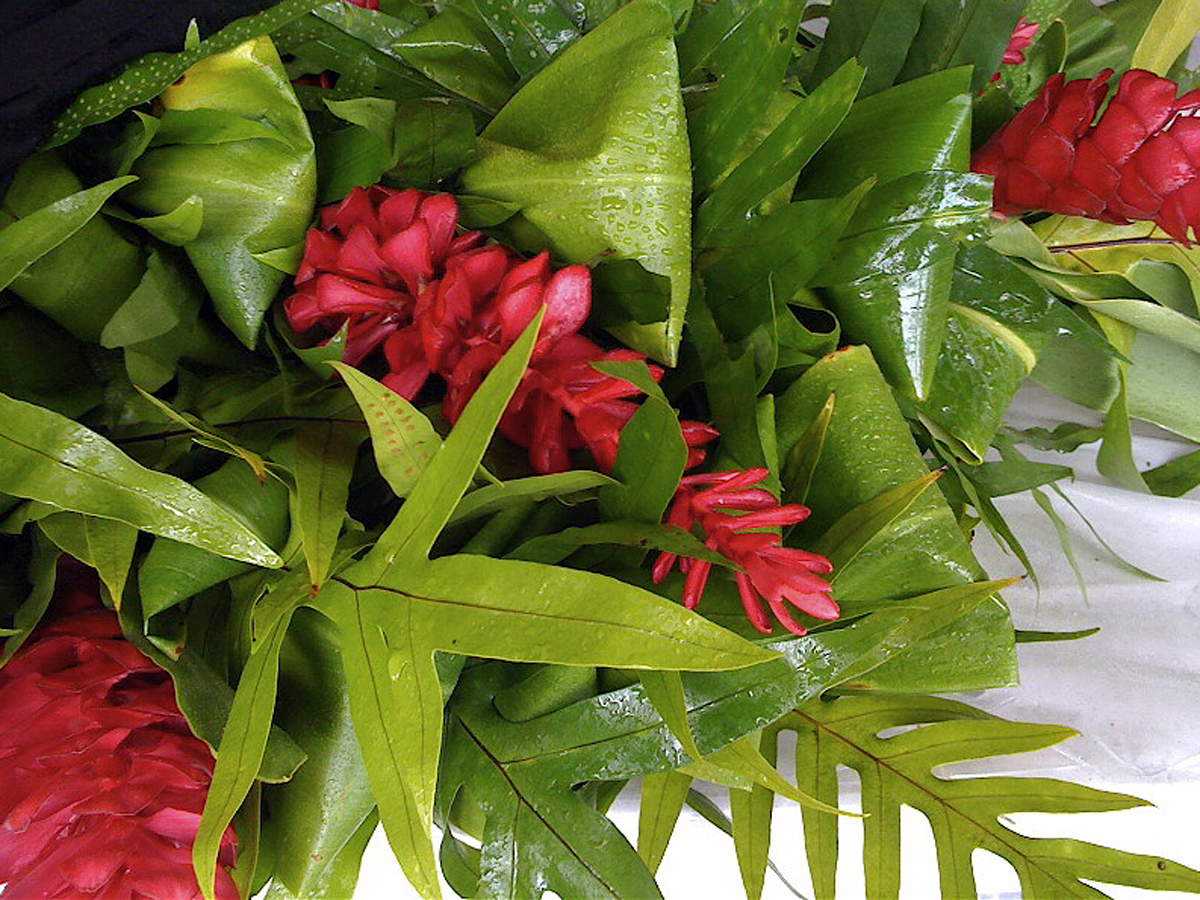
Ti, lauae, and red ginger combo

Materials to make one 12-foot lei:

1 kaau (which is 40) each of ti leaves, lauae, croton leaves. Be sure to leave about 4 inches of the stem on. The stems provide the slightly stiff backing for the lei. Do not strip the mid-rib from the ti leaf.

A few tropical flowers—such as, heliconia, red ginger, bird of paradise, bougainvillia clusters—with 6-inch stems to intersperse throughout the lei (optional)

One 24-gauge paddle wire from the floral supplier or craft store. One paddle is enough for one and a half lei, or approximately 18 feet total.

String to tie on the finished lei to the boat

Gloves (optional) to protect hands from croton stains

33-gal. plastic trash bag (optional)

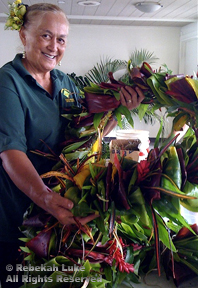
Ululani's lei

Tools:

Work surface such as a table or floor, hand clippers, scissors, spray bottle of water

Step 1. Gather and prep materials by sorting by color and size, cleaning, and bundling.

Step 2. Pick a palette of 3 or 4 types of leaves if you have a wide choice. Include ti and lauae in your palette.

Step 3. Take the tip of a large ti leaf and turn it under to meet the stem, shiny side out, bending it in half but not creasing it. Fasten the tip to the stem with the wire, winding it around the leaf 5 inches from the ends. Begin winding about 5 inches from the beginning of the wire, securing both the ends of the leaf and the wire together. Grasp the two ends of the leaf and the end of the wire with one hand (if you’re right-handed, use your right hand), and wind the wire with the other hand, going around about 5 times. Be sure to pull the wire taut. This is the start. You will use one continuous length of wire and not cut it until the end (unless the wire accidentally breaks).

Step 4. With the tip of the ti leaf facing up and pointing toward you, place a lauae leaf on top with stem pointing toward you. Wind the wire around 1/2 inch down from your start 3 times, again pulling taut. Next add some croton in the same way, 1/2 inch down. Then add another ti leaf. This grouping forms your pattern.

Step 5. Repeat Step 4. Alternate placement right and left, if you wish, to cover the sides. With each addition, come down about 1/2 inch. Remember to pull the wire taut as you wind so that your lei does not come apart.

Keep the width of the lei the same by checking the sections you did earlier. If your lei is getting wider (this is common with beginning lei makers), allow less material to show or leave more space as you add. Just be sure your wire is wound every 1/2 inch, catching all the stems. From time to time, turn your lei over to examine the back. Hold your lei up with one hand and give it a good shake to make sure it is secure. From time to time, spray the lei with water to keep it fresh.

Step 6. After the lei is the desired length, end it by winding the wire around itself about 10 times. Snip wire with scissors. Tie string with a square knot to the lei at 4 or 5 points as a way to fasten the lei to the boat.

Step 7. Keep the lei cool until ready to decorate. A cold air-conditioned room is ideal. Mist with water.

Step 8 (optional). For transporting or brief storage, roll the lei into a wreath and place in a 33-gallon plastic trash bag. Leave an opening for the lei to breathe.

And that’s the story of the boat lei. Enjoy your creation!

Copyright 2010 Rebekah Luke


Movies on a rainy day – these filmmakers are Hawaiian

2 05 2010

More and more indigenous Hawaiians are finding not only their voices but their audiences. I find that exciting. The Oiwi Film Festival opens today at The Honolulu Academy of Arts Doris Duke Theatre. The festival features the collective voices of Native Hawaiian filmmakers and runs through May 26, different movies on different days. Tickets are affordable at $8 with a dollar off for students, seniors and military. If you’re a member of the Academy of Arts, five bucks gets you in. I posted more information on kalahuihawaii.wordpress.com.


Flying moths over Kaneohe Bay

28 02 2010
Cool light northerly
winds meet odd-looking sailboats
Kaneohe Bay
Up on hydrofoils
small fast single-handed craft
skate on calm water
Iridescent wings
of high-tech mylar sailcloth
look and fly like moths

Stressed out? Take a few moments to view, hear, and feel what it’s like on Kaneohe Bay in the shadow of the Ko‘olau mountain range on a partly cloudy afternoon.

Taking time to relax and being mindful of the present is healing. Though some moments are anxious, as when awaiting a tsunami (yesterday) or faced with other disaster, it does a body good to rest and renew one’s spirit. Paint a canvas. Give and receive Reiki. Or go sailing! Last Saturday Ken and Georgia called with a kind invitation to see the moths on the bay, so we abandoned other plans and went!

We had fun making the movie. Turn up the speaker volume of your computer and enjoy!

Copyright 2010 Rebekah Luke


Declutter for the year of the tiger

10 02 2010

The Chinese Lunar New Year of the Tiger starts this February 14, presenting another chance for me to declutter the studio and garden. A few more days to get rid of the stale energy to make room for the new — key to continuing the healing.

Last week I blessed the Punahou Carnival plant booth with several small avocado trees that I’d been nurturing for five months and about 175 strong bromeliad plants that had spread from where perhaps a dozen were first placed 20 years ago in the front yard.

Pulling out the broms uncovered quite a few vanda orchid plants. I call them lei vandas, but their correct name is Vanda Miss Joaquin. I haven’t seen them commercially for a long time. On Oahu, their popularity has been replaced by dendrobium orchids from Thailand. (Imagine!)

When I was a girl in Wahiawa, Uncle Harry and Aunty Edna who lived next door had a farm and a garden that included these vandas. On special occasions, when visitors would arrive from overseas, or when someone was going away, Aunty Edna would let me pick the flowers to make lei.

She sometimes separated the blossom and strung the bottom half maunaloa style into a lei of saturated color that resembled the look of a lei of flowers from the maunaloa vine. (Maunaloa is one of those plants that cannot be taken out of Hawaii.) She needed a lot of blossoms for this style of lei.

The color of a fresh maunaloa style vanda lei was as intense as the magenta akulikuli blossoms from the ice plant (Lampranthus multiradiatus) that grew on both sides of Uncle Harry and Aunty Edna’s walkway from the street to the front steps. Beautiful! Aunty Edna made akulikuli lei too! Now these are rarely seen.

These memories inspired me to clean and re-pot my lei vandas where they will have more air and sunlight among some native kupukupu fern that I relocated from the side of the garage. I mapped out some garden paths to make the place more interesting and inviting. I guess I’ve taken on the delightful pastime of re-landscaping the garden!

The vandas aren’t blooming at the moment, but I thought you might like to see what they could look like in their prime. Photographer Dominic Kite of Scotland has given me permission to link to his photo of Vanda Miss Joaquin. Thank you Dominic! If you want to see more of Dominic’s photos, you may go to his website dominickite.com. But for the moment, click on this link:

Vanda Miss Joaquin by Dominic Kite

Related articles from Sept. 2009 (see Earlier Posts in the sidebar):

“Sweet memories and coming home, part 1,” Sept. 7, 2009

“Gratitude for my abundant garden,” Sept. 8, 2009

Copyright 2010 Rebekah Luke


Master plan for Hawaiian sovereignty

1 02 2010

A master plan for Hawaiian sovereignty exists. It is entitled “Hookupu a Ka Lahui Hawaii,” and I just installed it on http://kalahuihawaii.wordpress.com/. It was first published in 1995, 15 years ago. If you are interested in the manao (ideas) of Native Hawaiians concerning their homeland, do take a look.  Mahalo!