Sweet memories and coming home, part 2

11 09 2009

For a time I joined the morning water exercise class at Pohai Nani, a vibrant senior living community in Kaneohe, which led to my  practice of Reiki there for the residents and staff. One day, more than five years ago, Judy who coordinated activities showed me the little chapel and told of a dream to refurbish it.

I saw a cute, tiny room with an arched ceiling and pews for no more than about 8 to 12 people, if that many. The glass doors on the side slid open to overlook a small enclosed garden patio.  A hallway entrance was plain and dim. I agreed the chapel could used some refreshing.

Judy mused, wouldn’t it be nice to have the chapel decorated with a painting, something Hawaiian, to brighten the area? Maybe something in the hallway to welcome the residents, maybe even something in the chapel itself? I envisioned a fresco-like painting on a wall.

If it was to be Hawaiian, then the only person I knew who could do such a project was Ipo Nihipali, a Native Hawaiian artist known for her paintings of native birds and who had just completed a large outdoor painting at the Kamakakuokalani Center for Hawaiian Studies at the University of Hawaii at Manoa. Later I called Ipo to ask if Pohai Nani could contact her directly, and I gave Judy the information. I moved on to another project and didn’t see Ipo until this summer at a Hawaiian civic club celebration.

“Rebekah! Rebekah Luke! I have been looking for you!” Ipo exclaimed. She grasped my hand in both of hers. They were trembling and deliciously warm. “I finished it. I finished the painting!” Ipo said she had gotten the commission after all. She said she prayed about the piece and allowed the kupuna (elders) to guide her work. “We’re having the blessing on July 22nd, and I want you to come!” I assured her I would be there.

As soon as one steps onto the breezeway leading to the main entrance at Pohai Nani, the new painting beckons. It was decided that the imagery grace the lobby rather than the chapel for all to enjoy. Entitled KO‘OLAU! the painting is exquisitely executed and depicts our mountain cliffs, the forest, native birds, plants, a waterfall and stream. The piece is enhanced with real pohaku (stones), native ohia lehua branches, a sprouting coconut, ti leaf bundles, and arrangements of tropical ginger beneath the painting, creating a three-dimensional set. It is as if you can step right into the painting.

Recalling Ipo’s words at the ceremony, the manao (thoughts, ideas) for the  painting is something like this:

Do you remember what it was like, when you were a child, to swim in the pool and play in the forest? Look, you can do that again. Come. Leave your earthly possessions here, and go to the other side. Look at the mountains and see your ancestors. They are calling and waiting to carry you home once more. “Oh! Ko‘olau, my beloved rainbow of dreams.”

KO‘OLAU! is a magnificent work, amazing, and a miracle. Ipo will tell you that herself. That’s because she is legally blind (when she can see, it is as if she is looking through a glass of water), and she has Parkinson’s or Parkinson’s-like tremors. What a gift.

Mahalo e Ipo, my tita angel! Aloha no wau ia oe. ~ Rebekah

Artists Ipo Nihipali and her father Joseph Dowson at the blessing and dedication of "KO‘OLAU!"

Native Hawaiian artists Ipo Nihipali and her father Joseph Dowson at the blessing of KO‘OLAU!
Copyright 2009 Rebekah Luke


Alii Sunday at Kawaiahao

31 08 2009

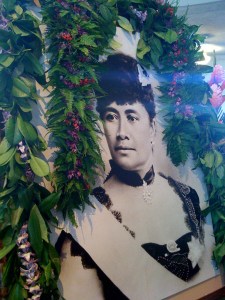
Liliu's portrait

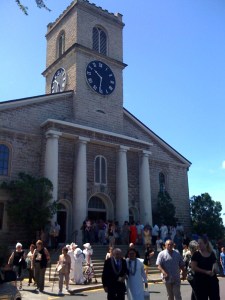
Yesterday was Alii Sunday at Kawaiahao Church in Honolulu, honoring Queen Liliuokalani (b. 1838-d. 1917), sister of King David Kalakaua. She reigned as the last monarch of Hawaii from 1891 to 1893 when she was overthrown. Her birthday is September 2.

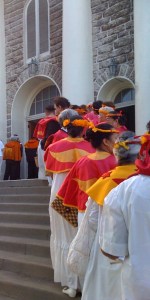
Each Alii Sunday, the Hawaiian Royal Societies and other ahahui (Hawaiian clubs) walk in the  processional, and the front pews are reserved for them.

Yesterday I attended as a member of the Koolauloa Hawaiian Civic Club with Kamakea, our vice president. We rode in to Honolulu with her son Kaimana, who is a member of the Royal Order of Kamehameha I.

This post shares the highlights for me. You may wish to go sometime. Visitors are welcome to Sunday worship service. Portions are in the Hawaiian language. Kawaiahao is part of the United Church of Christ.

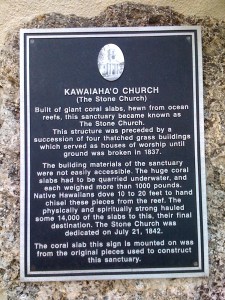
Kawaiahao Church is on the corner of King and Punchbowl streets. A plaque describes its construction

Kawaiahao Church is on the corner of King and Punchbowl streets. A plaque describes its construction.

Kawaiahao plaque

The Hawaiian Royal Societies, or Aha Hipuu, are a special sight. They include:

Royal Order of Kamehameha I who wear red and yellow capes over black suits. The different patterns and lengths of the capes indicate rank.

• Hale O Na Alii O Hawaii, whose members wear white with red and yellow capes. Hale O Na Alii O Hawaii at Kawaiahao

Ahahui Kaahumanu, whose formal attire consists of black muumuus, black hats and deep-yellow lei resembling feathers.

Ahahui Mamakakaua—Daughters and Sons of the Hawaiian Warriors wear black with red, black, and yellow capes (some capes have green).

Other groups who were represented on Alii Sunday were the Daughters of Hawaii in their pure white hats and muumuus (they operate the Queen Emma Summer Palace), the children of Queen Liliuokalani Children’s Center (QLCC is supported by Liliu’s estate, and its beneficiaries are the orphan and destitute children in Hawaii with preference to those of Hawaiian ancestry), and the Association of Hawaiian Civic Clubs that strung crown flowers into 52 strands of lei to drape on the statue of Queen Liliuokalani at the Hawaii State Capitol following the service.

Crown flower was Queen’s favorite. The lavender blossom drapes the left side of her portrait, at the top of this post, and the altar in the next photo.

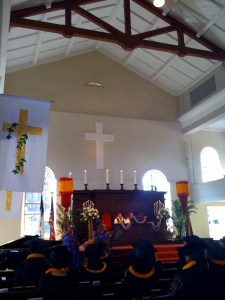
Kawaiahao interior


At left are the Ahahui Kaahumanu ladies in their formal black in the foreground. Aunty Ilima and Aunty Millie in purple muumuu sing Liliuokalani’s compositions, “Tutu” and “Paoakalani.” [See comment below.]

The church service itself was more lively and less formal than the congregational ones I attended in high school, about the last time I went. Admittedly, that was a few decades ago!

Kalowena gave a tribute to Queen Liliuokalani, and in her remarks she wondered, if Liliu’s time and our time coincided, would Google have given her an edge in maintaining Hawaii’s place in the world? Would her compositions be on iTunes, and would she be blogging and twittering?

This Sunday there was frequent applause, lots of “Amens” by the whole congregation, a testimony by a recent member for the sermon, and a hip-hop dance performance of the Black Eyed Peas’s “Where is the Love” by the youth ensemble. Apart from the pipe organist and choir in the back balcony, there was an ohana (family) choir of anyone else who wanted to sing from the front of the church.

Until she became Queen, Liliuokalani led the Kawaiahao Church choir. She composed more than 150 songs. Some were lyrics only, some were melodies without lyrics, and the rest were full arrangements. At Sunday’s service we sang “The Queen’s Prayer.” A fitting recessional was her “Aloha Oe” now famous around the world. I felt so sad.  ~ Rebekah

[See comment at the bottom.]

If you go …

Do view the 20 original portraits in oil painted by Susan S. Hoffstot entitled “Alii of Hawaii — The Hoffstot Collection” that are displayed on the walls of the right and left balconies. These were a gift from the artist and her husband William H. Hoffstot, Jr., “… to the glory of God, the honor of the Hawaiian people and the enrichment of the State of Hawaii” and dedicated on September 2, 1973.

[UPDATE: The portraits were painted by Patric Bauernschmidt, not Susan S. Hoffstot. Please read the comment by Patric’s granddaughter André below.]

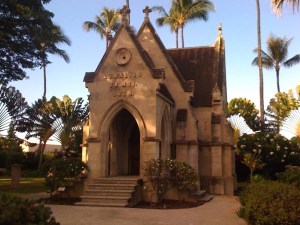
In addition to the church building are other historical structures. One is the tomb of King Lunalilo. Read the plaque explaining why Lunalilo is not buried at the Royal Mausoleum with the other monarchs.

Lunalilo's tomb

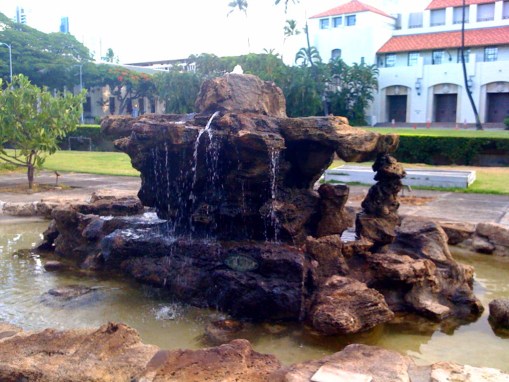
Another is a fountain on the King street side of the church. That’s the Library of Hawaii and Honolulu Hale city hall in the background.

Kawaiahao fountain

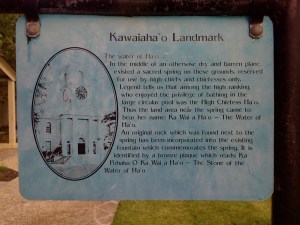
Kawaiahao fountain sign

The motto translates, "The life of the land is perpetuated in righteousness."

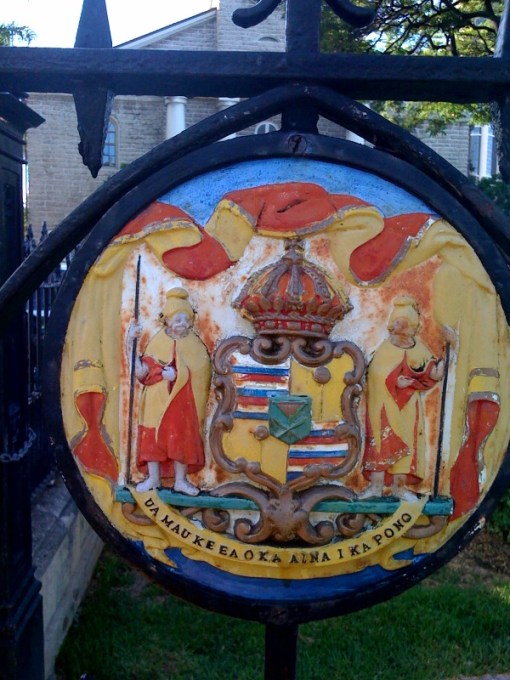
And a third is the seal on the gate to Lunalilo's tomb. "Ua mau ke ea o ka aina i ka pono." This motto became the Hawaii state motto, and it means, "The life of the land is perpetuated in righteousness."

Copyright 2009 Rebekah Luke

Rev. Rebekah Luke has a healing ministry and is ordained by the Universal Life Church. The only two tenets of the ULC are “Freedom of religion” and “Do the right thing.” For more information, click on REIKI HEALING BY OELEN on the menu bar.

Suggested reading:

Liliuokalani. Hawaii’s Story by Hawaii’s Queen. Mutual Publishing, 1991. ISBN 978-0935180855 Paperbound.

Liliuokalani, Her Majesty Queen. The Queen’s Songbook. Honolulu: Hui Hanai, 1999. Edited by Dorothy Kahananui Gillett and Barbara Barnard Smith. ISBN 0-9616738-7-7 Clothbound Edition and ISBN 0-9616738-8-5 Paperbound Edition.