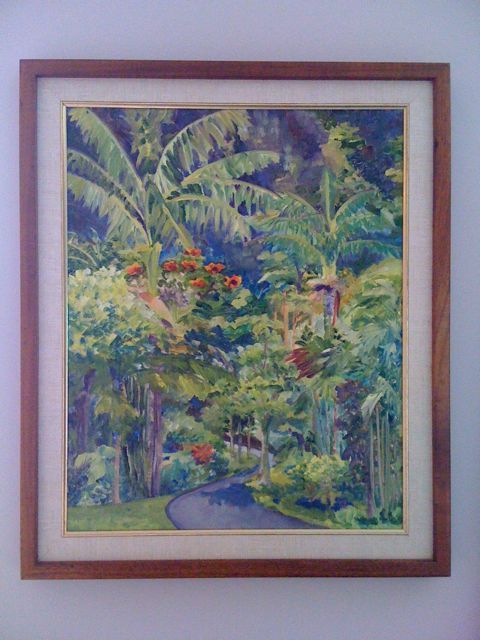
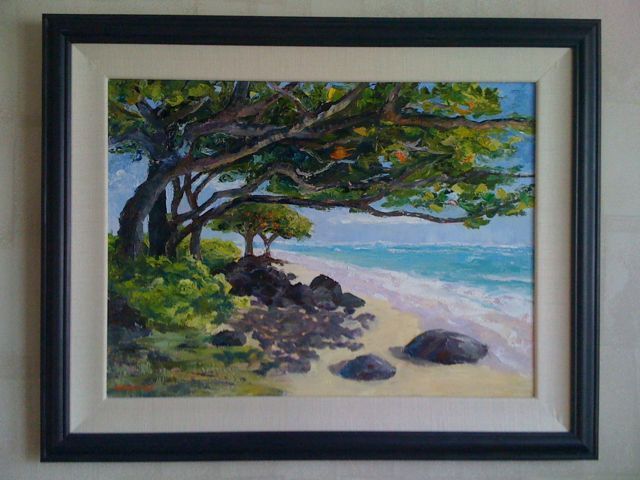
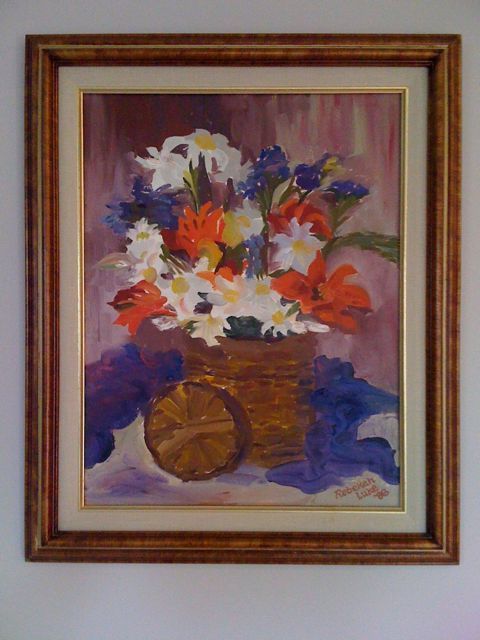
My post “Hello from Pennsylvania” is lost in transit. In the meantime I will show you three of my oils that live at my sister-in-law Penny’s house in Pennsylvania.
I painted the basket of flowers as a student of Gloria Foss. The green one is a scene at Hoomaluhia Botanical Garden on Oahu. The seasscape is of Kaaawa beach; Penny commissioned this painting of the place where her children played when they visited us in Hawaii.
I’m always delightfully surprised to see my work hanging in people’s homes and how they have been integrated as decor. These show the images in their picture frames, Penny, thanks for everything. The paintings look great! ~ Rebekah
Paintings at my sister-in-law’s
12 12 2009Comments : 2 Comments »
Tags: Hawaii, oil painting
Categories : Fine Art
Taiji for health
18 11 2009The WCC Taiji Class had a lovely visit from its master Alex Dong this week. He is a fourth generation Taiji master who was born in China, moved to Hawaii as a boy and attended school here. From Hawaii he moved to New York City and opened schools in many parts of the world. He travels from school to school.
I’ve been attending the class at Windward Community College in Kaneohe on the island of Oahu for only about three years. Class is twice a week and tuition is $40 a month. Once or twice annually, Master Dong returns to teach weekend workshops from which we learn the finer points of the Taiji form, that is “Dong Style Orthodox Taiji” evolved from the Yang and Hao styles.
When he’s not in town, his senior students or appointed teachers lead the class. Students may advance their study during the various workshops taught by Master Dong wherever in the world he gives them. Many combine the workshops with vacation travel abroad—New York, Greece, Italy, Croatia, Czech Republic, Brazil, Great Britain, China, Hawaii, for example.
To become more acquainted with Taiji, I’ll refer you to the website alexdongtaiji.com. There I read that Alex Dong comes from a family of Taijiquan masters. His great-grandfather, Grand Master Tung Ying Jie was the national champion of China for many years, and he was a leading disciple of Yang Cheng-Fu, the main proponent of the modern Yang Long Form. Tung Ying Jie also studied with Li Xiang Yuan who was a disciple of Hao Wei Jing founder of the Hao style Taiji. Alex Dong’s grandfather, Grand Master Dong Hu Ling, spread the art in Southeast Asia and the United States, and his father, Grand Master Dong Zeng Chen, is world famous for his skills, especially in Taiji push hands.
Taiji had been recommended to me for exercise, and I do think my health has improved since I began. Balance, concentration and memory, strength, breathing (I am asthmatic, but less so now), energy, grounding, flexibility, posture—these are just some of the aspects of mind, body, and spirit that Taiji addresses.
To give you an idea of how whole Taiji is, I asked the master sifu (teacher) what he did to cross train. He replied, “Nothing. Only Taiji.”
So far I practice all three sections of the slow set and the sabre (knife) set; I practice between classes, read articles and books, and watch the videos of the master performing. My first Taiji teacher Lois explained that learning Taiji is like peeling away the layers of an onion. That is so true! A warm “Thank you!” to all of my teachers.
At this stage of my practice, I have a personal interest in relating the energy work of Taiji to Qigong to Reiki and healing.
For related posts, please see my 9/3/09 entry “Learning about energy healing.” From the menu bar, Reiki Healing by Oelen, tells about my Reiki practice.
Copyright 2009 Rebekah Luke
Comments : Leave a Comment »
Tags: Alex Dong, exercise, Hawaii, health, Reiki, tai chi, taiji, Travel, wholeness
Categories : About me, Reiki Healing, Travel
Ho‘oilo, the Hawaiian wet season
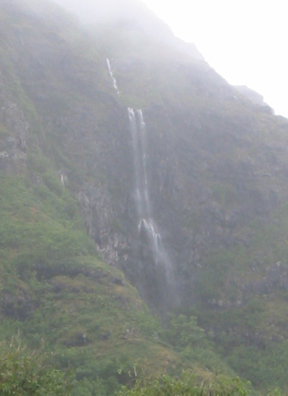
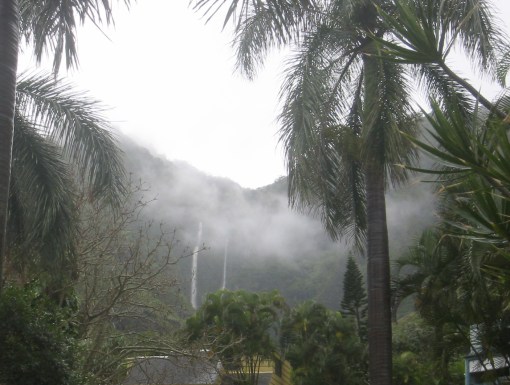
3 11 2009It’s ho‘oilo, the wet season, and here comes the rain. It’s the time of year to consider painting rainy-day pictures.
This is a view from the studio and two more waterfalls I can see when I look straight back into Makaua Valley. When it’s not raining, the falls are dry.


In 2006, it rained continuously for 40 days and 40 nights, causing landslides, flooding in Kaaawa village, and extensive damage to Makaua stream, a stone’s throw away from the studio.
We are so very thankful that the stream has been restored to pre-storm conditions in several sections. The restoration was completed and blessed just last month.
Leaving the stream unrepaired was considered a risk to public health and safety.
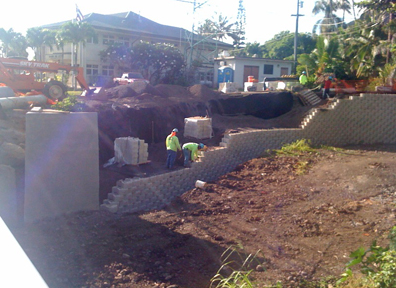
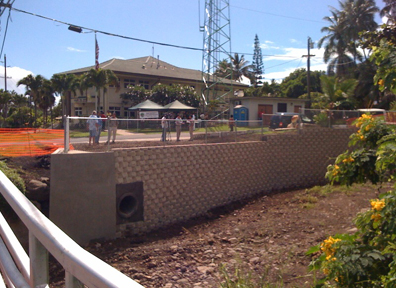
One damaged section was ma uka (mountain side) of the bridge (see photos below). On Kamehameha Highway, the main artery between Kahaluu and Haleiwa on Oahu, this bridge was in jeopardy. Many thanks to the federal and state governments, the contractors, and the community—including the private land owners and tenants of the land next to the stream and the contractors—for making this $816,092.00 restoration project possible.
In this 2006 photo, roaring Makaua Stream had already washed out the embankment. In the background is a residential road and the fire station. Kamehameha Highway is just out of the picture on the left side.

Here you can see the reconstruction work. The debris and the huge boulders that washed down have been cleared away. The job took 200 days to complete.

The restoration project including the new embankment, jumbo drainage pipe, and fencing was completed and blessed in October, just in time for new rains.

The photos of 2006 were made by Peter Krape.
Copyright 2009 Rebekah Luke
Comments : Leave a Comment »
Tags: Hawaii, Hawaiian weather, hooilo, Kaaawa, Makaua, Oahu, rainy season, stream restoration
Categories : Hawaiian, Travel
Vog: an art lesson
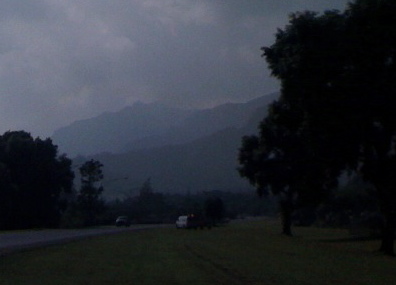
29 10 2009It’s voggy in the landscape today. I saw it when I drove from Kaaawa to Kaneohe.

The Koolau Mountains in vog, about 10:15 a.m. today. Notice the ridges appear in three tints of gray.
What’s vog? Vog is the less-than-clear air that we have when the kona winds from the southeast blow the emissions from the volcano up the island chain toward the northwest. It’s like the words fog and smog. It hangs around until the regular trade winds return.
Vog is worst on Hawaii island, a.k.a the Big Island, home of the eruption. The falling ash deteriorates homes and crops, and the smokey air makes it hard to breathe. It reminds me of when I arrived at art school in Pasadena (Los Angeles) one August and was told as I gazed out the floor-to-ceiling windows, “The mountains are right there in our backyard, and they’re beautiful, but it’s so smoggy, we can’t see them.”
One good thing about the atmosphere as today’s vog, though, is that it serves to explain how to paint distance. Generally, objects in the foreground have the darkest value, and as objects recede into the middle-ground and background, they become lighter in value. As one’s eye moves back into space, the values become lighter.
On an ordinary sunny day, the kind that prompts us to say, “It’s just another beautiful day in Hawaii!” the Koolau Mountains are clear and colorful enough to see the individual trees on them. To represent such a scene with paint and for it to “read” properly, we consider the logic of light and either lighten and/or mute the colors in the background, even though we don’t see them that way with our eyes. But on a day like today, you absolutely can see it.
If you have ever seen the Blue Ridge Mountains in Appalachia, or photos of them, it’s the same thing.

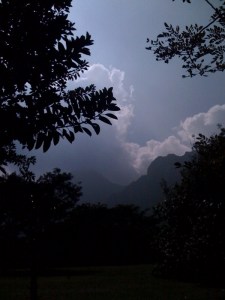
Nuuanu Pali Lookout (center of photo) viewed from Luluku, about 10:30 a.m. today
This morning my destination was Hoomaluhia Botanical Garden at Luluku at the foot of the mountains where I go to paint. Here is a photo of the Nuuanu Pali pass viewed from Luluku. Ordinarily the cars on the highway and the people at the lookout are visible.
Notice that both photos appear blue, or blue-gray. My own eyes did not see the scene this way because I am used to seeing the scene in full color (the whole spectrum), and my brain translated it into full color. But, as the saying goes, the camera doesn’t lie. Blue is the color of atmosphere.
Now, knowing about values (shades of gray) as they relate to distance, and knowing about the color of atmosphere, you can represent distance in a painting by muting and lightening the colors of objects as they recede.
If you forget to do this initially in an oil painting, there is a glazing technique you can use, but only after the paint is dry. Take a dollop of painting medium with your palette knife and mix it with a tint of blue pigment (e.g., white + ultramarine + cobalt). Have a clean, soft cloth handy. Brush the glaze over the part of the painting that you want to lighten. Then, working quickly (because glaze dries fast), wipe off with the cloth little by little, if you wish, to get the effect you want. Ta-dah!
The values underneath that you painted originally will stay the same, that is, the relationships among the values will remain. You are simply putting in the atmosphere with your tinted glaze.
Don’t worry if the glaze gets beyond the area you want. Just go back and paint over it. (We call that “destroy and recover.”)
Copyright 2009 Rebekah Luke
Thanks to Gloria Foss who taught me how to do this. To see my oils, click on PAINTINGS in the menu bar.
Comments : 2 Comments »
Tags: art, art lesson, Big Island, Hawaii, Koolau Mountains, oil painting, painting, vog, volcano
Categories : Fine Art, Hawaiian, Travel
Guardians of tradition
21 10 2009“Guardians of Tradition” are we, I was reminded last evening. The event: a gathering of Punahou School alumni to hear a lecture by kumu Hattie Eldredge Phillips at Kauihelani, the Hawaiian resources center of the Case Middle School.
Hattie is of the well-known Eldredge family that has touched the students, faculty, staff, parents, and alumni of Punahou for generations—as student leaders, teachers and coaches.
In front of last night’s audience, she introduced her brother Pal, who teaches first graders, her very good friend and colleague Malia Ane, who teaches grade 3, and Malia’s mother Marilyn Ane, retired kindergarten teacher. The Ane family is equally dedicated to Punahou. Each would take the microphone to share stories and mele (songs) about Punahou traditions and how they came to be, reliving the journey we alumni were all so fortunate to be a part of. None of what she does is done alone, Hattie said. The others on stage with her and ke Akua were her allies.
It was a bittersweet moment when Hattie prefaced that the empty rocking chair draped with lei was to be for her brother David who passed over the day before. Dave Eldredge retired from Punahou after 40 years as an athletic coach and teacher. He established the Hawaiian studies program at Punahou and designed the school’s fabulous Holoku Pageant.
The Holoku Pageant was how I first met Dave—Mr. Eldredge—who was the adviser to the Hawaiian Club when I was a student, and his sister Hattie, who was one class ahead of me and taught all the hula. Part of the philosophy of teaching hula and mele to students was/is that the students will in turn teach the dance and music to others, thereby helping to perpetuate Hawaiian culture. And this has been happening for all the time Mr. Eldredge, and now Hattie, Pal, and Malia have spent at Punahou. Mr. Eldredge would be proud of Hattie’s program that was dedicated to him last night.
Some highlights:
The entire Eldredge family, though grieving, was present at Kauihelani, a thoroughly modern Hawaiian resource center facility that is Hattie’s domain. Seventh graders have a huge and great place to learn Hawaiian values, history, tradition, activities, and culture. There they can connect with real events happening in the community.
Pal Eldredge, who has researched the history of Punahou School, showed us some interesting, old photos of campus, gave us the correct lyrics for the alma mater “Oahu-a” and played guitar.
Marilyn Ane (Class of ’48) told how she started the “Flaming P” tradition to generate school spirit.
Malia Ane, also known as “Queen of Mele,” led the gang in a group duet of “Pupu Hinuhinu” and “Maile Lei.” It was Malia who started the tradition of teaching Hawaiian songs to the elementary grades.
Leilehua Phillips, Hattie’s daughter and past queen of the Holoku Pageant, performed a hula. Hattie inherited the directorship of the pageant from Dave few years ago.
We all sang a medley of Punahou fight songs. The women—Hattie, Malia, and Marilyn—were football song- and cheerleaders, no surprise!
And the special request from the audience that brought the house down: that Marilyn Ane lead the alumni audience in the cheer “Geeve ’em the hash, the hash, the hash” as the video camera rolled. It was hilarious! I know, it’s something you had to be there for, and I’m sure Dave was. “E Aunty, you still got it!”
We are shown the way by those who came and went before us. We have only to listen for their guidance, follow in their footsteps and teach our children. That was Hattie’s message, and it came through loud and clear.
Mahalo!
Copyright 2009 Rebekah Luke
Comments : Leave a Comment »
Tags: David Eldredge, Hattie Eldredge, Hawaii, Malia Ane, Marilyn Ane, Pal Eldredge, Punahou School
Categories : Friends & Family, Hawaiian, Memoir
Wrongful occupation of Hawaii
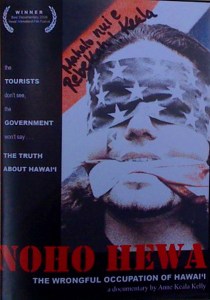
9 10 2009Anne Keala Kelly has made a very disturbing documentary film entitled “Noho Hewa: The Wrongful Occupation of Hawai‘i” that all Hawaiians and Hawaiians at heart should see. It is so disturbing that at the end of last night’s screening, when the house lights came up and Keala asked the audience for questions, there was dead silence in the Paliku Theatre of Windward Community College.
“Noho Hewa: The Wrongful Occupation of Hawai‘i” is so disturbing that it won the Best Documentary 2008 Award of the Hawaii International Film Festival. That was last October. Now, ten more minutes have been added, and the DVD is now available for $20 to help the filmmaker recoup her expenses.
Our family bought two copies. You may go to nohohewa.com for information about future screenings or to purchase the DVD. Keala will take her guerrilla film to the University of New Mexico in Albuquerque on October 12, 2009, and to Pacific Lutheran University in Tacoma on October 15, 2009. Admission is free.

For more information by the filmmaker, visit nohohewa.com
Quoting the DVD cover notes of “Noho Hewa”:
Hawai‘i, thought of by most as the 50th state, is, according to international law, an independent country under an illegal and prolonged occupation by the United States. Through this occupation, Hawai‘i has become home to the largest military command on earth. It also has more endangered species’ habitats per square mile and is the location of more open field tests of genetically modified organisms than anywhere else in the world.
Beyond the illegitimacy of the U.S. presence in Hawai‘i, “Noho Hewa” looks at the methodical removal of Hawaiians from their homeland. The film considers how the erasure of Hawaiian people and history through government sponsored acts of desecration is central to an ongoing agenda to ethnically cleanse Hawai‘i of the Kanaka ‘Oiwi, the indigenous population of Hawai‘i.
If you are alive at all, “Noho Hewa” will shock you. I am Hawaiian. I consider myself an activist. My Hawaiian friends, neighbors, citizens of Ka Lahui Hawaii, and my extended family are in this film. This piece of journalism—it’s excellent—has woken me up even more to the truth about Hawaii, my beloved home. If you can, share this information with others and decide what you will do. It will take all the courage you have. Mahalo to Anne Keala Kelly for hers.
Copyright 2009 Rebekah Luke
Comments : 2 Comments »
Tags: Anne Keala Kelly, Hawaii, Hawaiian, Hawaiian sovereignty, indigenous people, Noho Hewa, United States military, US military occupation
Categories : Fine Art, Friends & Family, Hawaiian, Travel
FAQs about my art: an interview with self
25 09 2009Rebekah, what is your medium? Oil.
What kind of painter are you? Mostly plein air (French, literally, open air). I go on location outdoors, into the field, and study the light.
How would you describe your style? Impressionistic representationalism. Sometimes abstract.
What is your subject matter? Hawaiian places; landscapes; Hawaii nei. More recently, I’ve added still life, and I am doing some seascapes. I paint subjects I think people would like to hang on their walls.
Do you paint from photographs? Rarely. I always felt if I painted from a photograph, the painting would look like a photograph. Sometimes I’ll make a black-and-white photo to see the values (range of darks to lights). I prefer painting en plein air or from life.
How long does it take to finish a painting? It depends on a lot of things, but on average about four or five times out on location. Some may take five hours, others five years.
Is your work in galleries? It used to be, but not at the present time. I am seeking a good venue and good representation.
Where can I see your work? Right here on Rebekah’s Studio! Come and visit my virtual gallery. Click on Paintings on the menu bar. To see the actual original painting, please contact me and we can make an appointment to see it. I’d love to show you!
How did you learn to paint? I took lessons, primarily from Gloria Foss. Before that I took the required art history classes in high school and college. I also studied art as part of the photography program at Art Center College of Design in Pasadena.
When and where did you start showing your work? In earnest at the Honolulu Zoo Fence on Monsarrat avenue and at Arts of Paradise gallery at the International Market Place, both in Waikiki in the later 1980s, and at invitational and juried shows. You might like to read my August 26, 2009, post “I wasn’t always a painter.”
What are your prices, what does a painting cost? An example would be U.S. $600.00 for an original 16″ x 20″ landscape in oil, frame included. Smaller ones are priced less, larger ones more.
How do you price your work? Besides the general guide in the above Q and A, I look at the overall piece, the thing. I imagine a price and I imagine selling the piece for that price. If I experience an awful feeling in my stomach, then the price is too low. I also go to galleries and shows and look at other artists’ works and prices for comparison. I think my prices are realistic.
Does the price include shipping? No. The customer pays for shipping and delivery. I take care of the packing and packaging.
Why is art so expensive to buy? The materials don’t cost that much. Artists are like actors. We don’t work every day. (Actually, we do, but we don’t sell every day; you get the idea.) This is how we earn our living—you know, food, shelter, gas, not so much clothing.
I love your work, but I don’t think I can afford to buy it. Can I? Sometimes for things we really want, we need to sacrifice. I have a layaway plan, normally three monthly payments each of 1/3, 1/3, 1/3. It’s possible to stretch payments out longer. The customer does not get the painting until it is paid in full. The installment payments are not refundable. That’s the deal. Several collectors of my paintings purchase on layaway, and they are able to enjoy enduring original art that way. If your finances can’t handle the layaway plan, then you probably can’t afford the painting.
Do you make reproductions? I’m wondering if I should manufacture some more. I have a giclée entitled “Mele’s Beach” that’s almost sold out.
Do you accept credit cards? Yes, through PayPal.
Who buys your paintings? Anyone. I have customers, patrons, and angels. 😉
Do you teach painting? Not formally. I’m happy to have people watch me paint and answer their questions, give a demo and talk about my art. My best audiences/pupils are kids. I might offer some tips on this blog.
Do you ever donate your artwork to a benefit auction event of a non-profit organization? Only if I can have part of the income. The reasons are: The non-profit receives merchandise and a donation for the painting if it is sold. The winning bidder gets a painting and a charitable tax deduction. The artist receives no income and can deduct only the cost of materials (i.e., canvas, paint, frame, wire). The public gets the erroneous idea that artists don’t mind donating their work. When I participate, I suggest this arrangement: Set an upset price of an amount I would like. The organization may keep the difference between the upset price and the winning bid. If the painting doesn’t sell, then I get the painting back.
Why aren’t there any new paintings in your virtual gallery? I keep checking back and see the same images. I would love to install new ones as fast as I can. And I’m glad you’re checking back. The thing is, oil paint takes a long time to dry, especially in a humid climate like Hawaii. Only when the painting is bone dry does it get a finishing varnish coat. Then that has to dry, then I photograph it, and then the painting gets a frame. It could take up to six months from the time I finish a painting to when it’s put on display. So, please stay tuned! I value your interest.
Thanks, Rebekah. And thank you! If you have other questions, you may Leave a Comment below or contact me by email. RL
Copyright 2009 Rebekah Luke
Comments : 1 Comment »
Tags: Fine Art, Hawaii, oil painting, painting, plein air
Categories : About me, Fine Art, Hawaiian


Recent comments