Reflections on “The Help”

21 08 2011
Cover of "The Help"

Book cover

Two thumbs up for the acclaimed movie The Help, a screenplay written and directed by Tate Taylor. DH and I viewed it last night.

The 1960s Civil Rights issues cannot be forgotten, and for dear readers younger than 50, The Help talks about a piece of that, delivering the information in a way that might stir more interest in that important era of American history.

Though the ending is hopeful, I wondered how much racist issues persist today in comparison, and I hoped more people would watch the film before it leaves the theaters.

Though based on Kathryn Stockett’s novel (i.e., fiction) that tells the stories of black maids in the service of white employers, the movie was convincing as an accurate reflection of truth.

“We were there,” said DH, meaning the stories are contemporary with us, and meaning that we had been in Mississippi.

On one of our driving trips across half of America, I think it was around 2003, we called on our cousin Eddy in Memphis, Tennessee. (Eddy and her siblings remark how brave their Chinese-American father from Hawaii and Caucasian mother from Mississippi were, to marry in the South in the 1950s. I recall she said she feels equally comfortable whether in Hawaii or the South for that reason.)

In Memphis, Eddy the tour guide escorted us to places like Graceland, SUN studio (where she’d worked), Beale Street, and Stax Museum, but it was the National Civil Rights Museum that we liked visiting the most because of how the museum showed how all the events of that time related, one with another.

During the early Sixties DH and I were in high school, he in Pennsylvania and I in Hawaii. We read about the protests but we could not possibly comprehend everything. Visiting the Civil Rights Museum and viewing the story of The Help would be on my recommended list for everyone 12 and up.

One day Eddy drove us south across the border into Mississippi, to Ripley, where her mother was born, to visit her aunt who’d made a peanut butter pie. She lived in a neighborhood with wide streets and mature shady trees. Last night both DH and I recognized its ambiance in The Help, though the movie was filmed in Jackson, Mississippi.

What parents need to know

In browsing the reviews for The Help online I came across http://commonsensemedia.org/ that I thought parents might welcome these days when media and digital activities seem to take precedent over school and home activities. There’s a good “what parents need to know” section, for example, when you look up a movie. But it’s not just about movies. Worth checking out.

Copyright 2011 Rebekah Luke


Hakka dinner with Tsung Tsin

31 07 2011

Favorite food of Hakka people

For relatives on my mom’s side and friends interested in Hakka Chinese things, here is my link to the Tsung Tsin Association in Honolulu’s website where you can learn about this Hakka club too: http://tinyurl.com/tsungtsinhi

The group seeks new members to help achieve its mission “to promote the exchange of knowledge among the Hakka peoples, develop a spirit of cooperation among the Hakka in Hawaii and throughout the world, and promote education, charity, and benevolence.”

Last night, taking advantage of my “guest” status, eight of my cousins and friends partook of a Hakka dinner cooked by the chef of Golden Palace Seafood Restaurant. About 120 people attended.

At our table were my eldest first cousins, Eileen and Kwong-Yen, and cousin Audrey Helen and her husband Howard; our mothers were sisters. Nani and Rae came; they are cousins on Eileen’s father’s side. So did Pixie whose birthday is today—Happy Birthday, Pixie!—and Lori who is a professional foodie.

We ate dishes prepared especially for this event that are not part of the regular menu—as there is no Hakka-specific restaurant in Honolulu—and were reminded of our childhood and the foods our parents and grandparents made.

I consider Hakka food “Chinese soul food.” Some people call it peasant food. My friend Lori described it as “rustic” and “pigcentric.” It’s salty because Hakka people worked in the fields outdoors and needed to replace the salt in their bodies. Salt was also used as a preservative for foods like cabbage and eggs. Hakka cooks also use a lot of oil, because in the olden days there was not enough oil, so now that it is available, they use it (that is what I was told on a Hakka food tour I took in China one time.)

Although today’s advice is to eat what our ancestors ate, I don’t indulge like this very often anymore, and if I do, I modify the recipe and try to make it healthier. I do, however, like that the food we ate as kids did not contain much sugar.

Last night’s flavors allowed us to reminisce about the recipes. The occasion and the Tsung Tsin Association gave us a chance to revisit our roots. Please consider getting in touch. It’s a well-organized and very friendly community.

Copyright 2011 Rebekah Luke


Seven Polynesian voyaging canoes

25 06 2011
Hōkūle a

Hokulea (photo courtesy of Wikipedia)

In this lifetime I’ve witnessed the revival of the Polynesian voyaging canoe.

One time, a man I was married to—a newspaper reporter and a sail-boater (before DH)—was excited about meeting the artist Herb Kawainui Kane whom he had just interviewed.

He saw Herb Kane’s beautiful paintings of double-hulled canoes under sail. He learned of Herb’s dream to build such a canoe in Hawaii that would make a voyage across the Pacific to the land of his ancestors in the way that the Polynesians first came to the Hawaiian Islands. He had an idea of what the boats looked like, and he was in the process of figuring out how exactly how to build them.

The reporter had crewed for Rudy Choy, a naval architect, from California to Hawaii on the Aikane II, a modern 65-foot catamaran built for his sunset dinner cruise fleet, on its shakedown voyage. He introduced the painter and the naval architect to each other, and that was about the start of the Polynesian Voyaging Society that celebrated the now-famous Hokulea’s 1976 voyage from Hawaii to Tahiti.

I was young and just a “fly on the wall” at the time, but that tidbit is true and a treasured memory of mine.

You can find out about Polynesian voyaging on this Polynesian Voyaging Society website. For more than a generation the organization has educated our island youngsters and the public with the ancient knowledge of traveling across the ocean without modern navigation instruments. PVS has played a major role in showing Native Hawaiians their ocean heritage.

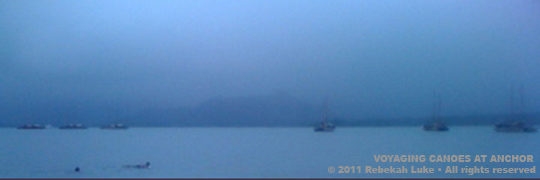
Six of the seven voyaging canoes at anchor in Kaneohe Bay at Hakipuu this afternoon. The blue-toned scene is from a rain squall.

Fast forward 35 years to yesterday afternoon when seven Polynesian voyaging canoes called at “Hokulea Beach,” within Kualoa Park on Oahu where Hokulea was launched originally. These seven canoes began their voyage from New Zealand and are on their way to North America. They sailed from Nukuhiva in the Marquesas on June 2 and called at other Hawaiian islands to the east before reaching Oahu.

It was a wonderful sight to watch them enter Kaneohe Bay. The canoes represent Tahiti, Samoa, Fiji, Tonga, New Aotearoa, New Guinea, Vanuatu, Kiribati, and the Solomon Islands and are sailing together in a voyage titled “Te Mana O Te Moana.”

With sails furled and anchors down, the celebration continued on land today, with ceremonies, exchanges of greeting, singing, dancing, and eating.

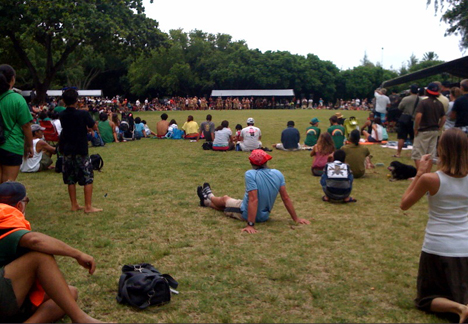
Oahu islanders and visitors enjoy festivities at Kualoa Park.

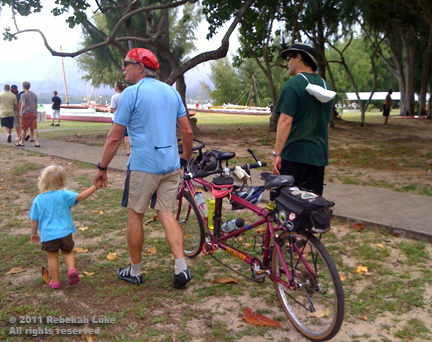
DH and I rode our tandem bicycle from the studio to take it all in.

Our tandem rig. Miss Marvelous and her dad, far right, are anxious to show her Papa (DH) the canoes.

Copyright 2011 Rebekah Luke


My grandfather Chong’s house

19 06 2011

My mother's birthplace

Fathers Day 2011

My trip to North Kohala last Monday, Tuesday, and Wednesday with my cousin Nathan, cousin Ann, and DH to scout places and activities for a family reunion in 2012 included some sleuthing, at least in our minds!

I do apologize for keeping you in suspense by my last post. 😉

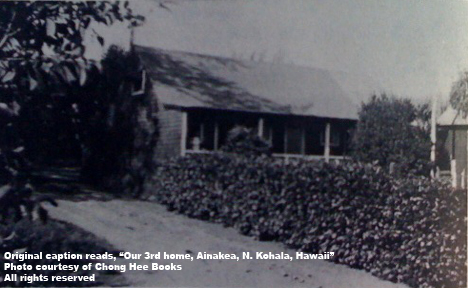
Our main quest was to determine whether or not the house our mothers, aunties, and uncles were born in (between c. 1905 to 1925)—in the ahupuaa (land division) of Ainakea—was still standing. One would think a simple phone call could give the answer, but I had gotten conflicting reports in recent years, and even last week! With my investigative reporter’s background, I had to fly inter-island and see for myself. DH and my cousins would corroborate the findings.

Wouldn’t it be wonderful if the house was still there? I imagined our other cousins could see firsthand during our reunion where their (grand)parents lived. We could walk the aina (the land) where our ancestors played and grew up before they moved to Honolulu in 1925 for higher education. I belong to the third generation, and the sixth generation has begun to show up. What an opportunity this could be.

My grandfather Chong How Kong, also known as Ah Nee, worked as the overseer for the estate of Dr. Benjamin Davis Bond (1853-1930), a physician, and his wife Emma Renton Bond (1866-1951). It’s located in the ahupuaa of Iole. Iole is next to Ainakea. Dr. Bond’s father, the very Father Elias Bond (1813-1896) was responsible for my grandparents’ emigration from China.

Today, there is a new land owner (New Moon Foundation) and the “Bond Historic District,” a 56-acre federally registered historic district, within its boundaries. The towns of Hawi and Kapaau and other tiny communities on the northern tip of Hawaii island to the end of the road are characterized by country living, attractive small-business establishments, and a tightly knit, caring community.

Now, about those conflicting reports. From time to time over the years various family members would revisit the old homestead and be welcomed on the property by whoever lived there. I was there in 1990 with DH and cousins Elly and Jim, and in 2003 with my friends Linda and Terry. Ann went with her husband (now late) cousin Anson a few years later. We each took the obligatory photo of us standing in front of the house.
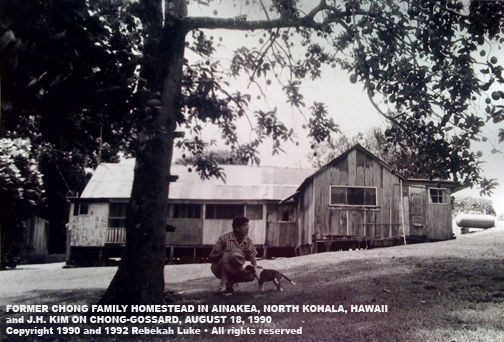
In 1990, the front porch is enclosed and the kitchen wing Ah Nee built is still attached. That's my cousin Jim with a friend in the shade of the avocado tree.
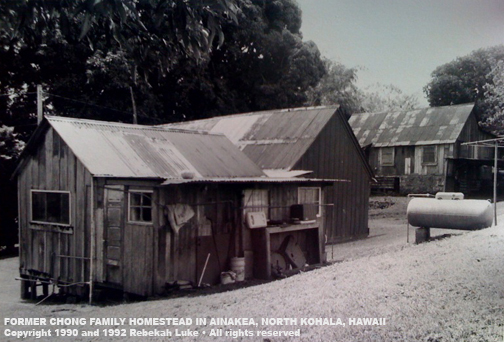
View of the kitchen in 1990. During our family's time in the 1920s, bachelors lived in the house in the rear. My grandmother cooked for them as well as for her own family of 15 children.
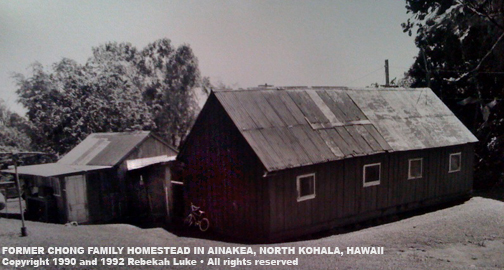
View from the back of the house in 1990
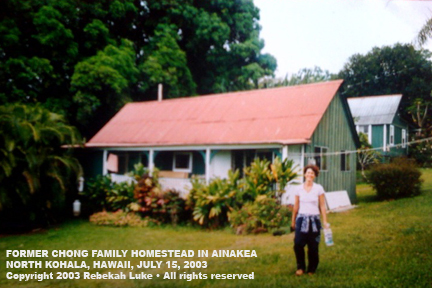
Brenda greets us in 2003. The kitchen has been removed, and the house renovated. The porch is open, there are new windows on the side, and the cottage in the back is spruced up. At this time it is occupied by the Kohala Family Homeschooling Learning Center.
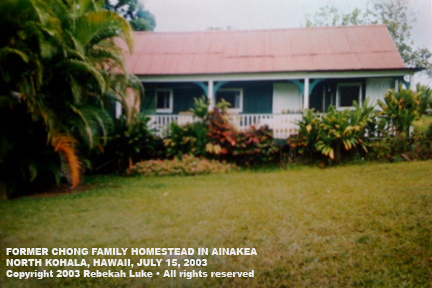
Front view with open porch
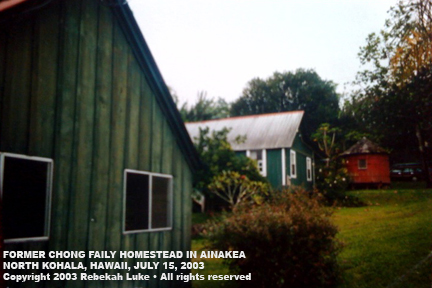
This 2003 photo shows new windows and paint.

After the magnitude-6.7 and 6.0 earthquakes hit Hawaii on October 15, 2006, I was curious how the house survived, if at all. By phone from Oahu I reached a woman who told me rather authoritatively that the house was still standing, but that it was tagged for demolition because of earthquake damage. Okay, that’s it, I thought.

A few times after that, cousins vacationing on the Big Island would call me for directions to the place. “Not sure if the house is still there,” I’d tell them, “but here’s how to find the site. Let me know what you find.” And I’d describe the wooden gate between two ironwood trees that opened onto the grassy driveway. Later they would say how they couldn’t find it. “Well, it’s a small house, and it’s some distance in from the highway,” I’d say.

Last year when I contacted New Moon Foundation to ask about the house and any educational programs it advertised on its website (research for the family reunion), the office had no idea what house I was referring to. That puzzled me.

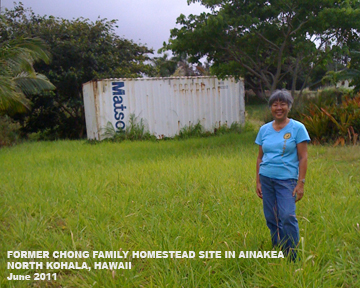
Continuing in my search, my Facebook friend Anna, a widow of a Bond descendant, introduced me to her son Boyd, who lives in Kapaau and knows a lot of North Kohala history. He said over the phone when I called to make an appointment to meet him that the house was still there. Oh, yay! When we met in person just a few days ago, he reported, “No, sorry, it’s not.” Indeed when we drove by, finally, we saw from the highway that it was gone. 😦  In its place: a Matson container.

On the adjacent lot are some homes, with a bumpy road parallel to the property line. We drove up the road for a better look at the lot from the side and turned around half way when it got rougher. A dog started barking, and the neighbor emerged. “Go talk to her,” DH urged.

I explained why we were there, how sad the houses were torn down (there was more than one). Her name was Mrs. Castillo.  She said, “Oh, they weren’t torn down. They were moved away on a truck.” Imagine my surprise! She said the property was then graded and a new road was put in. “Before or after the earthquake?” I asked. “Before,” she replied. Hmmm …

Staff at New Moon Foundation was gone for the afternoon, so we planned to ask the next morning. Back at the Kohala Village Inn, while I continued to reflect on this news, I decided to look up the satellite map from Google.

I found the aerial view of the neighbor’s house, and I also saw our family house we were looking for. I was sure of it. I got excited! I thought, the house was moved all right, but just to a spot farther in on same lot. Now I really had to return to the spot to find out for certain.

The next morning at the Iole office I explained our quest. “I’m imagining our parents as kids playing with the Bond kids, and there must have been a short cut between the two places,” I said to the admin staff. They pulled up the Google map, the same map, and mentioned it was the place of the Meditation Hale (house).

They’ll take us there!  Of our entire scouting trip, that was the most joyous moment for me. Through the fruit orchards, down the gulch into the forest, and up a private trail. As we walked into Ainakea, it was plainly evident that our grandparents’ house was not there after all. That darned Google map is old!

Between the Meditation Hall in the rear of the property and the highway we found a rock terrace and a pair of orange trees remaining. Back in the studio I’m comparing the photos from different eras, wishing I would have thought to bring them on the trip in the first place.
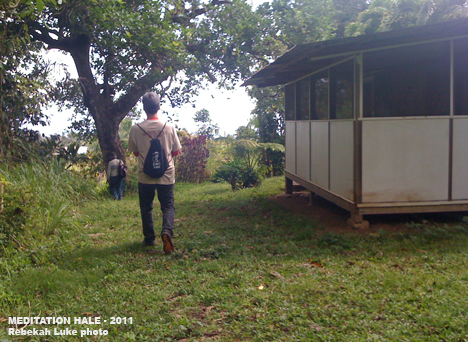
DH and cousin Nate walk quietly past the Meditation Hale at Ainakea.
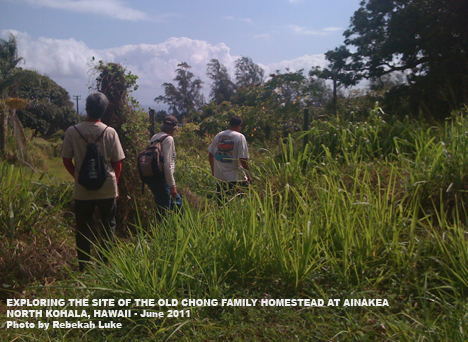
Looking toward the highway from the back of the property, you can see the ironwood trees where the old gate was.

Why do we care so much after all this time. Well, there’s just something about finding one’s roots, and my cousins will like to come here.

There’s still a missing piece to the puzzle. Where is the house? You know, we were so happy to walk on the land, we never asked New Moon Foundation the question.
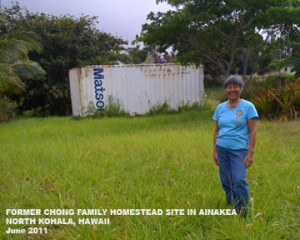
The Matson container and me

Copyright 2011 Rebekah Luke


The house where Momma was born

14 06 2011

Yesterday I met a wonderful person, the great grandson of my grandfather’s employer. I came to my ancestral homeland to revisit the house on the land where mother was born. What did I find? Boys and girls, do I have a story to tell!

To be continued …

Copyright 2011 Rebekah Luke


Spring cleaning for summer

10 06 2011

It’s a little late for me to be spring cleaning. I mean, really late. But Chalida and her family are in town, and on Saturday they are coming here for several days to take care of the animals while DH and I take a scouting trip to North Kohala to plan a family reunion there for 2012.

Chalida, the daughter of my good friend Linda, lives and teaches in San Francisco. She, her hubby, also an educator, and two children ages 3 and 3 months are an adventurous family. A bicycle family. I think they may not even own a car and manage quite well, thank you, on two wheelers. They love to travel.

After a couple of nights at the Hilton Hawaiian Village that has a pool and lots of visitor diversions, they’ll drive here over the mountain. I’m happy to return the hospitality. Chalida and her sister Lisa picked me up (Lisa drove) from SFO and put me up one whirlwind weekend when I flew over to surprise Linda for her big birthday party. (Note: A great way to avoid jet lag, HNL to SFO. Take the red-eye flight on Friday night, party on Saturday, fly home Sunday, arrive for dinner.)

Mugshot, literally. From left, Chalida, me, and Lisa. A souvenir, with patina from the dishwasher, from Linda's birthday. We're modeling lipstick for Lisa's upcoming wedding.

The last time Chalida was here was for my and DH’s wedding, and she was just a tot. It will be great for her son to meet Miss Marvelous, I’m thinking.

Today I am still in the process of converting the studio to a guest suite for four. As you can imagine, all of you who have been here, it is a monumental task. It will be a transformation! I decided to do this for myself as much as for our friends.

Why did I wait so long? I won’t try to make excuses. Just trying to “talk” it out here to uncover some reasons and then promise not to do it again. Sort of like the promise I made when I said I would never move again. Because it’s so hard.

First, I’m part Chinese. What I consider messiness and clutter is just the Chinese way, at least from my parents’ generation, and I found this to be true when I visited Chinese homes in China. What a revelation! It’s a cultural carry-over. Like, it’s in our genes!

Next, I’m an artist/writer/producer, and there are ideas on the back of envelops, leftovers from an earlier project that got buried when I started the next one, all of that paper that I want to read some day. Even DH, who has looked down his nose at my things, my precious things like my beloved mug in the photo, finally admitted, “It’s hard.” We both crave the Zen look. (But do you know that in Japan people have separate “store houses”? I saw on TV.) In reality, our style is Eclectic.

Anyway, my intention is to toss, toss, toss. I believe when Nature appears with its disasters It spares those who have cleaned house. So I’m working on it. For a time I allowed www.flylady.com to be my coach. She says rearranged clutter is still clutter. (If you have CHAOS, Can’t Have Anybody Over Syndrome, you may want FlyLady to help you, but a word of warning, she sends you a lot of emails.) So I know the drill. I just have to put it into action. By tomorrow. I better get busy!

Copyright 2011 Rebekah Luke


My tie to Barack Obama

27 04 2011

President Barack Obama’s announcement this morning inspired me to post this portrait I made of some members of my hanai family in Washington, DC. We visited the capital with Ivalee, our mom, who was in town to accept the prestigious Jefferson Award for public service, on behalf of the award winners of Hawaii.

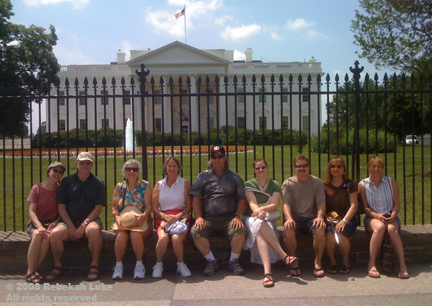
Cherie, David Lee, Ivalee, Ruth, Terry, Sarah, Karl, Julie & Kathy in front of the White House in June 2008

I was best friends with Ivalee’s daughter Margaret (not pictured) in high school, and when my parents divorced, Ivalee and her husband Dave said I could stay with them. The couple had six children, and I remember her saying then, what’s one more? Theirs was the home where all the kids congregated, and she was always welcoming.

Not in the photo is “Doc” Sinclair, who passed over a few years earlier, and my hanai brother Brian who was busy tending to his physician duties in Hawaii, in the footsteps of his father. And me, who made the photo.

Later Ivalee told me she made it a point to import kids for her family to play with—much easier. Her husband was not home much—too busy at work.

This morning Margaret’s husband Jon sent me a message that the White House released Barack Obama’s birth certificate. Jon said he examined the birth certificate posted online closely and saw that David A Sinclair was the attending physician. How about that?

How about that indeed. I recognize the signature! Our dad, David A Sinclair, MD, ob/gyn, delivered Barack Obama. In Hawaii.

Copyright 2011 Rebekah Luke