Harmony and balance

26 02 2015

Aloha, studio fans. Today’s post is inspired by musical harmony and spiritual harmony. I don’t know why so many of us have struggles this season, but know that you are not alone. You are not saying so, because you are not a complainer, but I am aware that many friends are facing challenges now.

In whatever way you or someone you love is sidelined from regular activities and loving relationships, I hope that you will heal and find a way back to harmony, balance, and wellness. Not necessarily back to the former comfortable routine, but perhaps to something better and filled with more joy.

That is my wish for myself, too. It is a time to consider a new direction, perhaps. A reconstruction project at home and trying to age gracefully (oh, my) when inside I feel much younger is why I’m adjusting, but I won’t bore you with all that! 😉

One of the things that gives me joy is good music, or making good music, to be more exact. Singing with a choir for me is like pressing a reset button because of the sounds our voices make, because of the way the singers have to listen to each other to blend in harmony, and because of the “high” we come away with after a good rehearsal or performance. Choral singing requires being in the moment, and for the moment any other worries, anxieties, or fears are put aside. That brings me to:

Travel tip:Ke Ahe Lau Makani” (The Comforting Gentleness of the Spreading Wind)

You are cordially invited to a concert of sacred Hawaiian choral music at 7 p.m. on Saturday, March 7 at Kawaiahao Church, King and Punchbowl streets in Honolulu. Admission is free.

The concert will be the culmination of “Ke Ahe Lau Makani,” a Hawaiian music festival that takes place from 2 p.m. on the same day. The Royal Hawaiian Band will accompany a new choral number. Kawaiolaonapukanileo, the music ensemble directed by Nola A. Nahulu, sponsors the event.

Anyone who wishes to sing, individual or choir, may participate. Included in the festival fee of $20 per person for March 7 festival are a music packet, rehearsal from 2 to 5 p.m., and a picnic of Hawaiian food on the lawn at 5 p.m. Registration is due by March 2.

Another rehearsal is scheduled for Monday, March 2, from 5 to 6:30 p.m. at Na Mea Hawaii store at Ward Warehouse in Honolulu. Attendance will give singers an advantage to learning the music—some familiar, others not—written or arranged by Hawaiian composers.

My first exposure to Hawaiian choral music was as a child, with my parents, who took me to Sunday service at Kawaiahao Church. In those days the choir sang from the loft in the back of the sanctuary with harmonious voices, energetic and strong. Hawaiian voices comprised then and now a unique and beautiful blend. My mother, a piano teacher, pointed all this out to me. My father, a Hawaiian, simply came along and appreciated the music.

Some of the anthems on the March 7 program are part of the Kawaiahao Church Choir repertoire. This church choir and other choirs will be singing together, and with you, too, if you come. I hope you will!
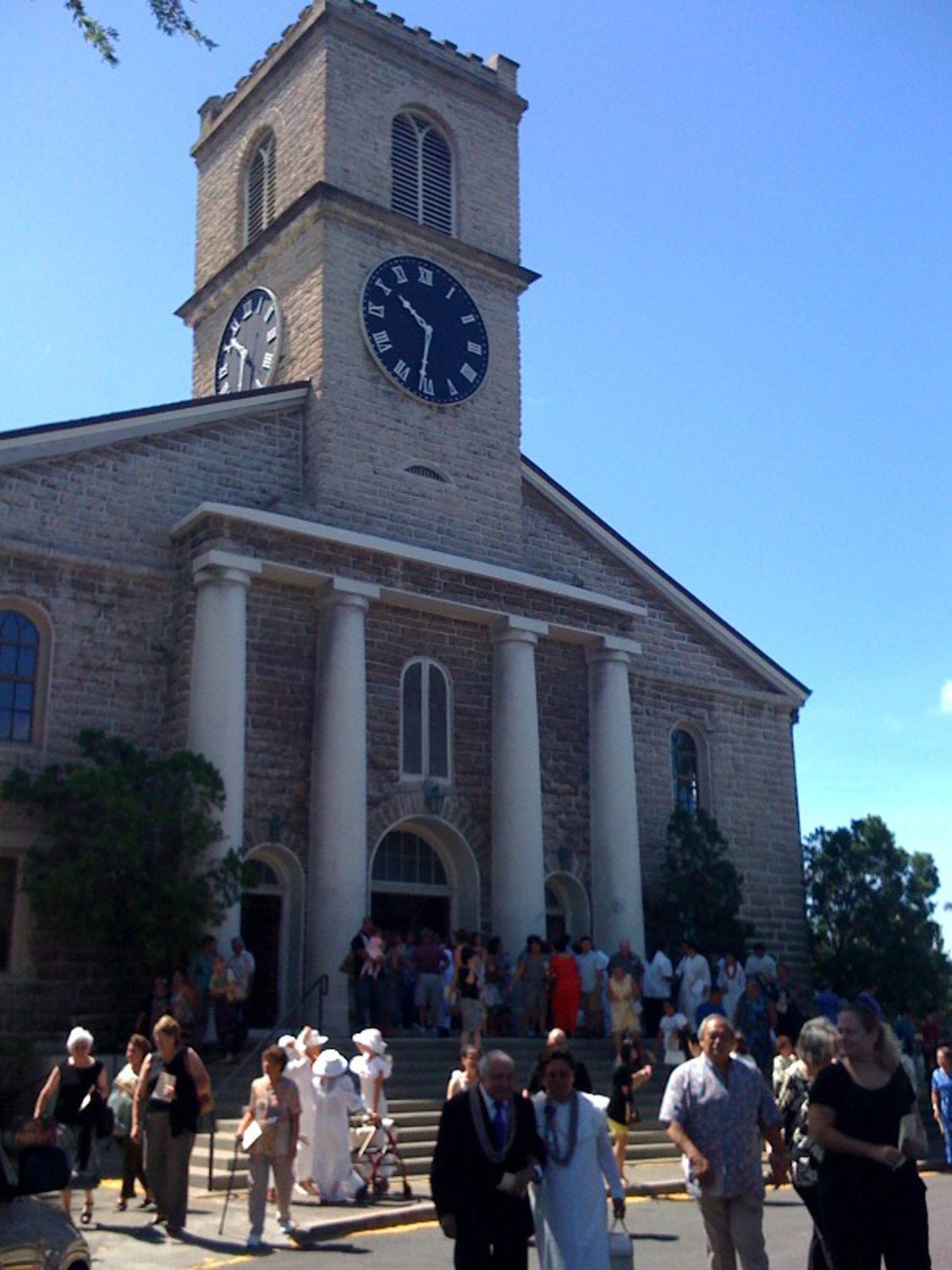
Kawaiahao Church is on the corner of King and Punchbowl streets. A plaque describes its construction

Kawaiahao Church is on the corner of King and Punchbowl streets. I’m singing with Kawaiolaonapukanileo here in the March 7 Hawaiian choral music festival.

Copyright 2015 Rebekah Luke


Memories of Christmases past

15 12 2014
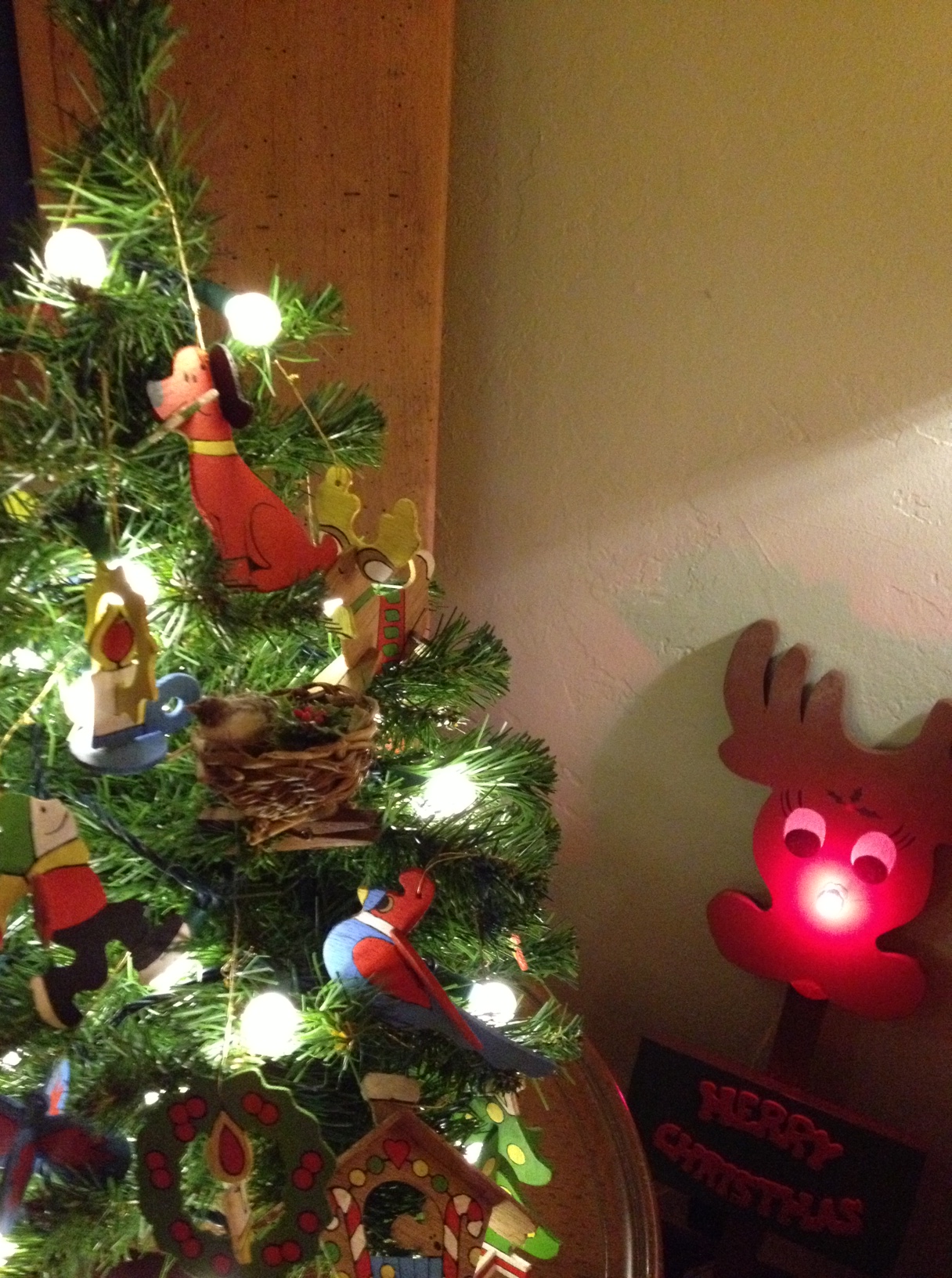
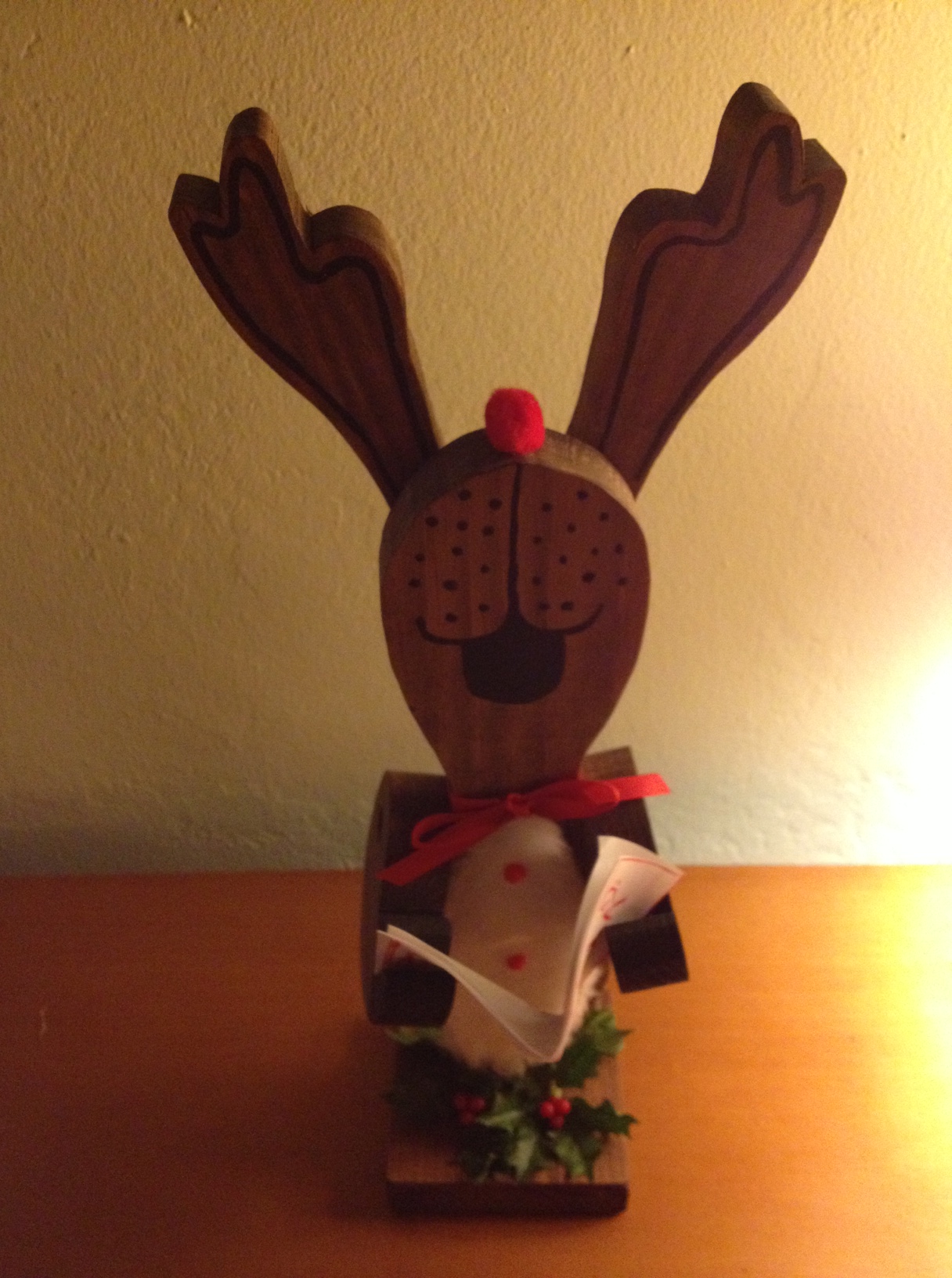
Walter made the reindeer caroler.

Caroling reindeer by Walter

A couple of early marriage Christmas memories come to mind as I catch up with the holiday spirit this year—the time when DH and I waited until Christmas Eve to shop and the time I flew from Honolulu to Philadelphia on Christmas Day.

They were fun times.

The first time, we had a list of loved ones we wanted to give presents to, but we hadn’t planned ahead or gotten anyone’s Santa list. We’d procrastinated, and soon it was Christmas Eve. We headed out to Ala Moana Center, at that time still the largest shopping center in the world, before they were called malls, and when most of the merchants were local.

It’s fun to shop with Pete. He will tell you that he can leave me at a certain spot in a store, go away to pick up what he needs, and then come back a half hour later and I will have moved less than ten feet. He always knows he can find me.

His style of shopping is like fishing, he says. You poke around, see what you like, hook it, then move on, to the next hole. No dilly dallying. Especially on Christmas Eve!

The second memory is about the time when I ran a Hawaiian cooperative from its brick-and-mortar store in rural Hau‘ula on O‘ahu. It was a cute shop that carried Native Hawaiian made products, and the only good gift store for miles.

We stayed open on Christmas Eve until 6 p.m.  I let the other workers go home, and I took the closing shift. DH and I spent every Christmas in Springfield, Pennsylvania, while his parents were alive, and this time he was already there. I flew out alone on Christmas Day and was among just a handful of passengers on the plane, so cabin service was great.

What I remember is arriving at the Philadelphia airport the next morning and being scooped up by Pete, his brother Paul, and their dad—my father-in-law Walter. It was boxing day and we were going straight to Mitchell’s in Delaware.

The family was celebrating Christmas “late” this year. Paul had just driven up from North Carolina. Mitchell’s was Dad’s favorite craft store, and everything was on sale. Wrapping paper, suitable gifts, and all-around good buys. I found a shiny eggplant tree ornament. Cool! Mom’s favorite color was purple.

Toy trains and cars for Paul’s boys, some things for the girls, brushes and tubes of oil color for me. The others had a field day selecting supplies for whatever craft and woodworking projects they were working on. Heck, everything was on sale, and Delaware had no sales tax!

The wooden ornaments for the tree were made by Pete's parents for their granddaughter Ari. Dad made the big Rudolph with the shiny nose, too.

The wooden ornaments for the tree were made by Pete’s parents for their granddaughter Ari. Dad crafted the big Rudolph with the shiny nose, too.

Because we arrived early in the morning, we’d beat the crowds. On the way home to where my mother-in-law Dorothy was waiting and where Pete’s sister Penny would be arriving, we probably stopped at the Brandywine River Museum of Art to pick up more presents, and we probably stopped at the Brothers restaurant run by my Italian sister-in-law Patty’s relatives for pizza. There are certain places we always went when touring Pete’s old stomping grounds at Christmastime.

Nice, sweet memories, and a reminder that it’s not necessary to plan everything to the last detail during the holidays. Christmas is not just a day on the calendar. Christmas can be every day. I think if I keep open minded to welcome the surprises that are bound to come along this year, it will be enough.

(Well, okay, I did start a list today. Sort of! ;-))

Copyright 2014 Rebekah Luke


A Thanksgiving memory

27 11 2014

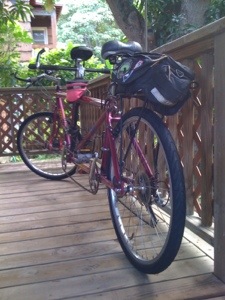
My Friends ~ I am thinking the captain/DH and I should take a spin through the back roads of Kaaawa on our double bike this morning to smell all the turkeys being roasted in the neighborhood. A hurricane struck for Thanksgiving the first year I met him more than 30 years ago, the first time I returned from Kahoʻolawe. The power was out, but he had a gas oven he wasn’t using, so his neighbor brought her bird over to take advantage of its availability. Others kalua-ed their food in an imu. Whichever you celebrate — Happy Thanksgiving! or Lonoikamakahiki! — I wish for you and yours a wonderful and blessed day. Giving thanks. ~ Rebekah

20141127-081909.jpg
Copyright 2014 Rebekah Luke


Mālama pono

2 07 2014

Conflicted, I wasn’t planning to submit a comment to the U. S. Department of Interior. But now I think I will. Based on something like this:

The most welcoming group of strangers I’ve met, the one that made me feel like I was coming home, were the card-carrying citizens of Ka Lāhui Hawai‘i, a name that translates to “the Hawaiian nation,” although for the time being this group is described as “a native initiative for sovereignty.”

I met them in January 1993, the 100th anniversary of the overthrow of Queen Liliʻuokalani and the Hawaiian monarchy, when my hanai father—RIP David A. Sinclair, MD, yes, the same who delivered Barack Obama—pointed out a small article in the Washington Post about a movement being led by Mililani Trask, then the kia‘āina (governor). “Isn’t this something you should be involved in?” Because I’m Hawaiian.

Some activity was taking place at ‘Iolani Palace for Martin Luther King Jr. Day, and I was drawn to a small tent identified with a banner reading “Ho‘omakaukau” — let’s get ready — on the lawn of the Library of Hawaii next door. Keali‘i Gora, a nokali (registrar) and the lukanela (lieutenant), enrolled me as a citizen of Ka Lāhui Hawai‘i. I took an oath. He and others gave out educational materials and information about the meeting, and it was the one organizing the peaceful march to the Palace.

That was the beginning of my involvement and the first of many meetings—district council meetings, island caucus meetings, legislative meetings, town hall meetings, constitutional conventions. I helped as a district officer and attended the legislative meetings, not as a delegate but out of interest and support.

I learned that Ka Lāhui Hawai‘i has a de facto government with a written constitution that was part of the educational materials for the people. Toward the end of Mililani Trask’s last term as kia‘āina (an elected position), at a church in Keaukaha, I witnessed her and Lilikalā Kameʻeleihiwa outline the Ka Lāhui Hawai‘i master plan document for sovereignty. It was a beautiful thing, entitled “Ho‘okupu a Ka Lāhui Hawaiʻi” (respectful offering to all).

My active involvement that was a big chunk out of my life included almost a decade as the executive director of Hale Kūʻai Cooperative that marketed Native Hawaiian made products—a small but significant economic development effort for Hawaiians.

Life happens and time passes, and Ka Lāhui Hawai‘i became inactive. Now other political forces have caused us to gather again, because of the Department of Interior meetings. The day before yesterday a parallel discussion began: whether to reconvene the Ka Lāhui Hawai‘i mokuna (legislature). It is an opportunity for an initiative that had at one time a reportedly 22,000 citizens living in the Hawaiian Islands and elsewhere on its rolls. To those expressing “No” to the Department of Interior’s questions, what next? Ka Lāhui Hawai‘i is an option.

For now, Ka Lāhui Hawai‘i citizens are attaching their names at the bottom of comments to the questions currently being asked by the Department of Interior as posed in the Federal Register. They say “No,” but more importantly, Ka Lāhui Hawaiʻi citizens are reminding the Department and all of us that it already has a Constitution, a Master Plan, and a platform on the Four Arenas of Sovereignty that further describes and defines four political arenas: native to native, native to nation/state, the international arena, and nation to nation.

I believe those documents will be attached and filed with the Department of Interior. They are very comprehensive and worth another read. The answer to “What do Hawaiians want?” is not as simple as the question, but the prior work of Ka Lāhui Hawai‘i ought not to be discounted, for there one can read some thoughtful answers.

When I first associated with Ka Lāhui Hawai‘i, I was embarrassed because I hadn’t learn much Hawaiian language (and still haven’t and I’m still embarrassed). I admitted, once as we were leaving an evening meeting, “I need to look the words up in the dictionary.” Two friendly young women said, “That’s okay!”

I asked, “How do you say goodbye? What is it that you are saying?”

They slowly pronounced every syllable for me. “A hui hou. Mālama pono!” Meaning, “See you again. Do the right thing.”

I personally want to do the right thing, but I don’t know what that is. I’ll at least point Ka Lāhui Hawai‘i citizens, honorary citizens, and would-be citizens to “Ho‘okupu a Ka Lāhui Hawai‘i” where we left off.

Copyright 2014 Rebekah Luke


Six degrees of separation among cousins in the Islands

8 06 2014

I got a Facebook message late last week from Boyd, who wrote, “Hey cousin, my wife and I will be on island for a wedding this weekend, and probably cruising your coastline Sat. AMish . . .” 

Yes, yes, I’ll be home, please stop by, here’s how to get here, etc., etc. Boyd and I have called each other “cousin” since we met at Iole in North Kohala for my family reunion (mom’s side) in 2012. Boyd is a folk historian and a wonderfully engaging storyteller. I’d asked him to tell our group about what life might have been like in the old days, and what he knew of the Chinese immigrants; and he wanted to hear our stories to add to his repertoire. We gathered at Kalahikiola Church near the old homestead where my mother and her 14 siblings grew up before the clan moved to Oahu.

After becoming acquainted we declared ourselves calabash cousins because his ancestors employed my ancestors, living on adjoining land divisions—Iole and Ainakea on Hawaii island. My aunties told me the children played together between the properties on both sides of a gulch.

Yesterday Boyd came to my island to visit me, and I felt like “Mom” was coming, so DH and I tidied up to make the studio presentable. I wasn’t sure exactly what time he and his wife Becky would arrive, so I planned lunch for four. I thought of the old days before the Information Age when families would call on each other, traveling distances to meet, to talk story (as we say in Hawaii) and catch up on all the happenings. These visits have evolved into Sunday night family dinner for many of us.

Yesterday’s Saturday lunch was a lot of fun. They did arrive just in time for lunch. We ate lupulu—a Samoan treat baked with taro leaves, corned beef, onions, tomato and coconut milk. We had poi, sweet potato, alae salt, Cathy’s inamona (Hawaiian kukui nut relish), and Joe’s chili pepper water.

Boyd and my DH, who you recall is a volunteer docent at the Bishop Museum, traded information on Hawaiian history while we women dutifully listened to stories we’d heard before. I heard Becky mention she was more comfortable with bodies and energy, that she left the storytelling to Boyd,  so when there was a break in the conversation I asked Becky, “Are you a healer?”

Boyd answered, “Yes, she is!” So with my experience as a Reiki Master and hers as a massage therapist and Healing Touch practitioner, we hit it off, and I was able to hear about the wonderful healing environment going on in Kohala.

Continuing to talk about people and places we knew throughout the afternoon, we revisited the family reunion Welcome Dinner two years ago held at Kahua Ranch and hosted by the owner Monty and his new bride Elly. They had invited our family over. “How do you know Elly?” Boyd asked.

“She’s my first cousin,” I said. “Her father and my mother were siblings.”

“Well, then,” Boyd gleamed with a twinkle in his eye, “we really are cousins — through marriage!” Indeed. It turns out that both he and Monty descend from common ancestors.

Copyright 2014 Rebekah Luke


A nostalgic banana pie

6 04 2014

Yesterday I went to visit Kay, my first cousin Roger’s recent widow, to see if she was okay and to offer help. I rang the doorbell and knocked on the front door. No answer. So I sat down on the porch and dialed her number. “I’m here.” She asked me to go around the left side of the house and up the steps to the back entrance.

Those red concrete steps. A sudden flash of memory. A two-year-old’s memory. I lived there until I was two! I remember going up and down those steps with my mother. This was Uncle Kiu’s house on 6th avenue, that backed up to the house my parents and I lived in on 7th avenue.

My mother didn’t drive, so she either walked or took the bus with me in tow, several blocks down the hill to Kapahulu avenue where all the shops were. She also carried me back up that steep hill, I remember. I also remember the butcher reserving the end piece of char siu for me.

So from our house, we took a short cut through the back yards and past Uncle Kiu’s on our walk. Somewhere I have a photo of me on those steps, and perhaps that is how I am able to remember those occasions.

Then we moved to Wahiawa next door to Uncle Harry and Aunty Edna on Kilani avenue for a change in climate and lived there until I was 12. Today I got to thinking about my childhood and my relatives and Uncle Harry’s wonderful two-crusted banana pie that he often baked.

Hey, are there any bananas in the kitchen this afternoon? Yes! I decided to make Uncle Harry’s pie.

Warm, fragrant banana pie with flavors of cinnamon, nutmeg, lime, and butter. Mmmm...

Warm, fragrant banana pie with flavors of cinnamon, nutmeg, lime, and butter. Mmmm…

Copyright 2014 Rebekah Luke


Remembering the Manoa Falls Trail

4 02 2014


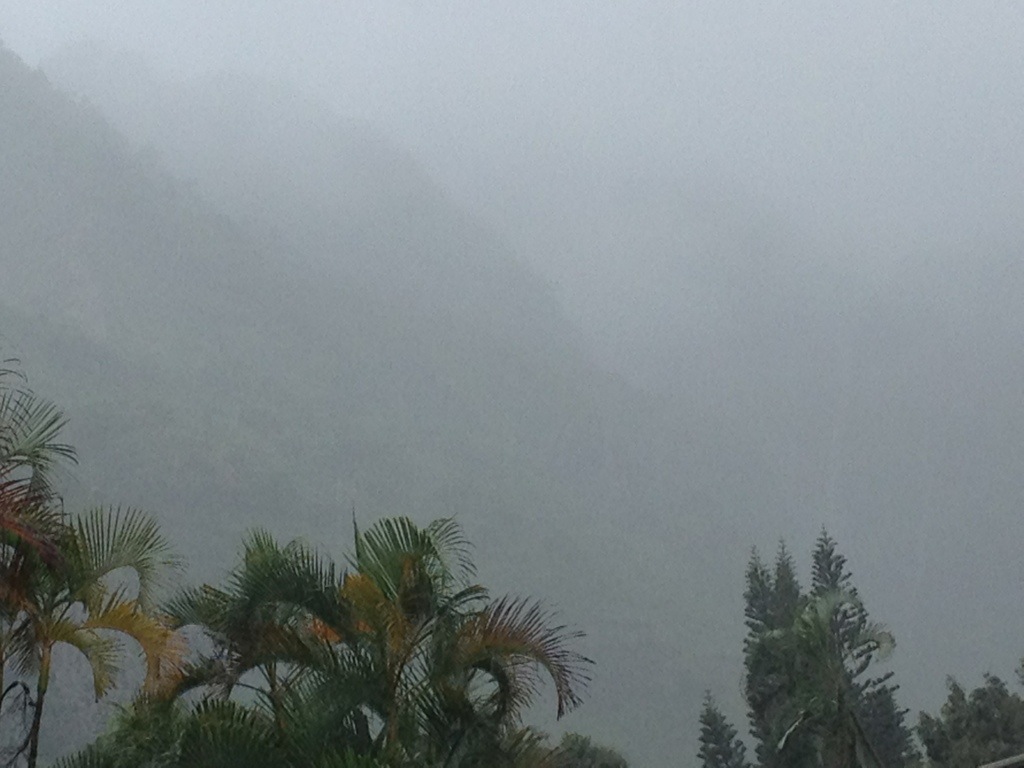
Sloshing rain puddles/
Feeling like a kid again/
Muddy, barefoot, soaked.

Ponding, waterfalls/
Scents of wet green earth surround/
Warm island winter.

20140204-094448.jpg

20140204-094336.jpg

Copyright 2014 Rebekah Luke