Special Chinese food: joong

14 12 2010

Nani showed me how to make joong at her house today. Last month I was with her when she bought a whole bunch of eggs in flats. She said they were to make hahm dahn, or salted eggs, for joong. I began salivating.

“You know how to make joong?!” I asked. Coincidentally, my cousin Tim had just issued a joong cook-off challenge to his cousins via Facebook, but most had no idea what he was talking about!

Nani said she has made joong every year for 60 years starting from the time her mother taught her. At choir practice last week I asked how the hahm dahn were coming along, hinting that I wanted to see the production.

Joong is a Chinese festival food—a pouch of soft, sticky, sweet rice hiding savory morsels pork, peanuts, and a salted egg yolk. At least the way Nani makes them.

I recall my mother treating joong as special food. Nani said Chinese people eat joong for Boat Day in the spring although she makes it more often, and that joong represented an anchor—something heavy that stuck to the bottom of your stomach. Could be, I thought, but joong is also delicious.

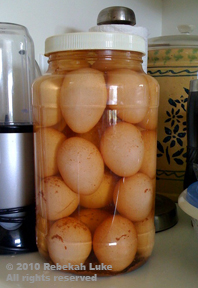
Today Nani and her three sisters Corinne, Barbara, and Rae and her cousin Eva were already gathered around the modern kitchen island when I arrived. Each had her own set up. Each had started soaking chicken eggs in brine 30 days ago. What they made today they took home to boil for 6 hours. After cooling in the cooking water overnight they will be ready to eat or freeze for later enjoyment.

As with most Chinese recipes, much goes into preparation before cooking. Last night Nani softened the bamboo leaves that she bought in Chinatown by heating them in boiling water. She soaked the peanuts and the glutinous rice. She marinated cubes of belly pork with Hawaiian salt and Chinese five spices. Just prior to assembling the joong, she cracked the salted eggs into a bowl.

There are similar rice pouch type foods – of Chinese and other ethnic origins – of other shapes, using other kinds of outer leaves, using other fillings, but according to my joong mentor, those are not joong.

I can hardly wait to taste our efforts. Thank you, Nani, for sharing your family joong-making day with me!

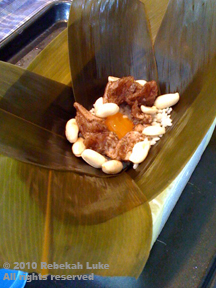
This metal form makes it easy to assemble the joong. You build an upside-down pyramid starting with 3 bamboo leaves inserted a certain way.

The process starts with soaking eggs in brine at least 30 days in advance. These are chicken eggs. You may also use duck eggs that would be more of a delicacy. These eggs are tan because Nani added tea to the solution. (Aha! Chef’s secret?!)

Once the bamboo leaves are in place, top sides touching the food, add a serving spoon of rice, the hahm dahn yolk (discard the whites), two pieces of marinated pork, and a few peanuts. Top with two serving spoons of the rice to cover the filling you see here. Then fold both long sides of the leaves over as if gift wrapping a box, followed by the short sides. Secure with string.

More finished bundles will go into this pot. Add water to cover and set to boil and simmer for 6 hours.

P.S. Nani said the following book most closely describes their family’s way to make joong. In it, the recipe is entitled “Savory Jeng.”

Every Grain of Rice by Ellen Blonder and Annabel Low. Clarkson N. Potter Inc./Random House, 1998. ISBN 0-609-60102-4

Copyright 2010 Rebekah Luke


’Bye ’bye Norfolk Island pine

12 10 2010

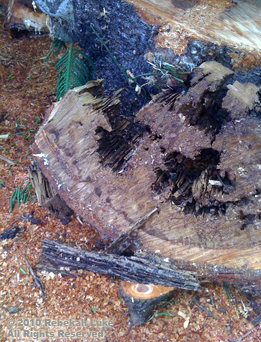
The old Norfolk Island pine tree is no longer at the Manoa Valley homestead where my hanai (adopted) mom lives. Mom decided to have the tall evergreen sentinel, damaged by termites and dry rot, cut down this past weekend before it fell down. With the wet and windy season approaching, I think Mom did the right thing.

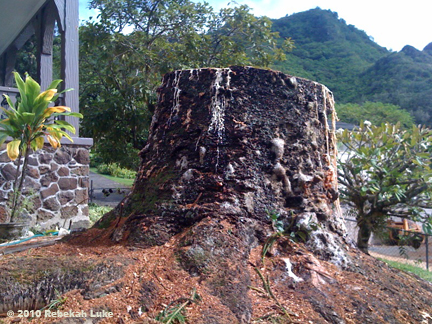
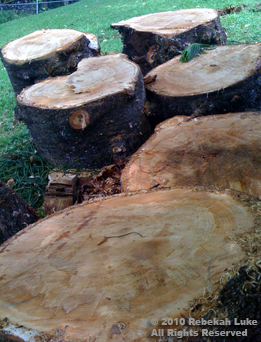
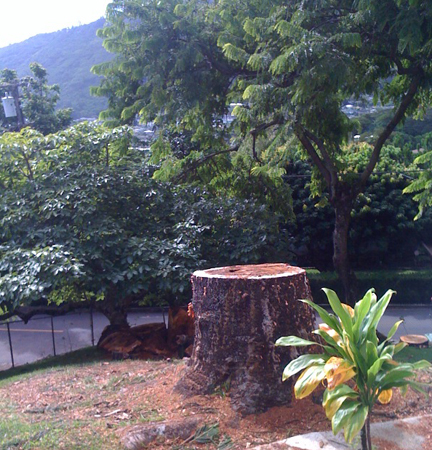
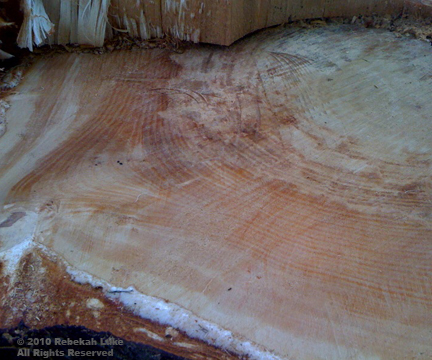
This tree was big. The existing stump measures about 40 inches in diameter. I counted the rings and estimated the tree was about 80 years old. Termites used to live in the lower part of the trunk. Sections from further up, however, are still good and useful to woodturners.

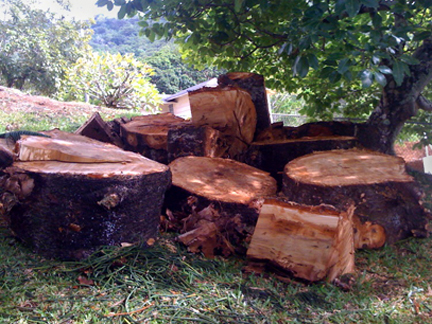
By the time I arrived at Mom’s yesterday to make these photographs, she had given away some of the choicer sections to the tree cutters. There’s still plenty more wood.

I eyeball the diameter of the Norfolk Island pine to be about 40 inches. Tree sap still oozes from the cut

Sections of the trunk

Termites used to live here

More trunk sections, still good for making art

The dark and blond two-toned shades are characteristic of Norfolk Island pine wood

New view from the front porch

I counted the rings. Each represents one year of life, right?

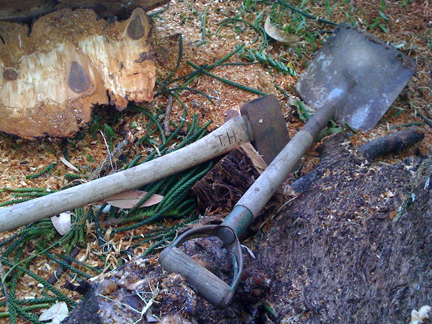
Workers left their tools behind; they're not pau (finished) yet

Copyright 2010 Rebekah Luke


Three sisters in Shanghai: is one my mom?

13 09 2010

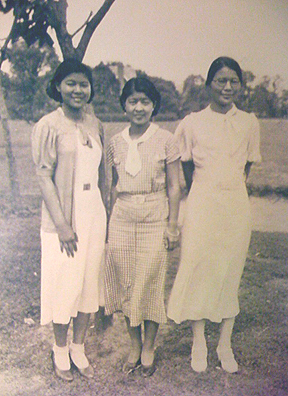
Shanghai, June 9, 1935: Maybe my mother, Aunty Inez, and Aunty Yun

Hello Family (Mom’s side),

While reorganizing and recycling things from the studio, I came across this photo. The handwritten caption reads, “The 3 sisters — who is the tallest? My pumps didn’t help to make me the tallest. Ha! Ha! June 9, 1935.”

Beloved Aunty Yun is at the far right, Aunty Inez is in the middle, and at first glance I identified the sister on the left as my mother, age 18. But looking again, is it she? Maybe, maybe not.

In the 1930s after my grandfather Chong How Kong died, my grandmother Siu Chin and many of her 14 children and their young families went to China from Hawaii, mostly as tourists. Some taught at the university level or worked. With my Uncle Fan’s and Aunty Yun’s tuition and room & board support, my mother went to the University of Shanghai to study music, English, and education.

They were all there until World War II broke out in China, and they made their way back to the Islands. Otherwise they may have stayed in China, and probably I would not be here. Mom continued her college education at the American Conservatory of Music in Chicago, returning to Honolulu to teach and direct music when she finished.

My mother was a member of the Mid-Pacific Institute Class of ’34. According to J. H. Kim On Chong-Gossard’s writing, our family genealogist, she traveled alone to Shanghai in September 1935. If she is in the photo, then one of the dates is wrong.

I emailed the photo to Cousin Millie, asking what she thought: Fo-Tsin (my mother) or Lois (Millie’s mother)? For Lois was in Shanghai too. Of course neither I nor Millie was born yet. I just haven’t seen a picture of my mom that full of face, but perhaps at 18 she was heavier than I’m used to seeing her in other photos. I usually recognize her high angular cheek bones. Photographers loved using her as a model.

While waiting for Millie’s opinion, I went through mom’s letters, photos, and other papers I still can’t throw away, even though I have no real heirs to save them for. I guess I’ve saved them for me, for a day like today.

I found one of her report cards from the University of Shanghai dated February 19, 1935. Another records that she entered the U. of Shanghai in Spring 1935.

I also found a letter she wrote to Aunty Nyuk in California, dated January 12, 1934, from Peiping [now Beijing]. Aunty Nyuk kept all of the correspondence, and after she died, the letters found their way to me. With all of my 14 aunties and uncles and their spouses now passed, it’s like piecing together a puzzle to get a fuller picture.

Some things are nice to keep. Unless Cousin Millie thinks that’s Lois on the left, I’ll gladly say, that’s my mom and my aunties!

Copyright 2010 Rebekah Luke

Epilogue: Millie says not her mom.


The One-ders of Facebook from my point of view

31 08 2010

Count me among the growing number of so-called older Facebook fans reported on in the broadcast and print press this week. I’ve been persuaded by my younger and smarter friends and family members to hop aboard, presumably to promote my work and stay connected.

In a few short weeks, Facebook did that and more for me. It is definitely social, like being at a party. It’s a great medium for keeping abreast of what the younger folks (and now older folks) are doing and thinking. As a networking tool, its extent is far reaching, and the type of information exchanged is surprising and intimate.

If you’re beginning to feel a little behind the times, just take a leap of faith and get on FB. You’ll be up to date in no time.

THE COUSINS

One of my initial objectives was to keep up with my younger relatives. I asked Miss Marvelous’s mom to tutor me in Facebook. Then with a curious interest  I “friended” my first cousins, and my first cousins once- and twice-removed online. And I’m not speaking of email. The medium of FB itself is friendly and as private as you wish, with encouragement to not just connect, but to interact too.

It’s plain to see through the conversation threads these features:

How well one can build and maintain a fan and fund base if you are a professional entertainer or filmmaker, as my cousins Sunway and Titus do day and night.

Parents use FB as another way to “talk” to their kids, and vice versa, about subjects they may not be able to discuss face to face, i.e., subjects they are likely to read on FB and not hear in person. 😉

Many of my FB friends appreciate fine food, posting photos and details of their most recent culinary adventure. Could be we’re friends because of our similar tastes!

My cousins on FB were the subjects of “The Cousins,” a collection of fresh stick figure drawings by cousin Toy.  I scored an adorable caricature of “Artist Cousin” for my profile photo on my fan page. I think Toy, encouraged by the positive feedback from her relatives online, might pursue her art further.

FB is immediate, so you can get the news headlines before the paper publishes it tomorrow morning.

The words and images some people choose to share are  fill in the blank .

For many people FB is the communications medium of choice or necessity. I re-connected with a young friend now a medic deployed to Afghanistan, and I was alerted via FB’s chat feature by my hanai sister who didn’t have my phone number handy that she fell with her horse and was in the hospital.

THE COUSINS GATHERING

Facebook is immediate and in real time. Not wanting to wait for the next big family reunion of the sort that takes months of planning, I wanted to get to know my younger cousins who already formed a network on FB. They comment on anything and everything and with everyone. I thought, too, it might be nice for them to get to know each other in a different venue. What kind of experience would it be to have them meet and converse in person?

I sent an evite to the cousins who lived on the island, (and who used email — duh), to an informal get-together at the studio, saying, “Log off the computer, it’s time to party!”

Surprisingly to me, while the conversations on FB are very chummy, Sunday’s “Cousins Gathering in the Country” was the first time several of the cousins met each other face to face!

With three generations of adult cousins present, we oldsters realize it’s time to tell the “kids” who’s who in our genealogy.

I brought out the silver gelatin prints that our late cousin Anson made in the 1950s (I inherited them from his widow Ann), and invited my cousins to have the images that had meaning for them. At the end of the evening most of the photos were on their way to new scrapbook albums. Some have already been posted to FB by cousin Tim, I see, and tagged (identified). Imagine having a photo of your great-great-grandmother for the first time!

Cousin Titus brought the short film “Lychee Thieves” (written & directed by Kathleen Man), that he co-produced, about the cast of characters’ individual desires for lychee from a certain tree and the conflicts that ensue. We all concurred, well done!

We talked, ate potluck, cracked jokes, just got to know each other a little better, and everyone went home with some of this season’s three-pound avocados that they watched us pick. It was fun!

Facebook remains a most intriguing social media. I find it enhances the times when you can still pick up the phone to hear your friend’s voice or meet and see your friend in person.

THE WONDER

My teacher AliceAnne Parker said the internet is just practice for what we all will be able to do eventually with our psychic ability. As the Light grid around our planet becomes stronger we will just know. Everything. I wonder if eventually is now. I wonder if Facebook is a means to understanding Oneness. We are One.

Did I say “leap of faith?”

Copyright 2010 Rebekah Luke


Lifelong learning about my art process

10 08 2010

Kaaawa Valley Morning

Some things take a long time. Waiting for an oil painting to dry is one of them. Here is “Kaaawa Valley Morning.” I painted it in May and varnished it this week. It’s already sold to a happy family waiting patiently to hang it in their home!

Oil paint takes at least three months to dry. A painted canvas should be bone dry before adding a protective varnish coat, for best results. So when commissioning an original painting, allow at least six months for delivery. That would be the technical aspect. As for the practical aspect, each artist has his/her own process that varies from artist to artist. Perhaps plan on a little longer.

Last Thursday I was happy to see Kit Kowalke, among other lovely friends, at our art reception at Ho‘omaluhia Botanical Garden. I first met Kit, an artist and art educator, when she was teaching at Honolulu Community College and I was in university relations. She was always cheerful, always a pleasure to be around, always sharing and helpful, always fun! And she still is.

She asked what medium, I said oil, she asked how do I paint, I said one at a time. That is, I like to finish one painting before starting another. And that my paintings take a long time to dry. Oil painters often switch to acrylic because the medium dries quickly, and they can get their work out on the market faster. Personally, I’ve been partial to oil because of the way the colors mix and look.

What I didn’t say was that I don’t like the state of unfinished-ness, or that unfinished projects are stressful to me.

“Oh!” Kit told me, “no need to paint one at a time, you can paint more than one at a time. Like two or three.”

“I can?!” 😕

“Yes!” she said. “Sometimes you might want to let an oil dry before painting on it some more. While you wait, start another one. Go back and forth.”

Well, that’s a perspective I’ll consider. And, I think that will ease my stress over things like unfinished home and garden remodeling projects. I can think of them as works in progress!

She asked more questions and gave me more tips, even volunteered which classes and workshops I could attend nearby. Which is what my intention was when I first left art school—to regularly keep my eye in training by always taking part in a studio class.

It is the advice given also by my tai chi sifu Alex Dong, who advocates not waiting until you have mastered a set before learning a new one because there are aspects of each set that help in understanding other sets. Or, (my interpretation) you will always be improving on the basics. Clicking on the above link to his website takes you to his journal article about the subject.

Somewhat similarly, when I was taking beginning kumidaiko (Japanese ensemble drumming) lessons and had an interest in composing, I asked the master Kenny Endo at what level one could start composing. How long must I study taiko before I would have enough knowledge to write drum music? He replied he believed one could start composing at any level.

Some things to think about. In my case, they still may take time because that’s my process. So far.

Copyright 2010 Rebekah Luke

Quite a few images are ready to leave the studio; these paintings are dry!  See my PAINTINGS page. If you are on Oahu, visit the art show at Ho‘omaluhia Botanical Garden during August 2010. Please see my previous post about seven artists.


The story of the boat lei

21 07 2010

Every two years in July about 50 sailing yachts compete from San Francisco Bay to Kaneohe Bay for the Pacific Cup, “the fun race to Hawaii.” It’s organized and hosted by Pacific Cup Yacht Club in Northern California and Kaneohe Yacht Club in Hawaii. The boats have handicap starts and sail under the Golden Gate Bridge and across the sea to arrive around the same time, hopefully, and in time for the parties ashore on Oahu.
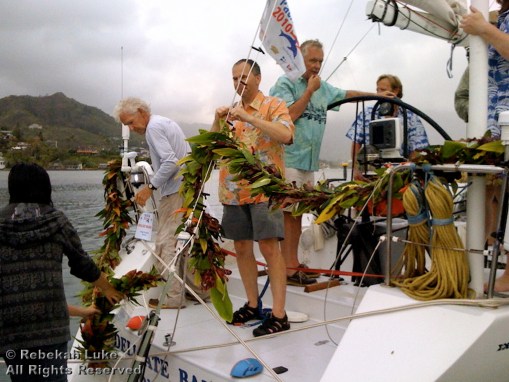
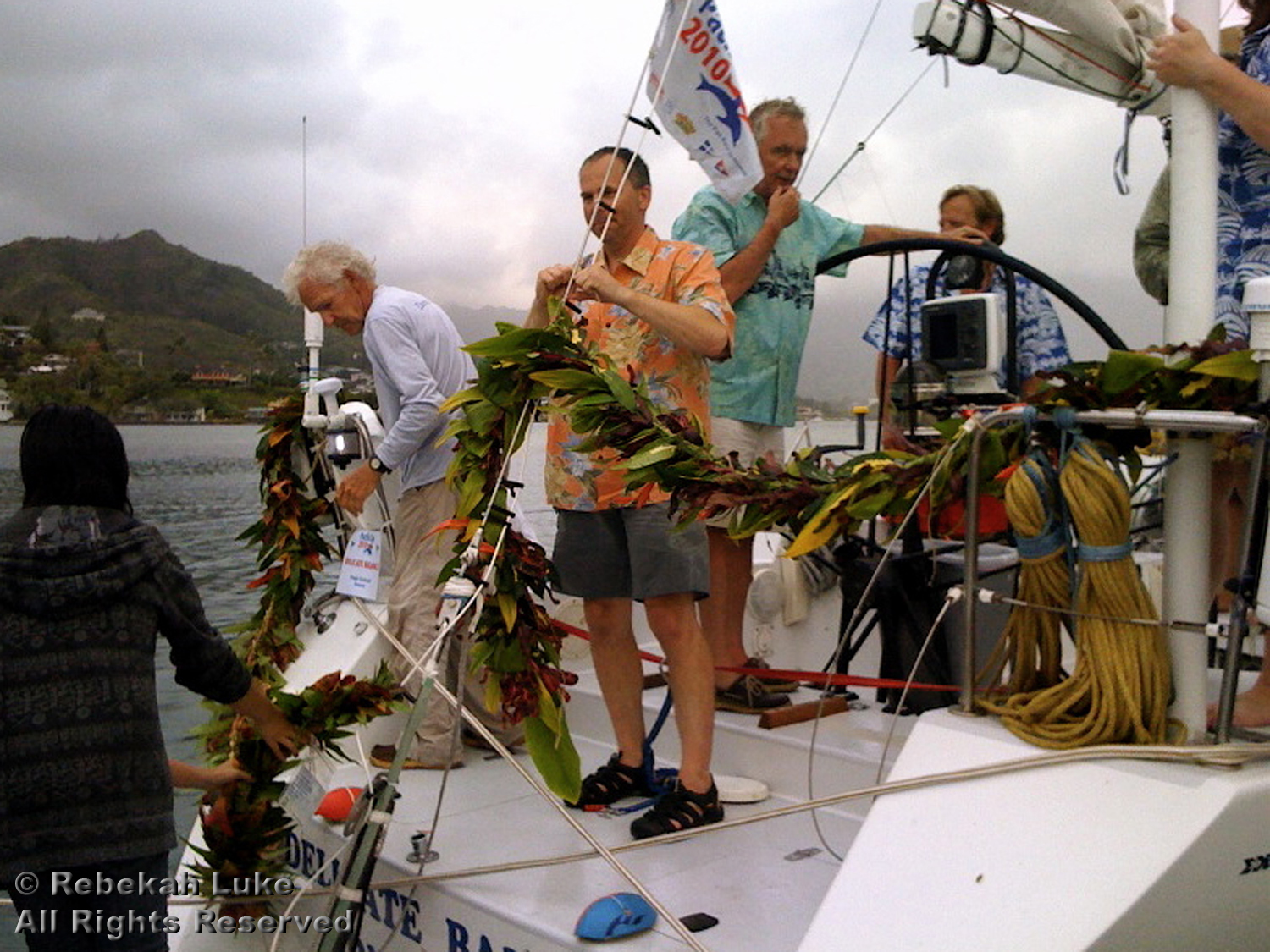
Delicate Balance arrives at Kaneohe on a cloudy afternoon. Two boat lei welcome her.

Many years ago I became the volunteer chair of the Boat Lei committee for KYC. I’m affectionately known as the Boat Lei Lady! A boat lei is a giant 12-foot garland of fresh, tropical foliage to greet and honor the vessel that carried her skipper and crew safely across the ocean.

Some call it a bow lei because it is attractive draped over the front end of the boat. Because most of the Pacific Cup yachts tie up stern to, we renamed it boat lei. It may be fastened anywhere as a decoration. The custom of presenting the lei has become a Pacific Cup tradition.

It takes many hands to make the boat lei for this event. The finished products are beautiful works of art and much admired. Event organizers inform the racers, family and friends they may pre-order the lei so it’s ready for their favorite boat when it arrives.

Last Friday, Saturday, and Sunday my crew made 45 boat lei! Many thanks to Michael and Bobbi for the promotion in California and for handling the sales from the e-store. That was a big help. Thanks to Kaneohe Yacht Club for lending the workspace. And, of course, mahalo (thanks) to all the lei artists for their remarkable team effort. Some KYC members also pitched in, and we are grateful for their contribution.
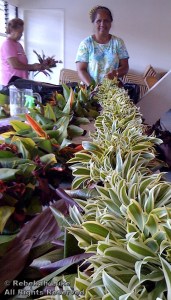
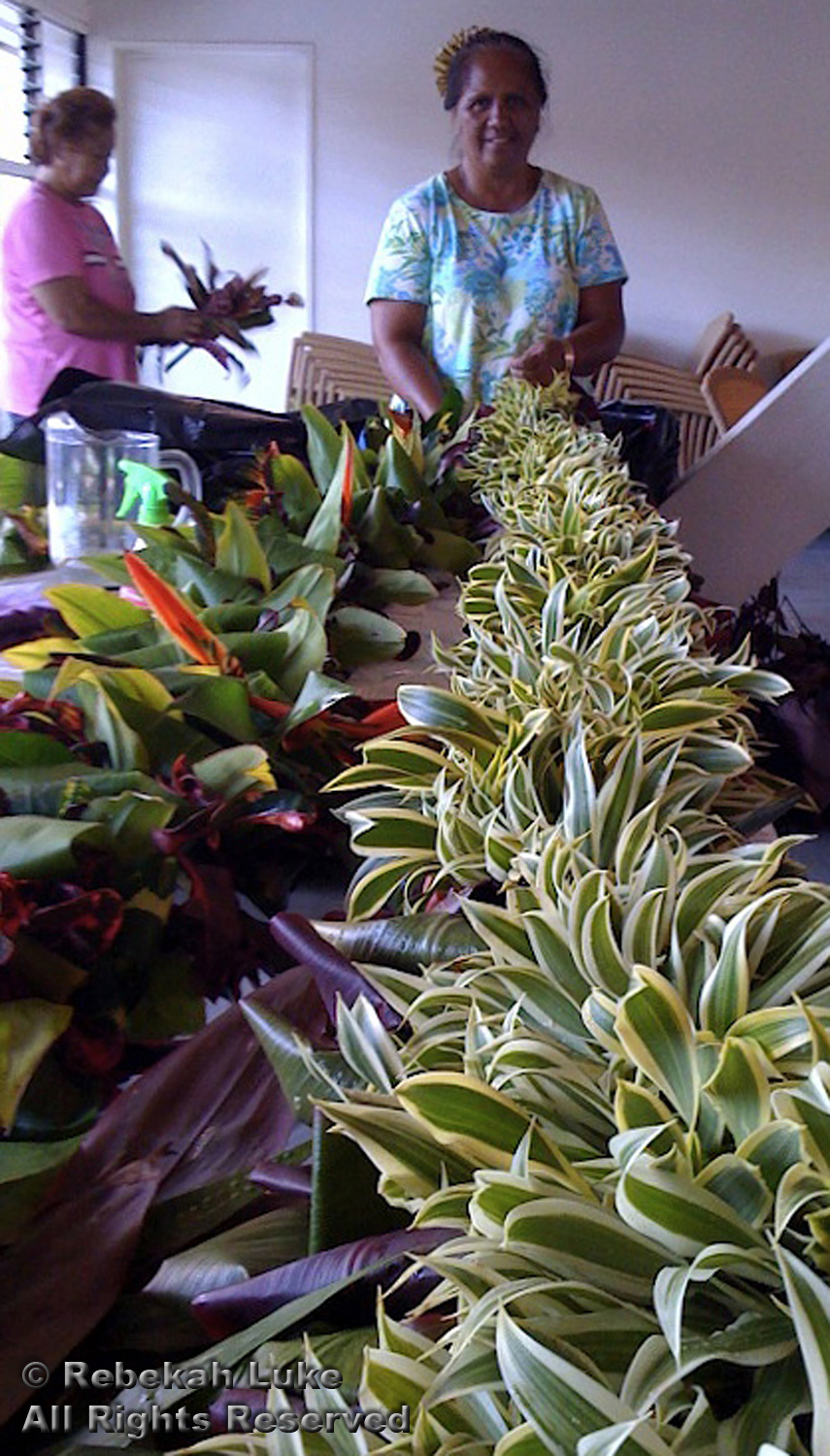
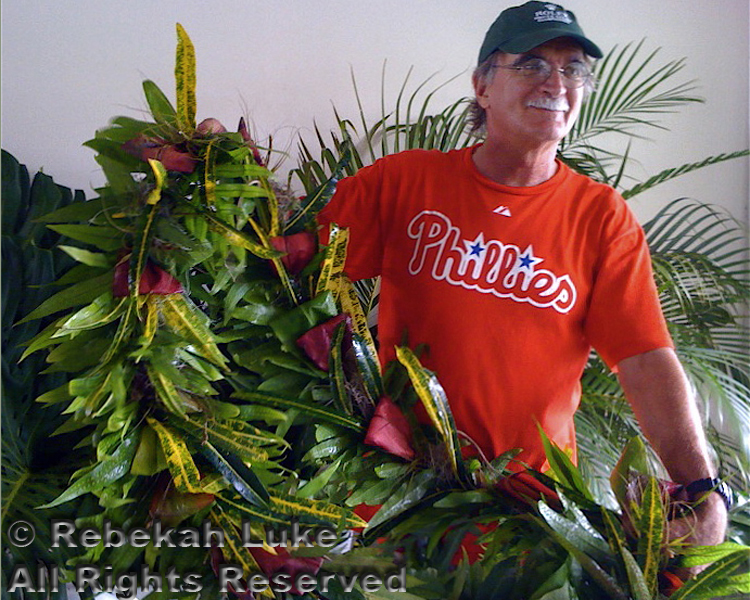
Haleaha finishes her 12-foot lei made with variegated Song of India clusters and red ti leaves

How do we make the lei? And how are we able to make so many? I’ve been asked. I will tell you! But first a little history and a funny story.

LITTLE HISTORY. In the early years I worked with  members of Hale Kuai Cooperative, a Native Hawaiian organization, to design the basic lei. We wanted cut foliage that would hold up in the sun, rain, trade winds, and salt air and look pretty for at least a couple of days in the elements.

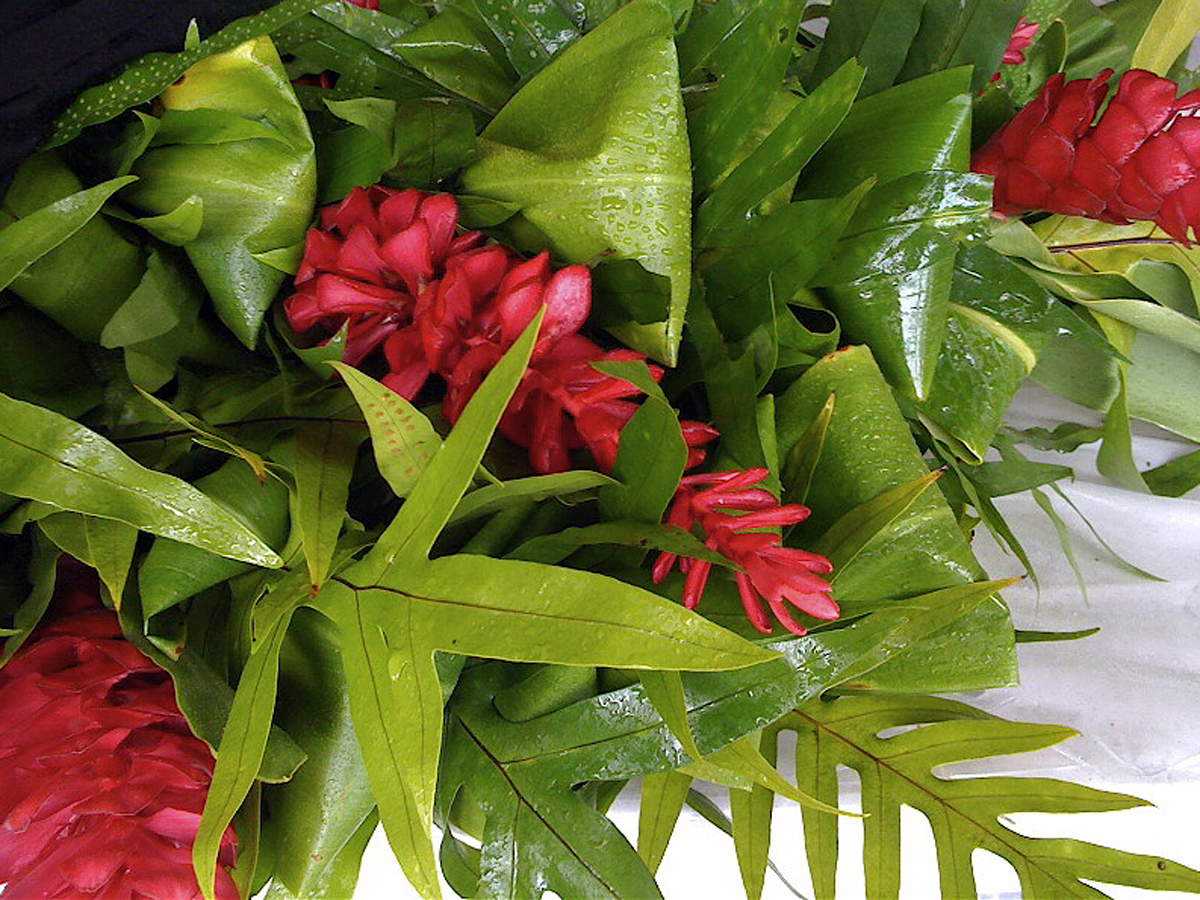
We settled on lai (say LAH-EEE, leaves from the ti plant), lauae (say LUH-AU-AY , a fragrant yet sturdy fern … Phymatosorus scolopendria, syn. Microsorium scolopendria), and multi-colored croton leaves. Our friend Kapa showed us how to use floral wire to bind the foliage; she learned the use of wire from her kumu hula. And Aunty Havana, who is a master at making hat lei, showed how to combine everything into lovely creations, once she figured out how to translate small to big. The lei became a product of the Co-op.
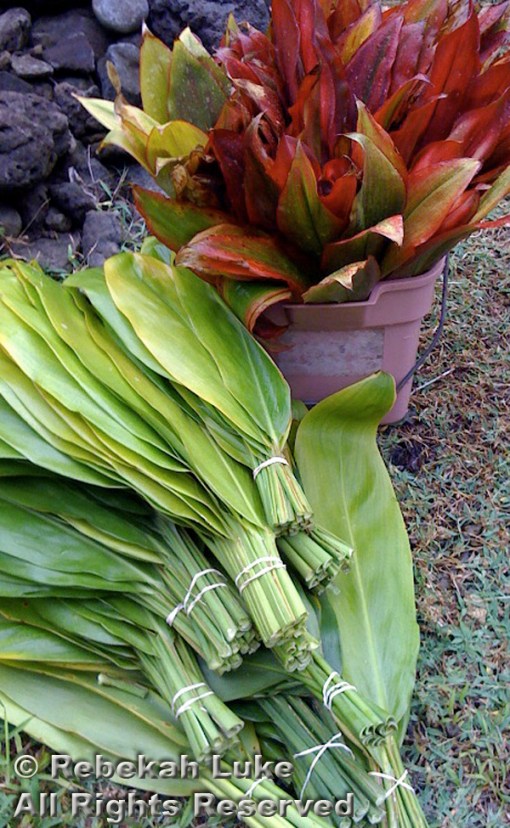
Green and red ti leaves. When picked from the stalk, they are called la‘i.

In more recent years, I have partnered with Koolauloa Hawaiian Civic Club to supply the boat lei. Volunteer members and friends gather the plant material from their gardens and from the mountains, donating the material and their time to the project. Other members and friends, who are artistic and enjoy lei making, work professionally as floral designers for a few days and assemble the lei.  The net proceeds from the sale of the lei provide scholarships for Native Hawaiian club members and/or their children.
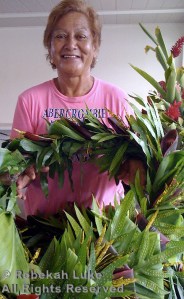
Clover's lei

FUNNY STORY. The very first year of my boat lei experience, we made the lei fine, but I had not given any thought to delivering the lei. I was so involved in providing a product that it did not occur to me that the boats would arrive at any time of day or night, 24/7. OMG! It was too late to organize any shift work.
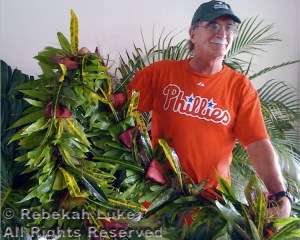
Pekelo's lei. Yellow-and-green croton and red ti provide accent color among the other greenery.

DH (Darling Husband) has a sailboat moored at the yacht club. He and I monitored the ETAs, and for an evening arrival, we would catnap on his little Mugquomp and wake up as the radio crackled to announce a boat had crossed the finish line. As we climbed out of our bunk and put on our jackets, for it was cool and a little rainy, we were fascinated and impressed by the radio conversation between Iwalani of the Escort committee and each arriving yacht. In her very calm, reassuring, professional, and gracious way, Iwalani gave the information and instructions on how to enter and come down the channel (with coral reef on both sides) to the dock at night. We had enough time on foot to greet the boat with a big lei.

DH and I were very short on sleep that year. Someone later suggested that we arrange for the Leis and Trays committee to deliver the lei. Brilliant! That committee is much larger and greets the boats with Hawaiian music, lei and mai tais for the captain and crew. Why not the lei for the boat too?

HOW TO MAKE A BOAT LEI

The style of the lei is known as wili (say WEE-LEE), meaning to wind. We wind by hand—one must have strong hands to tug—using wire instead of a natural twine or raffia traditionally used to make a hat or neck lei. Wire allows us to put the work down and makes it easier on our hands. Our lei are 12 feet long, but shorter lengths make lovely bouquets, wreaths, and table decorations. Allow enough time to gather & prep the materials and make the lei. It takes about two hours to make, excluding time to gather.

Each artist has his/her “line,” so do not worry that your lei does not look like someone else’s. It won’t. The variables are selection and placement of the plant material as well as the available supply of the greenery and flowers. Here is the basic way to construct the lei.
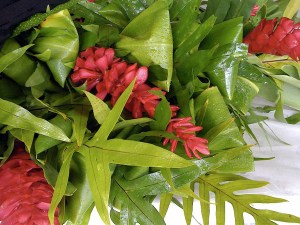
Ti, lauae, and red ginger combo

Materials to make one 12-foot lei:

1 kaau (which is 40) each of ti leaves, lauae, croton leaves. Be sure to leave about 4 inches of the stem on. The stems provide the slightly stiff backing for the lei. Do not strip the mid-rib from the ti leaf.

A few tropical flowers—such as, heliconia, red ginger, bird of paradise, bougainvillia clusters—with 6-inch stems to intersperse throughout the lei (optional)

One 24-gauge paddle wire from the floral supplier or craft store. One paddle is enough for one and a half lei, or approximately 18 feet total.

String to tie on the finished lei to the boat

Gloves (optional) to protect hands from croton stains

33-gal. plastic trash bag (optional)

Ululani's lei

Tools:

Work surface such as a table or floor, hand clippers, scissors, spray bottle of water

Step 1. Gather and prep materials by sorting by color and size, cleaning, and bundling.

Step 2. Pick a palette of 3 or 4 types of leaves if you have a wide choice. Include ti and lauae in your palette.

Step 3. Take the tip of a large ti leaf and turn it under to meet the stem, shiny side out, bending it in half but not creasing it. Fasten the tip to the stem with the wire, winding it around the leaf 5 inches from the ends. Begin winding about 5 inches from the beginning of the wire, securing both the ends of the leaf and the wire together. Grasp the two ends of the leaf and the end of the wire with one hand (if you’re right-handed, use your right hand), and wind the wire with the other hand, going around about 5 times. Be sure to pull the wire taut. This is the start. You will use one continuous length of wire and not cut it until the end (unless the wire accidentally breaks).

Step 4. With the tip of the ti leaf facing up and pointing toward you, place a lauae leaf on top with stem pointing toward you. Wind the wire around 1/2 inch down from your start 3 times, again pulling taut. Next add some croton in the same way, 1/2 inch down. Then add another ti leaf. This grouping forms your pattern.

Step 5. Repeat Step 4. Alternate placement right and left, if you wish, to cover the sides. With each addition, come down about 1/2 inch. Remember to pull the wire taut as you wind so that your lei does not come apart.

Keep the width of the lei the same by checking the sections you did earlier. If your lei is getting wider (this is common with beginning lei makers), allow less material to show or leave more space as you add. Just be sure your wire is wound every 1/2 inch, catching all the stems. From time to time, turn your lei over to examine the back. Hold your lei up with one hand and give it a good shake to make sure it is secure. From time to time, spray the lei with water to keep it fresh.

Step 6. After the lei is the desired length, end it by winding the wire around itself about 10 times. Snip wire with scissors. Tie string with a square knot to the lei at 4 or 5 points as a way to fasten the lei to the boat.

Step 7. Keep the lei cool until ready to decorate. A cold air-conditioned room is ideal. Mist with water.

Step 8 (optional). For transporting or brief storage, roll the lei into a wreath and place in a 33-gallon plastic trash bag. Leave an opening for the lei to breathe.

And that’s the story of the boat lei. Enjoy your creation!

Copyright 2010 Rebekah Luke


Momma and Dr. Usui said, honor and thank our teachers

27 05 2010

A shopper at last weekend’s Native Hawaiian Arts Market asked me if I considered myself a self-taught painter. “No is the short answer,” I replied quietly.

I believe in taking lessons, followed by lots of practice. I took lessons.

In the Hawaiian culture I learned everyone must have a teacher. Never mind you think you don’t need one, that you can do your own whatever. At least not in the beginning.

The first thing someone will ask is, “Who’s your kumu?” If you can say, “My kumu was ___ ,”  respect for your work goes up a notch. If you can’t, the response might be, “Uh-huh,” and you hardly will be given the time of day and wonder why.

Perhaps after working at it for a while, an artist will perfect his/her line and system and turn out creations that are identifiably theirs, but most successful artists have gotten a background of the universal principles and basic techniques prior to discovering how to manipulate the medium into something original and all their own.

Having a teacher gives your work credibility. It applies to more than just painting.

For example, at the opening of Oceania Exhibit at the National Museum of Ethnology, a.k.a. Minpaku, in Osaka, Japan, for which the museum built a replica of the Hale Kuai Cooperative store in Hauula to represent the Hawaiian Islands, Kealii Gora attended officially as cultural consultant, and I attended in my role as the real co-op’s executive director.

Ka Lahui Hawaii and yours truly co-founded the cooperative to buy and sell products made by Native Hawaiians.

Hale Kuai Cooperative caught the attention of Minpaku anthropology professor Akitoshi Shimizu, who led the project team. He felt it depicted a movement in economic development among indigenous Hawaiians in 1999.

The opening ceremony was hauntingly beautiful and Kealii’s oli (chanting) rocked the entire hall. Afterward a VIP guest confronted him and wanted to know “by what authority” Mr. Gora performed the protocol, along with a Maori representative from Aotearoa.

Interestingly, but not surprisingly, Kealii did not reply that he was an officer of Ka Lahui Hawaii (a de facto Hawaiian nation). That he most certainly was. He replied, “My teacher was Kumu John Keola Lake.” There wasn’t anything the guest could say after that.

Similarly, certified Reiki masters will identify their credentials by stating the genealogy of their Reiki line. I am 10th generation from Dr. Mikao Usui through Mrs. Takata. That brings to mind Dr. Usui’s precepts:

Just for today, do not worry.
Just for today, do not anger.
Honor your parents, teachers, and elders.
Earn your living honestly.
Give thanks to every living thing.

My mother, a piano teacher, taught me to remember and acknowledge my teachers. So I honor my teachers of art and Reiki by naming them here. Most of my teachers throughout my life were influential in some way, but these people made a loving impact.

Richard Nelson, Punahou School art history
Duane Preble, University of Hawaii at Manoa art history
Masao Miyamoto, University of Hawaii photographer
Michael Tamaru, University of Hawaii graphic designer
Glenn Christiansen, Darrow Watt, Norman Plate, Sunset photographers
Art Center College of Design faculty
Gloria Foss, The Foss School of Fine Arts, landscape painting
Vickie Kula, The Gloria Foss Color Course, studio drawing and painting
Susan Rogers-Aregger, Arts of Paradise gallery management
Alice Anne Parker, Reiki master
Lori Wong, Reiki master

Thank you for teaching me.

Copyright 2010 Rebekah Luke