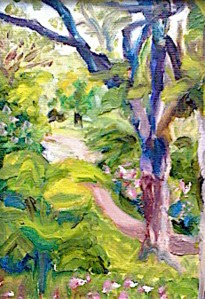
Looking Down Upon the Path - 5"x7" oil on canvas

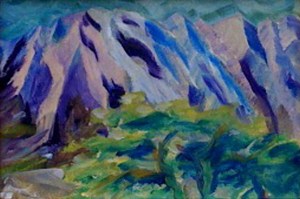
Blue Koolau Mountains - 5"x7" Oil on Canvas

Looking Down Upon the Path - 5"x7" oil on canvas

Blue Koolau Mountains - 5"x7" Oil on Canvas
Rebekah, what is your medium? Oil.
What kind of painter are you? Mostly plein air (French, literally, open air). I go on location outdoors, into the field, and study the light.
How would you describe your style? Impressionistic representationalism. Sometimes abstract.
What is your subject matter? Hawaiian places; landscapes; Hawaii nei. More recently, I’ve added still life, and I am doing some seascapes. I paint subjects I think people would like to hang on their walls.
Do you paint from photographs? Rarely. I always felt if I painted from a photograph, the painting would look like a photograph. Sometimes I’ll make a black-and-white photo to see the values (range of darks to lights). I prefer painting en plein air or from life.
How long does it take to finish a painting? It depends on a lot of things, but on average about four or five times out on location. Some may take five hours, others five years.
Is your work in galleries? It used to be, but not at the present time. I am seeking a good venue and good representation.
Where can I see your work? Right here on Rebekah’s Studio! Come and visit my virtual gallery. Click on Paintings on the menu bar. To see the actual original painting, please contact me and we can make an appointment to see it. I’d love to show you!
How did you learn to paint? I took lessons, primarily from Gloria Foss. Before that I took the required art history classes in high school and college. I also studied art as part of the photography program at Art Center College of Design in Pasadena.
When and where did you start showing your work? In earnest at the Honolulu Zoo Fence on Monsarrat avenue and at Arts of Paradise gallery at the International Market Place, both in Waikiki in the later 1980s, and at invitational and juried shows. You might like to read my August 26, 2009, post “I wasn’t always a painter.”
What are your prices, what does a painting cost? An example would be U.S. $600.00 for an original 16″ x 20″ landscape in oil, frame included. Smaller ones are priced less, larger ones more.
How do you price your work? Besides the general guide in the above Q and A, I look at the overall piece, the thing. I imagine a price and I imagine selling the piece for that price. If I experience an awful feeling in my stomach, then the price is too low. I also go to galleries and shows and look at other artists’ works and prices for comparison. I think my prices are realistic.
Does the price include shipping? No. The customer pays for shipping and delivery. I take care of the packing and packaging.
Why is art so expensive to buy? The materials don’t cost that much. Artists are like actors. We don’t work every day. (Actually, we do, but we don’t sell every day; you get the idea.) This is how we earn our living—you know, food, shelter, gas, not so much clothing.
I love your work, but I don’t think I can afford to buy it. Can I? Sometimes for things we really want, we need to sacrifice. I have a layaway plan, normally three monthly payments each of 1/3, 1/3, 1/3. It’s possible to stretch payments out longer. The customer does not get the painting until it is paid in full. The installment payments are not refundable. That’s the deal. Several collectors of my paintings purchase on layaway, and they are able to enjoy enduring original art that way. If your finances can’t handle the layaway plan, then you probably can’t afford the painting.
Do you make reproductions? I’m wondering if I should manufacture some more. I have a giclée entitled “Mele’s Beach” that’s almost sold out.
Do you accept credit cards? Yes, through PayPal.
Who buys your paintings? Anyone. I have customers, patrons, and angels. 😉
Do you teach painting? Not formally. I’m happy to have people watch me paint and answer their questions, give a demo and talk about my art. My best audiences/pupils are kids. I might offer some tips on this blog.
Do you ever donate your artwork to a benefit auction event of a non-profit organization? Only if I can have part of the income. The reasons are: The non-profit receives merchandise and a donation for the painting if it is sold. The winning bidder gets a painting and a charitable tax deduction. The artist receives no income and can deduct only the cost of materials (i.e., canvas, paint, frame, wire). The public gets the erroneous idea that artists don’t mind donating their work. When I participate, I suggest this arrangement: Set an upset price of an amount I would like. The organization may keep the difference between the upset price and the winning bid. If the painting doesn’t sell, then I get the painting back.
Why aren’t there any new paintings in your virtual gallery? I keep checking back and see the same images. I would love to install new ones as fast as I can. And I’m glad you’re checking back. The thing is, oil paint takes a long time to dry, especially in a humid climate like Hawaii. Only when the painting is bone dry does it get a finishing varnish coat. Then that has to dry, then I photograph it, and then the painting gets a frame. It could take up to six months from the time I finish a painting to when it’s put on display. So, please stay tuned! I value your interest.
Thanks, Rebekah. And thank you! If you have other questions, you may Leave a Comment below or contact me by email. RL

Honolulu Academy of Arts
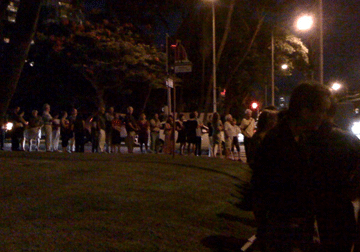
It felt like all of Honolulu came to see the 36-plus views of Mount Fuji at the Honolulu Academy of Arts last night. More than 900 people stood in line to enter the opening of “Hokusai’s Summit: Thirty-six Views of Mount Fuji” at our city’s art museum.
I skipped my tai chi class to meet my friend Becky at the corner of Victoria and Beretania, and at 7 o’clock the line extended around the block. Neither of us had eaten dinner, but it was so crowded that we opted to bypass the refreshments and headed for the gallery.

This special exhibition that will extend for several months from now and into 2010 offers the opportunity to study the work of Japanese artist Katsushika Hokusai (1760-1849), who lived during the Edo period when a new art called ukiyo-e emerged. It is believed that he made 30,000 works of art and published more than 270 books. His life was dedicated to drawing.
The Honolulu Academy of Arts is known for its fine Asian collection, within which there are more than 10,000 Japanese woodblock prints. The collection includes a rare complete set of the famous Thirty-six Views of Mount Fuji series by Hokusai. This is what the Academy of Arts has put on public display.
The exhibit is rounded out by items about the woodblock printing process, about Hokusai’s stylistic development, of Mount Fuji by the artist Hiroshige, and of Mount Fuji by other painters. Reading the “Visitors’ Guide” handout and the labels next to each piece of art when I have more time will give me a working knowledge of the subject for sure.
What impressed me last night was how woodblock printing lends itself to simplicity and a limited color ink palette, something I can try in my own work. Hokusai was so skilled in drawing, he could incorporate the detail of human activity that I found delightful and often amusing. And, of course, it was fun to see all the different treatments of Mount Fuji.
I also was very impressed by the turnout! In the crowd I bumped into my high school journalism teacher, former work associates, other artists and writers, my cousin, “the ants” (like ants at a picnic), and many whose faces I’ve seen around town but couldn’t place because of the different venue. When Becky and I were tired of rubbing shoulders, literally, we decided it was refreshment time: sake-tasting, fruity punch, cubed cheddar, cubed pepper jack, lavosh, and sweet gingery senbei crackers. Becky, who is a member of the Academy of Arts, said there are three or four major exhibitions a year and that the openings are popular events. You can say that again. Long live the arts!
Ayla learned how to kick off her blanket this morning as a result of my playing peekaboo with the receiving blanket and her legs. Still in the car seat from the ride to our house, she kicked off the cloth on cue repeatedly, smiling widely, then cooing each time I covered her tiny little feet with it, liking the great game with Popo (Chinese grandmother, me). So much fun, she started giggling!
Was that her first giggle? I thought how blessed darling husband is to be the caregiver for this child. He’s there during the daytime when the baby’s cheerfully awake. While Ayla’s parents are away at work, he’s treated to many of baby’s firsts. I began reflecting on how the sweetest and most rewarding moments of life have to do with being there.
In my professional work, being there has made all the difference.
As a general assignment reporter who wrote the daily news, I had to be at events as they were happening, or there would be no story.
As a photographer, I could not notice a gorgeous scene and decide to come back later to make the picture because later the light will have changed and be different. I would have missed the shot.
As a children’s book designer who worked with models, locations, and photography, I had to go there to the photo; it wasn’t going to come to me.
As a plein air landscape painter, I have to be on location the same time each day until the painting is finished to capture the light I saw the first time.
Nowadays back at the studio, I’m experimenting with painting still life and changing my technique. My intention is to paint looser, to use a different color palette than my landscape greens, to apply definite strokes of thick oil paint with a palette knife, and to paint fast. This requires being in the mood, being in the present, and being able to concentrate in order to get it right the first time.

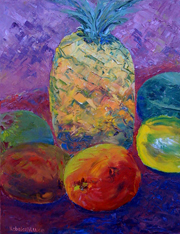
Mango papaya pineapple
I’m painting subject matter that’s appeared previously in this blog. Wanting to capture magnificence before it fades away, I had to be there to witness the mangos turn from green to shades of red and red-orange to bright yummy yellow. I had to be there to see the night blooming cereus open for one night only until next year.
Something funny happened, too, because I wasn’t there. As the green, almost-ripe avocado pear sat on the table of my set, waiting for me to preserve its three pounds of glory in a painting, its color turned to the alizarin-brown of ripeness. Before I got around to putting pigment on canvas, I had to eat it!
As a Reiki practitioner, I know that our Reiki Master in Spirit is there for us all the time. We just have to relax, be open to receive, smile, and maybe giggle to witness the healing.
To see more images, click on PAINTINGS in the menu bar.
For a time I joined the morning water exercise class at Pohai Nani, a vibrant senior living community in Kaneohe, which led to my practice of Reiki there for the residents and staff. One day, more than five years ago, Judy who coordinated activities showed me the little chapel and told of a dream to refurbish it.
I saw a cute, tiny room with an arched ceiling and pews for no more than about 8 to 12 people, if that many. The glass doors on the side slid open to overlook a small enclosed garden patio. A hallway entrance was plain and dim. I agreed the chapel could used some refreshing.
Judy mused, wouldn’t it be nice to have the chapel decorated with a painting, something Hawaiian, to brighten the area? Maybe something in the hallway to welcome the residents, maybe even something in the chapel itself? I envisioned a fresco-like painting on a wall.
If it was to be Hawaiian, then the only person I knew who could do such a project was Ipo Nihipali, a Native Hawaiian artist known for her paintings of native birds and who had just completed a large outdoor painting at the Kamakakuokalani Center for Hawaiian Studies at the University of Hawaii at Manoa. Later I called Ipo to ask if Pohai Nani could contact her directly, and I gave Judy the information. I moved on to another project and didn’t see Ipo until this summer at a Hawaiian civic club celebration.
“Rebekah! Rebekah Luke! I have been looking for you!” Ipo exclaimed. She grasped my hand in both of hers. They were trembling and deliciously warm. “I finished it. I finished the painting!” Ipo said she had gotten the commission after all. She said she prayed about the piece and allowed the kupuna (elders) to guide her work. “We’re having the blessing on July 22nd, and I want you to come!” I assured her I would be there.
As soon as one steps onto the breezeway leading to the main entrance at Pohai Nani, the new painting beckons. It was decided that the imagery grace the lobby rather than the chapel for all to enjoy. Entitled KO‘OLAU! the painting is exquisitely executed and depicts our mountain cliffs, the forest, native birds, plants, a waterfall and stream. The piece is enhanced with real pohaku (stones), native ohia lehua branches, a sprouting coconut, ti leaf bundles, and arrangements of tropical ginger beneath the painting, creating a three-dimensional set. It is as if you can step right into the painting.
Recalling Ipo’s words at the ceremony, the manao (thoughts, ideas) for the painting is something like this:
Do you remember what it was like, when you were a child, to swim in the pool and play in the forest? Look, you can do that again. Come. Leave your earthly possessions here, and go to the other side. Look at the mountains and see your ancestors. They are calling and waiting to carry you home once more. “Oh! Ko‘olau, my beloved rainbow of dreams.”
KO‘OLAU! is a magnificent work, amazing, and a miracle. Ipo will tell you that herself. That’s because she is legally blind (when she can see, it is as if she is looking through a glass of water), and she has Parkinson’s or Parkinson’s-like tremors. What a gift.
Mahalo e Ipo, my tita angel! Aloha no wau ia oe. ~ Rebekah

Native Hawaiian artists Ipo Nihipali and her father Joseph Dowson at the blessing of KO‘OLAU!

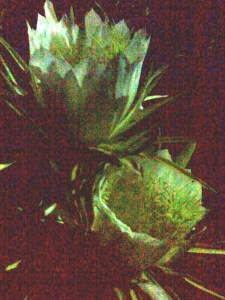
In my garden for one night only, 12 night blooming cereus flowers like these
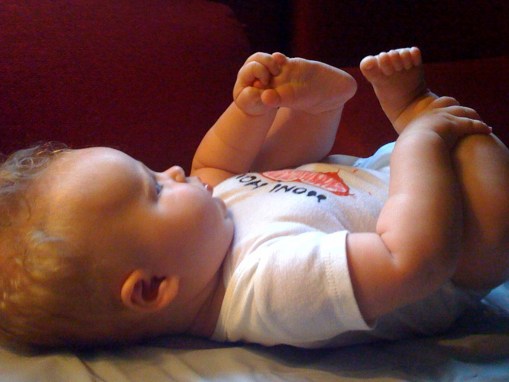
I made two paintings with light today. One is of our granddaughter Ayla, and the other of night blooming cereus. Both were taken with my iPhone, hand held with existing light. The only adjustment I made was to the contrast on the cereus, as I shot it just a few moments ago, and it’s dark outside! The real artist, though, and I’m sure you’ll agree, is our Creator. Mahalo e ke Akua. ~ Rebekah

She's marvelous!
To see my paintings in oil, click on PAINTINGS in the menu bar. RL

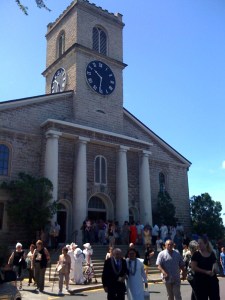
Yesterday was Alii Sunday at Kawaiahao Church in Honolulu, honoring Queen Liliuokalani (b. 1838-d. 1917), sister of King David Kalakaua. She reigned as the last monarch of Hawaii from 1891 to 1893 when she was overthrown. Her birthday is September 2.
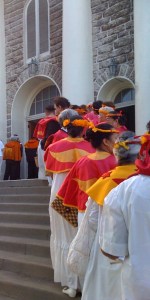
Each Alii Sunday, the Hawaiian Royal Societies and other ahahui (Hawaiian clubs) walk in the processional, and the front pews are reserved for them.
Yesterday I attended as a member of the Koolauloa Hawaiian Civic Club with Kamakea, our vice president. We rode in to Honolulu with her son Kaimana, who is a member of the Royal Order of Kamehameha I.
This post shares the highlights for me. You may wish to go sometime. Visitors are welcome to Sunday worship service. Portions are in the Hawaiian language. Kawaiahao is part of the United Church of Christ.

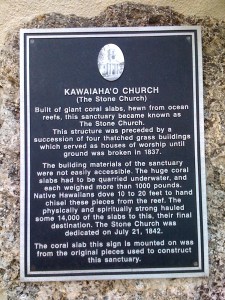
Kawaiahao Church is on the corner of King and Punchbowl streets. A plaque describes its construction.

The Hawaiian Royal Societies, or Aha Hipuu, are a special sight. They include:
• Royal Order of Kamehameha I who wear red and yellow capes over black suits. The different patterns and lengths of the capes indicate rank.
• Hale O Na Alii O Hawaii, whose members wear white with red and yellow capes. 
• Ahahui Kaahumanu, whose formal attire consists of black muumuus, black hats and deep-yellow lei resembling feathers.
• Ahahui Mamakakaua—Daughters and Sons of the Hawaiian Warriors wear black with red, black, and yellow capes (some capes have green).
Other groups who were represented on Alii Sunday were the Daughters of Hawaii in their pure white hats and muumuus (they operate the Queen Emma Summer Palace), the children of Queen Liliuokalani Children’s Center (QLCC is supported by Liliu’s estate, and its beneficiaries are the orphan and destitute children in Hawaii with preference to those of Hawaiian ancestry), and the Association of Hawaiian Civic Clubs that strung crown flowers into 52 strands of lei to drape on the statue of Queen Liliuokalani at the Hawaii State Capitol following the service.
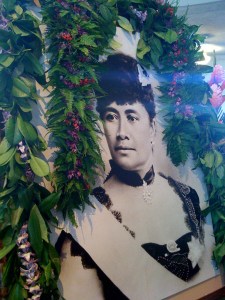
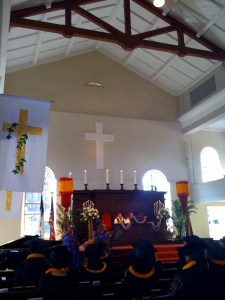
Crown flower was Queen’s favorite. The lavender blossom drapes the left side of her portrait, at the top of this post, and the altar in the next photo.

At left are the Ahahui Kaahumanu ladies in their formal black in the foreground. Aunty Ilima and Aunty Millie in purple muumuu sing Liliuokalani’s compositions, “Tutu” and “Paoakalani.” [See comment below.]
The church service itself was more lively and less formal than the congregational ones I attended in high school, about the last time I went. Admittedly, that was a few decades ago!
Kalowena gave a tribute to Queen Liliuokalani, and in her remarks she wondered, if Liliu’s time and our time coincided, would Google have given her an edge in maintaining Hawaii’s place in the world? Would her compositions be on iTunes, and would she be blogging and twittering?
This Sunday there was frequent applause, lots of “Amens” by the whole congregation, a testimony by a recent member for the sermon, and a hip-hop dance performance of the Black Eyed Peas’s “Where is the Love” by the youth ensemble. Apart from the pipe organist and choir in the back balcony, there was an ohana (family) choir of anyone else who wanted to sing from the front of the church.
Until she became Queen, Liliuokalani led the Kawaiahao Church choir. She composed more than 150 songs. Some were lyrics only, some were melodies without lyrics, and the rest were full arrangements. At Sunday’s service we sang “The Queen’s Prayer.” A fitting recessional was her “Aloha Oe” now famous around the world. I felt so sad. ~ Rebekah
[See comment at the bottom.]
If you go …
Do view the 20 original portraits in oil painted by Susan S. Hoffstot entitled “Alii of Hawaii — The Hoffstot Collection” that are displayed on the walls of the right and left balconies. These were a gift from the artist and her husband William H. Hoffstot, Jr., “… to the glory of God, the honor of the Hawaiian people and the enrichment of the State of Hawaii” and dedicated on September 2, 1973.
[UPDATE: The portraits were painted by Patric Bauernschmidt, not Susan S. Hoffstot. Please read the comment by Patric’s granddaughter André below.]
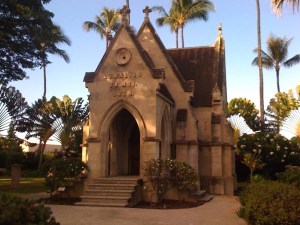
In addition to the church building are other historical structures. One is the tomb of King Lunalilo. Read the plaque explaining why Lunalilo is not buried at the Royal Mausoleum with the other monarchs.

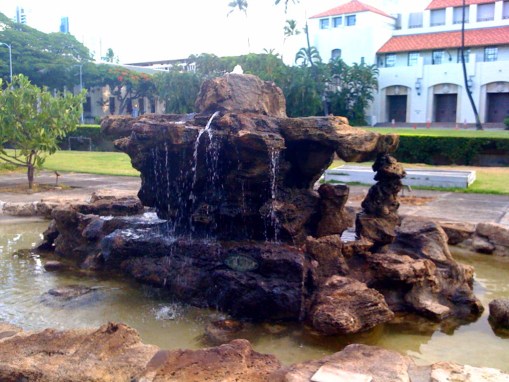
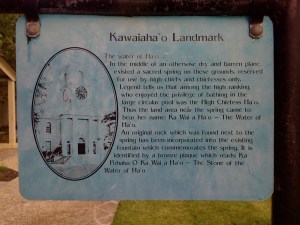
Another is a fountain on the King street side of the church. That’s the Library of Hawaii and Honolulu Hale city hall in the background.


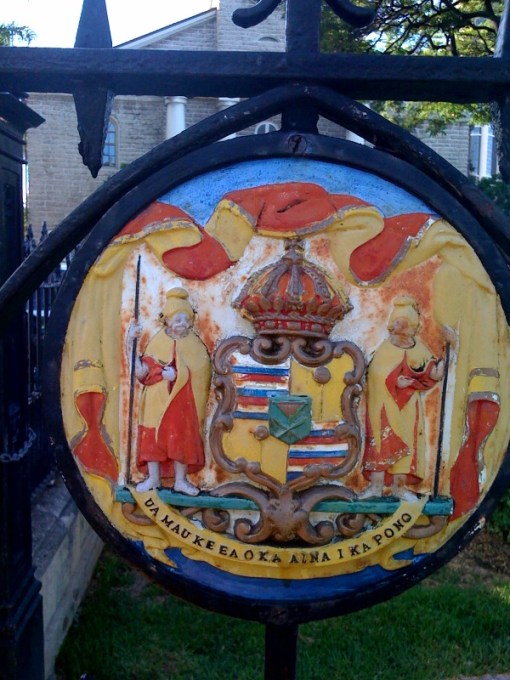
And a third is the seal on the gate to Lunalilo's tomb. "Ua mau ke ea o ka aina i ka pono." This motto became the Hawaii state motto, and it means, "The life of the land is perpetuated in righteousness."
Rev. Rebekah Luke has a healing ministry and is ordained by the Universal Life Church. The only two tenets of the ULC are “Freedom of religion” and “Do the right thing.” For more information, click on REIKI HEALING BY OELEN on the menu bar.
Suggested reading:
Liliuokalani. Hawaii’s Story by Hawaii’s Queen. Mutual Publishing, 1991. ISBN 978-0935180855 Paperbound.
Liliuokalani, Her Majesty Queen. The Queen’s Songbook. Honolulu: Hui Hanai, 1999. Edited by Dorothy Kahananui Gillett and Barbara Barnard Smith. ISBN 0-9616738-7-7 Clothbound Edition and ISBN 0-9616738-8-5 Paperbound Edition.
Recent comments